
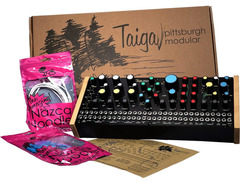
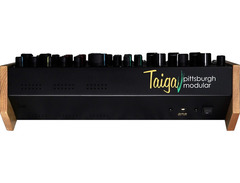
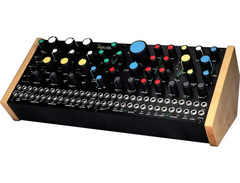

Pricing and availability
We compare 600+ stores and found this item at 8 stores. Prices updated .
Store
Reviews
Price









Average Price: $766
Standard/Professional
$500
$1501+
Price Tier
Budget
Standard
High-end
Price History
Based on price data from 5 merchants for "Pittsburgh Modular Taiga Semi-modular Paraphonic Synthesizer". Prices shown reflect NEW condition. Tracking began Apr 2, 2026.
* Product prices and availability are updated by Equipboard every 24hrs and are subject to change. Equipboard may receive compensation for purchases made at participating retailers linked on this site. This compensation does not affect what products or prices are displayed, or the order of prices listed. For more information, please refer to our affiliate disclosure.
Description
Introducing the Pittsburgh Modular Taiga Semi-modular Paraphonic Synthesizer, an advanced instrument that transcends the boundaries of traditional analog synthesis. Engineered by Pittsburgh Modular, renowned for their innovative analog creations, Taiga is a testament to the future of analog synthesis.
This semi-modular, Eurorack-compatible synthesizer is a musical beast, offering an array of harmonically rich, customizable sonics that go beyond the expected realm of analog synthesis. Taiga is built around three unique analog oscillators, each equipped with multi-stage wavefolders, providing a wide variety of waveforms from sine, triangle, to saw and beyond. These oscillators, combined with a six-stage wavefolder circuit, enable the creation of complex, rich harmonics.
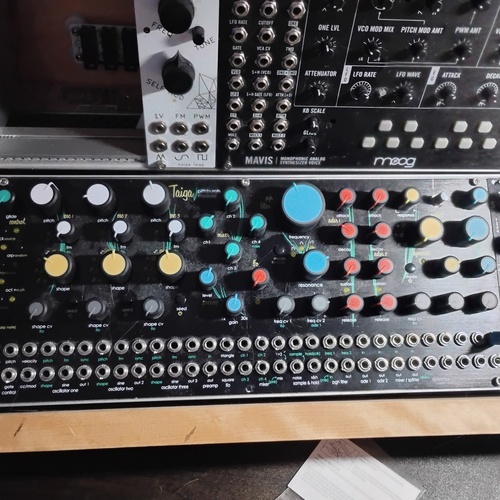
This synthesizer also features the acclaimed "No Dead Spots" multi-mode filter, a proprietary Pittsburgh invention, capable of individual or simultaneous lowpass, bandpass, and highpass configurations. The filter maintains a rich sonic character across the frequency spectrum, giving your music an unmatched depth and presence.
To complement its robust sound engine, Taiga provides extensive control options. It can be fully controlled via MIDI or CV, which includes a MIDI-to-CV converter, offering seamless integration into almost any setup. An additional layer of control is offered through the onboard digital multi-mod tool, which brings in deep modulation control, a random generator, and an extra LFO and envelope generator.
Discover an unmatched sonic playground with the Pittsburgh Modular Taiga Semi-modular Paraphonic Synthesizer.
Key Features:
- 60HP Eurorack-compatible module with removable housing
- Three 100% analog oscillators with multi-stage wavefolders
- Proprietary "No Dead Spots" multi-mode filter
- MIDI-to-CV converter for extensive control options
- Onboard digital multi-mod tool with modulation control, random generator, and additional LFO and envelope generator
- Noise generator pitched between pure white and pink noise
- Dual-range analog LFO with square and triangle wave options
- Two all-analog ADSR/envelope generators
- 100% analog bucket brigade delay
- 4-channel mixer capable of managing audio or CV signals
- High-gain, soft-clipping overdrive limiter preamp
- Clock-syncable arpeggiator, built-in clock divider, and a sample & hold circuit
Owner's manual
Pittsburgh Modular Taiga Semi-modular Paraphonic Synthesizer User ManualProduct specs
| Type | Paraphonic Synthesizer |
| Analog/Digital | Analog |
| Oscillators | 3 x Analog, Fequency Modulation (FM) |
| Waveforms | Sine, Triangle, Saw |
| Envelope Generator | 2 x ADSR |
| LFO | Dual Range |
| Filter | Lowpass, Bandpass, Highpass |
| Arpeggiator | Clock-synced |
| Analog Outputs | 1 x 1/8" TS (main out) |
| Headphones | 1 x 1/8" TRS |
| Other I/O | 60 x 1/8" patchbay points (including main out, headphones) |
| Power Supply | Tiaga Wall-wart Power Supply (included) |
| Power Usage | 650mA |
| HP Size | 60HP |
| Depth | 1.57" |
FAQs
-
Is the Pittsburgh Modular Taiga suitable for beginners in modular synthesis?
-
Yes, the Pittsburgh Modular Taiga is a semi-modular synthesizer, which means it offers a pre-wired setup while allowing for patching flexibility. This makes it accessible for beginners to explore modular synthesis without needing to build a system from scratch.
-
How many oscillators does the Pittsburgh Modular Taiga have?
-
The Pittsburgh Modular Taiga features three analog oscillators, providing a rich and versatile sound palette for creating complex tones and textures.
-
What types of waveforms can the Pittsburgh Modular Taiga generate?
-
The Pittsburgh Modular Taiga can generate sine, triangle, and saw waveforms, allowing for a wide range of sound design possibilities.
-
Does the Pittsburgh Modular Taiga include an arpeggiator?
-
Yes, the Pittsburgh Modular Taiga includes a clock-synced arpeggiator, which can add rhythmic complexity and movement to your sound.
-
Can the Pittsburgh Modular Taiga be integrated into a Eurorack setup?
-
Yes, the Pittsburgh Modular Taiga is Eurorack compatible, making it easy to integrate into an existing modular setup or to expand with additional modules.
-
What are the main filter types available on the Pittsburgh Modular Taiga?
-
The Pittsburgh Modular Taiga offers lowpass, bandpass, and highpass filters, providing a variety of tonal shaping options for sound design.
-
What is the power requirement for the Pittsburgh Modular Taiga?
-
The Pittsburgh Modular Taiga requires a Tiaga wall-wart power supply, which is included, and uses 650mA of power.
Videos

Doctor Mix
Taiga Synthesizer: Unboxing & Demo

Taiga Synthesizer: Unboxing & Demo
Doctor Mix
Pittsburgh Modular Taiga: Experiments in Waveshaping & Chaos

Sarah Belle Reid
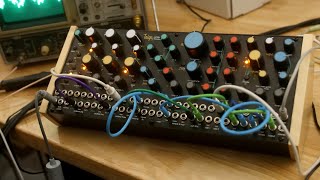
The New King of Semi-Modular // Pittsburgh Modular Taiga

Jorb
Pittsburgh Modular Taiga Review

Molten Music Technology
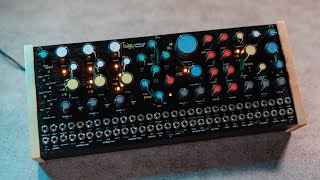
Pittsburgh Taiga Is A Colorful Analog Semi-Modular Synthesizer!

Patchwerks
Pittsburgh Modular Taiga Sonic Deep Dive – Daniel Fisher

Sweetwater
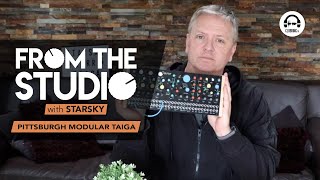
From the Studio - Pittsburgh Modular Taiga

clubbingtvofficial
Reviews
PROS
-
Endless sound creation possibilities
-
User-friendly patching with easy-to-understand points
-
Unique with 3 VCOs and dedicated wavefolders
-
Offers Buchla-like dynamics section
-
Quality build without needing a display
-
Comprehensive, color-coded labeling for ease of use
-
BBD-Delay at end of signal chain for added versatility
-
Can produce both soft and "industrial" sounds
-
Integrates well into Eurorack setups
-
Encourages exploration beyond conventional sound synthesis
CONS
-
Initial setup challenges reported (e.g., MIDI channel settings)
-
Extremely bright orange LEDs can be blinding
-
Design may be too radical and minimalist for some
-
MIDI implementation limited to mini TRS input
-
VCO tuning ranges can be cumbersome when decoupled from MIDI
-
Sound character described as flat by some users
-
Compact layout leads to densely packed controls
Owner Insights
We analyzed real musician discussions from forums and Reddit to find what players love, question, and tweak about Pittsburgh Modular Taiga Semi-modular Paraphonic Synthesizer.
Features and functionality
-
There's only one VCA, meaning despite three voices, only one output source is available, which some users find restrictive.
Source -
The BBD delay is often criticized for its short delay times and excessive high-end roll-off, making it less suitable for conventional delay use.
Source -
The Taiga's envelopes have a broad range, with optimal settings often between 7-10 o'clock for attack and release to avoid sluggish response.
Source -
The synth lacks an LFO clock input, though oscillators can be tuned to low frequencies to function as LFOs, which still limits oscillator availability.
Source -
The Taiga lacks a patchable wavefolder input, limiting wavefolding to its oscillators, which has been noted as a limitation for some users.
Source -
Taiga's low-pass filter doesn't close completely to silence, suggesting it's designed more for tonal shaping than complete cutoff.
Source
User experience
-
Oscillator drift is common, noted by owners using tuners like Walrus Audio to maintain intonation, which affects usability in live settings.
Source -
A firmware update reportedly addresses several initial issues, improving overall functionality for users.
Source -
Owners find Taiga excels at crafting gritty, bold analog leads and modulated sounds, highlighting its characterful oscillators and PGH filter.
Source
Mods and upgrades
Setup and maintenance
-
Internal adjustments are necessary for pitch tracking; trimmers are available, but multiple attempts are often required for precise calibration.
Source -
It's important to consider power consumption when integrating Taiga into a modular system; some starter cases may not provide sufficient power.
Source
Build quality
Comparisons
-
Compared to the Moog Grandmother, Taiga's patch bay is more user-friendly due to color-coded ins and outs and their convenient placement.
Source
Critic Reviews
Based on 0 Reviews and 0 Ratings
Genre Usage
Based on how artists on Equipboard use this gear, it is most commonly found in the following genres.
Community setups
Show yours
More Pittsburgh Modular Synthesizers


$1,111.00 - $1,299.99


$3,266.16 - $3,499.99
in Synthesizers Rank


$469.00 - $699.99
in Synthesizers Rank


$20,218.87
in Synthesizers Rank


$499.00 - $545.00
in Synthesizers Rank

.jpeg?v=1785070563)
.jpg?v=1785070565)

$3,333.00 - $3,499.99
in Synthesizers Rank


$999.00 - $1,084.00
in Synthesizers Rank


-m.webp?v=1785077944)
$1,100.00
in Synthesizers Rank

-m.webp?v=1785106826)
$379.00 - $499.99
in Synthesizers Rank


$700.00 - $2,398.00
in Synthesizers Rank


$2,000.00
in Synthesizers Rank


$411.00 - $699.99
in Synthesizers Rank


$277.00 - $349.00
in Synthesizers Rank


$2,199.00 - $2,941.08
in Synthesizers Rank


$1,480.57 - $1,899.00
in Synthesizers Rank


$297.67 - $652.00
in Synthesizers Rank


$1,353.97 - $1,839.99
in Synthesizers Rank


$379.00 - $549.99
in Synthesizers Rank


$466.28 - $899.99
in Synthesizers Rank


$279.00 - $449.99
in Synthesizers Rank


$229.19 - $749.99
in Synthesizers Rank


$278.16 - $1,763.18
in Synthesizers Rank


$79.99 - $495.44
in Synthesizers Rank


$325.00 - $1,332.49
in Synthesizers Rank

.jpeg?v=1785048582)
-m.webp?v=1785102997)
$1,790.00 - $1,899.00
in Synthesizers Rank


$480.92 - $699.00
in Synthesizers Rank


$499.99 - $719.99
in Synthesizers Rank


$303.89 - $915.00
in Synthesizers Rank


$3,999.00 - $4,999.00
in Synthesizers Rank


$1,469.00 - $2,159.99
in Synthesizers Rank

$290.00
in Synthesizers Rank


$479.99 - $1,099.00
in Synthesizers Rank


$166.00 - $274.95
in Synthesizers Rank


$350.00
in Synthesizers Rank


$382.00 - $449.99
in Synthesizers Rank


-m.webp?v=1785077875)
$962.85
in Synthesizers Rank

$6,600.00 - $10,444.00
in Synthesizers Rank

$29.95 - $69.99
in Synthesizers Rank

Accessories & Related Items


-s.webp?v=1785077136)


-s.webp?v=1785074639)

Artist usage


Similar


Gear Guides






.webp)

Most Popular Synthesizers
Most Popular Brands
-
Added to Equipboard on by
 marshallartman
GearIQ 74
-


