


Pricing and availability
We compare 600+ stores and found this item at 1 store. Prices updated .
Store
Reviews
Price




Average Price: $418
Standard/Professional
$249
$700+
Price Tier
Budget
Standard
High-end
* Product prices and availability are updated by Equipboard every 24hrs and are subject to change. Equipboard may receive compensation for purchases made at participating retailers linked on this site. This compensation does not affect what products or prices are displayed, or the order of prices listed. For more information, please refer to our affiliate disclosure.
Description
Product specs
| Brand | Roland |
| Model | S-760 Digital Sampler |
| Finish | Black |
| Year | 1994 - 1998 |
| Made In | Japan |
| Categories | Rackmount Synths, Samplers |
| Analog / Digital | Digital |
| MIDI I/O | MIDI Input, MIDI Output, MIDI Through |
| Polyphony | 24 Voices |
FAQs
-
What are the main connectivity options for the Roland S-760 sampler?
-
The Roland S-760 features a headphone jack, stereo input and output jacks, four individual output jacks, MIDI connectors (IN, OUT/THRU), and a SCSI connector for external storage.
-
How many voices of polyphony does the Roland S-760 support?
-
The Roland S-760 supports 24 voices of polyphony, allowing for complex sampling and sound layering.
-
Is the Roland S-760 compatible with modern DAWs?
-
While the Roland S-760 can interface with MIDI, integration with modern DAWs may require additional hardware or software solutions, as it was designed in the pre-DAW era.
-
What sampling capabilities does the Roland S-760 offer?
-
The Roland S-760 offers high-quality digital sampling with stereo capabilities, making it suitable for professional audio production.
-
Can the Roland S-760 be used for live performances?
-
Yes, the Roland S-760's robust connectivity and 24-voice polyphony make it suitable for live performances, though it may require additional equipment for optimal integration.
Videos

Samplers
How to Jungle on the S-760 with Octamed
How to Jungle on the S-760 with Octamed
Samplers
Estrella - Roland S-760, Akai S900, Alesis 3630 - French House

Taylor Sullivan
Roland S-760 Sample Rates Sound Amazing!

The Daydream Sound
![Video thumbnail for Daft Punk Revolution 909 used filter Roland S-760 sampler [No talk] by Techno Frontier](https://img.youtube.com/vi/PyCEVSvbj7Q/mqdefault.jpg)
Daft Punk Revolution 909 used filter Roland S-760 sampler [No talk]

Techno Frontier
Roland S-760 - SCSI2SD

Roy Maya
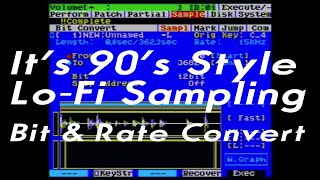
90's Lo-Fi Sampling style Lo-Fi Making Roland S-760 bit-rate convert
Techno Frontier
Reviews
Owner Insights
We analyzed real musician discussions from forums and Reddit to find what players love, question, and tweak about Roland S-760.
Mods and upgrades
-
The OP-760-1 expansion board adds four extra digital outputs, requiring a 4-channel DAC for analog output, but many users find the LCD adequate without it.
Source -
Modern SCSI solutions like ZuluSCSI are considered straightforward plug-and-play options, with external setups being preferred for ease of use.
Source -
Consider running samples through a compressor like the dbx 166 to fine-tune transients before sampling, enhancing the final sound output from the S-760.
Source
Software and compatibility
-
The S-760 requires the system disk content to boot, which can potentially be loaded from a SCSI drive instead of the original floppy disk.
Source
User experience
-
Some users find the S-760 challenging to use compared to other hardware, but others believe this difficulty is exaggerated and manageable with patience.
Source
Comparisons
-
In the 90s, house music was successfully created using the S-760 without the expansion board, highlighting its capabilities even in its most basic form.
Source
Features and functionality
-
To fully utilize the S-760's sound, sampling directly into the unit's ADC is recommended, as it enhances the sampler's distinct audio character.
Source
Critic Reviews
5.0 out of 5
Based on 1 Review and 10 Ratings
Artist usage
Add artist
I just got into the Roland S-760, and that’s a really cool adjunct to all the other MIDI gear I’ve got. It has a fabulous library, and I like the fact that it has a video screen.
(from Mark Snow's interview in the Mar 1996 issue of Keyboard magazine)


Isham's 'orchestra pit' is, however, no slouch, with several Akais (S3200, CD3000, S1000, S1000PB and three S2000s), three Emu E4Xs, three Roland S760s, plus a selection of older units. "They each have their own characteristics — the Akais have a tremendous transient response, and for percussion they're just brilliant; the Rolands have a warmth about them. I also have so many because of the various different programmers that work in the different formats. Eric Persing of Spectrasonics pretty much works for Roland, and he's just so good that I had to have some Roland gear to take advantage of his wonderful work."


Tweet from Robin Beanland in which he says he used a Roland S-760 for the Killer Instinct soundtrack.

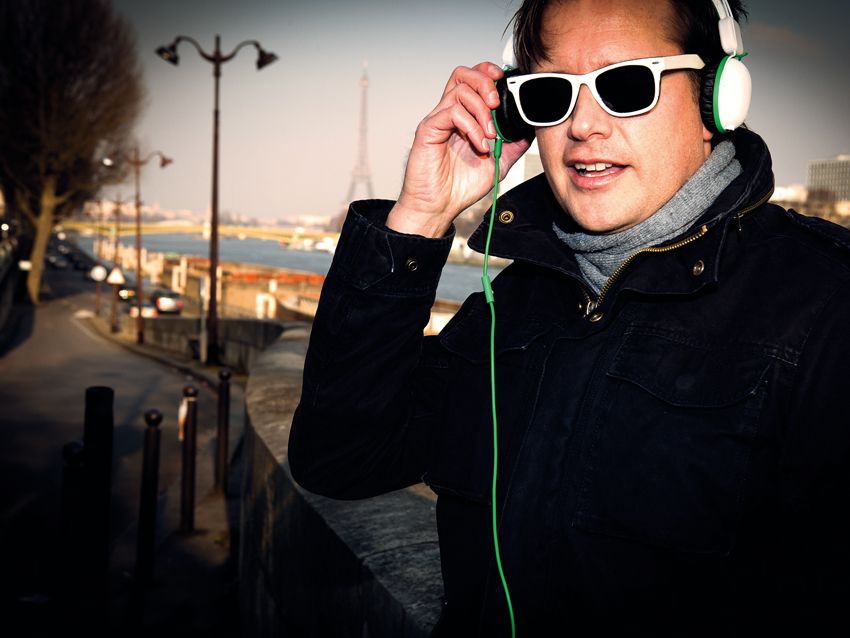
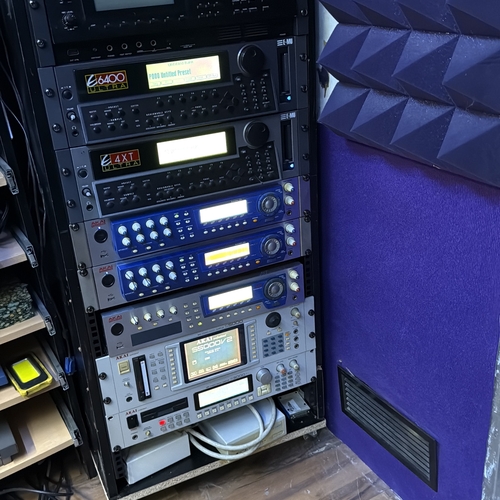
In a feature by Future Music on MusicRadar, Lifelike is shown using the Roland S-760 in his Paris studio, highlighting its role in the creation of his track "So Electric."

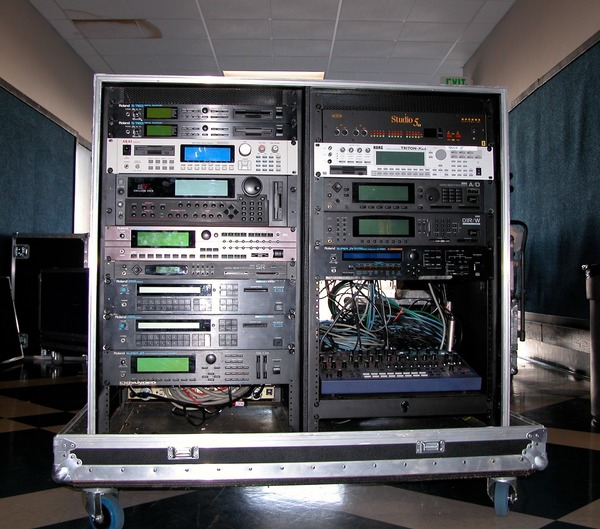
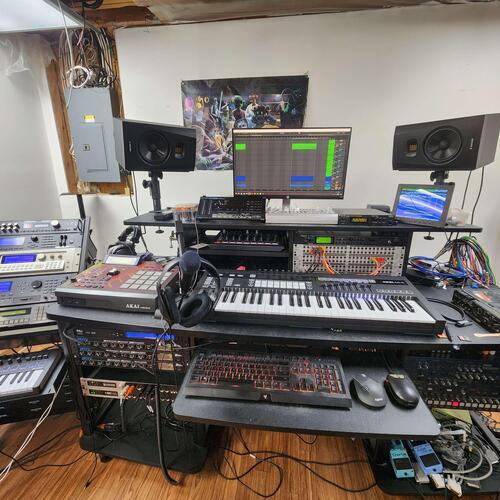
In this shot there are two S-760 samplers on the top left hand side of the rack.

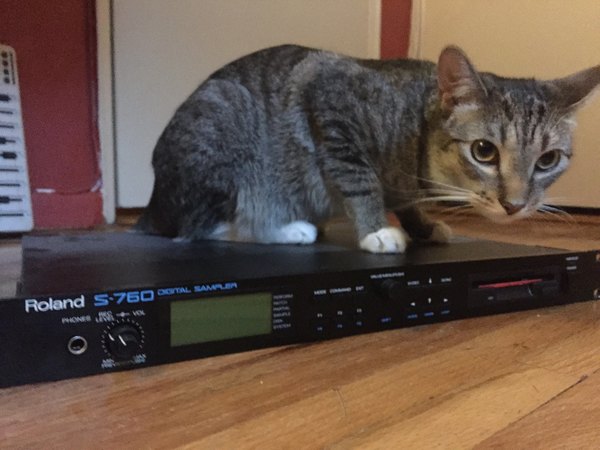
The Roland S-760 was used exclusively on the production of Silver Disco's debut album "Red Unicorn". It can be heard in almost every song, where it's key role was sampling old disco records from his personal collection over the years. It's also apparent that his cat is also a big fan of the sampler. Today, it is mostly used to bounce samples from his DAW and back in, achieving a more "warm" and fitting sound DAW's simply cannot produce. This is not limited to bouncing synth stems as well.


"I've got an 8100 Power Mac that was basically outdated the second I bought it. I use Performer, and I have four 760 Roland samplers. I have a Korg TR rack sound module, a Korg O1RW sound module, a Korg X3R, an old Proteus FX and a Roland JD-1080. I've got a Roland R-8M. My keyboard is a Roland D-70. I have an old Ensoniq ASR-10 sampler. I have a Tascam DA-88 and a Mackie 32*8 mixing console, plus a couple of Lexicon reverb units."


Kenji Kawai is confirmed to use a Roland S-760, as it is listed on his official website under the "Profile" section.

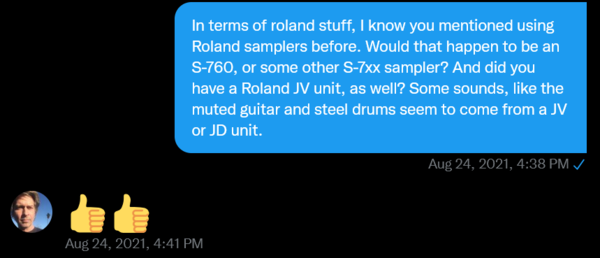
When asked about using Roland S-7xx samplers (specifically, the S-760), he gave a thumbs up, suggesting that is what he used for his samplers. Further proof of him using the sampler can be seen with his usage of the L-CD701 Rhythm Section Vol. 1, L-CD702 Orchestral Family Vol. 2, and SV-SP70-01 Library Preview Disc's.


Frank Klepacki confirmed his use of the Roland S-760 sampler among other equipment in the creation of music, as detailed in his own words: "I was using an ASR-10 sampler, a Roland S760 sampler, and a Roland JD-990 synth module to create all the music. And of course a REAL guitar." This information is substantiated by the archived Facebook note titled "BEHIND THE MUSIC OF THE FIRST COMMAND & CONQUER."

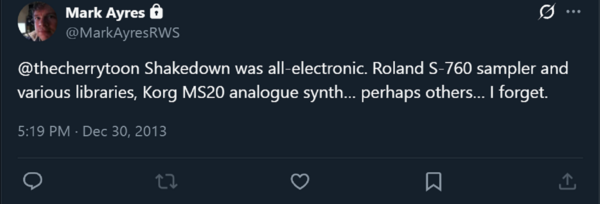
"Shakedown was all-electronic. Roland S-760 sampler and various libraries, Korg MS20 analogue synth… perhaps others… I forget."


"A UNIQUE OPPORTUNITY!
Ex-BBC Radiophonic Workshop (Blake’s Seven, The Living Planet) and current film and TV composer Elizabeth Parker is selling the famous circular studio she took with her from the BBC when the RW was disbanded.
The studio is virtually complete, including nearly all the equipment she has been using on a regular basis in her profession - up to and including a film project she is finishing in the first half of November before the studio is dismantled. Just add a mother keyboard, mastering, monitoring, and video, and you have virtually the complete set- up used for prestigious projects like the BBC’s World Cup coverage, The Human Body, Weird Nature, Animal Olympics, the Monty Python Holy Grail DVD, Michael Palin TV series, etc.
The custom woodwork and cabling alone is believed to have cost £4500 in the late 1980s, and is probably one of the most famous studio designs in the world. When it was removed from the BBC, the installation and re-design at Liz's private studio was masterminded by Rupert Brun, one of the BBC's most highly respected engineers.
Full documentation is included in the sale. Removal and/or packing and shipping is a serious task, so please bear that in mind before bidding. VEMIA will assist at cost if you need."
"The studio consists of:
The studio desk, custom made for the Radiophonic Workshop, out of limed Ash. (Buyer dismantles and collects). Complete with a vast quantity of high-quality cabling, with every cable, jack, phono and XLR numbered and labelled by Rupert Brun, with full diagrams, spreadsheets, etc. Roland XV 5080 with 8-voice expansion unit for sample playback Emu Proteus 2000 (with Proteus 1, 2, and 3 (World) Expansion Cards) Proteus 2 and Proteus 3 World Modules. Emu 4XT Ultra with maximum memory. Roland 760 Samplers (x3) with maximum sample and playback memory + mouse unit for 2 of them Emu Xtreme Lead 1 with MoPhat Card. Yamaha 01 Digital Mixer. Yamaha 01V Digital Mixer. Yamaha KM802 Mixer. Spirit Folio F1 100mm Fader Mixer. Peavey PC 1600X Midi Command Stations (x3) Alesis ADAT XT 8 track digital recorder + remote control. Denon DRM-550 Cassette Deck. Akai Professional rackmount DP3200 Routers (x3) 48-Way Patch Bays (x3) Iomega 250 Zip Drives (x2 - one still in box) CD Rom Players (x3) - one still in box. Emu Proformance Piano Module. Emu Procussion Module. Opcode Studio 4 Midi Interfaces (x2) [Opcode] Studio 5 Midi Interface. Apple 7600 computer with unused new RAM + 21" monitor Apple 8600 computer + monitor. PPM Meter - West German, made by RTW, Köln, and bought from the BBC. Magneto Optical 230 drive. Apple Mac G4, Dual Processor with 512MB RAM, 40GB hard drive in four partitions, extra internal 230GB hard drive."
Album Usage
The Roland S-760 has been featured on the following albums:

Don't Give Up (Grafix Remix)
Chicane (2024)
Red Unicorn (2024 Remastered)
Silver Disco (2012)
So Electric
lifelike (2007)
Command & Conquer (Original Soundtrack)
Frank Klepacki (2005)
Alive 1997
Daft Punk & Daft Punk (2001)
Discovery
Daft Punk & Daft Punk (2001)
Homework
Daft Punk & Daft Punk (1997)
Genre Usage
Based on how artists on Equipboard use this gear, it is most commonly found in the following genres.
Used With
Based on how musicians on Equipboard use Roland S-760, it is most commonly used with the following gear.


-s.webp?v=1783177011)

-s.webp?v=1783238222)


Community setups
Show yours

Similar
Add recommendation1 alternative for Roland S-760, curated by the Equipboard community.
More Roland Audio Samplers

$293.00
in Audio Samplers Rank


$445.00 - $499.99
in Audio Samplers Rank


$599.99 - $689.99
in Audio Samplers Rank


$240.00
in Audio Samplers Rank


$406.01
in Audio Samplers Rank


$1,000.00
in Audio Samplers Rank


$389.99
in Audio Samplers Rank


$170.50 - $269.99
in Audio Samplers Rank


$120.00
in Audio Samplers Rank


$200.00
in Audio Samplers Rank


$306.91
in Audio Samplers Rank

$249.00
in Audio Samplers Rank


$697.13
in Audio Samplers Rank


$697.13
in Audio Samplers Rank


$325.00
in Audio Samplers Rank


$132.44
in Audio Samplers Rank




$109.99 - $256.75
in Audio Samplers Rank


-m.webp?v=1783339576)
$1,467.61 - $1,799.00
in Audio Samplers Rank
.jpg?v=1783265555)


$72.00
in Audio Samplers Rank


-m.webp?v=1783177011)
$298.54
in Audio Samplers Rank


$425.00
in Audio Samplers Rank

.jpg?v=1783335869)


$220.00
in Audio Samplers Rank


$225.00 - $478.00
in Audio Samplers Rank


$275.00 - $349.00
in Audio Samplers Rank


$225.00
in Audio Samplers Rank


$89.00
in Audio Samplers Rank


$179.12
in Audio Samplers Rank


$599.00
in Audio Samplers Rank


$450.00
in Audio Samplers Rank


$2,390.00 - $3,099.00
in Audio Samplers Rank

$625.00
in Audio Samplers Rank


$235.63
in Audio Samplers Rank


$220.00
in Audio Samplers Rank
.jpg?v=1782612968)


$584.10 - $699.00
in Audio Samplers Rank


$16.99 - $225.00
in Audio Samplers Rank


$369.00 - $507.99
in Audio Samplers Rank

in Audio Samplers Rank


$692.61
in Audio Samplers Rank


Accessories & Related Items


Gear Guides





Most Popular Audio Samplers
Most Popular Brands


