

Pricing and availability
We compare 600+ stores and found this item at 1 store. Prices updated .
Store
Reviews
Price




Average Price: $60
Budget/Beginner
$200
$501+
Price Tier
Budget
Standard
High-end
* Product prices and availability are updated by Equipboard every 24hrs and are subject to change. Equipboard may receive compensation for purchases made at participating retailers linked on this site. This compensation does not affect what products or prices are displayed, or the order of prices listed. For more information, please refer to our affiliate disclosure.
Description
The Sonic IR is a mini pedal allowing you to apply a cabinet IR to your guitar or bass signal coming from a guitar pre-amp, a distortion pedal, an overdrive or a pre-amp type pedal . Its single input is designed for line level: you could connect an amplifier speaker output to it only by going first through a load-box, in order to produce a line level signal.
The Sonic IR pedal is NOT a load-box, do not directly connect the speaker output of a tube amp to the pedal, otherwise your amp and the pedal will be damaged.
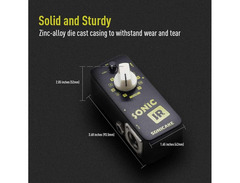
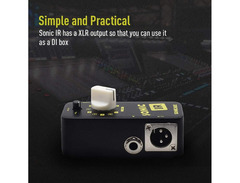
The input jack is on the right side and the pedal provides two outputs on the left side: a jack and a balanced output with an XLR connector. Two controls are available: the IR selection via a notched potentiometer (11 positions = 11 IRs) and a small volume knob. There is no light indicating that the pedal is turned on : it would have been nice and practical, so that one can quickly check that the pedal is well powered and in operation… The pedal package is quite minimalist but it comes in a small box, well protected by some foam. A user manual -in mini-card format- and a USB cable are provided (mini-USB format connector). A power supply is not provided: you will need to feed the pedal with 9 volts (200 mA). The pedal measures 9.3 cm x 4.2 cm x 5.2 cm (height), for a weight of 270 grams. It seems to be very robust – it is made of a die-cast zinc alloy – and the potentiometers also seem solid and well assembled: they do not float and they offer a good response to manipulations. This is also the case with the USB connector, which does not move around in its slot when you connect a cable to it. A good point for the construction. Also note that there is NO footswitch: it is a pedal intended to be ON in your signal chain all the time…. The specs
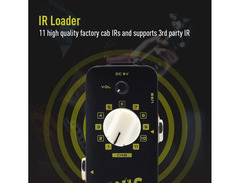
The loader provides 11 slots and offers support for IRs with a length of 1024 points (23.2 ms).
The following specifications are provided by Sonicake: 24-bits IR support, 44.1kHz, 1024 point length Signal to noise ratio: 100dB Frequency response: 20Hz to 20kHz
The latency is not specified: searching forums on the web, I could spot some answers presented as coming from Sonicake mentioning 8 to 9 ms, which is higher than competing chargers, but useable in my opinion (a latency number to be compared to the 1.2 ms announced for the Torpedo Cab M+ in 20 ms mode, and to the 2 ms for the Mooer Radar). We will get back to this point at the end of this review. The pedal does not offer additional functions such as an equalizer or a power amp simulation: it is the pure and direct IR, with volume adjustment, and that’s it ! Factory IRs and first tests The pedal’s 11 slots come loaded from the factory with 9 guitar cabs IRs and 2 IRs for bass players: Number Name Based on 1 Champion 1x8 Fender® Champ* 1x8" cabinet 2 Voks 2x12 VOX® AC30* 2x12" cabinet 3 TR65 2X12 Fender® ‘65 Twin Reverb* 2x12" cabinet 4 UK 2550 2x12 Marshall® 2550* 2x12" cabinet 5 BM59 4X10 Fender® ‘59 Bassman* 4x10" cabinet 6 Tanger 4x12 Orange® PPC412* 4x12" cabinet 7 UK 1960 4x12 Marshall® 1960AV* 4x12" cabinet 8 6505 4x12 Peavey® 6505* 4x12" cabinet 9 Mebo 4x12 Mesa/Boogie® Rectifier* 4x12" cabinet 10 M Bass 2x10 Mark Bass®* 2x10" bass cabinet 11 A Bass 8x10 Ampeg® SVT-810F* 8x10" bass cabinet
Owner's manual
Sonicake Sonic IR User ManualProduct specs
| Bypass | true bypass |
| Power | 9V |
| Analog/Digital | digital |
| Mono/Stereo | mono |
Videos

SONICAKE
SONICAKE Sonic IR Speaker Cabinet Simulator Impulse Response Loader Guitar Bass Effects Pedal
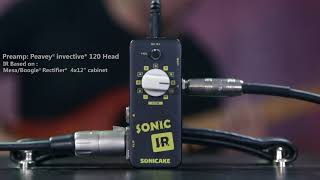
SONICAKE Sonic IR Speaker Cabinet Simulator Impulse Response Loader Guitar Bass Effects Pedal
SONICAKE
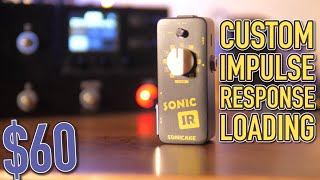
An Affordable Impulse Response Pedal // Sonic IR Demo

Alex Price

An IR Pedal Steal? Testing the Sonicake Sonic IR

No Fear Guitar Gear

Best Value Impulse Response Loader? - Sonicake Sonic IR

Ben Fletcher

SONICAKE Sonic IR Pedal | 11 Different Speaker Cab Impulse Responses In A Tiny Format
SONICAKE

Sonicake Sonic IR. Using a pedal as an amp direct into PA and Recording Software.

Mik Crone
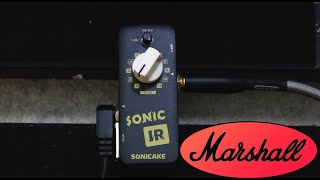
SONICAKE Sonic IR Review | Is It Any Good? @harrychrisrobin
SONICAKE
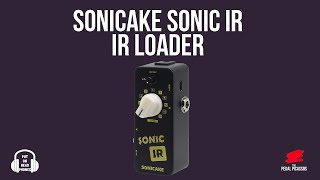
Sonicake Sonic IR - The Ultimate IR Loader with Strymon Iridium & Boost Review
SONICAKE
Reviews
PROS
-
Compact design fits easily into crowded pedalboards
-
Excellent value for a high-quality A/B pedal
-
Durable construction, built like a tank
-
High gain fuzz provides powerful, heavy tones
-
No noticeable signal degradation or popping
-
Stock IRs are impressive straight out of the box
-
Works well for direct PA connections, no DI box needed
-
Compatible with Windows after file conversion
-
Outstanding performance compared to more expensive pedals
CONS
-
Limited functionality in A+B mode with a single footswitch
-
No internal battery option due to small size
-
Built-in memory is small, slow, and easily corrupted
-
Mac compatibility issues for IR file transfers
-
Acoustic IRs require significant volume and gain adjustments
Owner Insights
We analyzed real musician discussions from forums and Reddit to find what players love, question, and tweak about Sonicake Sonic IR.
Features and functionality
-
The Sonicake Sonic IR includes a type-C port for easy IR file management via drag and drop on a PC.
Source -
It functions as a passive DI, showing no tonal difference when compared to the Joyo Preamp House's DI.
Source -
The pedal can be used directly with an audio interface for recording, providing quality sound without needing a large amp setup.
Source -
It may include a simple preamp or boost for volume control, although additional EQ from a preamp can enhance its performance.
Source
Setup and maintenance
-
Requires both DC power and USB connection to manage IRs, and lacks a power switch, necessitating removal from the chain to turn off.
Source
Build quality
-
The sticker on the back can come off with Velcro, causing adhesive issues if super glue is used to reattach it.
Source
Comparisons
-
Compared to Valeton Coral Cab, which includes EQ and presence controls, the Sonicake does not have these additional features.
Source
Use cases and applications
-
Works well with clean tones using the Vox cabinet IR, providing standout mix presence, and pairs with a Strymon Riverside for fat tones on the 8x10 cabinet IR.
Source -
Ideal for users in close-quarter living spaces who need to record without disturbing neighbors, as it eliminates the need for loud amps.
Source -
Stock IR maps are well-regarded, with the ability to switch sounds easily by adjusting the knob to different settings.
Source
Critic Reviews
3.5 out of 5
Based on 0 Reviews and 2 Ratings
Genre Usage
Based on how artists on Equipboard use this gear, it is most commonly found in the following genres.
Used With
Based on how musicians on Equipboard use Sonicake Sonic IR, it is most commonly used with the following gear.


Community setups
Show yours
More Amp & Cabinet Simulators

$1,249.00 - $1,479.00
in Amp & Cabinet Simulators Rank


$99.00 - $258.00
in Amp & Cabinet Simulators Rank


$1,449.00 - $2,049.99
in Amp & Cabinet Simulators Rank


$130.00
in Amp & Cabinet Simulators Rank


$359.00 - $399.00
in Amp & Cabinet Simulators Rank


.jpg?v=1784640202)

$1,390.00 - $1,990.00
in Amp & Cabinet Simulators Rank

.jpg?v=1784782132)


$299.00 - $399.00
in Amp & Cabinet Simulators Rank


.png?v=1784844572)

$125.98 - $149.00
in Amp & Cabinet Simulators Rank


$42.58
in Amp & Cabinet Simulators Rank


$799.99 - $835.00
in Amp & Cabinet Simulators Rank


$39.99
in Amp & Cabinet Simulators Rank


$80.00 - $90.91
in Amp & Cabinet Simulators Rank


$274.00 - $399.00
in Amp & Cabinet Simulators Rank


$453.00 - $829.00
in Amp & Cabinet Simulators Rank


$297.49 - $399.99
in Amp & Cabinet Simulators Rank


$99.00 - $588.01
in Amp & Cabinet Simulators Rank


$299.99 - $381.48
in Amp & Cabinet Simulators Rank


$228.35 - $299.99
in Amp & Cabinet Simulators Rank


$245.19 - $299.99
in Amp & Cabinet Simulators Rank


$125.00
in Amp & Cabinet Simulators Rank


$20.60 - $36.90
in Amp & Cabinet Simulators Rank


$224.10
in Amp & Cabinet Simulators Rank
.png?v=1784600217)

$131.99 - $219.99
in Amp & Cabinet Simulators Rank


$24.00 - $28.90
in Amp & Cabinet Simulators Rank


$99.00 - $179.00
in Amp & Cabinet Simulators Rank


$35.57 - $42.99
in Amp & Cabinet Simulators Rank


$249.00
in Amp & Cabinet Simulators Rank


$422.00 - $499.99
in Amp & Cabinet Simulators Rank


$99.97
in Amp & Cabinet Simulators Rank


$79.20 - $99.00
in Amp & Cabinet Simulators Rank


$179.99 - $366.93
in Amp & Cabinet Simulators Rank

$297.98 - $384.99
in Amp & Cabinet Simulators Rank


$135.00 - $149.99
in Amp & Cabinet Simulators Rank


$85.00 - $139.00
in Amp & Cabinet Simulators Rank


$66.00 - $75.99
in Amp & Cabinet Simulators Rank


$75.00
in Amp & Cabinet Simulators Rank


$115.00 - $169.00
in Amp & Cabinet Simulators Rank


$280.00 - $349.99
in Amp & Cabinet Simulators Rank


$229.74 - $283.96
in Amp & Cabinet Simulators Rank


$149.99
in Amp & Cabinet Simulators Rank


Artist usage


Similar


Gear Guides
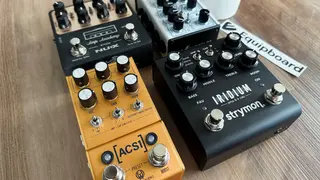




.jpg)
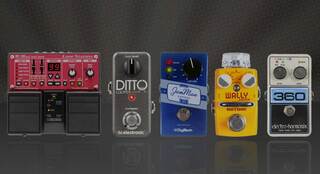

Most Popular Amp & Cabinet Simulators
Most Popular Brands
-
Added to Equipboard on by
 iangronow
GearIQ 579
-

