


Pricing and availability
We compare 600+ stores and found this item at 3 stores. Prices updated .
Store
Reviews
Price




Average Price: $116
Budget/Beginner
$200
$501+
Price Tier
Budget
Standard
High-end
Price History
Based on price data from 1 merchant for "Mooer Radar Speaker CAB Simulator". Prices shown reflect NEW condition. Tracking began Apr 19, 2026.
* Product prices and availability are updated by Equipboard every 24hrs and are subject to change. Equipboard may receive compensation for purchases made at participating retailers linked on this site. This compensation does not affect what products or prices are displayed, or the order of prices listed. For more information, please refer to our affiliate disclosure.
Description
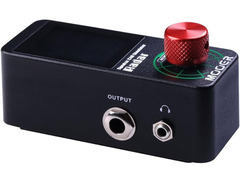
Meet the Mooer Radar Speaker CAB Simulator, your gateway into the world of amp and cabinet simulator pedals. This compact marvel packs a punch, bringing you an array of thirty diverse cabinet models. But that's not all, the Radar goes the extra mile, providing power amp and microphone placement simulations to really tailor your sound. The biggest game-changer? Its onboard headphone output, which lets you skip the amp and directly tap into the sound of your pedalboard.
Key Features:
- Offers 30 onboard cabinet models
- Simulates power amp and microphone placements
- Onboard headphone output for direct monitoring
- Compact and easy-to-use design
- Affordable entry into amp and cabinet simulation
- Ideal for diverse music genres and playing styles
Product specs
| Available since | November 2017 |
| Effect Types | Speaker Simulation |
FAQs
-
What types of speaker cabinets does the Mooer Radar simulate?
-
The Mooer Radar simulates 30 different speaker cabinet models, offering a wide range of tones for various musical styles.
-
Can the Mooer Radar load custom impulse responses (IRs)?
-
Yes, the Mooer Radar can load custom impulse responses, allowing users to tailor their sound further by using their preferred IR files.
-
Does the Mooer Radar include microphone and power amp simulations?
-
The Mooer Radar features 11 microphone models and 4 power amp models, providing comprehensive simulation options for crafting your ideal tone.
-
How many user presets can the Mooer Radar store?
-
The Mooer Radar can store and recall up to 36 user presets, making it easy to switch between different setups and sounds.
-
Is the Mooer Radar compatible with PC editing software?
-
Yes, the Mooer Radar can connect to a PC editor via USB, allowing for detailed customization and management of your settings.
-
Does the Mooer Radar support headphone use?
-
The Mooer Radar supports headphones, making it suitable for silent practice and personal monitoring.
Equipboard's Expert Review

Equipboard tested this
Compact, Versatile, and Bang for Buck
The Mooer Radar packs an impressive punch for its size. We were intrigued to see how this compact speaker CAB simulator would hold up in various settings.
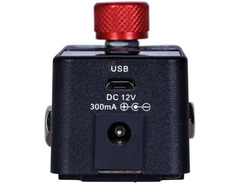
Initially, we were impressed by the Radar's fit and finish. It’s undeniably small, making it a pedalboard-friendly option. The build quality feels solid, though the high power draw necessitates a 12v supply, which could be a hassle if your current setup doesn’t accommodate that.
Feature-wise, the Mooer Radar is loaded. It includes multiple power amp and mic simulations, a graphic EQ, and variable high/low pass filters. The ability to load user’s own impulse responses (IRs) is a significant plus, as is the headphone output for silent practice. However, the absence of a user bank for managing presets and the limited selection of modeled mics are slight drawbacks.
In our sound tests, the Mooer Radar did not disappoint. The tone quality is commendable, enhancing both electric and acoustic instruments efficiently. It’s great for low volume practice without sacrificing sound integrity. When dialed in correctly, it mimics real speaker cabinets convincingly. Yet, we did encounter some noise issues at higher master volume settings, likely due to interference from nearby devices.
The bottom line is that the Mooer Radar is a versatile and budget-friendly option for those seeking a compact CAB simulator. It’s ideal for musicians needing a reliable tool for practice, recording, and live gigs without eating up pedalboard space. However, if you’re someone who demands extensive mic modeling options or has a complex power setup, the Radar might not be the perfect fit. Overall, it delivers good bang for the buck and comes highly recommended for its versatility and sound quality.
Videos

MooerAudio
MOOER RADAR Speaker CAB Simulator
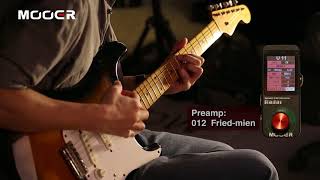
MOOER RADAR Speaker CAB Simulator
MooerAudio
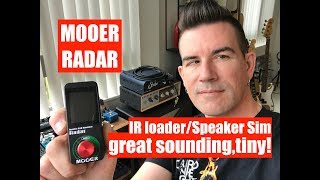
MOOER RADAR - AWESOME GUITAR CAB TONE in a tiny pedal!

Pete Thorn
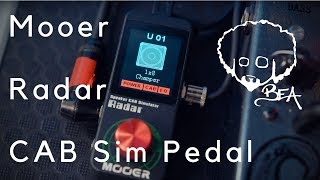
Mooer Radar CAB Sim Pedal | SUPER USEFUL & PORTABLE

Rabea Massaad
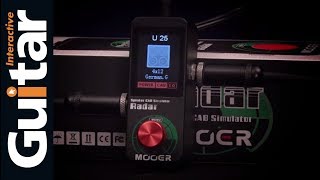
Mooer Radar Speaker Cab Simulator Pedal | Review

Guitar Interactive Magazine
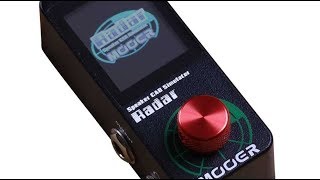
รีวิว Mooer Radar Speaker CAB Simulator สุดเทพ

CT Music Shop / Chordtabs
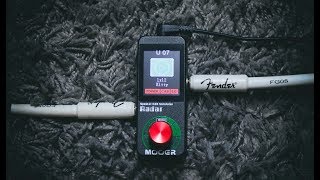
Mooer Radar | Guitar Cab Simulator | Review/Demo

Milian Malivuk Music
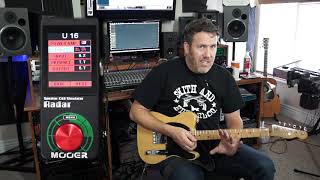
Mooer Radar Speaker Cab Simulator

Rich Bischoff
Mooer Radar Speaker Cab Simulator | This Thing Sounds GREAT!

Robert Jackson
Reviews
PROS
-
Compact design with a small footprint, ideal for pedalboards
-
Ability to load and manage up to 36 third-party IRs
-
Includes multiple power amp and mic simulations for diverse sound options
-
High-quality sound enhancement for both electric and acoustic instruments
-
Intuitive navigation with a single knob for easy operation
-
Low latency, making it suitable for live performances
-
Budget-friendly option with impressive versatility
-
Silent practice capability with a stereo headphone output
-
Great for low volume practice without sacrificing sound quality
CONS
-
Requires a separate 12V DC power supply, which may be inconvenient
-
Limited impulse response length of 23ms
-
USB connection can be unreliable with some setups
-
Noticeable noise at higher master volume settings
-
Lack of a dedicated user bank for preset management
-
Potential for interference from nearby devices at high power settings
-
Makes a loud thump when bypassed
Owner Insights
We analyzed real musician discussions from forums and Reddit to find what players love, question, and tweak about Mooer Radar Speaker CAB Simulator.
Comparisons
-
The NuX Solid Studio is preferred by some for its simpler interface, avoiding menu diving compared to the Radar.
Source -
Users compare the Radar's power amp simulation to the Hotone Binary IR Cab, suggesting the latter offers slightly better emulation, though personal preference plays a role.
Source -
Users liken the Radar setup to a Marshall stack, with a preamp acting as the amp head and the Radar as the speaker cab and mic.
Source
User experience
-
Users warn that using the Radar with other gear that has cab sims, like certain Behringer preamps, can cause phase issues, suggesting careful consideration of pedal integration.
Source -
Some users find the Radar lacking in brightness compared to Boss GT1000 patches, requiring additional EQ adjustments for desired tonal balance.
Source -
Without a preamp, the Radar can sound sterile; users suggest pedals like the DOD 250 for added saturation and depth.
Source
Value and pricing
-
The Radar is valued as a compact, versatile option for those seeking to minimize pedalboard space, often compared against larger EQ pedals.
Source
Mods and upgrades
-
Some users opt for the Radar over a 10-band EQ pedal for its compact size and additional features, despite fewer EQ bands.
Source -
Stock cabs are often replaced with ML Labs or Celestion IRs for improved sound; load via Mooer's software, despite initial hassle.
Source -
For better tone, users recommend using a preamp pedal, such as a Boss BD-2 set to low gain, before the Radar.
Source
Use cases and applications
-
Owners running stereo rigs often bypass the Radar's EQ in favor of separate EQ pedals, indicating flexibility in multiple setup configurations.
Source -
When used with JFET-based dirt pedals, the Radar offers more amp-like responsiveness and touch sensitivity.
Source -
The Radar is designed to be at the end of the signal chain, but some users prefer routing it into a compressor for volume control before delay/reverb effects.
Source
Features and functionality
-
The Radar's power amp simulation includes four types, crucial for adding "oomph" and fullness to the sound, especially when using solid-state power amps.
Source -
The Radar offers tweakable power amp and microphone settings, essentially simulating a mic’d up amp in a box.
Source -
Sensitive input/output gains can cause clipping; users suggest reducing both gains to avoid the Red Arrow of Clipping.
Source
Software and compatibility
-
The Radar lacks XLR output, necessitating a DI box for connecting to a mixing board effectively.
Source
Critic Reviews
4.5 out of 5
Based on 3 Reviews and 26 Ratings

Versatility has a new name..
The Mooer Radar is one of the most versatile pieces of gear I have ever come across. It is mainly a cab sim, but also features a power amp section, an EQ and mic simulation. You can choose between 30 stock cab sims (Fender, Marshall, Vox, Diezel, Soldano, and more) in total, 5 of which are Ampeg Bass cab sims, and upload more third party IR's in a total amount of 36 user presets. I didn't bother with that because the stock presets are already great. You can choose between 4 different power amps (by tube, there are 6L6,6V6, EL34 and EL84) which are the most common power amp sections today. The Radar also provides 11 different microphone simulations and an EQ section (one parametric and two graphic, one for guitar and one for bass). You can adjust in- and output-levels, the presence of the chosen power amp, the mic placement (in relation to the cab in the room) and position (in relation to the speaker cone). There are almost endless possibilities only with the stock presets. There are many possible uses: you can use the Radar for recording as well as for gigging when you don't want to carry a big amp and just plug straight into the PA. I haven't tried the last one, but for the next gigs the Radar will be on board for when the amp breaks or there is any need for a DI signal. The Radar also features a headphone output which is nice to have for playing late at night with great sound and without bothering your neighbors or the girlfriend you don't have ;-)
Preferred Settings + Usage:
I recommend updating the firmware to v1.2 because they fixed some problems and improved on some settings.
.png?v=1769635903)
126
It gets better
The factory cab sim sucks. I've used it only as a IR loader. It costs more than it’s worth.
Artist usage
Add artist

In this video, Rabea Massaad demos his Mooer Radar pedal.

.jpg)
Using the Radar Speaker CAB Simulator for some solos

.jpg)
In an Instagram post, Andy Sneap mentions using the Mooer Radar Speaker CAB Simulator as part of his live setup, highlighting its impressive performance with Mooer preamp pedals.

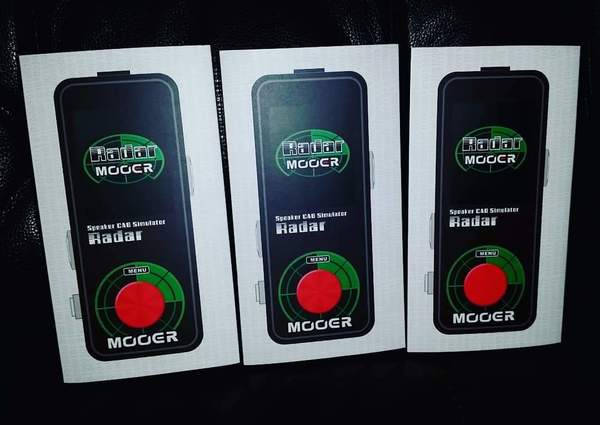
Marek's fellow Cradle of Filth guitarist posted to Facebook:
Another delivery from Mooer. 3 more radar cab simulators. Backups for Marek and I, plus 1 for Daniel Firth.


For all that ambiguity, Rook is pretty forthcoming in conversation, eagerly diving into the geekiest technical details of her creative process (she’s especially happy to talk guitar gear, singling out her purse-sized Mooer Radar pedal in particular as “a godsend”) and nonchalantly referring to the gradual changes in Black Dresses’ sound as having been “all kind of an accident.”


In this Thoman interview Richard talksthrough his Mooer Radar settings (15:33).


In the background is a Mooer Cab Sim Pedal.

.jpg)


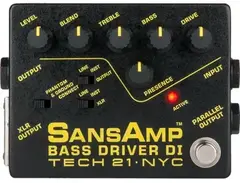
GUITAR // BASS_ _EVH 5150 III (50 Watt) HEAD _ENGL POWERBALL _ENGL 2×12 CAB _MESA BOOGIE RECTIFIER 4×12 CAB _LANEY vintage 4×12 CAB _MARSHALL vintage 1×12 CAB _KEMPER PROFILING AMP _TWO NOTES TORPEDO RELOAD _TECH 21 SANS AMP BASS DRIVER _EDEN WTDI _LTD VIPER 1000 DELUXE (EMG 81) _DIGITECH WHAMMY _MORLEY MARK TREMONTI WAHWAH _MAXON OD-820 OVERDRIVE PRO _DVK HAIRBALL _BOSS GX700 _BEHRINGER HM300 _LINE 6 POD X3 _MOOER 005 _MOOER Radar
Album Usage
The Mooer Radar Speaker CAB Simulator has been featured on the following albums:

Genre Usage
Based on how artists on Equipboard use this gear, it is most commonly found in the following genres.
Used With
Based on how musicians on Equipboard use Mooer Radar Speaker CAB Simulator, it is most commonly used with the following gear.




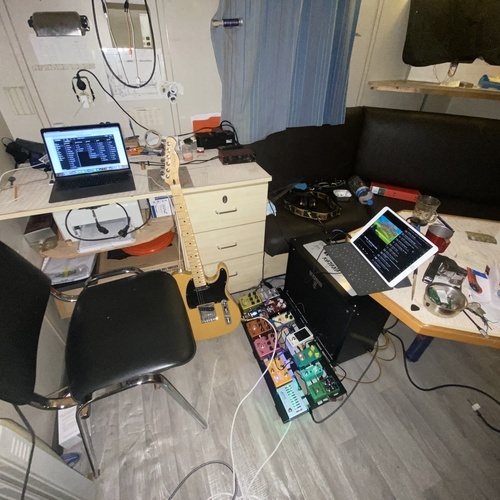
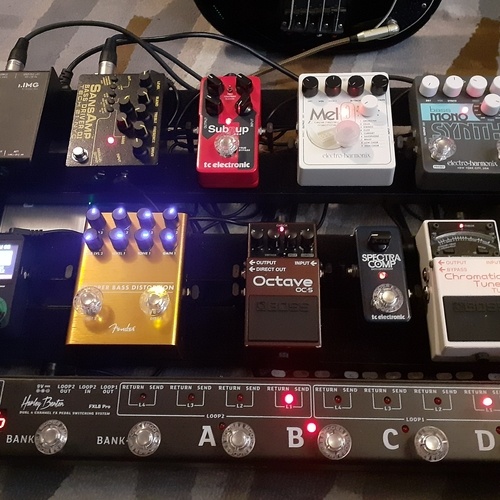
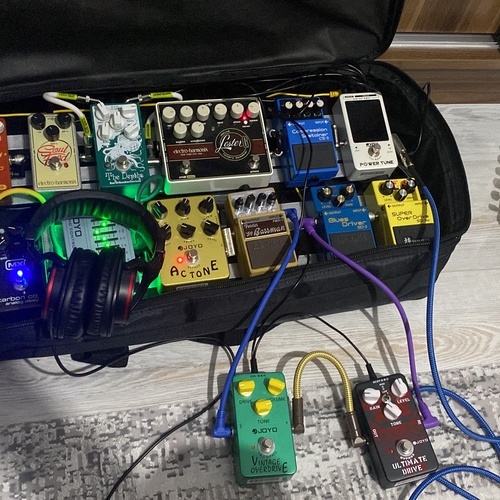
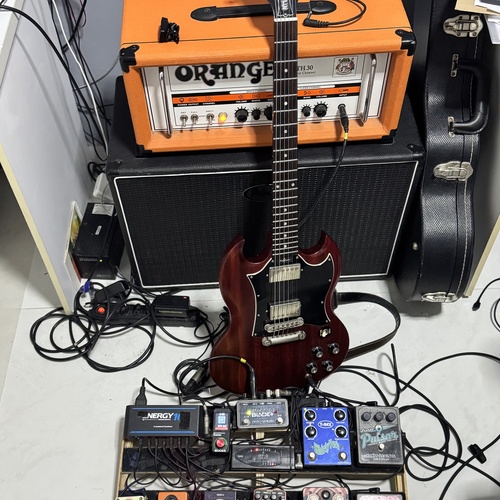
Community setups
Show yours











Similar
Add recommendation1 alternative for Mooer Radar Speaker CAB Simulator, curated by the Equipboard community.

$119.00 - $299.99
More Mooer Amp & Cabinet Simulators

$80.00 - $90.79
in Amp & Cabinet Simulators Rank


$79.20 - $99.00
in Amp & Cabinet Simulators Rank


$84.28 - $93.99
in Amp & Cabinet Simulators Rank

$81.92 - $83.55
in Amp & Cabinet Simulators Rank


$81.00 - $99.00
in Amp & Cabinet Simulators Rank

$77.00 - $99.00
in Amp & Cabinet Simulators Rank

$95.00 - $126.99
in Amp & Cabinet Simulators Rank

-m.webp?v=1784819249)
$81.00 - $99.00
in Amp & Cabinet Simulators Rank

$90.79
in Amp & Cabinet Simulators Rank

$85.83 - $85.99
in Amp & Cabinet Simulators Rank


$85.90 - $90.79
in Amp & Cabinet Simulators Rank

$82.90
in Amp & Cabinet Simulators Rank

$47.00 - $63.95
in Amp & Cabinet Simulators Rank

$82.46 - $86.23
in Amp & Cabinet Simulators Rank

$46.41 - $87.19
in Amp & Cabinet Simulators Rank

$78.33 - $88.00
in Amp & Cabinet Simulators Rank

$82.90 - $99.00
in Amp & Cabinet Simulators Rank

$53.54 - $104.50

$89.54 - $99.00


$85.83 - $98.00


$55.00 - $137.99

$55.00 - $73.14

$1,249.00 - $1,479.00
in Amp & Cabinet Simulators Rank


$99.00 - $258.00
in Amp & Cabinet Simulators Rank


$1,449.00 - $2,049.99
in Amp & Cabinet Simulators Rank


$130.00
in Amp & Cabinet Simulators Rank


$359.00 - $399.00
in Amp & Cabinet Simulators Rank


.jpg?v=1784640202)

$1,390.00 - $1,990.00
in Amp & Cabinet Simulators Rank

.jpg?v=1784782132)

$299.00 - $399.00
in Amp & Cabinet Simulators Rank


.png?v=1784844572)

$42.53
in Amp & Cabinet Simulators Rank


$799.99 - $835.00
in Amp & Cabinet Simulators Rank


$39.99
in Amp & Cabinet Simulators Rank


$274.00 - $399.00
in Amp & Cabinet Simulators Rank


$453.00 - $829.00
in Amp & Cabinet Simulators Rank


$297.49 - $399.99
in Amp & Cabinet Simulators Rank


$99.00 - $588.01
in Amp & Cabinet Simulators Rank


Gear Guides




.jpg)

Most Popular Amp & Cabinet Simulators
Most Popular Brands
-
Added to Equipboard on by
 toth_ben
GearIQ 5031
-


