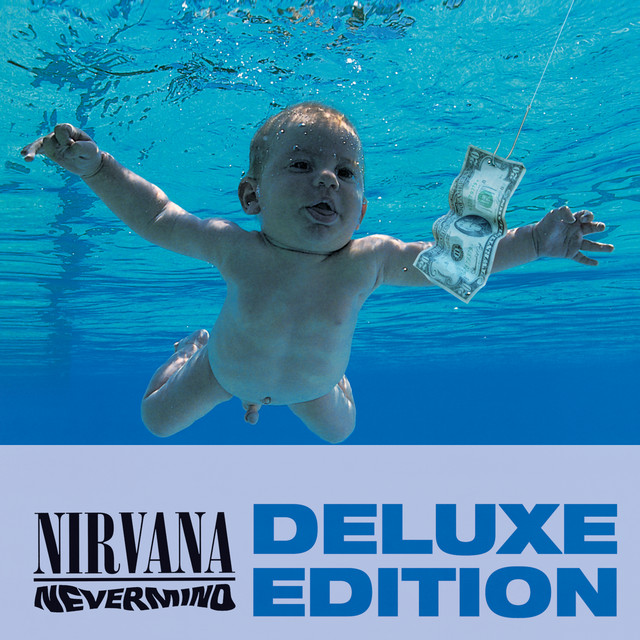
Nirvana – Nevermind
The music gear and equipment used by the artists, producers, engineers, and more involved in the making of the 1991 album Nevermind.
Music from Nevermind


Gear Used On Nevermind
Explore the instruments, equipment, software, and production tools used in the making of Nirvana – Nevermind (1991). Click more on each item to see exactly how it was used.
Guitars used by Kurt Cobain on Nevermind

Harmony Stella H912 12-String Acoustic
This acoustic guitar was used for the recording of the song "Polly" on Nevermind. When told in a Guitar World interview that the acoustic guitar he played in the song sounded a little flat, Cobain replied "That’s a 20-dollar junk shop Stella — I didn’t bother changing the strings. [laughs] It barely stays in tune. In fact I have to use duct tape to hold the tuning keys in place." It has also been rumored that the Stella only had 5 strings on it at the time of the recording. It is believed that this guitar was also used on the recording of "Something in the Way". Kurt had 11 nylon strings he only had 1 high E string Aaron Rash has a video were he explains the guitar in detail


Avg price: $1,302.00
Cobain used a 1966 Jaguar during the Nevermind tour and In Utero tour. He got this guitar with a Dimarzio PAF and a Dimarzio Super Distortion already in the guitar. But later he would put a Tune o' matic Bridge in the guitar, this guitar can be seen throughout the video.

-m.webp?v=1784026817)
Fender Mustang Electric Guitar
Avg price: $1,155.99
The Kurt Cobain Equipment F.A.Q. extensively documented Cobain's Fender Mustangs, his favorite guitar model. Mustangs featured prominently throughout the Nevermind and In Utero eras of Nirvana.
Guitars Page
A). Fender Mustangs. Kurt said that his favorite guitar was a Mustang (9).
1). One of the most note-worthy of the assorted lefty Mustangs he used was a 1969 Lake Placid Blue "competition" Mustang, serial # F 279651 (59). It was purchased around the same time as his Jaguar (discussed later), just prior to recording "Nevermind" (57). This is the guitar from the "Smells Like Teen Spirit" music video; however, Kurt had been seen using it often during shows (seen 2,10,15). Fender produced the Mustang competition series from around 1968-1973 and they are easily identifiable by the three racing stripes on the body. The "Fender Book" says that the competitions, quote, "sometimes" came with matching headstocks.(11). Kurt's Mustang was lake placid blue with matching headstock. It had two black, single coil sized pickups with a white mother-of-pearl pickguard; the bridge was replaced with a Stewart MacDonald Gotoh Tune-O-Matic (Kurt's favorite)(57) before the Argentina trip. Despite his babying this guitar, he trashed this guitar during the infamous Tree Club show (seen 2). As a result, it had lower edge damage and a broken neck joint (41). This guitar can also be seen on the relatively well-known "Hollywood Rock" festival concert footage shot in Rio de Janeiro, Brazil in 1993 (seen 13, 10). This guitar remained in storage during the "In Utero" tour because Kurt really liked this guitar (57). The Australian Hard Rock Cafe claims they have this guitar, but Earnie Bailey says he saw a photo of the guitar they had and it was right-handed. "The photo said that it had come from Courtney. Either she or Eric had a right-handed one exactly like Kurt's, I'm not sure whose it was, but this is mostly likely that guitar." He goes on to say, "The Hard Rock Cafe does not own Kurt's competition blue Mustang. I recently worked on the real one and its preset owner allowed me to photograph it in detail. Courtney gave it to him a month after Kurt's death, and it is eaxctly as I remember it, ever nick, ding, and solder joint" (59).
2). The March 1995 issue of "Guitar World" magazine mentions Kurt sent out 4 new, stock, Mustangs to be routed for humbuckers (32). Three were sonic blue and one fiesta red (41). The way Earnie modified these guitars is as follows:
First, the nut had to be cut for heavier strings, then the neck shimmed for a better bridge angle with the cardboard backings from hotel stationery pads, and a Gotoh Tune-O-Matic bridge was installed. Earnie also had to modify the tailpiece to block the vibrato, which Kurt hated. He would remove the two springs for the vibrato bar, add washers to the posts beneath the bridge plate, which locked it down to the plate. Lastly, Earnie would flip the tailpiece around allowing the strings to feed directly through the tailpiece, not under, and the ball ends of the strings would fit in the tailpiece's recesses (41).
Fiesta red Mustang (seen 1). Kurt received this guitar right before the first Roseland show. It came with a red swirl pickguard with white pickup covers. Earnie Bailey replaced the red tortoise pickguard with a white pearl pickguard from Chandler. It was used during the In Utero tour, most often seen with the white pearl pickguard. For the first Roseland NY show, Earnie switched the bridge pickup with a Seymour Duncan JB Hot Rails model in white, which is a fairly unusual pickup. When he received the Chandler pickguard, he decided black pickup covers would look better with the pearloid. This guitar was to be Kurt's first Japanese Mustang to get routed for a humbucker, the stock neck pickup only had the cover changed (59), and was fitted with a Seymour Duncan JB. Kurt later wanted all of his Mustangs routed for the JB., that is, except for the '69 competition (41).
Sonic blue Fender Mustang with a full-sized humbucker in the bridge (seen 15, 7). There were three of these guitars, two of them set-up like below (41), one of them had the serial # 0 016988 (59). One had a red-swirl pickguard (seen 7), another a matte red pickguard. These two were sent out for the In Utero tour. The third one was never set-up or modified and stayed at Kurt's house. It never came out of its box because the "In Utero" tour people were waiting for the other Mustangs to be broken, which they never were. Earnie also never swapped out the 250k pots to 500k's when the humbucker was added as he didn't expect these guitars to last very long (59).
Courtney gave one of these guitars to a young man named Bobby Costello in Florida. Last I had heard, the family was looking to sell the guitar and supplied me these pictures: Note from Courtney, Pic #1, Pic #2, Pic #3.
3). Early 60's sonic blue Mustang, serial # F207901, no pickguard. It was used in Geffen's "In Bloom" video (seen 42, 43)(41)(59). Kurt picked up this guitar at the time of the video shoot in Los Angeles. Earnie saw it at Kurt's house and says it was really clean-- it had no body contours and stock hardware. It never toured (41). The Mustang is visible behind the mannequin in the "Sliver" video but with a single-coil pickup in the bridge (seen 36)(59).
4). Early 60's sanded-down Fender Mustang used when Jason Everman was with the band. Had no contours and no decal with unusual hardware. Had a Soundgarden sticker on it (41)(seen pgs. 95, 96 on (25)). Also said to be visible in the "Incesticide" cd insert, but I don't know if it is really the same guitar ("Incesticide" 44). Said to have a cut-up vinyl record for a pickguard (15). Another picture.
5). 1977 sunburst Mustang with black pickguard, serial # S 714567 (59), rosewood neck, and rusty parts(41). It got a Duncan Hot Rails upon returning home from Rio (59). Earnie Bailey tells me he is "fairly certain" this was used for the encore at the Rio show (59)(seen 13). On the video which many of us own, he plays a Univox for the encore and though there is confusion as to what the "Rio" show really was, most consider it to be the Hollywood Rock Festival, January 23rd, 1993 (41). Aneurysm and Dive from 'Live! Tonight! Sold Out!' were taken from this show (seen 16). However, the 'LTSO' book lists this as being in Sao Paulo, while "Come As You Are" says otherwise (25)." Here is what Earnie tells me, "[This guitar] was brought to Rio by Ron Stone of Gold Mountain Entertainment. We received it the day we arrived in Rio. I am fairly certain Kurt grabbed it for the encore. I am not sure if the encore is on the bootleg video. The guitar had a baseball bat neck and I didn't have a hot rails pickup with me in Brazil to install. I really thought he was going to smash it because it didn't feel or sound right yet, but he didn't" (59).
6). Poorly modified Fender Mustang from the early days. Its control plate and weird bridge currently reside in a pink suitcase of Kurt's (15)(59).
Also, despite how many pictures appear, Kurt never used a white Mustang. The sonic blue tend to look white, especially with the crazy light show NIRVANA had during the "In Utero" tour. Jim Vincent's girlfriend did the lighting for the shows and also designed the sleeve for the band's first single. If any of you have any photos of the whole stage from the "In Utero" tour, please let me know! Jim has been looking for pictures of the stage for his girlfriend's portfolio.
Recording of 'Bleach'
Jack Endino says in the early days a Univox guitar (Hi-Flyer (57)) with stock humbuckers was used (54). Jack bought one of these type of stock Univox pickups from Kurt once. It was in pieces, but Jack was able to stick the wires together (57). The Univox(s) was around approximately until "Sappy" was recorded; a new guitar was seen at least by the time Jack did the "In Utero" demos which he remembers as being a small Fender guitar, "perhaps a Mustang." (...)
Recording of 'Nevermind'
(...) The guitars used were his competition Mustang, his Jaguar, and a new Stratocaster(s) with humbuckers in the bridge positions (6). Kurt purchased a bunch of Japanese Strats (had humbuckers installed in the bridges) and effects for this album from Rick King of Guitar Maniacs. Just prior to recording this album Kurt apparently developed a taste for Fender guitars.
(...) Tour Gear Summary
(...) "Nevermind"-era: Initially only the 1965 Jaguar, '69 Mustang, and Japanese strats for guitars; later the sunburst Tele painted blue. Univoxes continually used occasionally. Dean Markley .010-.052 guitar strings and orange Dunlop picks. (...)
"In Utero"-era: Everyone knows Kurt's usual guitar of choice was the Mustang. New sonic blue (red pickguard) and fiesta red (red swirl changed to white pearl) Mustangs used almost all of the time. (...) All the work to his new Mustangs (and Mexican Strats) was done before the band went on this tour. Sometimes Kurt would want one of his Mustangs to smash at the end of a show, instead of the predetermined black Mexican Strat, but they talked him out of it! Kurt agreed by saying, "Yeah, all right, I don't want to break that guitar because it feels really good" (57).
I'm sure there are still some mistakes here and there..
- Still photographs: Roseland new music seminar performance in NYC, 7/24/93.
- The infamous Trees Club show video footage shot in Dallas, Texas on 10/19/91.
- MTV Studios performance of "Smells Like Teen Spirit," "Polly," and "Territorial Pissings" taped in New York, NY 1990.
- Guitar World Online, soundcheck. Web address is: http://www.guitarworld.com/jan96/soundcheck/scfeature1/sft.page1.html
- Saturday Night Live rehearsal footage. 1993 NBC.
- "Guitar World" magazine. May 1996.
- MTV's New Year's "Live and Loud" concert footage at Pier 47 in Seattle, WA, 12/17/93 shown 12/31/93.
- "In Utero," album, 1993 DGC.
- "Musician" magazine interview. January 1992.
- My and Ralph Smith's discussions through e-mail with various people.
- My phone conversation with Fender, 8/19/96.
- Clay Guitars Web Page. Web address is: http://www.geocities.com/Hollywood/1375/fender.html
- "Hollywood Rock" festival concert footage. Rio de Janeiro, Brazil, 1993.
- Concert footage; said to be Trenton, NJ, 1991.
- Various photographs/concert footage.
- "Live! Tonight! Sold Out!" video. Geffen Home Video, 1994.
- Saturday Night Live performance, 1993.
- "Fender Frontline" magazine. Fall 1994 (Vol.14).
- Still photographs: "Nirvana" (Suzi Black, Omnibus Press) 1992.
- "Guitar Player" magazine interview. February 1992.
- "MTV Unplugged" concert video. Fall 1993. Soundtrack released as "MTV Unplugged in New York" (DGC, DGCD-24727) 1994.
- "Guitar World presents Alternative Guitar" magazine interview. Spring 1994. Ralph Smith feels the interview seems to date from the period right around when "Nevermind" was released.
- "Doll Parts" music video by Hole. (DGC) 1994.
- "Guitar Shop" magazine 1994. A review of the 11/15/93 show at the NY Coliseum, NYC.
- Book: "Come As You Are: The Story of Nirvana" by Michael Azerrad (Doubleday). October 1993. Either a picture or in the text.
- "In Utero" sheet music book (Hal-Leonard pub.) 1994.
- "What's the Frequency, Kenneth?" by R.E.M. (Warner Bros.) 1994.
- Book: "Ferrington Guitars, Featuring the Custom-made Guitars of Master Luthier Danny Ferrington" (HarperCollins and Callaway Editions) 1992.
- "Vintage Gallery: Collectable Guitars & Amps" magazine. October 1994, p. 47.
- Ralph Smith's telephone conversation with Fender, 11/4/94.
- "Heart-Shaped Box" music video. (DGC) 1993.
- "Guitar World" magazine (and possibly also a later issue for the item mentioned in parenthesis under the "Recording of 'Nevermind'"). March 1995.
- "Nevermind," album. (DGC) 1991.
- "Bleach," album. (SubPop) 1989.
- "Guitar Shop" magazine. August 1996.
- "Sliver" music video. (DGC & SubPop?) Year?
- "From the Muddy Banks of the Wishkah," album. (DGC) 1996. Photos from insert and cover.
- "Guitar World" magazine. October 1996.
- "Circus" magazine. December 17, 1996.
- My phone conversation with Jim Vincent, NIRVANA's tour tech from later 1993 through all of 1994. 1/28/97.
- Chris Lawrence's Equipment Tutorial which also contains information from Earnie Bailey, Kurt's main guitar technician. Web address is: http://www.geocities.com/SunsetStrip/Towers/5890/kurtseq.html
- "In Bloom" music video (DGC). Year?
- "In Bloom" music video (SubPop). Year? Preceded DGC's video.
- "Incesticide" album. DGC, SubPop 1992.
- L.A. Recycler. Web address is: http://www.recycler.com
- "Lithium" music video (DGC). Year?
- MTV Video Music Award show, 1992.
- Reading Festival. London, England. 8/92.
- "Come As You Are" music video (DGC). Year?
- Saturday Night Live live performance, 1993.
- "NIRVANA and the Sound of Seattle," book (more info?).
- New Year's Eve, 1993, live performance in Oakland, CA.
- "Goldmine" magazine/newspaper. 2/14/97, Vol 23, No 4, Issue 432. Pg. 16.
- Jack Endino's web page http://www.nwlink.com/~endino/
- "Guitar World Presents NIRVANA and the Seattle Sound" magazine. 1993.
- Information from my conversations with Chris Gill of "Guitar World" magazine, who did the equipment article in the August 1997 issue.
- "Guitar World" magazine, August 1997.
- My telephone conversation with Mark Snyder. Mark claims to have built Kurt's amp rack and demoed Kurt Mesa/Boogie gear at the time, Earnie doubts this.
- My conversations and emails with Earnie Bailey.
- Various emails.
- Uncut Legends #2.


Avg price: $3,133.69
This guitar was famous for being used in the "Smells Like Teen Spirit" music video but that wasn't the first time it was seen, it was first used in the Beehive Music and Video store where it was used for the songs "Breed" at 8:00 and "Floyd The Barber" at 11:01. Here's the guitar - and Kurt's sweater - on display at Seattle Experience Music Project.
Cobain avoided using this guitar in large concerts because it was the second Mustang Cobain had ever owned and it was one of Cobain's favorite guitars (Cobain usually smashed his guitars onstage therefore he didn't use his favorites frequently, roadware may also have been a factor in this).
More details:
1969 Fender Lake Placid Blue Competition Mustang with Matching Headstock. Kurt Cobain used this guitar in the "Smells Like Teen Spirit" music video on August 17, 1991. It was purchased around the same time as his Jaguar, just prior to recording "Nevermind". however, Kurt had been seen using it often during shows. Despite his babying this guitar, he trashed this guitar during the infamous Tree Club show. As a result, it had lower edge damage and a broken neck joint. This guitar can also be seen on the relatively well-known "Hollywood Rock" festival concert footage shot in Rio de Janeiro, Brazil on 01/23/1993.
Kurt's Mustang was lake placid blue with matching headstock. It had two black, single coil sized pickups with a white mother-of-pearl pickguard; serial # F 279651.
- Pickguard: White Pearl.
- Fingerboard : Rosewood w/ dot inlays; 22 frets.
- Pickups: H-S (Black Seymour Duncan Hot rails installed in the bridge position).
- Bridge/Tailpiece: Tune-O-Matic Bridge, Sept 91'
The bridge was replaced with a Stewart MacDonald Gotoh Tune-O-Matic (Kurt's favorite) before the Argentina trip. Oct'92.
First Recorded Use: 09/16/1991 Beehive Music & Video, Seattle, WA.
Last Recorded Use: 04/09/1993 Cow Palace (Trenjevka Woman's Group/Bosnia Rape Victim Benefit), Daly City, CA.
In an interview with GuitarWorld, when asked why he favors low-end models of guitars, Cobain replied:
"I don’t favor them — I can afford them. [laughs] I’m left-handed, and it’s not very easy to find reasonably priced, high-quality left-handed guitars. But out of all the guitars in the whole world, the Fender Mustang is my favorite. I’ve only owned two of them."
He added, "They’re cheap and totally inefficient, and they sound like crap and are very small. They also don’t stay in tune, and when you want to raise the string action on the fretboard, you have to loosen all the strings and completely remove the bridge. You have to turn these little screws with your fingers and hope that you’ve estimated it right. If you screw up, you have to repeat the process over and over until you get it right. Whoever invented that guitar was a dork."
Here is a still image of Cobain holding the Fender Mustang.

-m.webp?v=1784041151)
Avg price: $2,724.86
Kurt Cobain's Martin D-18 is found at the Martin Factory in Nazareth, PA. The plaque located under the guitar reads, "This well-worn D-18 was coined 'Grandpa' by Cobain himself, and was gifted to the rocker by then girlfriend Mary Lou Lord in 1991. The guitar was was used by Cobain by while on tour for Nirvana's second and most notable album, 'Nevermind'. Here's a pic of the guitar as well.


Cobain used this guitar for Nirvana's performances at Tower Records, New York, and Northern Lights, Minneapolis, during their Nevermind tour in 1991.
Effects Pedals used by Kurt Cobain on Nevermind

Avg price: $63.88
This screenshot from the Julien's Auctions website (slightly altered to make it fit better) shows the auction for Kurt Cobain's Boss DS-1 Distortion pedal. Jeff Toste was the recipient of the pedal after Cobain threw it into the crowd. A letter from Toste accompanying the pedal tells the story:
The third show of Nirvana's iconic Nevermind tour was at Club Babyhead in Providence, RI. It was September 25th, 1991 and The Melvins opened. I was at that show.
During the show Kurt Cobain had technical problems, and at one point he was getting no sound from his gear. He must have thought his distortion pedal (Boss DS-1) had something to do with it. He smashed the pedal on the stage and threw it into the crowd. It landed between the feet of the guy in front of me. I pulled it out from between his feet.
The left hinge on the pedal is broken, but otherwise works. The pedal still has the original duct tape used to secure it to the stage. I've had it ever since.
The winning bid of this particular auction was $8,960 USD. The original source of the auction is here.

Avg price: $92.73
Used in the studio for "Lithium", as stated by Nevermind producer Butch Vig in at least three interviews. Nirvana discusses the pedal in this December 10, 1993 MTV interview at 19:01 (a transcription can be found on the fansite Live Nirvana). The version is unknown, but it was likely a V3 or V6 due to Cobain's love of Mudhoney (he sports an official Mudhoney V6 Big Muff t-shirt in at least seven photos: here, here and here, here and here (both from April 19, 1990), here, and here, plus this April 17, 1990 show) and Vig's sonic comparison to his Russian Big Muff, which uses transistors and thusly makes an op-amp version unlikely.
MTV, December 10, 1993
[Kurt Loder] I know I saw you guys at Roseland, I think what I saw is right, the stuff you're using on stage for like little stomp boxes are just little stomp-boxes, right? They're not $300 great big...
[Kurt Cobain] Oh, no, they're old early ‘70s Electro-Harmonix effects boxes.
[Loder] Wow, how do you keep that stuff going?
[Cobain] Batteries.
[Dave Grohl] Earnie Bailey.
[Cobain] Yeah, our guitar friend - this guy who fixes - he can fix anything, a blender or a guitar... He's great. He’s just um…
[Krist Novoselic] He's into old technology.
[Cobain] They're kind of hard to find. Yeah. Those things are kinda hard to find and I guess they're becoming collector's items now.
[Loder] I think there's a store in New York that collects that stuff.
[Cobain] Hm hmm.
[Grohl] And probably sells it for exorbitant prices.
[Novoselic] He knows like, like they use this capacitor, they use this transistor, because they use this poor-grade cheap transistor at the time, that's what gave it that sound like, if you used a modern transistor it wouldn't sound as cool.
[Loder] True.
[Cobain] If you were to use the same schematic but used contemporary electronics you wouldn't get the same sound, you know what I mean?
[Michael Alex] The Soviet Union [unintelligible] Electro-Harmonix was buying them [unintelligible]
[Novoselic] It's a Red Army pedal, they make ‘em out of tanks. Tanks! And you go, koough! and you like, crank on it... koough!
[Alex] Yeah! [unintelligible] That's the technology that made that.
[Cobain] [unintelligible] old tank parts.
[Loder] Really?
[Cobain] Yeah!
[Loder] Oh, Jesus... [laughs]
[Pat Smear] They’re not the same, they’re not the same.
[Loder] Really?
[Novoselic] They're cheap metal, it's about that thick.
[Cobain] It's so heavy, the distortion box, it's just...
[Alex] [unintelligible] Soviet parts?
[Smear] No.
[Alex] Still?
[Smear] No, they’re not the same.
[Alex] They got a Big Muff.
[Smear] No, they're not as good.
[Novoselic] That's a Big Muff, it's a total tank! Tank materials, that's what they're made out of, it's like kay! you stomp on it and the metal around it is like total thick and like that olive, drab... like, Soviet olive green color. It's just like, wow, amazing...
Guitar World, August 1997, "Nirvana: Super Fuzz Big Muff - The definitive guide to Kurt Cobain’s grungy assortment of pawn shop prizes, turbo- charged stomp boxes and blown woofers." (first published online in abridged form on February 21, 2008, later unabridged on February 17, 2021)
But even though Vig wasn’t the biggest fan of effect pedals, he allowed Cobain to use a few on the album, especially since the guitarist felt that the DS-1 was the main factor in his tone. Cobain also used the Small Clone liberally. “That’s making the watery guitar sound you hear on the pre-chorus build-up of ‘Smells Like Teen Spirit’ and also ‘Come as You Are,’ ” says Vig. “We used an Electro- Harmonix Big Muff fuzz box through a Fender Bassman on ‘Lithium’ to get that thumpier, darker sound.”
Classic Rock Albums: Nirvana - Nevermind by Charles R. Cross & Jim Berkenstadt (1998)
To achieve the thumping, darker sound on "Lithium," the band employed an Electro-Harmonix Big Muff fuzz box through a Fender Bassman amplifier. “As I recall,” says Vig, “we used a U87 microphone on that. We wanted something that was not so bright, a heavier sound.” The U87 was a microphone that the producer usually reserved for capturing low-frequency instruments like bass guitar. Two tracks were devoted to Krist’s bass part. An additional three tracks recorded Kurt's guitar, all gauged to beef up the sound.
“I think when we did Nevermind, Kurt had a Mesa/Boogie, and I rented a Vox AC30 because, as I said, I love the clear tones on those. I also rented a Fender Bassman. We had one at Smart Studios that we used all the time. One of the engineers called Doug Wilson had modified it. I don’t know what he did, but it was the fattest, crunchiest, thickest guitar tone. So I rented one in LA when we did Nevermind, and although it didn’t sound quite the same, we used that on Lithium and for some of the really heavy tones as the main guitar amp.
“And we only used a couple of pedals. Kurt had a Big Muff. And I think I had a Russian Big Muff, which is, you know, very close. And he had a RAT. And then he had a Small Clone, which is sort of the watery effect on Teen Spirit in the verses. Come As You Are as well. But that was it; a pretty simple setup, really.”
In a July 27, 2007 Two Plus Two forum reply, Steve Albini recalled a Big Muff appearing during the recording of In Utero, although no indication was made of whether or not it was actually used. He affirmed the Big Muff’s presence in a May 30, 2020 Reddit AMA reply.
Two Plus Two, “Ask a music scene micro celebrity”, July 27, 2007 reply to damntang
Hi Steve,
Can you remember what gear kurt Cobain used when recording In Utero, I'm particularly interested in his pedals.
Cheers,
D.T.
electric
Boss DS3 and ubiquitous Big Muff Pi also a Sans Amp
Fender Quad Reverb broken, but one working tube sounded pretty great
Reddit, “steve albini AMA here is the thread” by u/steve_albini (May 30, 2020), reply to u/rock-phillistine
rock-phillistine 4. Once you mentioned he used a Sansamp, a Boss DS-2 and a Big Muff for distortion. Recently his guitar tech said he shipped two homemade fuzzes as well. Do you remember if he actually used the Big Muff or the homemade fuzzes? If so, for which tracks?
steve_albini - I only saw Kurt use regular commercial effects pedals, the ones you mentioned, and a box I brought with me that was a kind of ring modulator/overdrive called Pedal X made by a friend of mine. That might be what his tech (Ernie?) was referring to.
Contrary to rumour, Cobain was never sighted with a Big Muff on stage. In a September 13, 2021 Instagram message replying to Equipboard user eyeseeofficial, Nirvana tech Earnie Bailey reported never having seen it himself.
Which Muff Kurt used on Nevermind is one of the great mysteries and probably the question I see most. Wish I would have asked when the chance was there.
In my time, I never saw on[e] used on the stage. Krist once gave me an early triangle knob circuit board, minus the pots & enclosure. No backstory on it though and I doubt he’d remember it.
If I presented a series of pics of all the Muffs, Krist would be the most likely to remember, but Dave too as he was more of a guitar guy than people realized.
Citing Bailey via a “Personal communication with Caio Leme” in 2020, Live Nirvana reports that “a green Russian unit was among equipment that Krist once brought over to Earnie's house.”

Avg price: $303.00
This guitar effects pedal was used for the recording of "Nevermind”.
In this photo, the pedal clearly has the same knobs of that of the first version of the Pro Co Rat, as seen by the thick white lines which differ from the second one, proving that this is the correct model.
-m.webp?v=1784041080)
Electro-Harmonix EH-4600 Small Clone
Avg price: $98.90
Cobain had a Small Clone chorus from Electro-Harmonix in his pedalboard.

Avg price: $151.56
From http://www.kurtsequipment.com/ site, who claims the source for this info is Ernie Bailey itself, Kurt's guitar technician:
Sources: 59). My conversations and emails with Earnie Bailey. 60). Various emails.
Effects: 7). Orange MXR Phase 100 which was used for "Curmudgeon." This was owned by Kurt (59) and supposedly purchased at Voltage Guitars at the same time as his Fender XII and blue Mosrite (60).

Electro-Harmonix "Ram's Head" Big Muff Pi V2
Avg price: $344.83
Kurt Cobain is associated with using the Electro-Harmonix Big Muff Pi fuzz pedal, particularly in the studio at the Nevermind Sessions on the track "Lithium" and likely "Endless Nameless" which stemmed from a failed take of "Lithium." Although sources often debate which Big Muff version he specifically used, comparisons suggest that either the Triangle or the Ram's Head Big Muff sounded closest to his tone. However, the first version of the Ram's Head, featuring similar internal components, is likely the model he used, as noted on www.kurtsequipment.com.
Amplifiers used by Kurt Cobain on Nevermind

Avg price: $922.57
A Vox AC30 was used on Nirvana's "Nevermind" album, according to Butch Vig:
"Kurt had a Mesa/Boogie, but we also used a Fender Bassman a lot and a Vox AC30 on Nevermind," Vig recalls. "I prefer getting the amp to sound distorted instead of using special effects or pedals, which lose body and the fullness of the bottom end."

Avg price: $1,252.00
This was Kurt main pre-amp, used for live performances ever since May 2, 1990. Kurt trashed his Sunn amps the day earlier, on May 1st at the Cat’s Cradle, Chapel Hill, NC, and bought the Mesa Boogie, Crown Power Base 2 Poweramp, and an Aria Pro II Cardinal Series CS-350 Guitar on May 2nd before playing at the Milestone in Charlotte NC.
The Mesa Boogie Studio Preamp were run into a Crown Power Base 2 poweramp, Kurt used these to drive anything from a single stack to four 8x12 stacks (depending on the size of the venue). From that point on, the Mesa Boogie was used for the entirety of Nevermind and In Utero tours. During most of the Nevermind tour, the preamp was paired with a Crown Power Base 2 power amp. The Crown Power Base 2 Poweramp never worked out very well and was a particular source of frustration for "Nevermind" tour tech, Nick Close. The output on the Boogie Studio preamp was so hot, the Crown power amp would blow up a lot and have to be repaired. This setup was used until around January 1992, when Kurt kept the Mesa Boogie but switched to a duo of Crest 4801 power amps. Finally, they found amps which could take the beating. Earnie Bailey called these "the amp that wouldn't die"
Cobain said he turned all the midrange up. This was the amp set-up for the latter part of the "Nevermind" tour and all of the "In Utero" tour.
the "In Utero" tour, Same basic amp rig as the end of the "Nevermind" tour.
the Marshall cabs' speakers during the "In Utero" tour were Vintage 30's, Kurt used 8 cabinets, Chris 8, and Pat 4 Pat received Kurt's old 4x12's with the Celestion 75's when Kurt got his new ones with the V30's. The first Studio Preamp Kurt had was given to Pat, and Earnie ordered three more for the "In Utero" tour... two new ones for Kurt and a spare for Pat. "I kept tons of spares of everything on hand to avoid being stranded and unable to get parts, and to make sure the show never stopped due to a dead amp. I really liked the long, drawn out demolition sessions, and the more indestructible the amp rigs were, this part of the show would last as long as the guitar would, sometimes longer" A small,1980s red Marshall 3005 Lead 12 micro stack ministack was on stage, but it was never used. Kurt had one with Red Tolex, Krist and Pat both had ones with Black Tolex, they were used as Props. Pedals included the Sansamp Classic as Kurt's main distortion, Boss DS-2, E-H Polychorus & Echoflanger (whichever worked that day), and Small Clone chorus. Kurt took care of the settings on his pedals, "He knew all the sweet spots really well".
To get Kurt's tones you're going to at least need a closed back 4x12 cab, anything less and you just won't get the required air movement and low end thump. The preamp was set fairly clean, this allowed Kurt to use his distortion boxes to generate all of his signature aggressive distortion tones.

1960’s Lecrolab R600C 70 Watt Combo Amp
Used at Smart Studios while recording Nevermind. Very distinctive sounding amp, bridge the first gain treble channel to the second bass normal channel turn tones up to 9 o’clock and volumes to 4+ keep tremblo modulation and speed at 2 and you got just about every clean tone on the album before the Boss Ds-1 kicks in

Kurt Cobain used this cabinet in the early days of Nervemind which can be seen in some of the live photos and it was on display at MoPOP Seattle

Marshall 4x12 cab with 65 watt celestion creambacks.
Kurt Cobain used a Marshall 4x12 cabinet with Celestion G12T-75 speakers, likely from the 1980s, during the recording of "Nevermind" and on tour before "In Utero." This is detailed in an article from "The Kurt Cobain Equipment," created with input from Nirvana's guitar tech. Numerous photos from 1991 to 1992 further document its use, including performances like "Live at the Paramount" in 1991.

Fender 'Brownface' Bassman 6G6A/B (1962-1964)
Avg price: $2,299.99
Kurt Cobain utilized a Fender 6G6A/B Bassman amplifier during the recording of the album "Nevermind." This information is corroborated by Dave Friedman, who personally delivered the amp to the studio, as detailed in the "Live Nirvana | Equipment Guide | Kurt Cobain's Amplifiers and Effects Pedals."
Music Accessories used by Kurt Cobain on Nevermind

Ernie Ball Polypro Guitar Strap
Avg price: $8.30
Kurt Cobain used the Ernie Ball Polypro Guitar Strap for all his guitars following the release of "Nevermind." A photo from 1993 to 1994 shows him with a black version of this strap.

Purchased on September 18, 1991 from Music 6000 along with an Ibanez V300L, as summarized on fansite Live Nirvana's Day-By-Day History Calender for 1991.
Lacey, WA, US
- Kurt Cobain buys an Ibanez V300L guitar and a GC70 guitar case at Music 6000.
The Ibanez V300L and its GC70 case, which had a black sticker with "NIRVANA" in white letters, were used during the North American Nevermind Tour and for an in-store performance at Northern Lights of Minneapolis, MN on October 14, 1991.
-m.webp?v=1784027804)
Dunlop Straplok Dual Design Strap Retainer System
Avg price: $21.14
Kurt Cobain used the Dunlop Straplok Dual Design Strap Retainer System during the Nevermind tour on most of his guitars, most notably on his Fender Jaguar, until he switched to Schaller strap locks during the In Utero era. This information is supported by an image available on Equipboard.
Other Gear used by Kurt Cobain on Nevermind
-m.webp?v=1784041203)
DiMarzio DP100 Super Distortion
Avg price: $101.83
"Apparently Cobain developed a taste for Fender guitars just prior to recording Nevermind. "I like guitars in the Fender style because they have skinny necks," said Cobain in a late 1991 interview. "I've resorted to Japanese-made Fender Stratocasters because they're the most available left-handed guitars." During this period, he also acquired a left-handed '65 Jaguar that had a DiMarzio Super Distortion humbucker in the bridge position and a DiMarzio PAF in the neck position in place of the guitar's stock single-coil pickups. These modifications were made before Cobain purchased the guitar."


Microphones used by Kurt Cobain on Nevermind

Avg price: $112.58
"He also used a Fender Bassman on about four songs and a Vox AC30 for some clean tracks. Four microphones were used to mic Kurt's speaker cabinet (he would pick which mic he liked best for each song and its signal was sent through the Neve console at Sound City): a Shure SM57, an AKG 414, a Neumann U87, and occasionally a Sennheiser 421. His main effects were the DS-1 Distortion and Small Clone. A ProCo Rat distortion pedal was also used on some songs on the album (6)."

Avg price: $7,619.33
Used for vocals on Nevermind, as stated by producer Butch Vig in this March 1997 Sound on Sound interview and this September 24, 2021 Twitter post via Nirvana's account.
Sound on Sound, March 1997, "Butch Vig - Talking Garbage"
Utilising a Neumann U67 and an LA2A, most of Cobain's vocals were recorded in the small Studio B at Sound City and ran straight to tape. The results alternate between a smooth, compressed, phasey sound and one of extreme dryness when the voice sits alone, yet minimal effects were employed. "Kurt really had an amazing voice," confirms the producer. "He could scream and it would have this great rasp and tone to it, and yet he could also bring it down really quiet and sound so world-weary and exhausted and intimate. It's hard to put your finger on it, but not many artists have that kind of voice or persona. Kurt had this brilliant pop sensibility in terms of melodic structure and phrasing, and yet he loved the attitude of punk, and those are the two things that collided and made Nirvana so special.
Twitter, September 24, 2021
Papa Joel (@joeljeromemusic): @Nirvana What mic did you use to record Something in the way? Kurt's voice sounds read #Nevermind30
Vig: I used a U67 on all the vocals. #Nevermind30
Studio Equipment used by Kurt Cobain on Nevermind

Teletronix LA-2A Leveling Amplifier
Avg price: $5,424.95
Used for vocals on Nevermind, as stated by producer Butch Vig in this March 1997 Sound on Sound interview.
Utilising a Neumann U67 and an LA2A, most of Cobain's vocals were recorded in the small Studio B at Sound City and ran straight to tape. The results alternate between a smooth, compressed, phasey sound and one of extreme dryness when the voice sits alone, yet minimal effects were employed. "Kurt really had an amazing voice," confirms the producer. "He could scream and it would have this great rasp and tone to it, and yet he could also bring it down really quiet and sound so world-weary and exhausted and intimate. It's hard to put your finger on it, but not many artists have that kind of voice or persona. Kurt had this brilliant pop sensibility in terms of melodic structure and phrasing, and yet he loved the attitude of punk, and those are the two things that collided and made Nirvana so special.
"In the studio I used a fair amount of compression on the vocals so that I could control his dynamics, and I also got Kurt to do some double-tracking. I'm a big fan of doubling, particularly on choruses, so he did that quite a bit on the record and that's part of what the sound is. Andy Wallace, the mix engineer, had a little bit of tight slap echo -- almost a double echo -- on a couple of the songs, and he also used a little bit of reverb and so on, but for the most part the vocals were left fairly dry. That really was the approach that the band and myself wanted to take. We didn't want to have it too washed out with reverb or echo, and it was the same with the drums and the guitars; we wanted everything to be fairly dry and in your face.

In this YouTube video at 0:40, The drummer from Nirvana (and also the GOAT of rock) Dave Grohl mentions that this is the Neve 8028 mixing console Nirvana recorded on. Recording engineer Butch Vig would of used the Neve 8028 mixing console at Sound City studios to record Kurt Cobain on Nirvana's second album Nevermind.
Microphones used by Dave Grohl on Nevermind

Avg price: $616.22
Used for the bass drum on Nevermind, as stated by producer Butch Vig in this March 1997 Sound on Sound interview.
"In the case of Dave Grohl's kit I used an AKG D12 and a FET 47 on the kick, and then we built a drum tunnel consisting of old drum shells attached to the bass drum and extended out about six feet. That way you can move a mic back three to four feet, and the FET 47 was a little farther away from where the front head would have been. By having the drum tunnel, you isolate the room, so that you don't get all of the cymbal bleed, or whatever."
Otherwise the drum miking was fairly standard: a Shure SM57 on the snare, along with an AKG 451, Sennheiser 421s on the toms, AKG 414s and Neumann KM84s on the cymbals, and Neumann U87s for distant room mics.

Avg price: $4,227.86
Used for the bass drum on Nevermind, as stated by producer Butch Vig in this March 1997 Sound on Sound interview.
"In the case of Dave Grohl's kit I used an AKG D12 and a FET 47 on the kick, and then we built a drum tunnel consisting of old drum shells attached to the bass drum and extended out about six feet. That way you can move a mic back three to four feet, and the FET 47 was a little farther away from where the front head would have been. By having the drum tunnel, you isolate the room, so that you don't get all of the cymbal bleed, or whatever."
Otherwise the drum miking was fairly standard: a Shure SM57 on the snare, along with an AKG 451, Sennheiser 421s on the toms, AKG 414s and Neumann KM84s on the cymbals, and Neumann U87s for distant room mics.

Used for the snare on Nevermind, as stated by producer Butch Vig in this March 1997 Sound on Sound interview.
"In the case of Dave Grohl's kit I used an AKG D12 and a FET 47 on the kick, and then we built a drum tunnel consisting of old drum shells attached to the bass drum and extended out about six feet. That way you can move a mic back three to four feet, and the FET 47 was a little farther away from where the front head would have been. By having the drum tunnel, you isolate the room, so that you don't get all of the cymbal bleed, or whatever."
Otherwise the drum miking was fairly standard: a Shure SM57 on the snare, along with an AKG 451, Sennheiser 421s on the toms, AKG 414s and Neumann KM84s on the cymbals, and Neumann U87s for distant room mics.
-m.webp?v=1784041057)
Avg price: $387.98
Used for the toms on Nevermind, as stated by producer Butch Vig in this March 1997 Sound on Sound interview.
"In the case of Dave Grohl's kit I used an AKG D12 and a FET 47 on the kick, and then we built a drum tunnel consisting of old drum shells attached to the bass drum and extended out about six feet. That way you can move a mic back three to four feet, and the FET 47 was a little farther away from where the front head would have been. By having the drum tunnel, you isolate the room, so that you don't get all of the cymbal bleed, or whatever."
Otherwise the drum miking was fairly standard: a Shure SM57 on the snare, along with an AKG 451, Sennheiser 421s on the toms, AKG 414s and Neumann KM84s on the cymbals, and Neumann U87s for distant room mics.

Avg price: $2,200.00
Used for the cymbals on Nevermind, as stated by producer Butch Vig in this March 1997 Sound on Sound interview.
"In the case of Dave Grohl's kit I used an AKG D12 and a FET 47 on the kick, and then we built a drum tunnel consisting of old drum shells attached to the bass drum and extended out about six feet. That way you can move a mic back three to four feet, and the FET 47 was a little farther away from where the front head would have been. By having the drum tunnel, you isolate the room, so that you don't get all of the cymbal bleed, or whatever."
Otherwise the drum miking was fairly standard: a Shure SM57 on the snare, along with an AKG 451, Sennheiser 421s on the toms, AKG 414s and Neumann KM84s on the cymbals, and Neumann U87s for distant room mics.
-m.webp?v=1784041053)
Avg price: $3,628.54
Used for room mics on Nevermind, as stated by producer Butch Vig in this March 1997 Sound on Sound interview.
"In the case of Dave Grohl's kit I used an AKG D12 and a FET 47 on the kick, and then we built a drum tunnel consisting of old drum shells attached to the bass drum and extended out about six feet. That way you can move a mic back three to four feet, and the FET 47 was a little farther away from where the front head would have been. By having the drum tunnel, you isolate the room, so that you don't get all of the cymbal bleed, or whatever."
Otherwise the drum miking was fairly standard: a Shure SM57 on the snare, along with an AKG 451, Sennheiser 421s on the toms, AKG 414s and Neumann KM84s on the cymbals, and Neumann U87s for distant room mics.
Snare Drums used by Dave Grohl on Nevermind

Tama Bell Brass Snare Drum 14''x6.5''
Dave Grohl played Tama Bell Brass Snare Drum when Nirvana recorded 'Nevermind'.
Drum Sets used by Dave Grohl on Nevermind

Tama Granstar, Silky Yellow finish and Superstar Snare, Natural finish
This photo from Nirvana Live Guide is of Dave Grohl's kit 1990-1991. It was demolished at the Cabaret Metro, Chicago, 10/12/91.

Krist Novoselic
Roles:
Amplifiers used by Krist Novoselic on Nevermind

Avg price: $341.00
Bass Guitars used by Krist Novoselic on Nevermind

Avg price: $2,154.00
Krist Novoselic used the Gibson RD Artist Bass during Nirvana's "Nevermind" recordings and live performances. In the video "Nirvana - Breed (Live At The Paramount/1991)" at 02:30, you can clearly see the two switches and humbuckers characteristic of the RD Artist Bass, distinguishing it from the standard RD model.
Effects Pedals used by Krist Novoselic on Nevermind
-m.webp?v=1784041041)
Avg price: $84.74
"Krist's distortion pedal of choice." (as mentioned by Earnie Bailey, NIRVANA's guitar tech, and heard on many recordings (like Nevermind and maybe In Utero).
Revised source: Novoselic’s Pro Co RAT 2 can be clearly seen at NIrvana’s perforance in 1991 at the Paramount at the timestamp, 6:07, identifiable by its knob layout and logo font. The pedal in question is placed near Novoselic’s Mesa amps, so it must be his, not Kurt’s.
Microphones used by Krist Novoselic on Nevermind
Avg price: $4,227.86
Used for bass on Nevermind, as stated by producer Butch Vig in this March 1997 Sound on Sound interview.
The extremely warm, fuzzy sounds of Novoselic's bass guitar also resulted from a combination of DI and miking. "I like to put a couple of mics on the bass, even though I usually only end up using one," says Vig. "On Nevermind we placed a FET 47 and a Sennheiser RE20, and we then just used the 47, which has more of a thumpy, mid-range sound to it. Krist used an Ampeg SVT amp, which I'm a big fan of, while in terms of the DI I don't like to use normal DIs. I use a customised Tech 21 Sansamp, and I have a live split, so you can use it as a DI but it produces more of an amp sound. You can dirty it up, you can add some tone to it, and it's just much more usable as a DI signal as opposed to a straight DI, which to me sounds really thin.

Studio Equipment used by Butch Vig on Nevermind

In an article on Guitar.com The Humble Gear Used By Kurt Cobain on Nirvana’s ‘Nevermind’, it mentions that the Neve 8078 console at Sound City studio had a "big influence on the sound of the album":
Another piece of gear that had a big influence on the sound of the album was the Neve 8078 console that was at Sound City – a console that recorded dozens of iconic albums both before and after Nirvana recorded Nevermind there. In fact, that was part of the reason they went to Cannon Falls, Minnesota in the dead of winter to record their follow-up album, In Utero – they also had an 80-series Neve console at the time.