This page about 360 Systems Digital Keyboard is a stub. You can help improve it:


Pricing and availability




* Product prices and availability are updated by Equipboard every 24hrs and are subject to change. Equipboard may receive compensation for purchases made at participating retailers linked on this site. This compensation does not affect what products or prices are displayed, or the order of prices listed. For more information, please refer to our affiliate disclosure.
Description
The 360 Systems is a four-octave digital keyboard which can reproduce the sounds of real instruments stored in banks of EPROMs within its circuitry.
Up to 32 different voices may be installed in the instrument at any one time, and the keyboard may be split so that two voices can be played simultaneously. The system is eight-note polyphonic, and Moog-style performance wheels allow some degree of expression to be imparted to appropriate voices. Likewise, these controls allow you to do outlandish things such as pitch-bending a grand piano, an effect that is normally impossible without hydraulic jacks and a sympathetic insurance company.
Construction:
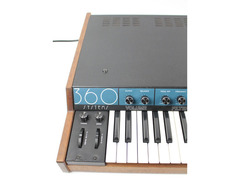
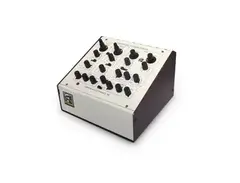
The 360 is an unremarkable looking machine, having a simple wooden case and a row of rather unimpressive controls. Appearances can be deceptive, however, and the inside reveals a veritable sea of chips.
When we looked at the original - prototype - 360 last year, the circuitry ran rather hot, and a cooling fan has now been fitted to alleviate this situation. A lot of the internal space is taken up by voice cards, and the most impressive of these contains the piano samples, amounting to about 50 EPROMs in all. The reason for using so many memory chips is that each voice is built up from several samples, so that no note is transposed by more than a tone either way from its original pitch.
Output of the 360 is in stereo and, where appropriate for a particular instrument, the sampled sounds are split where the original instrument has a natural range less than the keyboard span. A good example of this is the saxophone setting which has baritone, alto and tenor samples to cover a four-octave range.
The bass guitar sound uses a similar trick, whereby pulled notes are available to the right of the keyboard and slapped notes are to the left, and in the hands of a sympathetic player, the 360 can make an excellent impersonation of a funk bassist.
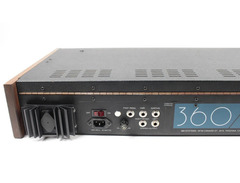
On the rear panel there is provision to connect a sustain pedal, a foot pedal for control of dynamics or brightness, and of course the stereo output.
The 360 weighs 43 lbs and measures 5¼" x 32" x 22".
Controls:
The row of instrument selectors allows any voice to be placed instantly under keyboard control, and the split point may be set wherever the user wishes for dual voice operation, a Swap button changing the voices to opposite sides of the keyboard when needed. In addition, a stack switch lets you play two voices together for a fatter sound - though this limits the system to four-note polyphony - and the transpose facility lets you set any interval between sounds within the limits of the individual voice capacities. The two voices may be mixed by means of the balance control, while a filter circuit permits independent tonal modifications to be made to each voice. Lastly, notes may be set to last their full duration once keyed, or to end as soon as the key is released.
Sounds:
360 Systems' internal layout
The only real limitations imposed by the 360 are its four-octave keyboard and lack of touch-sensitivity. As with any synth that attempts to replicate a traditional instrumental sound, the 360 must be played in something approximating the manner of the instrument being imitated in order to be convincing.
All the samples are beautifully recorded, and some of them last up to eight seconds so that the full natural decay of the original instrument can be reproduced. The acoustic guitar sample is particularly impressive, and once you've heard the string sound produced by the 360, conventional synths or string machines become more than a little artificial. The sound requiring the most memory is the grand piano, and as a result of this the piano voice card costs around £700. Mind you, it is superb.
"Once you've heard the string sound produced by the 360, conventional synths or string machines become more than a little artificial."
All the voicings are good (some are exceptional) and unlike our August '83 reviewer, I could detect no quantisation noise or other nasties in the final output, which was monitored at quite a high level via a pair of Tannoy studio monitors.
There is of course some compromise caused by the 360's lack of touch-sensitivity but, in any event, this probably wouldn't sound right even if it was fitted since the timbre of a conventional instrument changes with playing intensity, and this effect would be difficult to duplicate authentically by purely electronic means. Another point worth considering is that when a musician records a touch-sensitive instrument, there's more often than not some wretched engineer compressing it flat again just to keep the VU meters happy.
Although the review model's MIDI sockets were unsupported internally, it appears that all new production instruments have their MIDI sockets fully functional, with all the usual features. As already mentioned, the keyboard is not velocity sensitive but the voices will apparently receive the relevant MIDI data from a controlling velocity-sensitive MIDI synth, thereby eliminating one of its weaknesses.
Product specs
| Built-in Speakers | yes |
Videos

Syntaur
The Rare 360 Systems Digital Keyboard (Overview & Demo)
The Rare 360 Systems Digital Keyboard (Overview & Demo)
Syntaur

360 SYSTEMS Digital Keyboard - Rare and Historic Synthesizer Demo

Joshua Rouah

360 Systems Digital Keyboard Demo

Joseph McGinty
Reviews
Based on 0 Reviews and 0 Ratings
Artist usage
Add artist
Genre Usage
Based on how artists on Equipboard use this gear, it is most commonly found in the following genres.
Used With
Based on how musicians on Equipboard use 360 Systems Digital Keyboard, it is most commonly used with the following gear.


More 360 Systems Digital Pianos

$2,133.00 - $3,299.00
in Digital Pianos Rank

-m.webp?v=1784646098)
$299.00 - $499.99
in Digital Pianos Rank


$1,959.00 - $2,899.99
in Digital Pianos Rank

.jpg?v=1784600221)


$1,745.46 - $2,699.95
in Digital Pianos Rank

$1,499.00 - $2,699.00
in Digital Pianos Rank


.jpg?v=1784640202)

$2,500.00
in Digital Pianos Rank

.jpg?v=1784640200)


$1,589.99 - $2,499.99
in Digital Pianos Rank


$3,811.00 - $5,999.00
in Digital Pianos Rank


$371.99 - $429.99
in Digital Pianos Rank


$719.99 - $1,700.00
in Digital Pianos Rank


$449.00 - $874.99
in Digital Pianos Rank


$2,923.73 - $5,499.00
in Digital Pianos Rank


$799.99 - $899.99
in Digital Pianos Rank

$350.00
in Digital Pianos Rank


$999.95
in Digital Pianos Rank


$599.00 - $699.00
in Digital Pianos Rank


$799.95 - $1,099.99
in Digital Pianos Rank


-m.webp?v=1784645994)
$1,430.17
in Digital Pianos Rank


$300.00 - $874.99
in Digital Pianos Rank


$1,027.47 - $1,499.99
in Digital Pianos Rank


$399.99 - $2,099.99
in Digital Pianos Rank


$241.00 - $419.99
in Digital Pianos Rank


$2,281.00 - $3,999.00
in Digital Pianos Rank


$900.00
in Digital Pianos Rank


$649.00 - $649.99
in Digital Pianos Rank

.jpg?v=1783329859)

$2,119.15 - $3,199.99
in Digital Pianos Rank


$2,253.08
in Digital Pianos Rank


$500.00
in Digital Pianos Rank


$14.89 - $818.00
in Digital Pianos Rank

$583.00 - $699.99
in Digital Pianos Rank


$439.00 - $549.99
in Digital Pianos Rank

$1,090.00 - $1,799.99
in Digital Pianos Rank


$3,122.00 - $5,499.00
in Digital Pianos Rank


$2,369.00 - $4,299.00
in Digital Pianos Rank


$20.95
in Digital Pianos Rank
$749.00 - $839.00
in Digital Pianos Rank

$379.00 - $449.99
in Digital Pianos Rank

$2,379.63
in Digital Pianos Rank


.jpeg?v=1784574736)

$1,599.99 - $1,998.75
in Digital Pianos Rank

$329.99 - $389.00
in Digital Pianos Rank

Community setups


Similar


Gear Guides







Most Popular Digital Pianos
Most Popular Brands
-
Added to Equipboard on by
 hashimoto
GearIQ 14876
-


