
Pricing and availability




* Product prices and availability are updated by Equipboard every 24hrs and are subject to change. Equipboard may receive compensation for purchases made at participating retailers linked on this site. This compensation does not affect what products or prices are displayed, or the order of prices listed. For more information, please refer to our affiliate disclosure.


Reviews
5.0 out of 5
Based on 1 Review and 1 Rating

462
Hitmakers Reference Studio Monitors: Paul Carmody Design
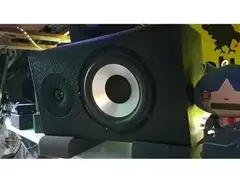
These are my main studio reference monitors. I built them myself from a design by a master audiophile speaker designer. He designed these specifically to be used as reference studio monitors. Two way passive, ported cabinets using Dayton DA175 Woofers and Vifa BC25TG15 Tweeters. I power mine with a Samson Servo 200 Reference Amplifier. They are incredible and kick the crap out of anything that could be bought in a store. I will let the designer explain the technical details, direct from his website, complete with cabinet blueprints, and crossover schematics. You can make your own pair for under $300 in materials - https://sites.google.com/site/undefinition/hitmakers :
Cabinet Design
This is a simple 2-way bookshelf speaker, with an internal volume of approximately .5 cu ft. The vent is mounted on the back panel. It is 2" diameter by 6" long (the kit version uses this port, but ordinary PVC would work just as well). This tunes the box to 48 Hz, and gives an F3 around 42 Hz, with a bit of bass boost near 75 Hz. The interior of the cabinet is lined with convoluted (eggcrate) foam. I used ordinary mattress topper, cut it into pieces with scissors, and hot glued it in place on the sides, top, and back of the enclosure. Don't worry about lining the back of the baffle; and don't bother lining the bottom of the cabinet, since that's where the crossover will most likely sit. And if you can't get a hold of foam, you can get approximately the same effect with a light fill of polyfil. To clarify: the only purpose of the lining/stuffing in this vented speaker is to absorb any high-frequency stuff bouncing around inside the cabinet; it's not going to have any effect on the bass (unless you overdo it, in which case, the bass will start sounding choked or thin).
Crossover Design
Since these are relatively simple drivers to work with, I tried to keep the crossover as simple and straightforward as possible. The woofer is 2nd order electrical with capacitor C2 acting as a notch filter to remove the breakup from the aluminum cone of the woofer. The tweeter filter is a simple 2nd order electrical filter with an L-Pad. The crossover point occurs around 2000 Hz. The impedance load of this speaker would probably be labeled "8 Ohms nominal" if it were a commercial speaker. Any pro audio amp would have no problem driving these things all day.
Listening Impressions
These drivers are performing way out of their price class. When handled gracefully in a crossover, they provide a full, balanced, effortless sound. The Hitmakers have just enough detail without becoming fatiguing. Imaging is precise for such a speaker and the soundstage allows for natural placement of sounds. The bass is deeper than what you get from most nearfield studio monitors, which might come in handy for some musicians and producers. (Although if you need true "sub-bass"--that is, the 30 Hz and below stuff--you'll need an active subwoofer. This should come as no surprise.)
Let me close by saying this: I'm really glad to bring this project to the world, and for me it sort of brings things full-circle. See, in my pre-DIY days, I would use some really hacked-up speaker setups work work on and mix with. Seriously, it was shameful, and no one should ever know. So when I finally saved up and bought a good pair of nearfield studio monitors, it was a real turning point for me. I could finally hear the actual tonal balance of what I was trying to do and mix it accordingly. But I spent big bucks on those [brand name omitted]! And if there had only been a DIY option, I would have gladly jumped at it--and not just for the sake of cost savings. It was the principle of the thing. As with most home studio recorders, my whole "studio" consisted of cobbled-together gear of various quality and origin. But at the end of the day, it wasn't about the gear--it was about what it would let me do... which was to create a professional-sounding recording without having access to multi-million dollar studios. It was the ability to hear something done by a professional and be able to go home and make something that sounded just as good, then play it back, listen, and think to myself, "I did that."
This project is free to the public and you can make these yourself. If you aren't handy with woodworking, there are kits available online if you search around a bit. I coated mine with Duratex Speaker Coating, which is basically bulletproof and also available online.
Genre Usage
Based on how artists on Equipboard use this gear, it is most commonly found in the following genres.
More Active & Passive Monitors
-m.webp?v=1785250703)
$299.99
in Active & Passive Monitors Rank


$243.50 - $398.99
in Active & Passive Monitors Rank


$539.99 - $2,588.00
in Active & Passive Monitors Rank


$199.99
in Active & Passive Monitors Rank


$142.25 - $199.99
in Active & Passive Monitors Rank


-m.webp?v=1785250679)
$202.81 - $594.98
in Active & Passive Monitors Rank
.jpg?v=1785175371)

-m.webp?v=1785247302)
$769.00 - $1,699.99
in Active & Passive Monitors Rank


$259.00 - $545.00
in Active & Passive Monitors Rank


$299.99
in Active & Passive Monitors Rank


$275.00 - $398.99
in Active & Passive Monitors Rank


$640.00 - $1,898.00
in Active & Passive Monitors Rank


$1,781.49 - $4,998.00
in Active & Passive Monitors Rank


$200.00
in Active & Passive Monitors Rank


$229.00 - $349.99
in Active & Passive Monitors Rank


$159.99
in Active & Passive Monitors Rank


$276.00 - $599.99
in Active & Passive Monitors Rank


.jpg?v=1784763257)

$555.00 - $1,260.32
in Active & Passive Monitors Rank


$629.00 - $949.00
in Active & Passive Monitors Rank

$1,200.00
in Active & Passive Monitors Rank


$196.00 - $349.99
in Active & Passive Monitors Rank


$109.99 - $209.00
in Active & Passive Monitors Rank


$179.00 - $485.40
in Active & Passive Monitors Rank


$142.00 - $191.78
in Active & Passive Monitors Rank


$162.00 - $385.00
in Active & Passive Monitors Rank


in Active & Passive Monitors Rank


$199.00 - $399.00
in Active & Passive Monitors Rank


$849.99 - $1,699.98
in Active & Passive Monitors Rank


$119.00 - $359.00
in Active & Passive Monitors Rank


$156.50 - $832.97
in Active & Passive Monitors Rank


$115.00 - $579.99
in Active & Passive Monitors Rank


-m.webp?v=1785251200)
$519.00 - $1,538.00
in Active & Passive Monitors Rank


$197.27 - $917.97
in Active & Passive Monitors Rank


$299.00
in Active & Passive Monitors Rank


$196.00 - $594.98
in Active & Passive Monitors Rank


$1,290.00 - $1,579.00
in Active & Passive Monitors Rank


$274.99 - $487.99
in Active & Passive Monitors Rank


$130.00 - $325.00
in Active & Passive Monitors Rank


$1,781.49 - $4,998.00
in Active & Passive Monitors Rank


-m.webp?v=1785250726)
$10,995.00 - $11,693.47
in Active & Passive Monitors Rank


Artist usage


Community setups


Similar


Gear Guides





Most Popular Active & Passive Monitors
Most Popular Brands
-
Added to Equipboard on by
spakerGearIQ 462
-


