

Pricing and availability
We compare 600+ stores and found this item at 2 stores. Prices updated .
Store
Reviews
Price




Average Price: $2,259
High-end/Boutique
$500
$1501+
Price Tier
Budget
Standard
High-end
Price History
Based on price data from 1 merchant for "Mayer EMI Vibes MD850". Prices shown reflect NEW condition. Tracking began May 20, 2026.
* Product prices and availability are updated by Equipboard every 24hrs and are subject to change. Equipboard may receive compensation for purchases made at participating retailers linked on this site. This compensation does not affect what products or prices are displayed, or the order of prices listed. For more information, please refer to our affiliate disclosure.
Description
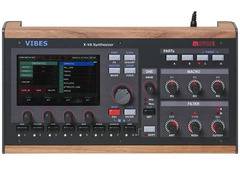
Mayer EMI MD850 Vibes
The MD850 Vibes is a 4-part multitimbral Performance Synthesizer built by Austrian boutique manufacturer Mayer EMI. Designed by Horst Mayer, it combines four independent synth parts with a dedicated drum section, giving producers and performers an all-in-one sound source for layered patches, split keyboards, and full multitimbral arrangements without needing a computer in the signal chain. The synthesis engine handles wavetables, SFZ-based multisamples, and classic subtractive VA workflows, with a deep modulation matrix and per-part effects. The "Aurora" firmware (released at Superbooth 2026) added new oscillator content, sound design tools, and workflow improvements. Built for studio and stage, the MD850 sits in the same conceptual space as the ASM Hydrasynth or Waldorf Iridium, but with a multitimbral architecture that lets it cover full arrangements on its own.
Specs
- 4-part multitimbral synthesizer with dedicated Drums part
- Hybrid synthesis: wavetables, SFZ multisamples, and subtractive structures
- Per-part effects, modulation matrix, and arpeggiator
- High-resolution color display with hands-on controls
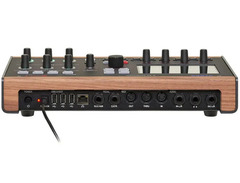
- MIDI In/Out/Thru, USB-MIDI, stereo and individual outputs
- Stereo audio input for processing external sources through the engine
- Free firmware updates including the "Aurora" release with expanded sound design tools
- Built in Austria, designed for studio production and live performance
Product specs
| Analog/Digital | digital |
Videos

Jonathan Knightsnare
First Impressions: Mayer MD850 Vibes – Is It Worth the Price?
First Impressions: Mayer MD850 Vibes – Is It Worth the Price?
Jonathan Knightsnare
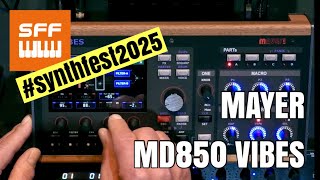
Mayer MD850 Vibes | SynthFest 2025

SynthFest France
Reviews
Critic Reviews
5.0 out of 5
Based on 1 Review and 1 Rating

186
The most underrated synth nobody is talking about yet
Full disclosure. I built over 200 of the factory presets for the Aurora update, so I've lived inside the engine of this synth for six months. Not a neutral take. But I'm not going to oversell it either, and I'll point at the rough edges where they exist.
First, the thing everyone gets wrong. They see the clip launcher and file it as a groovebox, or an MPC. No. The Mayer EMI MD850 is a deep wavetable synth, and it runs that engine four times over. Play it for five minutes and the groovebox idea just dies.
Think Serum 1, in hardware, four parts at once. Each part gives you the XVA engine: wavetable, virtual analog, a resonator model, SFZ. It reads Serum wavetables straight off the drive. And the SFZ side means you can drop a full multisampled instruments into a part and play it like any other oscillator.
Here's the bit that actually got me. It works backwards too. I pulled my old E-MU Proteus sample sets in as SFZ (ConvertWithMoss, free), and ran them through the MD850's filters, waveshaper, envelopes, FX. A thirty year old Rompler patch, suddenly a real synth voice. Resonant filter, proper envelopes, an FX chain, the lot. Not a frozen sample anymore. As a sound designer that's the whole game for me. One box covers wavetable leads, analog basses, sampled textures, resonant percussion, and I never have to leave it. The Prophet X showed people a sample can live inside a synth voice. This goes further. Open SFZ instead of a locked format, four parts instead of two, wavetable at the center instead of bolted on.
The clip launcher ties the four parts together. But it's the front end, not the identity. The identity is the engine underneath. That's why I keep saying four part Synthesizer or SynthStation, not groovebox.
For deeper editing there's VibesConnect. Runs in the browser, nothing to install. Clip launcher, wavetable, preset, performance drag and drop, full automation, and on an iPad you can ride all 19 mixer channels by hand. There's a 14 part drum machine sitting in the same box on top of the four synth parts.
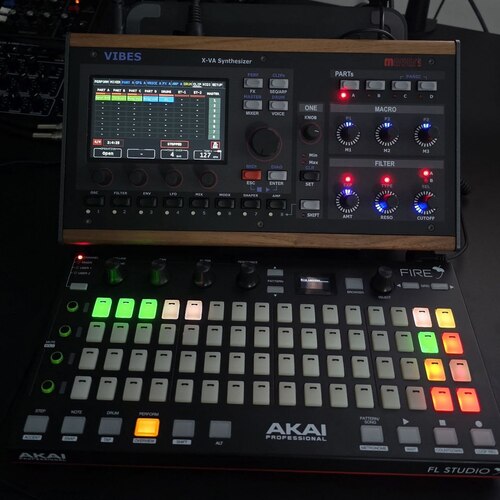
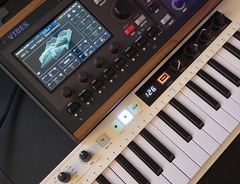
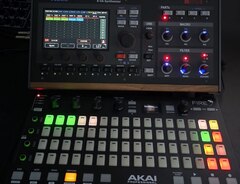
Takes outside controllers too. I run an Akai Fire with full integration (which Mayer programmed into it), and it talks to the Novation Launch Control XL MK3 when I want more knobs under my hands.
Now the honest part. The 2024 release firmware was rough. Genuinely. If you tried one early and walked away, fair enough, I'd have done the same. But this is three people in Austria, not a hundred engineers, and every update has actually closed gaps instead of adding bullet points. Aurora pushes it again. The thing keeps getting better, which I can't say for most gear I own.
Reference points: Hydrasynth, Waldorf Iridium, 3rd Wave, Prophet X. Definitely NOT AN MPC. The four parts, the drum machine, the launcher, the sampling, all of it sits in its own corner. 1,899 euro isn't impulse money. But 24 stereo voices, 14GB of storage, the full XVA engine four times over, it earns it.
What a spec sheet won't tell you is how it feels once you stop reading and start playing. The voices have body. The wavetables move in a way that keeps your hands on the knobs. Vintage Mode for Each Part. Stack four parts and it gets huge without going to mush. To my ear it sits warmer than the Iridium, but that's me playing an Iridium at Superbooth, not a proper side by side, so take it as taste.
Six months in I still sit down to check one preset and look up an hour later with half a track done. If you love wavetable synthesis, the opportunity to tune your old libraries, or you came off Serum wanting that depth in something physical, this one pays you back.
Preferred Settings + Usage:
One of my own, called "Accurate Moogy." Two wavetable oscillators loaded with Moog style saws, plus the SFZ oscillator slot with a single cycle saw loaded into it, detuned slightly, as a third voice, all running through the moog style Mayer filter. Three full oscillators feeding one voice, which the per part architecture lets you set up freely. The result is a fat, slightly drifting Moog character that sits perfectly in a mix.
Genre Usage
Based on how artists on Equipboard use this gear, it is most commonly found in the following genres.
Used With
Based on how musicians on Equipboard use Mayer EMI Vibes MD850, it is most commonly used with the following gear.


Community setups
Show yours
Similar
Add recommendation5 alternative and related items for Mayer EMI Vibes MD850, curated by the Equipboard community.

$2,500.00 - $3,499.99
Both the Mayer EMI MD850 and the Sequential Prophet X are built on the idea that a sampled instrument can live inside a full synth voice, running multisamples through real filters, envelopes and effects rather than just playing them back. Where the Prophet X pairs samples with two oscillators, the MD850 takes the concept further with its XVA engine across four parts, open SFZ multisample support, and wavetable synthesis at the center. Both reward sound designers who want acoustic and sampled textures shaped like proper synth patches, not frozen ROM playback.

$1,749.00 - $3,799.00
The MD850 and the Groove Synthesis 3rd Wave share the same core DNA. Both are wavetable synths at heart, both run four parts of multitimbrality, and both land at 24 voices, so each is essentially four independent synths in one box. Both also read Serum format wavetables, so your existing library moves over either way. The big difference is the filter philosophy. The 3rd Wave pairs its digital wavetables with real analog low pass filters for that warm PPG style character, while the MD850 stays fully digital but answers with a deeper oscillator menu per part (wavetable, VA, resonator and SFZ multisample) plus the clip launcher and drum machine on top

$1,899.00 - $1,999.00

$1,806.67 - $3,999.00
The Iridium is the closest spiritual neighbor to the MD850, since both are fully digital synths built around a multi engine oscillator concept where a single oscillator can be a wavetable, a virtual analog waveform, a resonator or a sampling source. The Iridium gives each of its three oscillators five engines (Wavetable, Waveform, Particle, Resonator and Kernel), and the MD850 covers the same ground with its wavetable, VA, resonator and SFZ oscillators. The split is in architecture: the Iridium is dual timbral across 16 voices, while the MD850 runs four full parts at 24 voices and wraps them in a clip launcher and a 14 part drum machine, so it leans harder into being a complete production instrument. In fairness, the Iridium is the deeper pure synth per voice, with three filters, a 40 slot mod matrix and Kernel FM synthesis the MD850 does not match. So the MD850's case is not more synth than Iridium, it is comparable digital engine power spread four parts deep and built as a full SynthStation with sequencing, mixing and drums on board.

$1,599.00 - $1,999.00
The Iridium Core is the compact, lower cost member of the Waldorf family, and it sits even closer to the MD850 on price while staying true to the same engine. Both are fully digital synths with three (Core) or four (MD850) oscillator slots that can each become a wavetable, virtual analog, resonator or sampling source, so the core sound design concept is nearly identical. The difference is scale and scope: the Core is 12 voices and bi timbral with two parts via split or layer, while the MD850 runs 24 voices across four full parts and adds a clip launcher and a 14 part drum machine on top. To be fair, the Core still carries Waldorf's deeper per voice synthesis, including Kernel FM and the dual digital filter with all its filter models, which the MD850 does not match. So against the Core the MD850's pitch is the same as against the full Iridium, comparable digital engine spread wider across four parts and built as a complete SynthStation, where the Core stays a focused two part sound design synth.
More Synthesizers


$3,266.16 - $3,499.99
in Synthesizers Rank


$469.00 - $699.99
in Synthesizers Rank


$20,218.87
in Synthesizers Rank


$439.00 - $545.00
in Synthesizers Rank
.jpeg?v=1784985816)
.jpg?v=1784893209)

$3,333.00 - $3,499.99
in Synthesizers Rank


$999.00 - $1,084.00
in Synthesizers Rank


-m.webp?v=1784905194)
$1,100.00
in Synthesizers Rank

-m.webp?v=1785020298)
$379.00 - $499.99
in Synthesizers Rank


$700.00 - $2,398.00
in Synthesizers Rank


$2,000.00
in Synthesizers Rank


$411.00 - $699.99
in Synthesizers Rank


$277.00 - $349.00
in Synthesizers Rank


$2,199.00 - $2,941.08
in Synthesizers Rank


$1,480.57 - $1,899.00
in Synthesizers Rank


$297.67 - $652.00
in Synthesizers Rank


$1,353.97 - $1,839.99
in Synthesizers Rank


$379.00 - $549.99
in Synthesizers Rank


$490.81 - $899.99
in Synthesizers Rank


$279.00 - $449.99
in Synthesizers Rank


$229.19 - $749.99
in Synthesizers Rank


$278.16 - $1,763.18
in Synthesizers Rank


$79.99 - $495.44
in Synthesizers Rank


$325.00 - $1,332.49
in Synthesizers Rank

.jpeg?v=1785025534)
-m.webp?v=1784992204)
$1,790.00 - $1,899.00
in Synthesizers Rank


$480.92 - $699.00
in Synthesizers Rank


$499.99 - $719.99
in Synthesizers Rank


$303.89 - $915.00
in Synthesizers Rank


$3,999.00 - $4,999.00
in Synthesizers Rank


$1,469.00 - $2,159.99
in Synthesizers Rank

$290.00
in Synthesizers Rank


$479.99 - $1,099.00
in Synthesizers Rank


$166.00 - $274.95
in Synthesizers Rank


$350.00
in Synthesizers Rank


$382.00 - $449.99
in Synthesizers Rank


-m.webp?v=1785025532)
$962.85
in Synthesizers Rank


$6,600.00 - $10,444.00
in Synthesizers Rank


$29.95 - $69.99
in Synthesizers Rank


$740.00
in Synthesizers Rank


$333.80
in Synthesizers Rank


Artist usage


Gear Guides






.webp)

Most Popular Synthesizers
Most Popular Brands
-
Added to Equipboard on by
 hashimoto
GearIQ 14956
-