
Pricing and availability
We compare 600+ stores and found this item at 4 stores. Prices updated .
Store
Reviews
Price



Price History
Based on price data from 3 merchants for "McDSP FilterBank EQ Plugin". Prices shown reflect NEW condition. Tracking began Apr 2, 2026.
* Product prices and availability are updated by Equipboard every 24hrs and are subject to change. Equipboard may receive compensation for purchases made at participating retailers linked on this site. This compensation does not affect what products or prices are displayed, or the order of prices listed. For more information, please refer to our affiliate disclosure.
Description
The McDSP FilterBank EQ Plugin is a staple for both aspiring and professional sound engineers looking to shape their audio with precision and creativity. Renowned for its unique filter types, this plugin offers a classic analog vibe with the flexibility of modern digital controls. Whether you're smoothing out vocals, tightening up bass lines, or adding warmth to your mix, the FilterBank EQ delivers unparalleled sound quality and versatility.
This plugin goes beyond typical EQ functionalities by incorporating a variety of filters including high-pass, low-pass, and parametric EQs, each with adjustable gain and frequency bands. Its intuitive interface allows for seamless adjustments, making it an excellent tool for both live performances and studio recordings. The FilterBank EQ is compatible with all major DAWs, ensuring that it fits effortlessly into your workflow.
A standout feature is its emulation of vintage hardware EQs, which brings a nostalgic touch to any project. With the McDSP FilterBank EQ Plugin, you gain access to a comprehensive suite of tools that can transform your sound from ordinary to extraordinary, making it an essential addition to any music producer's toolkit.
Key Features:
- Unique filter types for versatile audio shaping
- Emulation of vintage hardware EQs
- Compatible with all major DAWs
- High-pass, low-pass, and parametric EQs with adjustable gain and frequency
- Intuitive interface for easy adjustments
- Designed for both live and studio use
Product specs
| Software Type | FilterBank |
| Platform | Mac, PC |
| Upgrade/Full | Full |
| Download/Boxed | Download |
| Bit Depth | 32-bit, 64-bit |
| Format | AAX Native, VST3, AU |
| Authorization Type | iLok 2/3 or iLok Cloud (continuous internet connection) |
| Hardware Requirements - Mac | Intel Core 2 Duo or higher, 4GB RAM minimum |
| Hardware Requirements - PC | Intel Core 2 Duo / AMD Athlon 64 X2 or higher, 4GB RAM minimum |
| OS Requirements - Mac | macOS 10.13 or later |
| OS Requirements - PC | Windows 10 or later |
FAQs
-
What makes the McDSP FilterBank EQ Plugin unique compared to other EQ plugins?
-
The McDSP FilterBank EQ Plugin is renowned for its flexibility and precision, offering a wide range of EQ types and filters that emulate vintage analog gear while providing modern digital control. Its customizable filter configurations and analog-style saturation make it a versatile tool for both subtle and drastic tonal shaping.
-
Is the McDSP FilterBank EQ Plugin compatible with my DAW?
-
The McDSP FilterBank EQ Plugin is compatible with major DAWs that support AAX Native, VST3, or AU formats, including Pro Tools, Logic Pro, and Ableton Live. Ensure your DAW supports these formats for seamless integration.
-
What are the system requirements for running the McDSP FilterBank EQ Plugin on a Mac?
-
To run the McDSP FilterBank EQ Plugin on a Mac, you need macOS 10.13 or later, an Intel Core 2 Duo processor or higher, and a minimum of 4GB RAM. The plugin requires iLok 2/3 or iLok Cloud for authorization.
-
Does the McDSP FilterBank EQ Plugin require an internet connection?
-
The McDSP FilterBank EQ Plugin requires an internet connection if you are using iLok Cloud for authorization. If using a physical iLok dongle, an internet connection is not necessary after initial setup.
-
Can the McDSP FilterBank EQ Plugin be used on both 32-bit and 64-bit systems?
-
Yes, the McDSP FilterBank EQ Plugin supports both 32-bit and 64-bit systems, providing flexibility for use in various digital audio workstation environments.
Videos

McDSPTV
The Sound of Every Legendary EQ in One Plug-In
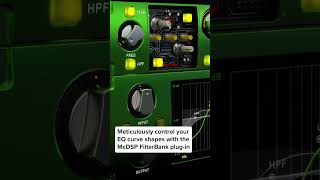
The Sound of Every Legendary EQ in One Plug-In
McDSPTV
Reviews
Owner Insights
We analyzed real musician discussions from forums and Reddit to find what players love, question, and tweak about McDSP FilterBank EQ Plugin.
Features and functionality
-
The McDSP FilterBank EQ plugin is often praised for its smooth and musical sound, making it a favorite among engineers like Bob Power.
Source
Value and pricing
-
The McDSP FilterBank, which includes three plugins, was available for $99, offering a cost-effective option for those seeking professional-grade EQ capabilities.
Source
User experience
-
Some users express that the McDSP EQ feels "silky smooth" and is characterized as "musical," suggesting an appealing tonal quality that distinguishes it from stock EQs.
Source -
It’s noted that achieving a specific tonal character in mixes guides users to choose between different EQs, with McDSP FilterBank offering a distinct option for sweetening high frequencies.
Source
Comparisons
-
It's noted that while stock EQs perform basic functions, plugins like McDSP FilterBank offer a different texture and finer controls, appealing to those seeking advanced EQ options.
Source -
McDSP FilterBank is preferred by some for a "sweeter top end" compared to SSL types or Fabfilter, making it suitable for adding air to a mix.
Source
4.0 out of 5
Based on 1 Review and 3 Ratings

41034
I fuckin' love fitlerbank.
This is just one of those plugins where the filters are so neutral but can be shaped so effectively. When I really wanna shape the bump at the cutoff of a highpass, low pass or shelving filter? this is it... gets you beyond analog filter imperfections into creativity at those cutoff points. This is a classic, utilitarian plugin that never goes outta style.
Artist usage
Add artist

The McDSP FilterBank EQ is one of Kaskade's preferred EQ plugins. He uses it to sculpt the sound of his favorite software synths, such as the Nexus.


The E6 was used for the backing vocals on "Makes Me Wonder", as stated by mix engineer Mark Endert in this September 2007 Sound on Sound interview.
Backing vocals: SSL channel compressors, McDSP Filterbank
“I compressed the backing vocals with the SSL channel compressors, also set to a 5:1 ratio. When I tried to blend the backing vocals into the chorus, they immediately sounded too slick and too good and too adult. This often happens when the harmonies are lower than the lead vocal; they tend to weigh the track down. In trying to keep the track fresh and young, I combined all the background vocals into two outs from the master output of Pro Tools, and then I put one plug–in EQ on that. I sucked out all the frequencies that made it full, using the McDSP E6 Filterbank, cutting radically at 79.1Hz and 211.2Hz. This made the backing vocals sound transitory and thin, and when I blended them back into the track it sounded much better. In this way the backing vocals could cut through the track, and not weigh it down."


The F2 was used for Winehouse's lead vocals on "Rehab", as stated by mix engineer Tom Elmhirst in this August 2007 Sound on Sound interview.
Lead vocals
- Urei 1176 blackface compressor, Pultec EQ, Fairchild compressor/limiter, McDSP F2 Filterbank, Waves Q10 Paragraphic EQ, Waves De-esser, Great British Spring reverb, EMT plate reverb.
"I am not a techno snob, I'll use whatever I can to make a great record. Simple as that. I do try to keep compression and EQ analogue, unless it's EQ to notch out specific frequencies, in which case plug-ins are more precise and effective. Amy is a very dynamic singer. She has a lot of bite in her voice, but I wanted it to sound warm and not take your head off. I often use the Renaissance Q10 EQ for radical reductive EQ'ing, and you can see this in the settings I used on Amy's voice. I'm cutting four frequencies by 18dB; in two cases, 465 and 917, with a Q of 100! That's a really heavy notch. At 3107Hz the Q is only 13.7, so that's quite wide. Taking off 18dB here is enormous, but that's what it was.
"There were specific frequencies in Amy's lead voice [the track labelled 'AmC'], that were bugging me. It may be due to hundreds of things, perhaps to do with the microphone that was used on the day. Don't get me wrong, it was not a bad vocal sound, but she does have some hard frequencies in her voice. There are a few tracks on the album that I did not mix [instead they were mixed by Gary 'G Major' Noble], and you can hear on them what she sounds like without the EQ I applied. I also use McDSP's Filterbank F2, probably shelving around 40Hz, and the Waves De-esser cuts around 5506Hz. Amy is not hugely sibilant. The threshold here is 22, which is not that high for me. There would probably be no more than 3dB of de-essing.
"In addition, I was also filtering with a Pultec outboard EQ and on the board as well. The outboard chain on Amy's vocal was Pultec, going into a Urei 1176 blackface compressor, going into a Fairchild compressor. On the Pultec I was probably adding around 12k, just to brighten it up a little bit, adding air. The Urei will have been set with a very fast attack and a super-fast release, doing perhaps 10dB of compression, while the Fairchild will have had a very slow release. I can't quite explain what this does, but in my head the Urei will catch anything that jumps out, while the Fairchild will pick up the slack and keep a more constant hold of the vocal -- ie. smooth things out. During the mix I'll be constantly playing with these two compressors; it's not something I set up and then leave. How hard the signal coming from the Urei hits the Fairchild affects the sound a lot.
"The vocals had a spring reverb which would have been tracked when they recorded Amy, at Chung King Studios in New York. I also recorded an EMT plate on the vocals at Metropolis. You can see both at the bottom of the Edit screen. I spent a lot of time on the vocal, and I would regularly come back to it. Late in the evening of the first day of mixing 'Rehab' I would have the vocal pretty much in the track all the time, and after that I'd constantly be tweaking it a little bit. I don't just do it and leave it. You're getting constantly closer to the final mix, but it's not immediate."


The E2 was used on Rihanna's backing vocals for "SOS", as stated by mix engineer Phil Tan in this February 2007 Sound on Sound interview. An image of the settings can be found here.
Backing vocals: McDSP Filterbank E2
"I compressed the background vocals using the Waves Renaissance Compressor, and sometimes you lose a little bit of top end in the process. This filter [right] was just a shelf to bring it back a little bit and give it some sheen. Because this is a high-energy track, you want the vocals to match that energy. Basically I boost 3.5dB from 5k upwards. I have loads of different EQs, and this one is a two-band that's very easy to operate. It worked, so I stayed with it. I may choose other EQs because of different capacities but also because they'll sound different. Some are fairly clean and some impose a bit more personality."

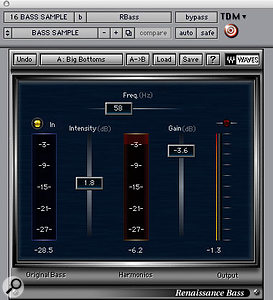
The E6 and F2 were used for the vocals on "Save Room", as stated by mix engineer Tony Maserati in this March 2007 Sound on Sound interview. Images of the E6 settings can be found here and here, while an image of the F2 settings can be found here.
Vocals: McDSP Filter Bank E6, Waves Renaissance Compressor, Renaissance EQ, L1 Ultramaximiser
"The song has two lead vocal comps, on tracks 48 and 49. You can see that I'm using a lot of plug-ins on those: I'm doing a lot of drastic stuff. They were probably recorded on two different occasions with two different engineers who didn't take the time to match the performances by using the same microphone and signal chains. I get really pissed at this lack of effort on the part of recordists — there are standards in engineering. John Legend is a phenomenal vocalist and before he comes into your room to record, you should reach out to other engineers who have recorded with him to find out what they used — especially, of course, the guy who recorded the song that you're going to be overdubbing onto! That's what I did, the first time I recorded John.
"We liked the lead vocal, it had an energy that we did not want to give up, but it's not recorded consistently. You can even see on the screen that the levels are all over the place. So I spent a lot of time and energy pushing and pulling all over the place to compensate for frequency anomalies and to make the two takes sound the same, as well as to force all the energy out of the vocals that is in there. On track 48 I have a Filter Bank EQ that's pushing a ton of bottom and taking off some top. The Renaissance Compressor is trying to make sense of that, levelling things out a bit with a really slow attack.
"I don't normally use the L1 Ultramaximiser on a lead voice, but it was probably already there, and I'm using it to get some intelligibility and energy from the vocal. The Renaissance is boosting above 9k and the McDSP is cutting around there as well. I think it's because I'm compensating for the L1, which is doing something I'm not entirely happy with. A lot of what I'm doing is simply compensating for a poor recording.
"Lastly I throw on the R4 Renaissance EQ, probably because after mixing for a couple of days, I felt that it needed a little bit more top, and I did not want to change my settings on the outboard, which was probably my GML 8200. I'm also EQ-ing on the board. So I'm being heavy-handed, also with the effects on track 49, in trying to match these two tracks. I was really fighting until we got something out of it, and I think we accomplished that. The end result sounds pretty good."
Album Usage
The McDSP FilterBank EQ Plugin has been featured on the following albums:

Genre Usage
Based on how artists on Equipboard use this gear, it is most commonly found in the following genres.
Used With
Based on how musicians on Equipboard use McDSP FilterBank EQ Plugin, it is most commonly used with the following gear.


-s.webp?v=1784631713)

More McDSP EQ Plugins


$169.00 - $199.00
in EQ Plugins Rank


$63.00 - $271.00
in EQ Plugins Rank


-m.webp?v=1784642550)
$34.99 - $39.99
in EQ Plugins Rank


$1,015.75 - $1,195.00
in EQ Plugins Rank


$34.99 - $49.99
in EQ Plugins Rank


$29.99 - $30.00
in EQ Plugins Rank


$49.00
in EQ Plugins Rank

$33.00 - $34.99
in EQ Plugins Rank


$33.00 - $34.99
in EQ Plugins Rank

.jpg?v=1784328016)


$80.00 - $99.00
in EQ Plugins Rank


$33.00 - $35.99
in EQ Plugins Rank


$34.99 - $85.00
in EQ Plugins Rank


$95.00 - $109.00
in EQ Plugins Rank


$33.00 - $34.99
in EQ Plugins Rank


$0.00
in EQ Plugins Rank


$33.00 - $35.99
in EQ Plugins Rank


$49.00 - $124.00
in EQ Plugins Rank

$33.00 - $34.99
in EQ Plugins Rank


$39.00
in EQ Plugins Rank


$39.00 - $49.00
in EQ Plugins Rank
.jpeg?v=1784574735)


$29.99 - $30.00
in EQ Plugins Rank


$179.00 - $199.00
in EQ Plugins Rank

$33.00 - $34.99
in EQ Plugins Rank


$95.00 - $129.00
in EQ Plugins Rank


$0.00
in EQ Plugins Rank
Accessories & Related Items


Community setups


Similar


Gear Guides





Most Popular EQ Plugins
Most Popular Brands
-
Added to Equipboard on by
 equipboard
GearIQ 4934
-