
Pricing and availability
We compare 600+ stores and found this item at 1 store. Prices updated .
Store
Reviews
Price




Average Price: $300
Budget/Beginner
$300
$801+
Price Tier
Budget
Standard
High-end
* Product prices and availability are updated by Equipboard every 24hrs and are subject to change. Equipboard may receive compensation for purchases made at participating retailers linked on this site. This compensation does not affect what products or prices are displayed, or the order of prices listed. For more information, please refer to our affiliate disclosure.
Description
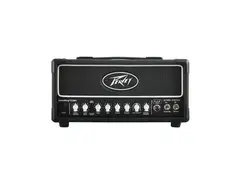
Discover the Peavey ValveKing 20 MH: a compact powerhouse designed for the guitarist who craves versatility without compromise. This all-tube guitar amplifier head offers switchable wattage for dynamic control over your sound, whether you're tearing it up on stage or crafting tones in the studio. With the EL84 power tubes at its heart, the ValveKing 20 MH delivers rich, full-bodied distortion that can only be achieved through true tube amplification. The innovative "Vari-Class" control seamlessly transitions between Class-A and Class-A/B operation, unlocking a spectrum of tones from sparkling cleans to aggressive growls. It's not just an amp; it's your new secret weapon for achieving the ultimate guitar tone.
Key Features:
- All-tube design with EL84 power tubes for authentic distortion and warmth
- Switchable wattage (20-watt, 5-watt, 1-watt) for versatile performance settings
- "Vari-Class" control for blending between Class-A and Class-A/B tones
- Dual channel configuration with three-band EQ and onboard reverb for detailed sound shaping
- Headphone jack for silent practice sessions
- Mic-simulated direct output for direct recording without a cab
Product specs
| Brand | Peavey |
| Model | ValveKing 20 MH 20W/5W/1W Tube Head |
| Finish | Black |
| Year | 2010s |
| Made In | China |
| Categories | Guitar Heads |
| Built-In Effects | Built-In Effects |
| Color Family | Black |
| Electronics | Tube |
| Impedance | 16 ohms, 8 ohms |
| Number of Channels | 2 Channels |
| Number of Inputs | 1 Input |
| Output Power (Watts) | 20 |
| Power Tube Type | EL84 |
| Reverb | Spring Reverb |
FAQs
-
What kind of power tubes does the Peavey ValveKing 20 MH use?
-
The Peavey ValveKing 20 MH uses EL84 power tubes, which are known for delivering a warm and harmonically rich tone suitable for a variety of music styles.
-
Can the Peavey ValveKing 20 MH be used for both practice and live performances?
-
Yes, the Peavey ValveKing 20 MH features switchable output power levels of 20W, 5W, and 1W, making it versatile for both quiet practice sessions and live performances.
-
Does the Peavey ValveKing 20 MH have built-in effects?
-
Yes, the Peavey ValveKing 20 MH includes built-in spring reverb, adding depth and ambiance to your sound without needing additional pedals.
-
Is the Peavey ValveKing 20 MH suitable for metal music?
-
The Peavey ValveKing 20 MH offers a broad range of tones with its two channels, making it capable of delivering both clean and high-gain sounds suitable for metal music.
-
What is the impedance of the Peavey ValveKing 20 MH?
-
The Peavey ValveKing 20 MH supports 16 ohms and 8 ohms impedance, allowing it to be compatible with various speaker cabinets.
Videos

Phillip McKnight
Review Peavey Valve King 20MH

Review Peavey Valve King 20MH
Phillip McKnight
Peavey ValveKing 20 MH im Test

guitarheaven.de
Peavey Classic 20MH vs Peavey Valveking 20MH vs Peavey 6505MH - Peavey Shootout!

The APW
Peavey ValveKing 20MH METAL | Phill Behean

Phill Behean Audio
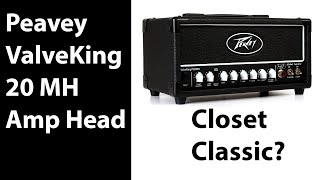
Peavey Valveking 20 MH - Closet Classic

budgetguitarist.com
Reviews
PROS
-
Impressive clean and distorted tones
-
Versatile wattage switch (20/5/1W) for different volume needs
-
Great pedal platform with excellent clean channel
-
Built-in attenuator for low-volume play without losing tone
-
Feature-rich: D.I. out, headphone and USB audio out, onboard reverb
-
Switchable FX loop enhances effects sound quality
-
Preamp tube swap significantly improves sound
-
Retro-modern look adds aesthetic appeal
-
Channels switchable with footpedal, adding performance versatility
-
Direct output offers high-quality recording options
CONS
-
Tolex covering prone to damage, requires careful handling
-
EQ shared between channels, limiting tone shaping flexibility
-
Volume balance issues between clean and lead channels
-
Onboard boost feature less effective, especially on clean channel
-
Onboard reverb quality is average, lacks control options
-
Footswitches for additional control can be difficult to find/expensive
Owner Insights
We analyzed real musician discussions from forums and Reddit to find what players love, question, and tweak about Peavey ValveKing 20 MH.
Features and functionality
-
The clean channel is reported to sound more musical on the full Class A setting, while the dirty channel shines on Class A/B.
Source -
Switching to the 5w setting can enhance fullness in tone even at similar volume levels compared to the 1w setting.
Source -
The amp's TSI indicator helps users adjust the bias safely, showing green for "good" bias and red for out-of-range settings.
Source
Use cases and applications
Software and compatibility
-
Some users have experienced issues with the USB out not working on various PCs, preferring the XLR out for interfacing.
Source
Setup and maintenance
User experience
-
Owners report a wide "green" range on the TSI indicator, allowing for personal preference in bias settings, though higher settings risk overheating.
Source -
Owners suggest experimenting with boosting pedals to refine the tone, indicating that a personalized setup can yield favorable results for various playing styles.
Source
Mods and upgrades
-
Some users recommend pairing the amp with a Tube Screamer or clone to achieve a satisfying metal tone, bridging the gap where the amp's gain falls short.
Source
Critic Reviews
4.0 out of 5
Based on 3 Reviews and 5 Ratings

192
Get off with your 100w amp you can't play anywhere, Peavey VK 20 MH is here!
When it comes to low-wattage tube amps, choices are plenty by now. The Peavey VK 20 MH is my first tube amp, and I couldn't be happier. They're discontinued by now, which I believe says something about the amp; it's that it was cannibalizing sales from other Peavey models. It's a perfect MIDDLE GROUND between the Classic 20MH and the 6505 20MH.
First, its retro-modern look fills you with classic Marshall vibe, and the result looks really great IRL. Some say the tolex is cheap; they are mostly right: this tolex just wants to rip apart from being carried and hit too much. Luckily for me, I use it in my home studio mostly and I take good care of it, so no problem here. I just think it would probably need extra care if you use it as a touring amp.
Feature-wise, there's not a single thing that's missing: it's a 2-channel tube amp with a built-in attenuator that gives you the possibility for bring it down from 20 watts to 5, to only 1 watt. I've been playing on 1w for most of the time since I got it, and being able to get those lushy tube tones at incredibly low volume is plain awesome.
Direct output is another great feature for those who can recognize the fact that you're not gonna get high-profile recording studio sounds with a <$500 amp in your bedroom, whatever sound treatment you make. It sounds very, very good. I never got to try a Boss tube amp Expander or a TwoNotes Torpedo, but I don't really care. My recordings sounds great no matter what. I just fire the amp up, plug in my guitar, disable the speaker output and the cab-sim output does what it's supposed to.
It also has USB audio out which I thought I'd use more, but since I'm not using Apple anymore and cannot aggregate audio interfaces plus it doesn't makes the amp's headphones jack a monitor. So basically, if you're on MacOS this is a given. If you're on Windows, don't mind this feature and use a dedicated audio interface.
The EQ is shared between the two channels, which is a downside to smaller/low-wattage tube amps. Hughes & Kettner Tubemeister 18 (Peavey Valveking's predecessor and competitor) is the same, and people who have either don't seem to complain about it. You should know what you buy and labeling shared EQ as a "bad thing" is a little silly. Plus, 12 o'clock on all 3 settings on this amp sounds pretty good on both channels out of the box.
Now for the 2 channels... The clean channel is very, very useful. It takes pedals very well, has a great warm tone to it, and I use it 90% of the time. The lead channel though is another story. First, on my amp it's pretty tamed out and tends on the darker side, so I usually have to bring up the treble a bit to get a tone I can then work with pedals. And there's a volume issue between the clean and lead channels: I can't seem to get a good balance between the two without bringing down the clean channel volume to 1 or 2. The lead channel is liked of tamed compared to the clean channel. Now, this could be a problem that could be fixed with new tubes and a bias (bought the amp used), but I don't really care since I can get a wider palette of distorted tones with pedals on the clean channel. But don't get me wrong; the lead channel sounds very good on its own, and many Doom guitar players vouched its lead channel virtues. Before I bought it, people were saying I could get trash metal and even modern high gain tones with a little boost; well it's mostly right. I can get a very good Dillinger Escape Plan's Ben Weinman like tone. I don't play down tuned stuff very much, but I guess it should sound pretty good. So all in all; the clean channel is awesome, the lead channel is good when used with pedals and a little EQ work. It's not the perfect channel-switching amp despite its two channels; you can use either channels to get a tone you like, and not bother with channel switching. Whatever style you play, you may find in on the VK, and that's more important to me than on-the-fly channel switching. I may retube the amp soon and edit this review accordingly.
The infamous A/AB dial. I just leave it all the way on AB. I get significantly higher volumes and definition from this setting compared to straight A class.
This little amp has an FX loop, and it makes a WORLD of difference. Delays and other time-based effects sound way better in the loop than in front of the amp. You'll have to use 4 cables, but it's totally worth it.
I had a hard time finding footswitches for it. First, I live in a city with no Peavey dealer around, so had to look online only to find out that ordering the og Peavey footswitch with shipping include would cost me too much (really, too much for a footswitch). So I looked into alternative. The footswitch has to have a stereo output, and a single stereo TRS cable (with 2 rings). With one dual footswitch you can control channel switching and boost, and with another you can turn on/off the onboard reverb and FX loop. I first ordered an Apex Dual Footswitch with stereo, but as other users experienced; it had strange effect on the amp. The volume would just tame a lot, sound would get distorted... So I returned it, didn't mess around this time and ordered a Boss FS-6U, which works perfectly.
The boost feature of the amp, I would recommend not using, or at least not consider it as a selling point to you. When using the amp with no pedals, the lead channel + boost gives you mean tones, but that's about it. It does not sound good on the clean channel at all. You can get a Klon Centaur clone pedal for next to nothing these days, and there's other boosters that sound wonderful (TC Spark, Xotic EP, Wampler Tumnus...), so if I were you, I wouldn't care about it. Not at all.
The reverb sounds okay. It has no setting other than a wet knob, so not much to talk about here. If you don't own a reverb pedal that you like yet, it's a cool little addition as you can carry the head around and have a crucial effect built in, like many pricier and top-end amplifiers do. That said, I use it a lot as an always-on effect, and keep the knob below 4, just to get a roomier sound, When I say it sounds okay, I mean it sounds good, it's just that you don't have much control over it. So for a reverb with no controls it sounds good.
I wanted an amp as versatile as possible. I thought 2 channels were needed but found out that with one really good clean channel, you can do pretty much everything. Still, I enjoy playing the lead channel from time to time, and must admit that maybe because the clean channel is so good, I may have missed something with the lead. Writing this makes me want to get back at it and try to get a great tone, and edit this review accordingly.

620
How could they put so much value in such a small enclosure?!
How many tube amplifiers have such a feature set for the price you can find this beauty for?
- D.I. out
- Headphones Out
- Onboard Boost
- Switchable FX Loop
- Onboard attenuator 20/5/1W
- Speaker defeat
- USB audio interface
- Onboard Reverb
Okay, there actually are many options to achieve that. But if you look on the used market, you can get these for around $300 USD. All 4 models of the Peavey Micro Head (Classic, 6505, Valveking and Invective) all sound great and have about the same feature set.
Valveking has the best clean channel of all models (to my ears at least), put your favorite OD in front of it and you can get monstruous tube tones. I don't use the dirty channel since I have ODs that get me where I want to, but it still sounds very good for anything up to Hard Rock. The onboard Reverb is not that great, but if you use it as a Room Reverb it is very good. Just don't expect Strymon Flint-type Reverb, it only has one control knob anyway.
It really is the perfect pedal platform amp. If you're looking for a small tube amp that you can easily carry and still have a bunch of options, don't hesitate for one bit!

Artist usage
Add artist

In the video titled "Welcome to my AMBIENT music STUDIO TOUR - Gear - Instruments & production workflow," at the 5:37 mark, the music producer A Last Picture From Voyager demonstrates the Peavey ValveKing 20 MH guitar amplifier head, indicating it as his primary amplifier. This video was published by A Last Picture From Voyager on YouTube.
Genre Usage
Based on how artists on Equipboard use this gear, it is most commonly found in the following genres.
Used With
Based on how musicians on Equipboard use Peavey ValveKing 20 MH, it is most commonly used with the following gear.

-s.webp?v=1784905105)


-s.webp?v=1784905131)
-s.webp?v=1784732274)


More Peavey Guitar Amplifier Heads

$825.00 - $1,999.99
in Guitar Amplifier Heads Rank


$1,535.05 - $1,699.99
in Guitar Amplifier Heads Rank

.jpeg?v=1784855195)


$599.00 - $899.99
in Guitar Amplifier Heads Rank


$999.99 - $4,765.84
in Guitar Amplifier Heads Rank


-m.webp?v=1784905297)
$899.99 - $1,999.99
in Guitar Amplifier Heads Rank


$999.99 - $2,499.99
in Guitar Amplifier Heads Rank


.jpeg?v=1784782055)


$1,377.55 - $1,699.99


$1,515.40 - $1,999.99


Accessories & Related Items



Community setups


Similar


Gear Guides








Most Popular Guitar Amplifier Heads
Most Popular Brands
-
Added to Equipboard on by
 luxiu
luxiuGearIQ 44621
-


