

Pricing and availability
We compare 600+ stores and found this item at 8 stores. Prices updated .
Store
Reviews
Price








Average Price: $203
Budget/Beginner
$300
$801+
Price Tier
Budget
Standard
High-end
Price History
Based on price data from 7 merchants for "Yamaha HS3 3.5-inch Powered Studio Monitor". Prices shown reflect NEW condition. Tracking began Apr 2, 2026.
* Product prices and availability are updated by Equipboard every 24hrs and are subject to change. Equipboard may receive compensation for purchases made at participating retailers linked on this site. This compensation does not affect what products or prices are displayed, or the order of prices listed. For more information, please refer to our affiliate disclosure.
Description
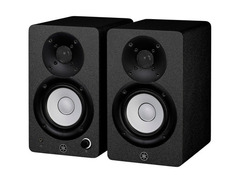
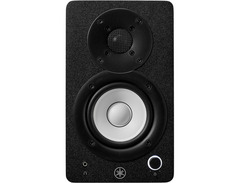
The Yamaha HS3 3.5-inch Powered Studio Monitor is a testament to how mighty performance can fit into a compact form. This space-saving marvel is designed to meet the needs of creators who demand premium sound without the bulk. Equipped with a 3.5-inch cone woofer and a 0.75-inch dome tweeter, the HS3 delivers an impressive 70Hz-22kHz frequency response. Its bi-amplified bass-reflex design ensures crisp, clear sound that remains true to the source, a characteristic that has made Yamaha a trusted name in studio monitors for decades.
Perfect for studios with limited space, the HS3 offers flexibility in input connections, including XLR/TRS combo, RCA, and stereo mini jacks, thanks to its rear panel design. The Room Control and High Trim functions allow for tailored sound adjustments, reducing unwanted low-end frequencies when placed near walls, ensuring your audio is perfectly balanced for any environment. Whether you're mixing music or editing video, these monitors provide a reliable, honest sound that translates well across various playback systems.
With anti-slip feet for stability and a travel-friendly size, the HS3 is perfect for on-the-go creators or small studio setups. Its high-performance Class-D amp and carefully selected components, including Yamaha's proprietary Twisted Flare Port technology, mean you won't sacrifice quality for convenience.
Key Features:
- 2-way bi-amplified bass-reflex design
- 3.5" cone woofer and 0.75" dome tweeter
- Frequency response: 70Hz-22kHz
- Room Control and High Trim functions
- XLR/TRS combo, RCA, and stereo mini input connections
- Includes stereo mini RCA cable, speaker cable, and anti-slip feet
Owner's manual
Yamaha HS3 3.5-inch Powered Studio Monitor User ManualProduct specs
| Powered | Yes |
| Power Configuration | 2-way |
| Quantity | Pair |
| LF Driver Size | 3.5" Woofer |
| HF Driver Size | 0.75" Tweeter |
| Total Power | 26W + 26W |
| Frequency Response | 70Hz-22kHz (-10dB) |
| Input Types | 1 x XLR-1/4" Combo, 1 x Dual RCA Stereo, 1 x 1/8" TRS |
| Features | Black Finish |
| Enclosure Material | MDF |
| Height | 8.8" |
| Width | 5.2" |
| Depth | 7.4" |
| Weight | 6.2 lbs. (each) |
FAQs
-
Are the Yamaha HS3 studio monitors suitable for small home studios?
-
Yes, the Yamaha HS3 studio monitors are well-suited for small home studios due to their compact size and accurate sound reproduction, making them ideal for close-field listening.
-
What type of inputs do the Yamaha HS3 monitors support?
-
The Yamaha HS3 monitors support XLR-1/4" combo, dual RCA stereo, and 1/8" TRS inputs, providing versatile connectivity options for various audio sources.
-
How much power do the Yamaha HS3 monitors deliver?
-
Each Yamaha HS3 monitor delivers 26 watts of power, providing clear and balanced sound for detailed audio monitoring in smaller spaces.
-
What is the frequency response range of the Yamaha HS3 monitors?
-
The Yamaha HS3 monitors have a frequency response range of 70Hz to 22kHz, allowing them to accurately reproduce a wide spectrum of audio frequencies.
-
Are the Yamaha HS3 monitors active or passive?
-
The Yamaha HS3 monitors are active, meaning they have built-in amplifiers, eliminating the need for an external power amplifier.
Videos

Yamaha Global
Yamaha HS3/HS4 High-Quality Compact Studio Monitors for the Uncompromising Creator
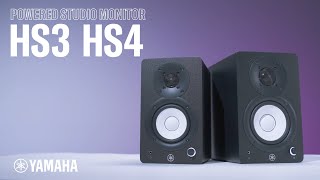
Yamaha HS3/HS4 High-Quality Compact Studio Monitors for the Uncompromising Creator
Yamaha Global
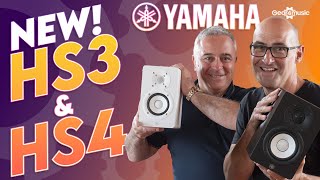
Exclusive First Look: Yamaha HS3 & HS4 Studio Monitors! - Gear4music Synth & Tech

Gear4music Synths & Tech

DON'T Buy Before Watching This! NEW Yamaha HS3 Studio Monitors

MixbusTv
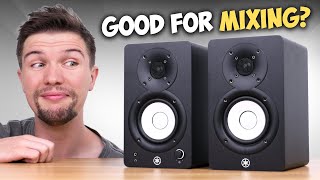
The NEW Yamaha HS3s are....

Edward Smith
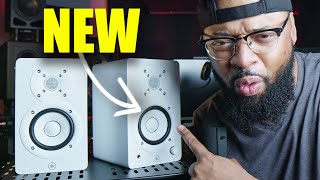
SMALL but MIGHTY - The NEW Yamaha HS3

Archie Beatz

YAMAHA HS3 REVIEW - Testing Songs & Unboxing - HS3 vs HS5

James DeCastro
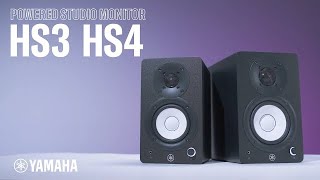
Yamaha HS3 Monitors

Robin Smith
Reviews
PROS
-
Compact size ideal for small desks and tight spaces
-
No hiss or white noise, excellent for low-volume listening
-
Clear sound with a flat response, perfect for small room setups
-
Comparable performance to larger Yamaha models, like the HS5
-
Offers great sound definition and balance for the price
-
Sufficient bass for small listening environments
CONS
-
Lacks bass reserves due to small 3.5-inch speaker size
-
Connector design perceived as outdated and cheap
-
Not suitable for professional studio use, more casual listening
-
Sound quality may be underwhelming compared to larger Yamaha models like HS7
Owner Insights
We analyzed real musician discussions from forums and Reddit to find what players love, question, and tweak about Yamaha HS3 3.5-inch Powered Studio Monitor.
Comparisons
-
HS3s are noted to be less effective for hip-hop due to limited bass response; HS7s or a subwoofer setup is recommended for bass-heavy genres.
Source -
Users transitioning from Kali Audio Ultra Nearfield setups note HS3s require less space and offer satisfactory sound for non-critical listening.
Source -
Kali LP-UNF ultra near field monitors are preferred for limited space due to front porting, compared to rear-ported models like Yamaha HS3 that require more room from walls.
Source
Use cases and applications
-
Pairing HS3s with a subwoofer like the Kali WS-6.2 can improve performance in untreated rooms, offering a balanced sound without large monitors.
Source -
Owners suggest that the HS3s are suitable for general use but may not suffice for critical listening or production without additional bass support.
Source -
HS3s are praised for desktop guitar monitoring, fitting well in crowded spaces without disturbing neighbors, suitable for casual guitar practice.
Source
Features and functionality
-
It's suggested that a pair of monitors is essential for accurate stereo imaging, especially for those new to music production.
Source -
HS3s are described as providing natural sound and adequate volume for guitar work without needing high volume levels.
Source -
Adam Audio monitors use ribbon tweeters, which provide crystal-clear highs but may produce a narrow sweet spot and can be harsh in tone.
Source -
The HS8 has a shelf adjustment switch that allows users to tweak bass frequencies, which could be beneficial for those not needing a subwoofer.
Source
Software and compatibility
-
An audio interface may be necessary to drive the HS3 monitors effectively, with the Focusrite Scarlett series being a popular choice among users.
Source -
Occasional distorted playback is reported when running resource-heavy applications, suggesting potential system resource issues rather than speaker faults.
Source
Value and pricing
-
Investing in a pair of monitors rather than a single unit is recommended to maximize the effectiveness of a studio setup.
Source
User experience
-
Owners report better-than-expected bass output, potentially influenced by desk resonance, noted on IKEA desktops.
Source -
Front ported monitors like Kali LP-UNF are recommended in multi-purpose rooms to avoid boomy bass from rear ports placed too close to walls.
Source -
Owners using HS8s at desks note that these models produce bass effectively without a subwoofer when placed less than a foot from the wall.
Source
Critic Reviews
Based on 0 Reviews and 0 Ratings
Genre Usage
Based on how artists on Equipboard use this gear, it is most commonly found in the following genres.
More Yamaha Active & Passive Monitors
-m.webp?v=1785077892)
$299.99
in Active & Passive Monitors Rank


$243.50 - $398.99
in Active & Passive Monitors Rank


$142.25 - $199.99
in Active & Passive Monitors Rank


-m.webp?v=1785164359)
$202.49 - $594.98
in Active & Passive Monitors Rank

.jpg?v=1785115134)


$299.99
in Active & Passive Monitors Rank


$275.00 - $398.99
in Active & Passive Monitors Rank


$196.00 - $349.99
in Active & Passive Monitors Rank


$196.00 - $594.98
in Active & Passive Monitors Rank


$274.99 - $487.99
in Active & Passive Monitors Rank


$275.00
in Active & Passive Monitors Rank


$300.00
in Active & Passive Monitors Rank


$149.99 - $169.99
in Active & Passive Monitors Rank


$199.00 - $219.99
in Active & Passive Monitors Rank


$262.49 - $594.98


Accessories & Related Items


-s.webp?v=1785164359)


Artist usage


Community setups


Similar


Gear Guides






Most Popular Active & Passive Monitors
Most Popular Brands
-
Added to Equipboard on by
 dc86
dc86GearIQ 923
-


