


Pricing and availability
We compare 600+ stores and found this item at 1 store. Prices updated .




Average Price: $4,120
High-end/Boutique
$249
$700+
Price Tier
Budget
Standard
High-end
* Product prices and availability are updated by Equipboard every 24hrs and are subject to change. Equipboard may receive compensation for purchases made at participating retailers linked on this site. This compensation does not affect what products or prices are displayed, or the order of prices listed. For more information, please refer to our affiliate disclosure.
Description
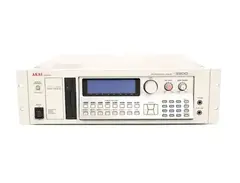
The Akai S1000 is a 16-bit, 44.1 kHz professional stereo digital sampler, released by Akai in 1988. The S1000 was among the first professional-quality 16-bit stereo samplers.[3] Its abilities to splice, crossfade, trim, and loop sound in 16-bit CD quality made it popular among producers in the late 80s through to the mid 90s. The S1000 used 24-bit internal processing, had digital filters and an effects send and return, and came with 2MB of RAM (expandable to 8MB).[2]
Version 2.0 of the S1000's operating system introduced primitive timestretching, allowing a sound's pitch and length to be altered independently of one another.
Videos

SynthMania
Akai S1000 - a few old school sounds
Akai S1000 - a few old school sounds
SynthMania

How To Make Jungle With AKAI S1000

IJO Sound

The Ultimate Guide to Sampling in the Akai S1000

Groovin in G

Akai S1000 | Old School Sampling

Espen Kraft

How I Start A Track | Akai S1000 Sampler | Jungle Production Techniques | Cubase VST | DAW |
IJO Sound

Akai S950 Vs S1000: Which Hardware Sampler Is Better?

TheBizzyBScience
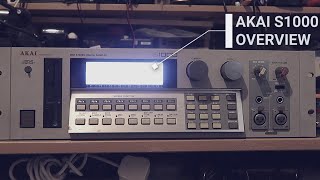
What was revolutionary about the Akai S1000 sampler?
TheBizzyBScience

How I Make Oldschool JUNGLE With AKAI S1000 & Hardware
IJO Sound
Hopes & Dreams (Akai S1000 Oldschool Drum'n'Bass)
IJO Sound

Unleashing the Full Potential of the AKAI S1000: The Ultimate OS v4.4 Upgrade!
TheBizzyBScience
Reviews
Owner Insights
We analyzed real musician discussions from forums and Reddit to find what players love, question, and tweak about Akai S1000.
Setup and maintenance
-
Replacing the PSU in the Akai S1000 is straightforward and easy; swapping the front panel and tact switches may require more effort.
Source
Mods and upgrades
-
Owners recommend a new LED display over EL Foils for brighter, more reliable visuals.
Source -
For those with faint displays, an iPhone 6 backlight mod can be a cost-effective alternative under $100, or opt for a new LED display for $120-140.
Source -
Replacing the floppy drive with a SCSI2SD is a recommended modification to streamline sample transfer and enhance usability.
Source -
An external floppy drive with 'omniflop' software can facilitate reading S1000 disks into a PC, useful for archiving and transferring sample libraries.
Source
Features and functionality
-
The S1000 supports 16 notes polyphony in mono, which may suffice for most applications despite its limitations.
Source -
The Akai S1000 is praised for its ability to pitch sounds across the keyboard effectively, offering a distinct and appealing tonal quality.
Source -
The Akai S1000 offers stereo sampling with converters praised for their compact, tight sound, providing a more detailed output compared to the S-950's crunchier tone.
Source
Software and compatibility
-
Some users connect a PowerBook G3 via SCSI for sample editing with Recycle and Bias Peak.
Source -
To integrate S1000 samples into a DAW, options include using its 8 outputs with MIDI control, or transferring samples via an external Atari Falcon with a card reader.
Source -
Conversion software like 'translator' or 'Awave' can convert S1000 samples into soundfonts for use in software samplers, maintaining the unique character of the original samples.
Source
User experience
Use cases and applications
-
The S1000 is favored for creating tracks with authentic, old-school sound textures, especially if users seek a gritty, bitcrushed aesthetic without extensive DAW processing.
Source -
Owners often map each drum hit to a single note, using envelopes and filters to refine sounds, particularly to enhance kick drums with additional 'umphhh'.
Source
Critic Reviews
4.5 out of 5
Based on 2 Reviews and 25 Ratings

1264
I love my Akai'sss
Yep. I love them. I want to marry all the Akais. They make the world sound like music and they make drums that kick your pants off. Stretchy digital goodness.
If it were a person, it would be amazing at facilitating original ideas at corperate meetings. Those meetings would never be boring.
Sample movies or your backyard or your kitchen. Sample the world into your Akai and you will smile forever and the world will be an ok place.

Artist usage
Add artist


We nevertheless upgraded to the Akai S1000 sampler. This is still the core of the onstage Doktor."

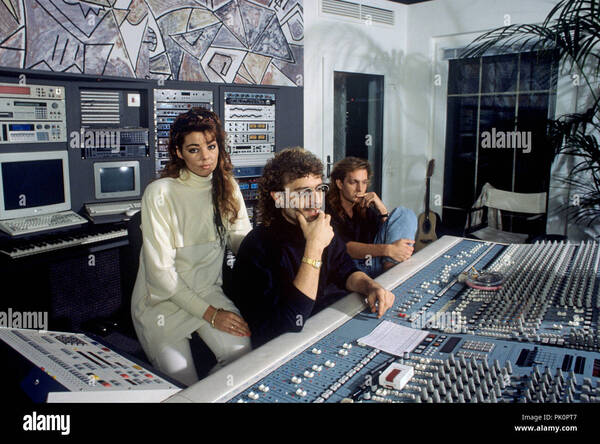
The Akai S1000, an audio sampler, can be seen mounted beneath the Akai S900 in the setup of Michael Cretu, as evidenced by the provided image.


"What do you remember of the hardware setup you had in the early days?
Andy: We had an 808, 303, 202 and 101, a monophonic digital synth, Akai 950 sampler and a few other analogue keyboards. We hired in an Akai S1000 to record the first EP.
Ed: Also the Oberheim Matrix 12 and Matrix 1000, which were pretty important. Sequencing was initially an Alesis MMT-8 then Dr T’s on Commodore."


Per Reverb.com:
Geoff Barrow was working as an assistant at Coach House studio while Massive Attack was recording its own debut album, Blue Lines. Seeing a strong aptitude in the young assistant, the group gifted Barrow with an Akai S1000 and an Atari 1040 computer to start him off on his sampling journey.


As if this isn't enough, Jones' collection of sound sources is breathtaking. Inhale deeply for an (incomplete) overview: Fairlight Series III; Yamaha TX816 rack; Akai S1000; Roland Super JX, MKS50, D50, Jupiter 8, Juno 60, D550, and MKS20 digital piano; Korg Wavestation; Prophet T8; MiniMoog; Vocoder VP330; Yamaha KX88 and TG77; and somewhere in a corner his old 808 drum machine. Still there?

:format(jpeg):mode_rgb():quality(90)/discogs-images/R-123219-1460891423-6452.jpeg.jpg)
Atari Teenage Riot's 1995 album was produced by Alec Empire and lists the following instruments in the liner notes: "This album was recorded with an ATARI 1040, a CASIO FZ-1 sampler and a TR-909 drummachine… Sorry but we had to use the AKAI S-1000 sometimes for timestretching"


EQUIPMENT LIST
RECORDING Akai S1000 Sampler + Hard Drive Alesis HR16 Drum Machine Atari 1040ST Computer Casio CZ230S Synth E-mu Systems Proteus Sample Reader Korg M1 Workstation Oberheim Matrix 1000 Synth Module Roland D110 Synth Module Roland Super JX Synth Module Steinberg Pro24 v3 Sequencing Software Yamaha RX5 Drum Machine Yamaha TX81Z Synth Module

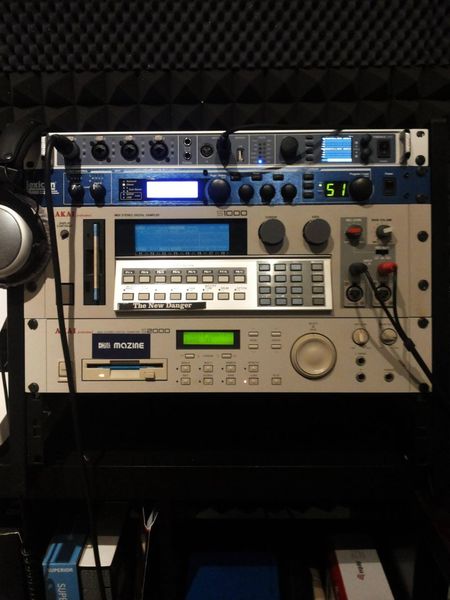
Mefjus uses the Akai S1000 for fun and beat-making, as shown in a photo posted on his Facebook timeline.


What kind of gear did you use at the time?
R: “Caustic” was a pretty minimal set up. All we used was the Atari, an Akai S1000 and S950, a Minimoog, Micromoog, Pro One and a Kawai K4 for strings… Less is more I’m starting to think! We did have a couple disks of Adrian Sherwood drums and Yello bass sounds for the Akai that were used a lot.


Although boasting a lush sound, the album was recorded largely at Paul's Rhythm Ranch studio on a single tascam 16-track with a Studiomaster desk. Synths used include: Roland D-50, Akai S1000 and S3000, Kork M1R, Waldorf Microwave, Roland Super Jupiter module, Oberheim Matrix 1000, Yamaha TX802, Minimoog, MIDIMoog, Oberheim Two-Voice, Roland Jupiter 8 and SH-101.


Album Usage
The Akai S1000 has been featured on the following albums:

L'Accident de piano
Mr. Oizo (2025)

Silhouettes
Klaus Schulze (2018)

The Crime of Suspense
Klaus Schulze (2017)
Waiting for Cousteau
Jean Michel Jarre (2015)

Reset
Atari Teenage Riot (2015)

Lambs Anger
Mr. Oizo (2008)

Melody A.M.
Röyksopp & Röyksopp (2001)

Why Does My Heart Feel So Bad?
Moby (1999)

Brand New Second Hand
Roots Manuva (1999)
Everything Is Wrong
Moby (1995)
Thinking About Myself
Cosmic Baby (1994)

Loops of Infinity
Cosmic Baby (1994)

Very (2018 Remaster)
Pet Shop Boys (1993)
Screamadelica
Primal Scream (1991)
Caustic Grip
Front Line Assembly (1990)
Genre Usage
Based on how artists on Equipboard use this gear, it is most commonly found in the following genres.
Used With
Based on how musicians on Equipboard use Akai S1000, it is most commonly used with the following gear.

-s.webp?v=1783318437)

-s.webp?v=1783263541)


Community setups
Show yours
Similar
Add recommendation1 alternative for Akai S1000, curated by the Equipboard community.

$69.00
TAL's Sampler features an explicit emulation of the S1000's distinctive DAC circuit.
More Akai Audio Samplers

$179.12
in Audio Samplers Rank


$599.00
in Audio Samplers Rank


$450.00
in Audio Samplers Rank


$2,429.00 - $3,099.00
in Audio Samplers Rank

$377.00 - $507.99
in Audio Samplers Rank

$692.61
in Audio Samplers Rank


$800.00
in Audio Samplers Rank


$345.70
in Audio Samplers Rank


$1,432.98
in Audio Samplers Rank


-m.webp?v=1783177316)
$338.54
in Audio Samplers Rank


$1,071.74
in Audio Samplers Rank


-m.webp?v=1781852796)
$110.00
in Audio Samplers Rank


$348.56
in Audio Samplers Rank
.jpg?v=1782915672)


$835.91
in Audio Samplers Rank


$1,100.00
in Audio Samplers Rank

$537.37
in Audio Samplers Rank


$847.85
in Audio Samplers Rank


$4,119.83
in Audio Samplers Rank


$293.00
in Audio Samplers Rank


$109.99 - $256.75
in Audio Samplers Rank


-m.webp?v=1783339576)
$1,467.61 - $1,799.00
in Audio Samplers Rank
.jpg?v=1783265555)


$445.00 - $499.99
in Audio Samplers Rank


$72.00
in Audio Samplers Rank


-m.webp?v=1783177011)
$298.54
in Audio Samplers Rank

$425.00
in Audio Samplers Rank

.jpg?v=1782938947)


$220.00
in Audio Samplers Rank


$225.00 - $478.00
in Audio Samplers Rank


$599.99 - $689.99
in Audio Samplers Rank


$275.00 - $349.00
in Audio Samplers Rank


$240.00
in Audio Samplers Rank


$225.00
in Audio Samplers Rank


Accessories & Related Items
-s.webp?v=1783177316)



Gear Guides






Most Popular Audio Samplers
Most Popular Brands
-
Added to Equipboard on by
 buddycephalus
Gear IQ 146
-


