

Pricing and availability
We compare 600+ stores and found this item at 1 store. Prices updated .
Store
Reviews
Price




Average Price: $693
Standard/Professional
$249
$700+
Price Tier
Budget
Standard
High-end
* Product prices and availability are updated by Equipboard every 24hrs and are subject to change. Equipboard may receive compensation for purchases made at participating retailers linked on this site. This compensation does not affect what products or prices are displayed, or the order of prices listed. For more information, please refer to our affiliate disclosure.
Description
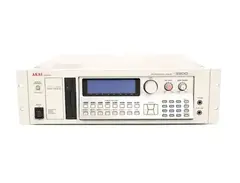
The S900 sampler was Akai's first truly professional sampler, released in 1986. Its sampling specifications were pro-quality at the time: 12-bit stereo sampling, 7.5kHz to 40kHz variable sampling rates and a maximum of 63 seconds of sample time at 7.5kHz. Up to 32 samples can be created and stored to disk along with any edit settings. This was one of the first rack-mount samplers to use a built-in disk drive. Although the drive could load sounds while you play, it was still a very slow process.
AKAI S900 12 bit Rack Sampler Specifications: • Polyphony - 8 voices • Sampler - 12-bit linear, 7.5 - 40kHz sampling rates (63 seconds). • Memory - 750 kB RAM in S900 (not expandable) • VCA - ADSR • Control - MIDI
Product specs
| Brand | Akai |
| Model | S900 MIDI Digital Sampler |
| Finish | White |
| Year | 1986 |
| Made In | Japan |
| Categories | Digital Synthesizers, Samplers |
| Analog / Digital | Digital |
| MIDI I/O | MIDI Input, MIDI Output, MIDI Through |
| Polyphony | 8 Voices |
FAQs
-
What is the maximum sampling time of the Akai S900 MIDI Digital Sampler?
-
The Akai S900 offers a maximum sampling time of 63.3 seconds at a reduced sampling rate of 7.5 kHz, allowing for extended sample lengths.
-
How many voices of polyphony does the Akai S900 support?
-
The Akai S900 supports 8 voices of polyphony, enabling multiple samples to be played simultaneously.
-
Is the Akai S900 suitable for live performances?
-
Yes, the Akai S900 is suitable for live performances, offering MIDI connectivity and real-time sample manipulation, which are ideal for dynamic stage use.
-
What are the main connectivity options on the Akai S900?
-
The Akai S900 features MIDI Input, MIDI Output, and MIDI Through, providing versatile connectivity for integration with other MIDI-equipped gear.
-
Does the Akai S900 have a unique sound character?
-
Yes, the Akai S900 is known for its distinct sound character, particularly its drum samples, which have been widely used in hip hop and electronic music for their recognizable and memorable qualities.
Videos

Espen Kraft
S900 - This made Akai the KINGS of sampling

S900 - This made Akai the KINGS of sampling
Espen Kraft
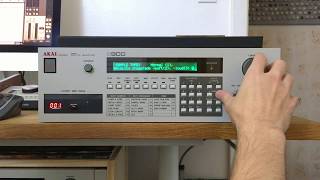
Akai S900 Demo

Gear Geek
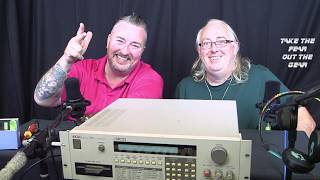
AKAI S900 12BIT STEREO SAMPLER

Take the Fear out the Gear
Reviews
Owner Insights
We analyzed real musician discussions from forums and Reddit to find what players love, question, and tweak about Akai S900 MIDI Digital Sampler.
Features and functionality
-
The S950 uses analog filters and changes clock frequency for pitch adjustments, which is unique among digital samplers.
Source -
The S950's sampling rate at 10kHz creates a pleasant crunch, making it ideal for jungle drums.
Source -
The Akai S900 is often paired with an MPC due to its lack of a built-in sequencer, making it reliant on external devices for sequencing tasks.
Source
Setup and maintenance
Comparisons
-
The S950's 48kHz sampling rate provides a "fat and open" sound, contrasting with myths about its lo-fi quality.
Source -
Despite technological advancements, hardware samplers like the S900 offer a distinct sound that plugins and software often fail to fully replicate, especially in terms of vintage vibe and feel.
Source
Value and pricing
-
The S950 is highly valued for its sound, often priced 2-3x higher than the S1000 on the market.
Source
Mods and upgrades
-
Replacing the S900's floppy drive with a smart card reader is a popular upgrade. This process is well-documented and allows for more modern storage solutions.
Source
User experience
-
The S900's AD/DA stage is noted for its unique sonic character, particularly enhancing low-end frequencies, making it favorable for drums and bass applications.
Source
Use cases and applications
-
The chromatic sampling feature in the S900 introduces aliasing artifacts when transposing samples, a characteristic sought after for creating unique textures in music production.
Source
Critic Reviews
4.5 out of 5
Based on 2 Reviews and 15 Ratings

436
A certified classic!!!
Most are seeking the S-950, because of the time stretch feature, but what they don't know is the S900 is a secret weapon itself with it's digitally controlled analog filter. It also has an uncanny sound that works perfectly for drum and percussive sounds. I still use my S900 to give certain types of samples that dry 12-Bit grit. This is one sampler I will never let go...

257
Nice warm filter and easy to use
I acquired my S900 from the then manager of Swan Yard Studios just as they were closing back in 2002, it had been used on countless recordings in the 80's and 90's along with an Oberheim Matrix 6r i bought and an Oberheim DPX-1, none of which i own today. The S900 was very similar to a later S950 i owned from what i can recall.
Artist usage
Add artist
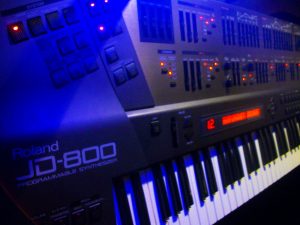
Presented on Legowelt's official website, cited as being one of the pieces of gear used by Legowelt at some point.


At 3:50 Paul Barker, Al's righthand man back in the day details how the band used Akai S900 samplers in addition to the Fairlight CMI to write and record material for TLORAH. I'm putting this under both Al and Paul as they both presumably used the equipment together back in the day.


Per "Rock This Town" publication, special issue 1991:
NOTE: the article lists two Akai "S9000" samplers, but Akai has never used this model number for any product at any point in its history. Akai DID make the very-popular S900 sampler in this timeframe, so the extra zero has to be a typo.
In 1991, the setup was as follows: [Rock This Town special issue 1991]
Sound studio: Analog Synths: Roland System 100/100M/101 (+Roland Midi interface MPU-101);YAMAHA CS-40M (in the Take One video); Oberheim Matrix 1000; Digital Synths: Yamaha DX-7 (2); Ensonic VFX; Roland DDR30; Yamaha tg77; Korg Wavestation; Sequencer: Atari 1040 (Sequ. Cubase 2.0); Samplers: AkaiS9000 (2); AkaiS1000 (8Mg + Hard Drive Mfile 44); AkaiS1000PB (4Mg); Emulator II; akai 1100, e-mu Procussion, roland s-10 for live use @ the mixing desk; Effects: Lexicon 480L; Yamaha SPX90 II (2); Roland SRV-2000; Roland SDE-3000; Alesis Midiverb II; Alesis Quadraverb; ART DRX; spx 1000 (x2); Eventide h3000 se; Mixing: Table TAC Scorpion 32/16; Recorder TASCAM MS16 tracks; Recorder DAT Luxman; Speakers Yamaha NS 10M pro ATC SCM50; QUAD ampli (for NS-10M); Diverse: compressor/limiter, noise gate, parametric eq. Live: Backline: Akai S9000; Roland DDR30; Simons & Roland Pads; Emulator II; TASCAM238 8
Graphic Studio: Commodore Amiga 2500 (6Mg + Hard Drive 40Mg); Commodore Amiga 500; Digitizer SNAPSHOT; Camera Sony CCD V-200E; Laserprint NEC Silentwriter LC890; Monitor NEC Multisync 2A.


Future Sound of London equipment list from the August 1992 issue of Music Technology Magazine:
Instruments
Akai S612 Sampler + MD280 Disk Drive Akai S900 Sampler Akai S1000 Sampler w/8Mb memory E-mu Proteus/1 w/Protologic board Jen SX1000 Synth Roland D110 Synth Module Roland JX3P Synth Roland MC202 Monosynth Roland MKS50 Synth Module + PG300 Programmer Roland TB303 Bass Synth Roland TR606 Drum Machine Yamaha DS55 Synth Yamaha TX81Z
Effects
Alesis Quadraverb (x2) Alesis MIDIverb II BBE 422A Sonic Maximiser Bel Electronics BD80 Digital Delay Drawmer DS201 Dual Gate Fostex 3070 Compressor/Limiter Ibanez DM1100 Digital Delay Korg DRV1000 Digital Reverb Yamaha SPX90 Multi effects Processor
Recording
Aiwa HDX1 DAT Recorder Atari 1040ST Computer w/C-lab Creator software Fostex B16 Multitrack Groove MC2V MIDI/CV Converter Korg KMS30 Sync Unit Nakamichi 480Z Cassette Deck Sony DTC1000ES DAT Recorder Soundtracs CM4400 Mixing Desk Technics SL1200 Mk2 Turntable Yamaha NS10M Monitors


4th down on list of PSB synths/ samplers


You’ve joined the Philip Glass Ensemble in 1974. I guess the live rig has changed a few times over all these years. Could you share with us how your setup has evolved until the latest pre-Bidule setup?
When I joined, the keyboards consisted of 3 Farfisa Mini-Compact organs. That was it. Over the years of my involvement, the Ensemble went through a series of migrations to new hardware. The first was the replacement of one of the Farfisas by a Yamaha YC45-D dual manual electric organ, a wonderful machine with touch sensitivity and adjustable percussive attack. After that, we added an Arp Explorer synthesizer. Next came a Sequential Circuits Prophet 5, then an Oberheim OBXa, then a Yamaha Dx7 (one of the first in the US, hand-carried back from a tour in Japan), then an Emulator I sampler (serial #002), then a Roland Juno-106 and a Roland JX3P, and an Emulator II sampler, and then, as we adopted MIDI controllers and rack modules, a Roland Super Jupiter, a Yamaha TX-816 rack and a YTX-802, several Oberheim Matrix-6R. and a number of Akai S-900 samplers, later replaced with Digidesign Samplecell I cards running on Mac IIs.


This article states that Linkous owns an Akai S900.

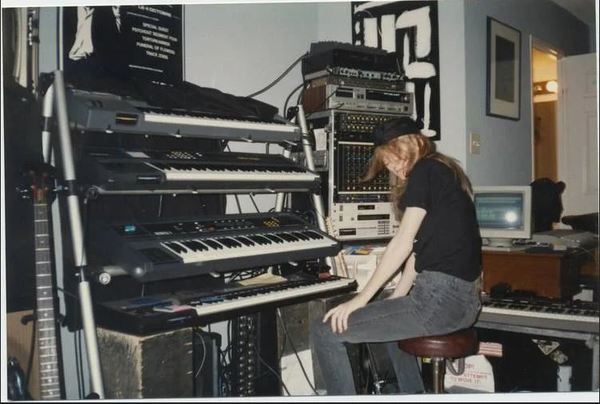
In this photo it shows Dwayne Goettel in their studio with an Ensoniq ESQ-1, Ensoniq Mirage, E-Mu EMAX, Akai S900. There is an effects rack with a Lexicon PCM 41, a pair of Korg SDD-1000s. In the background is an Atari 1040ST running Steinberg Pro 24 sequencing software.


""There are three sound sources", he explains. "There's an Akai S900 which has samples transferred from the Fairlight Series III, a Roland Super Jupiter and a Roland MKS20 piano module. All of those go into an Akai MIDI mixer and through two effects: a Yamaha SPX90 and an Alesis Midifex. They're all mapped by a Cooper Electronics MIDI Link, and I play them from a KX5 slung round my neck and a couple of Yamaha pedals. They put out program numbers to the MIDI link and that sends out separate program numbers to everything else. In other words I'll build up an entire patch with sound sources, a mix, effects and a stereo output, and store it. Then, when I send one program number into it from either the keyboard or from the pedal, it'll send the appropriate numbers out."


"By the time 'Floodland' was recorded, we had an Akai S900 sampler. Like manna from heaven. Most of the drums on 'Floodland' came via the Akai. The DMX toms were resampled from the drum machine and off tape. Resampled RX5 kick, snare and hats formed the rest of the skeleton crew. We've been creating samples ever since, but we don't collect much any more; one encounters the same old samples circulating the globe under different names. Some of them sound suspiciously like they've been sampled off Sisters records. It's been a long time since we changed one of the Doktor's standard voices. We've created and collected a lot of "special effects" drum sounds, but we don't use them live because the sound would vary too wildly from song to song. It's not a practical solution unless you have everything submixed with automation - or running off a tape machine, like certain electronic bands we know (and all of the very famous ones we don't know). They might as well just play the record. We like a bit of risk, and we like to be able to tinker with things from concert to concert. The Akai S900 is still a perfectly fine drum sampler. Its grainy sound can be an advantage."

At 3:50, Paul states how him and the rest of the band created and recorded much of TLORAH using a Fairlight CMI and Akai S900.


From the FAQ page found on The Enigma Archive: "From the credits of various albums, it is known that Michael Cretu uses or has used the Waveframe 1000, Audi Frame Workstation, MIDIMoog, PPG System, Korg M1, C-Lab Notator, Takamine 6 and 12 String, Tom Anderson Electric Guitars, Otari DTR-900, Akai 900, Linn 9000, Prophet 2002, X-Pander, EMS Vocoder, DX-7, and Roland Super Jupiter."
Album Usage
The Akai S900 MIDI Digital Sampler has been featured on the following albums:
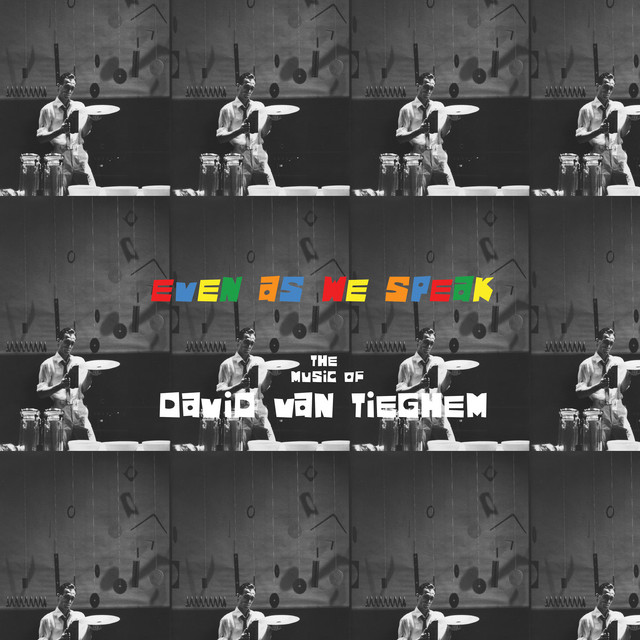
Even As We Speak: The Music of David Van Tieghem
David Van Tieghem (2025)
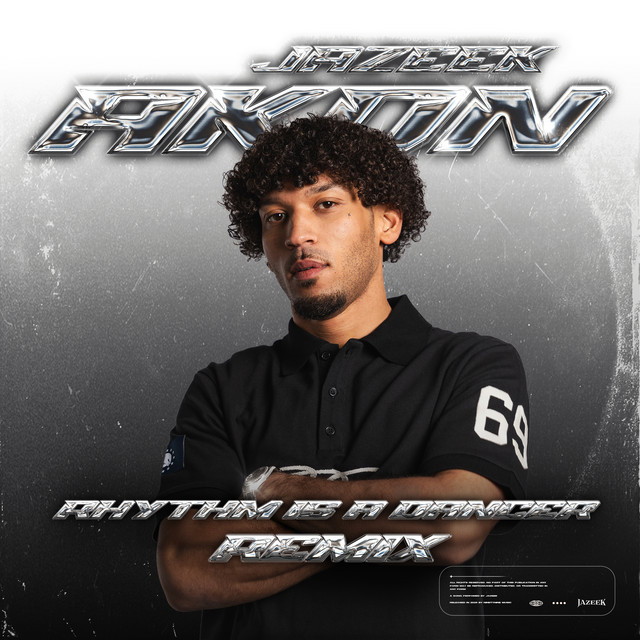
Akon (Rhythm Is A Dancer Remix)
Snap! (2025)
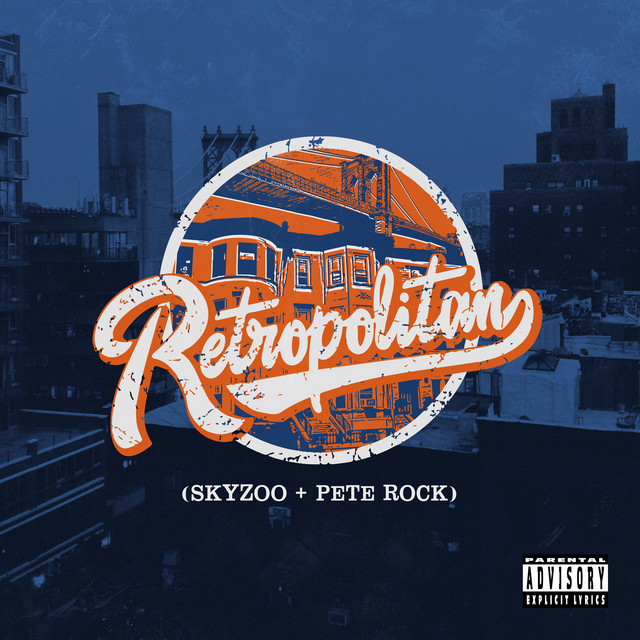
Retropolitan
Pete Rock (2019)
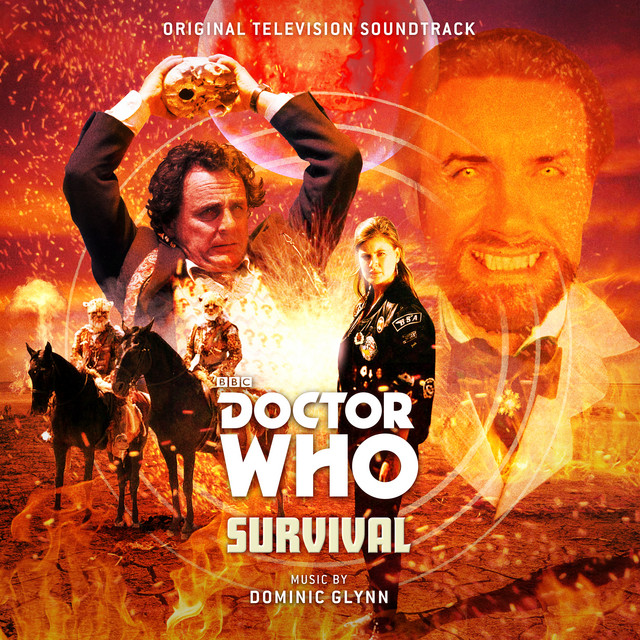
Doctor Who: Survival (Original Television Soundtrack)
Dominic Glynn (2017)
Big Fun
Inner City & Kevin Saunderson & The Magician & Themba (2003)
Politics Of The Business
Prince Paul (2003)
![Akai S900 MIDI Digital Sampler as heard on Storms in Africa (Pt. II) [2009 Remaster] by Enya (1989)](https://images.equipboard.com/uploads/album/image/539384/storms-in-africa-pt-ii-2009-remaster.jpg)
Storms in Africa (Pt. II) [2009 Remaster]
Enya (1989)
Presto
Rush (1989)

Pacific
808 State (1989)
Doble Vida (Remastered)
Soda Stereo (1988)
The Celts
Enya (1987)
Ruido Blanco (Remastered)
Soda Stereo (1987)
Hold Your Fire
Rush (1987)
Floodland
The Sisters of Mercy (1987)
Signos (Remastered)
Soda Stereo (1986)
Three of a Perfect Pair
King Crimson (1984)
Beat
King Crimson (1982)
Discipline
King Crimson (1981)
Genre Usage
Based on how artists on Equipboard use this gear, it is most commonly found in the following genres.
Used With
Based on how musicians on Equipboard use Akai S900 MIDI Digital Sampler, it is most commonly used with the following gear.




-s.webp?v=1783263558)


Similar
Add recommendation1 alternative for Akai S900 MIDI Digital Sampler, curated by the Equipboard community.

$599.00
The S950 was the successor to the S900, bringing a higher maximum sample rate (48 vs 40khz) and making many of the S900 features available only through later OS upgrades (such as time stretch and crossfade looping) available right from the start.
More Akai Audio Samplers

$179.12
in Audio Samplers Rank


$599.00
in Audio Samplers Rank


$450.00
in Audio Samplers Rank


$2,390.00 - $3,099.00
in Audio Samplers Rank

$369.00 - $507.99
in Audio Samplers Rank

$800.00
in Audio Samplers Rank


$793.00 - $799.00
in Audio Samplers Rank

$345.70
in Audio Samplers Rank


$1,432.98
in Audio Samplers Rank


-m.webp?v=1783350107)
$300.00
in Audio Samplers Rank


$1,074.74
in Audio Samplers Rank


-m.webp?v=1781852796)
$110.00
in Audio Samplers Rank


$348.56
in Audio Samplers Rank
.jpg?v=1782915672)


$4,119.83
in Audio Samplers Rank


$835.91
in Audio Samplers Rank


$1,100.00
in Audio Samplers Rank

$537.37
in Audio Samplers Rank


$847.85
in Audio Samplers Rank


$4,119.83
in Audio Samplers Rank


$293.00
in Audio Samplers Rank


$109.99 - $256.75
in Audio Samplers Rank


-m.webp?v=1783339576)
$1,467.61 - $1,799.00
in Audio Samplers Rank
.jpg?v=1783265555)


$445.00 - $499.99
in Audio Samplers Rank


$72.00
in Audio Samplers Rank


-m.webp?v=1783349871)
$298.54
in Audio Samplers Rank

$425.00
in Audio Samplers Rank

.jpg?v=1783335869)


$200.00
in Audio Samplers Rank


$225.00 - $478.00
in Audio Samplers Rank


$599.99 - $689.99
in Audio Samplers Rank


$275.00 - $349.00
in Audio Samplers Rank


$240.00
in Audio Samplers Rank


$225.00
in Audio Samplers Rank


Accessories & Related Items



-s.webp?v=1783350107)


Community setups


Gear Guides






Most Popular Audio Samplers
Most Popular Brands
-
Added to Equipboard on by
 fancypants
Gear IQ 1395
-


