Pricing and availability
We compare 600+ stores and found this item at 4 stores. Prices updated .
Store
Reviews
Price


Average Price: $194
Standard/Professional
$100
$301+
Price Tier
Budget
Standard
High-end
Price History
Based on price data from 2 merchants for "KMA Machines Moai Maea". Prices shown reflect NEW condition. Tracking began Apr 7, 2026.
* Product prices and availability are updated by Equipboard every 24hrs and are subject to change. Equipboard may receive compensation for purchases made at participating retailers linked on this site. This compensation does not affect what products or prices are displayed, or the order of prices listed. For more information, please refer to our affiliate disclosure.
Description
Unleash the sonic potential of your electric guitar with the KMA Machines Moai Maea, a pedal that takes octave effects to a whole new level. Inspired by the lush landscapes of Easter Island, this harmonizer and octave pedal offers a versatile sound palette that promises to expand your musical horizons. With independently switchable octaves and a clean mix option, the Moai Maea gives you the freedom to craft intricate soundscapes with ease. Whether you're looking to create a wall of sound with just a single note or layer complex harmonies, this pedal has got you covered.
Dive into the world of vintage fuzz octaver sounds and explore a higher octave along with up to two sub-octaves, delivering sounds that range from classic to cosmic. The intuitive control layout, featuring Clean, Octave +1, Octave -1, and Octave -2, ensures you have all the tools at your fingertips to dial in the perfect tone. With three footswitch options—Octaver, Shriek, and Drone—you can seamlessly transition between effects during live performances, making it an indispensable tool for any gigging musician.
Handmade in Germany, the Moai Maea ensures robust build quality and reliable performance, while its true bypass design guarantees that your tone remains pristine when the pedal is not engaged.
Key Features:
- Produces higher octave and up to two sub-octaves
- Independently switchable octaves with clean mix option
- Footswitches: Octaver, Shriek, Drone
- Connections: Input, Output, Loop in/out, 9V DC power supply
- Power consumption: 20 mA
- True Bypass
- Handmade in Germany
Product specs
| Available since | September 2017 |
| Effect Types | Octaver |
FAQs
-
What kind of power supply does the KMA Machines Moai Maea require?
-
The KMA Machines Moai Maea requires a standard 9V DC power supply, center-negative, which is commonly used for guitar effects pedals.
-
Is the KMA Machines Moai Maea suitable for bass guitar?
-
Yes, the KMA Machines Moai Maea works well with bass guitars, providing rich octave effects that enhance the low-end frequencies.
-
How does the KMA Machines Moai Maea differ from digital octave pedals?
-
The KMA Machines Moai Maea is an analog octaver, which typically offers a warmer and more natural sound compared to digital octave pedals, known for their precision and versatility.
-
Can the KMA Machines Moai Maea be used in a live performance setting?
-
Absolutely, the KMA Machines Moai Maea is designed for both live performances and studio use, offering reliable tracking and a robust build quality ideal for gigging musicians.
-
What are the main tone-shaping controls on the KMA Machines Moai Maea?
-
The KMA Machines Moai Maea features controls for adjusting the blend of octave effects and the level of the original signal, allowing for precise tone customization.
Videos

KMA Machines
KMA Machines - Moai Maea - Official Studio Demo
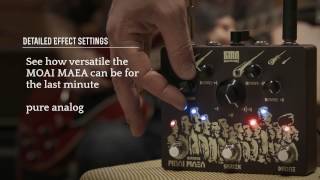
KMA Machines - Moai Maea - Official Studio Demo
KMA Machines

KMA Audio Machines MOAI MAEA - Demo by Alberto Barrero

Alberto Barrero
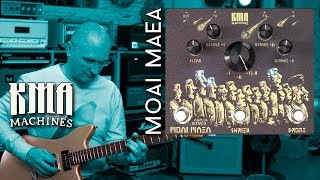
KMA Moai Maea - A serious Octave Pedal!

EytschPi42
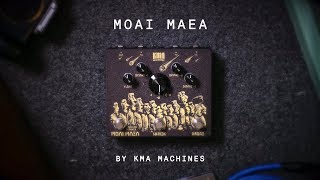
KMA Machines Moai Maea (demo)

Aaron Sternke

KMA Machines Moai Maea Analog Subsonic Octaver

Pedal of the Day
Reviews
PROS
-
Gain control on everything offers versatile sound modification
-
Allows for creative sound exploration with coherent octaves
-
Excellent tracking with single notes, especially before fuzz/overdrive
-
Robust build quality and straightforward, easy-to-use knobs
-
Unique ability to create massive, weird, or oldschool sounds
-
FX chain capability for expanded sound design
-
Great analog octave effects with individual octave activation
-
Can produce a fuzzy sound similar to a Moog synthesizer
-
Distinctive thick upper and lower octave reaches
CONS
-
Monophonic nature limits usability with chords, causing digital trash
-
Some users report poor tracking performance
-
Lower tunings result in unpredictable performance
-
Muddled sound when combining two lower octaves with the upper
-
Noticeable clicky switches can be a problem on small stages
-
Generates noise, potentially requiring a noise gate for clean sound
-
Upper-octave artifacts bleed into the sub-octave mode
-
Imbalanced sound between analog sub and upper octaves
Owner Insights
We analyzed real musician discussions from forums and Reddit to find what players love, question, and tweak about KMA Machines Moai Maea.
Setup and maintenance
-
Using a compressor before the pedal can improve tracking on lower strings.
Source
Use cases and applications
-
The pedal is best used for statement moments in songs rather than as an always-on effect.
Source
Features and functionality
-
The "shriek" feature might produce oscillating noise, which could be a normal characteristic or a product defect.
Source -
The Moai Maea includes a gain-adjusting trimpot inside the pedal for high octave fuzz, allowing for personalized fuzz intensity.
Source -
The pedal supports simultaneous engagement of +1/-1/-2 octaves with independent volume controls for each, enabling diverse soundscapes from classic octafuzz to synth-like tones.
Source -
An FX loop in the clean path allows for parallel processing with other effects like chorus and delay, enhancing creative sound design options.
Source
User experience
-
Users find playing with fingers improves tracking compared to using a pick on bass guitars.
Source -
Owners find the pedal excels at both vintage octave tones and experimental, droning sounds, adding versatility to their setup.
Source -
Sub-octaves can cause floor vibrations, offering a powerful bass presence that may enhance live performances.
Source
4.5 out of 5
Based on 1 Review and 4 Ratings

835
Disappointed
In the sub-octave mode you will always hear upper-octave fuzzy artifacts bleeding into your signal even if upper octave is turned off. Also upper octave is audible even in the minimal position of the corresponding knob when the upper octave mode is engaged. The developer is aware about the artifacts, so he responded to me, explaining them: "It’s a crosstalk coming from the adaptive comparator bleeding into the reference voltage supply and was audible at the suboctave part of the circuit. They are all gone since we change from THT to SMD parts and doing other modification to get rid of them". So there are now lucky owners of Moai Maea without artifacts? I don't know. I sold mine.
Also, the whole idea of analog upper+sub ocatve pedals is a little artificial, because while the analog sub-octaves could pass for "octave", the analog upper octave isn't really octaive, it's a fuzz with upper-octave overtones. So the upper-and-sub octave sound is a little imbalanced - fuzzy in the upper range. Also don't forget, analog sub-octaves become glitchy in a bad way when you play chords or play too low. On a positive side, at least this pedal sound quite awesome with synth. Also the idea of 3 analog octave effect is cool.
Preferred Settings + Usage:
If you still want to use that pedal for recording, you can use plugins like DeNoise to cut out frequencies occupied by artifacts
Genre Usage
Based on how artists on Equipboard use this gear, it is most commonly found in the following genres.
More KMA Machines Harmonizer & Octave Effects Pedals


$129.00 - $239.99


-m.webp?v=1784732274)


-m.webp?v=1784891100)
$184.38 - $319.99


-m.webp?v=1784893434)
$135.00 - $239.99


$140.00


-m.webp?v=1784892359)
$182.50 - $230.40


$184.38 - $319.99


$299.00 - $400.00


-m.webp?v=1784891598)
$229.00 - $449.99


$159.00 - $197.80

-m.webp?v=1784890914)
$199.00 - $244.90


$145.68 - $169.00


$79.00 - $119.00


$411.00 - $499.00


$133.00 - $249.99


$181.92 - $299.99

$229.00

-m.webp?v=1784818849)
$160.00


$113.98


$73.37 - $133.99


-m.webp?v=1784891573)
$209.00 - $271.20


-m.webp?v=1784818966)


$179.95 - $239.00


$133.75 - $164.99


.png?v=1784844572)
-m.webp?v=1784892823)
$143.00 - $169.99


$114.00 - $164.99


$109.99 - $143.00


-m.webp?v=1784818690)
$439.00 - $557.00


$214.18


$120.00


$150.00


$66.00 - $147.00


$132.00 - $229.99


$299.00 - $334.00


$177.00 - $179.00
Artist usage


Community setups


Similar


Gear Guides




.jpg)



Most Popular Harmonizer & Octave Effects Pedals
Most Popular Brands
-
Added to Equipboard on by
 jamieeeee
GearIQ 75
-