

Pricing and availability
We compare 600+ stores and found this item at 10 stores. Prices updated .
Store
Reviews
Price









Average Price: $552
High-end/Boutique
$149
$350+
Price Tier
Budget
Standard
High-end
Price History
Based on price data from 7 merchants for "Moog Labyrinth". Prices shown reflect NEW condition. Tracking began Apr 2, 2026.
* Product prices and availability are updated by Equipboard every 24hrs and are subject to change. Equipboard may receive compensation for purchases made at participating retailers linked on this site. This compensation does not affect what products or prices are displayed, or the order of prices listed. For more information, please refer to our affiliate disclosure.
Description
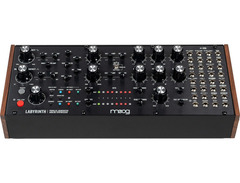
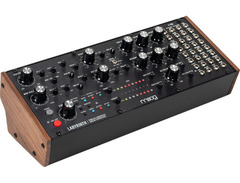
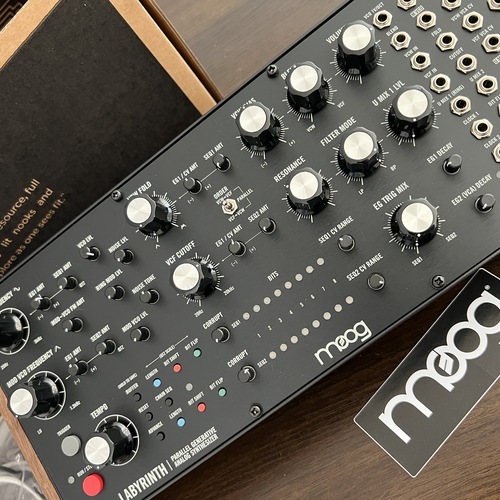
Discover the Moog Labyrinth, a semi-modular synthesizer that bridges the gap between traditional Moog soundscapes and innovative generative sequencing. This instrument is a dream tool for those looking to push their creative boundaries, offering a perfect blend of classic analog warmth with modern experimental capabilities. At its core, the Labyrinth features dual generative sequencers that craft evolving musical patterns, ideal for creating intricate melodic and percussive sequences. These sequencers, coupled with a robust synthesis engine, allow for a rich tapestry of sound that evolves over time, making each performance unique.
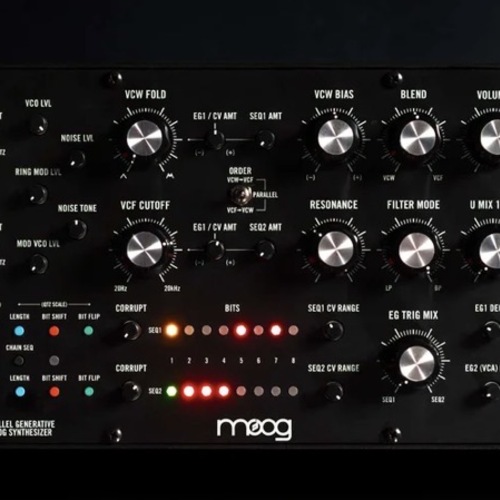
The Labyrinth's synthesis engine is powered by two oscillators, enhanced by a voltage-controlled wavefolder for a spectrum of sonic possibilities, from harmonic richness to gritty textures. A state-variable filter morphs seamlessly between lowpass and bandpass, adding another layer of tonal versatility. The comprehensive 32-point patch bay ensures that the Labyrinth can easily integrate with any existing modular setup, offering endless opportunities for sonic exploration and expansion.
Whether you're a composer, producer, or live performer, the Moog Labyrinth offers a playground of sound that inspires creativity and innovation, making it a must-have for any serious musician's arsenal.
Key Features:
- Dual generative sequencers for evolving rhythmic and melodic patterns
- Two oscillators with West Coast-style wavefolder control
- State-variable filter with lowpass/bandpass morphing
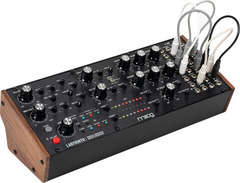
- Comprehensive 32-point patch bay for modular connectivity
- Includes power supply, patch cables, and custom patch sheet overlays for immediate playability
Owner's manual
Moog Labyrinth User ManualProduct specs
| Type | Parallel Generative Synthesizer |
| Analog/Digital | Analog |
| Other Controllers | VCO Frequency, Mod VCO Frequency, Tempo, VCW Fold, VCF Cutoff |
| Oscillators | 2 x Analog VCO |
| Filter | 2-pole State Variable Filter, Lowpass/Bandpass Morphing |
| Sequencer | 2 x 8-step Generative Digital Sequencers |
| Analog Outputs | 1 x 1/4" (main/headphones) |
| MIDI I/O | 1 x 1/8" In |
| Other I/O | 32-point Patch Bay |
| Features | Patch Overlay Sheet, 5 x 12" Patch Cables Included |
FAQs
-
Is the Moog Labyrinth suitable for beginners in modular synthesis?
-
The Moog Labyrinth, with its semi-modular design and dual sequencers, is ideal for those with some understanding of synthesis but eager to explore generative soundscapes. Beginners might find the patch bay and advanced features challenging without prior experience.
-
What are the standout features of the Moog Labyrinth's sound engine?
-
The Moog Labyrinth features dual analog VCOs, a VC wavefolder, and a 2-pole state variable filter capable of lowpass and bandpass morphing, allowing for rich and dynamic sound creation.
-
Can the Moog Labyrinth be integrated with other modular systems?
-
Yes, the Moog Labyrinth includes a 32-point patch bay, enabling seamless integration with other Eurorack and modular setups, enhancing its versatility in complex sound design.
-
What kind of sounds can I create with the Moog Labyrinth?
-
The Moog Labyrinth excels in creating generative patterns, evolving textures, and intricate layers, making it suitable for ambient, experimental, and electronic music genres.
-
Does the Moog Labyrinth require a power supply?
-
Yes, the Moog Labyrinth requires a standard power supply, which is typically included, to operate its analog components and digital sequencers effectively.
-
How does the Moog Labyrinth's sequencer differ from traditional sequencers?
-
The Moog Labyrinth features two 8-step generative digital sequencers that allow for complex, evolving sequences, offering more dynamic and unpredictable performance compared to traditional step sequencers.
Videos

ANDREW HUANG
Moog Labyrinth - their best release in years

Moog Labyrinth - their best release in years
ANDREW HUANG
Moog Labyrinth - Demo and Review

Red Means Recording

Moog Labyrinth | First Look | Sound Examples | Thomann

Thomann Synthesizers
Moog Labyrinth: Explained & Generative Techno Jams

mylarmelodies
Moog Labyrinth Semi-Modular Synth: Overview + Explorations

Sarah Belle Reid
How Moog Labyrinth & Plaits/Braids could power a live set
mylarmelodies
MOOG LABYRINTH: Can You Tame Chaos? // A Synth Review

The Midlife Synthesist
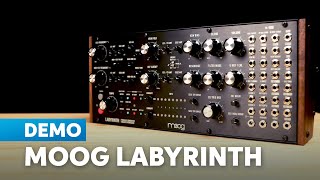
Moog Labyrinth Demo: Designed to Inspire, Built for Exploration

Sweetwater
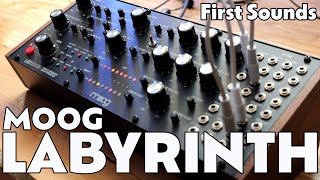
Exploring the Moog Labyrinth | Overview & User Experience | First Sounds

Braintree56
Reviews
PROS
-
Offers unique generative sequencing and modulation, ideal for experimental music
-
Dual generative sequencers provide expanded functionality, akin to Turing Machine Eurorack
-
High-quality Moog build with wood side panels and versatile patch bay
-
Unconventional sound design, blending rhythmic manipulation with melodic patterns
-
Expanded wave folder adds new dimensions to sound creation
-
Sequences can be frozen to capture spontaneous creative moments
-
Perfect for those seeking to expand beyond traditional Moog sounds
-
Compatible with other semi-modular gear, enhancing modular systems
-
Delivers classic Moog mono synth sound with unexpected twists
-
Encourages experimentation with a cheat sheet for easier learning
CONS
-
Lacks the traditional Moog sound; may not satisfy purists
-
Steep learning curve with non-standard terminology
-
Thin tonal quality in upper registers; may need external effects
-
Small knobs can be difficult to manipulate without add-ons
-
Limited CV control over key parameters like "Corrupt" and "Mod → VCO FM AMT"
-
Filter can clip at high resonance, causing intermodulation issues
-
No printed manual; requires online download
-
Not ideal as a standalone instrument; benefits from additional equipment
Owner Insights
We analyzed real musician discussions from forums and Reddit to find what players love, question, and tweak about Moog Labyrinth.
Features and functionality
-
Lacks a standard ADSR envelope, only offering a decay envelope, resulting in sharp attack and more percussive sounds.
Source -
The synth is not only generative; users can manually input steps by adjusting sequencer knobs.
Source -
Feeding input to the Labyrinth's clock initiates sequencer run/stop, simplifying integration without needing separate MIDI input for basic sequencing operations.
Source -
The Labyrinth's wavefolder is praised for enhancing bass sounds, complementing other modules like the DPO for thick, rich tones.
Source -
The Labyrinth allows for live manipulation of sequences, including adding ratchets and accents on the fly, which enhances its playability during jam sessions.
Source
Use cases and applications
-
Ideal for those interested in creating loopy techno or generative soundscapes, particularly with a focus on live performance.
Source -
Appeals to users wanting a physical instrument with a focus on sequencing rather than keyboard play.
Source -
Labyrinth integrates well as a controller for other modules, allowing sequences to be multed out, enhancing its utility in larger modular setups.
Source -
The Labyrinth is described as becoming "all kinds of crazy things," offering vast creative potential for those willing to explore its capabilities.
Source
Comparisons
-
Compared to Moog Mother 32, the Labyrinth is less suitable for conventional play as it can't be played like a normal synth via MIDI.
Source -
Many users find the Labyrinth more flexible and deeper than the Subharmonicon, which tends to be more standalone and less integrated with external modules.
Source -
Some consider the Labyrinth to be a more powerful variant of the DFAM, suggesting a preference for those seeking more versatility in their modular setup.
Source
User experience
-
Owners suggest using patch sheets to navigate its complexity, which may not be beginner-friendly.
Source -
Despite its large HP footprint, the Labyrinth's sequencer and voice functionalities are highly valued, particularly when paired with robust sequencers like the Hermod+.
Source -
Owners often choose to sequence the Labyrinth externally despite enjoying its manual sequencer walkthrough, indicating a preference for external integration.
Source
Critic Reviews
Based on 0 Reviews and 0 Ratings
Artist usage
Add artist
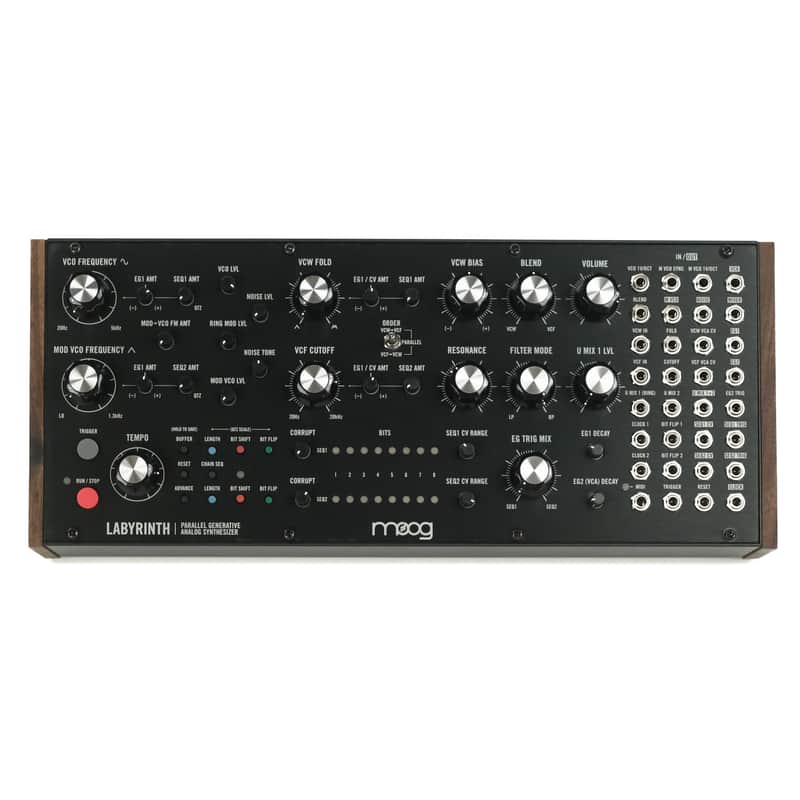
A Reverb listing for the Moog Labyrinth Signed By deadmau5 sold through the Official deadmau5 Reverb Shop, in condition used/mint. The listing page states that all items in the Official deadmau5 Reverb Shop come with a signed Certificate of Authenticity.


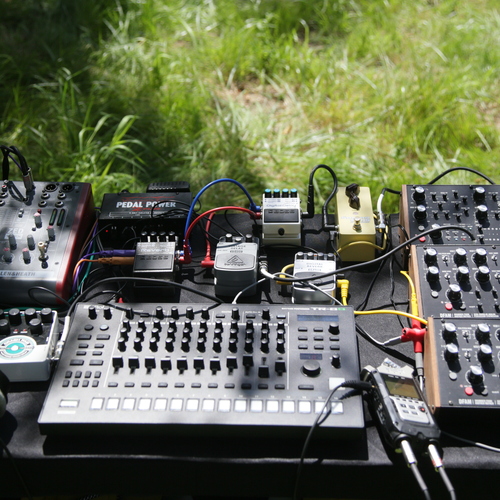
In an interview with MusicTech, it was confirmed that Carl Cox utilizes the Moog Labyrinth as part of his music production process. He integrates the Moog Labyrinth along with the Moog DFAM and Roland TR-8S into the V10 mixer, connects them to Ableton, and records his sessions to create music.
Source: https://musictech.com/features/interviews/carl-cox-evolution-ultra-music-festival/


In this review and demo, Andrew Huang discusses the Labyrinth from Moog. He says:
This is my favorite instrument to come out in ages because it just constantly gives you these delightful surprises. You have to always be recording when you're using it because you're able to transform the sounds and sequences so quickly. You can never fully predict where you're gonna end up with it, even though you can steer it in a lot of ways. It's really genius.


Album Usage
The Moog Labyrinth has been featured on the following albums:
Genre Usage
Based on how artists on Equipboard use this gear, it is most commonly found in the following genres.
Used With
Based on how musicians on Equipboard use Moog Labyrinth, it is most commonly used with the following gear.


Community setups
Show yours


More Moog Modular Synthesizers

$1,750.00


.png?v=1783959784)


$290.00 - $315.00
in Modular Synthesizers Rank


$119.00
in Modular Synthesizers Rank


$1.29 - $3,421.95
in Modular Synthesizers Rank


$599.00
in Modular Synthesizers Rank


$489.00 - $682.77
in Modular Synthesizers Rank

$575.62
in Modular Synthesizers Rank


$62.00 - $98.00
in Modular Synthesizers Rank


$132.00 - $179.99
in Modular Synthesizers Rank


$84.00 - $110.00
in Modular Synthesizers Rank


$225.00
in Modular Synthesizers Rank


$95.20 - $225.00
in Modular Synthesizers Rank


$222.85
in Modular Synthesizers Rank
.jpg?v=1783828865)

Accessories & Related Items


-s.webp?v=1783951308)
-s.webp?v=1783984033)


Similar


Most Popular Modular Synthesizers
Most Popular Brands
-
Added to Equipboard on by
 michael
GearIQ 42751
-


