

Pricing and availability
We compare 600+ stores and found this item at 1 store. Prices updated .
Store
Reviews
Price




* Product prices and availability are updated by Equipboard every 24hrs and are subject to change. Equipboard may receive compensation for purchases made at participating retailers linked on this site. This compensation does not affect what products or prices are displayed, or the order of prices listed. For more information, please refer to our affiliate disclosure.
Description
Released in 1984 the MKS-80 is basically a refined Jupiter 8 in a module. It is called the Super Jupiter and it is very fat and very analog! Its great sound is due in part to the classic analog Roland technology in its filters, modulation capabilities and a thick cluster of 16 analog oscillators at 2 per voice. It comes in a 2 space rack-module - no keyboard here. Tons of editing capabilities, although editing is tedious. It's got all the classic sounds of the Jupiter synths and so much more. An excellent choice for ambient drones, pads, blips, buzzes and leads.
Product specs
| Brand | Roland |
| Model | MKS-80 Super Jupiter Rackmount Sound Module with MPG-80 Programmer |
| Year | 1984 - 1989 |
| Made In | Japan |
| Categories | Analog Synths, Rackmount Synths |
| Analog / Digital | Analog |
| MIDI I/O | MIDI Input, MIDI Output, MIDI Through |
| Polyphony | 8 Voices |
FAQs
-
Is the Roland MKS-80 Super Jupiter polyphonic or monophonic?
-
The Roland MKS-80 Super Jupiter is a polyphonic synthesizer with 8 voices, allowing for rich, layered sound production.
-
What type of synthesis does the Roland MKS-80 use?
-
The Roland MKS-80 utilizes analog synthesis, providing warm and classic synth tones characteristic of the 1980s era.
-
Can the Roland MKS-80 Super Jupiter be controlled via MIDI?
-
Yes, the Roland MKS-80 features MIDI Input, Output, and Through, making it compatible with various MIDI controllers and sequencers.
-
What is the main advantage of using the MPG-80 programmer with the MKS-80?
-
The MPG-80 programmer offers hands-on control over the MKS-80's parameters, making it easier to tweak and customize sounds in real-time.
-
How does the sound of the Roland MKS-80 compare to other Roland synthesizers from the same era?
-
The MKS-80 is known for its powerful, versatile sound, often compared to the Jupiter-8, but in a rackmount format, offering a wide range of classic analog tones.
Videos

Espen Kraft
Roland MKS-80 Super Jupiter | Analog 80s Power!
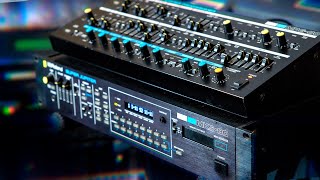
Roland MKS-80 Super Jupiter | Analog 80s Power!
Espen Kraft
Roland MKS-80 Super Jupiter - Favourite patches

roboticrealm
Roland MKS-80 Super Jupiter (Rev4) ALL STOCK PATCHES - NO TALKING

MR TUNA Music
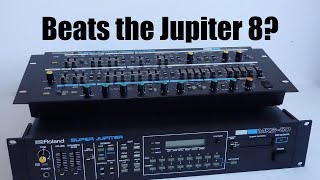
7 mins of Roland MKS80 Sounds - Uninterrupted! #SuperJupiter

Andy Whitmore
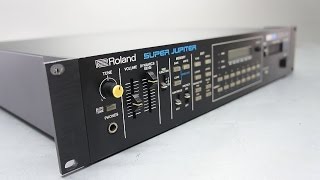
Roland MKS-80 Super Jupiter Analog Synthesizer - Synth-Pop Demo, by al l bo

Alexander Biber
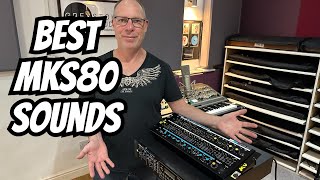
Super Jupiter: Unlocking the Best MKS80 Sounds
Andy Whitmore
Reviews
PROS
-
V4 version offers unique sounds not replicable in V5 due to circuitry differences
-
Deeper sound at the XLR connector compared to other Roland synths
-
Considered a generational improvement over the Jupiter-8
-
Offers functionalities Jupiter-8 lacks: Unison solo, Unison detune, Last note priority
-
Allows different key modes for upper and lower in split mode
-
Cross mod depth controlled by ENV 1 adds versatility
CONS
-
V5 MKS80's sound quality and circuitry not preferred by some users
-
Not a discrete instrument like the JP8, which may affect tonal quality for purists
Owner Insights
We analyzed real musician discussions from forums and Reddit to find what players love, question, and tweak about Roland MKS-80 Super Jupiter.
Setup and maintenance
Comparisons
-
Despite owning a Jupiter-6 and Juno-106, owners find the MKS-80 distinct with its unique character when paired with the MPG-80 programmer.
Source
Features and functionality
-
The MPG-80 programmer uses sysex, not MIDI, offering a tactile programming experience unique to the MKS-80.
Source -
Envelope key follow on the MKS-80 shortens decay and release times as you ascend the keyboard, enhancing expressiveness.
Source -
The MKS-80 includes velocity sensitivity, a highly underrated feature that adds dynamic control to its vintage sound.
Source
User experience
Critic Reviews
5.0 out of 5
Based on 0 Reviews and 8 Ratings
Artist usage
Add artist

Atari 1040 ST, Atari Mega ST 4, Roland: Super JX 10, S 50, D 50, MKS 80, MKS 30, U 110, MPG 80; Akai X 7000, Fairlight, Yamaha TX 81 Z, Akai S 612, Korg DVP 1, Roland SRV 2000, Korg SDD 1200, Ibanez SDR 1000, Eventide Harmonizer, 3x Hohner HS-1/E, 2x Klark EQ, Arsonic-Sigma 5.2, EMS Synthi A, and others...


Mentioned in a "studio gear" list in a 2001 interview with Rocket Baby.


The Body Bags score was composed using Digital Performer software running on a Macintosh Iicx computer. Sampling was done with an Emulator IIIxp and a Forat F16. Other electronic instruments include Hammond B3, Wurlitzer electric piano, MicroMoog, Roland MKS80, D550, Prophet VS, Yamaha DX and TX series, EMU Proteus 1 and 2, Korg M1r and M1rex, and an AKAI 612.
The score was digitally recorded using Alesis ADATs and BRC and John Hardy microphone preamps. Microphones included AKG414, Shure VP88 and SM57. The music was mixed on a custom Speck Electronics model 62 console. Signal processors used include: Behringer MDX 2000, SNR 802, DBX165a, B&B and Troisi cq, Dyna-Mite, Aphex expander gates, Lexicon and Yamaha Reverbs, Zoom, TC and Korg delays. Additional DSP and editing done in Sound Designer/Sound Tools. -John Carpenter


For Very they used: Korg M1Rs Akai S1000s Akai S3000s Roland S770 E-mu Systems Proteuses Oberheim Matrix 1000 Roland MKS80s Roland MKS50s PPG Waveterm Roland JD800 Roland Juno 106 Sequential Circuits Prophet V Roland R70 Fairlight CMI Macintosh running Notator Logic Dynaudio monitors This is according to Music Technology magazine (Dec 1993)


You’ve joined the Philip Glass Ensemble in 1974. I guess the live rig has changed a few times over all these years. Could you share with us how your setup has evolved until the latest pre-Bidule setup?
When I joined, the keyboards consisted of 3 Farfisa Mini-Compact organs. That was it. Over the years of my involvement, the Ensemble went through a series of migrations to new hardware. The first was the replacement of one of the Farfisas by a Yamaha YC45-D dual manual electric organ, a wonderful machine with touch sensitivity and adjustable percussive attack. After that, we added an Arp Explorer synthesizer. Next came a Sequential Circuits Prophet 5, then an Oberheim OBXa, then a Yamaha Dx7 (one of the first in the US, hand-carried back from a tour in Japan), then an Emulator I sampler (serial #002), then a Roland Juno-106 and a Roland JX3P, and an Emulator II sampler, and then, as we adopted MIDI controllers and rack modules, a Roland Super Jupiter, a Yamaha TX-816 rack and a YTX-802, several Oberheim Matrix-6R. and a number of Akai S-900 samplers, later replaced with Digidesign Samplecell I cards running on Mac IIs.


Harry Gregson-Williams's LA studio complex, Wavecrest Music, commenced operations in Venice Beach in August 2003, and comprises three floors of editing suites, mix rooms and a live room, as well as Harry's own studio on the top level. This houses the following gear:
Sequencing and digital audio
*Steinberg Cubase SX and Ableton Live running on dual 3.6GHz Xeon server with 4GB RAM, two RME HD*SP 9652 soundcards, 75GB mirrored SATA system drives and 400GB mirrored SATA audio/sample storage drives. MIDI is streamed over LAN to Gigastudio PCs, and an Emagic Unitor 8 and AMT8 are used for hardware synths. *Pro Tools HD Accel system running on dual 2GHz Apple G5, with one 192 Analog and seven 192 Digital interfaces.
Samplers
*14x Emu E4X. *24x Roland S760. *7x 3.0GHz Pentium 4 PCs with 80GB SATA system drives, RME HDSP 9652 soundcards and 250GB SATA sound drives with custom and commercial sound libraries, running Tascam Gigastudio 3.
Software synths and plug-ins
*Arturia ARP 2600, Minimoog V and CS80. *Antares Filter and Auto-Tune. *Applied Acoustics Lounge Lizard. *Gmedia Imposcar and Oddity. *GRM Tools. *Korg Legacy Collection. *Native Instruments Absynth 3, Battery 2, FM7, Kontakt 2, Pro 53, Reaktor 4. *Ohm Force Ohm Boyz. *Spectrasonics Stylus RMX, Atmosphere and Trilogy. *Steinberg D'Cota, X-Phraze, Virtual Guitarist, VG Electric Edition, Groove Agent and Halion.
Hardware synths
*Access Virus, Indigo 2 and Redback. *Clavia Nord Rack, Nord 3 KB and Nord Modular. *Korg Trinity Pro X, Wavestation A/D and M1R. *Novation Supernova II Pro. *Roland JP8080, JD990, JV1080 and MKS80. *Studio Electronics SE1, ATC1 and Omega 8. *Waldorf Q, Microwave II, Microwave XT and Pulse.
Recording, mixing & outboard
*Avalon 727 preamp. *Eventide DSP4000 effects. *Lexicon PCM80 and 90 reverbs. *Quested HQ108 speakers in 5.1 setup. *5x Yamaha 02R digital mixers.

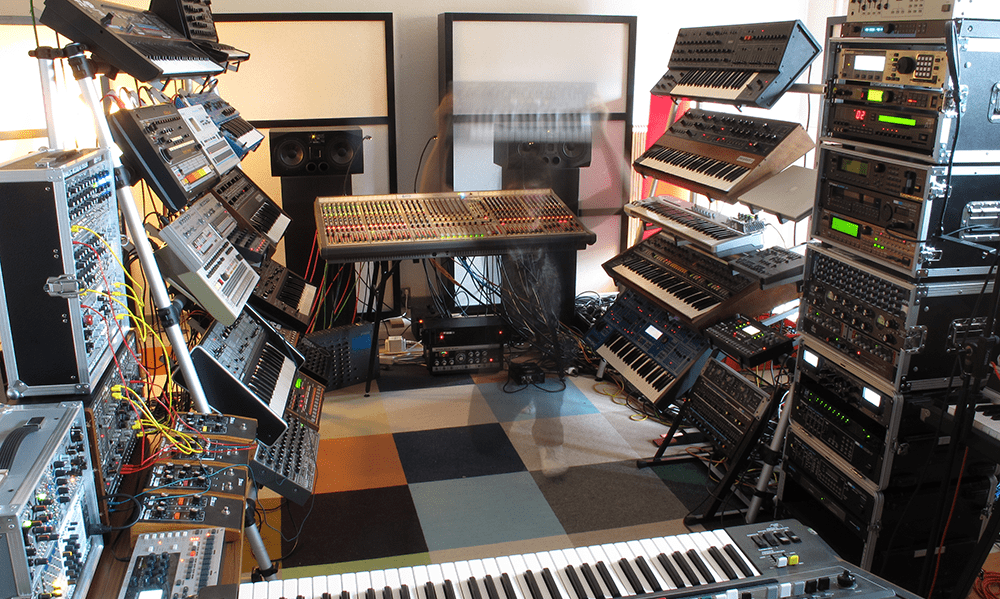
In his My Studio feature for Attack Magazine, Mathew Jonson writes: "Lots of rack synths over there too: MKS-80, MKS-30, MKS-7, MKS-70…"


"There are three sound sources", he explains. "There's an Akai S900 which has samples transferred from the Fairlight Series III, a Roland Super Jupiter and a Roland MKS20 piano module. All of those go into an Akai MIDI mixer and through two effects: a Yamaha SPX90 and an Alesis Midifex. They're all mapped by a Cooper Electronics MIDI Link, and I play them from a KX5 slung round my neck and a couple of Yamaha pedals. They put out program numbers to the MIDI link and that sends out separate program numbers to everything else. In other words I'll build up an entire patch with sound sources, a mix, effects and a stereo output, and store it. Then, when I send one program number into it from either the keyboard or from the pedal, it'll send the appropriate numbers out."


From the FAQ page found on The Enigma Archive: "From the credits of various albums, it is known that Michael Cretu uses or has used the Waveframe 1000, Audi Frame Workstation, MIDIMoog, PPG System, Korg M1, C-Lab Notator, Takamine 6 and 12 String, Tom Anderson Electric Guitars, Otari DTR-900, Akai 900, Linn 9000, Prophet 2002, X-Pander, EMS Vocoder, DX-7, and Roland Super Jupiter."


On the Reverb site Deb Demure talks about his guitars, pedals, amps, synths and softwares he uses in Drab Majesty

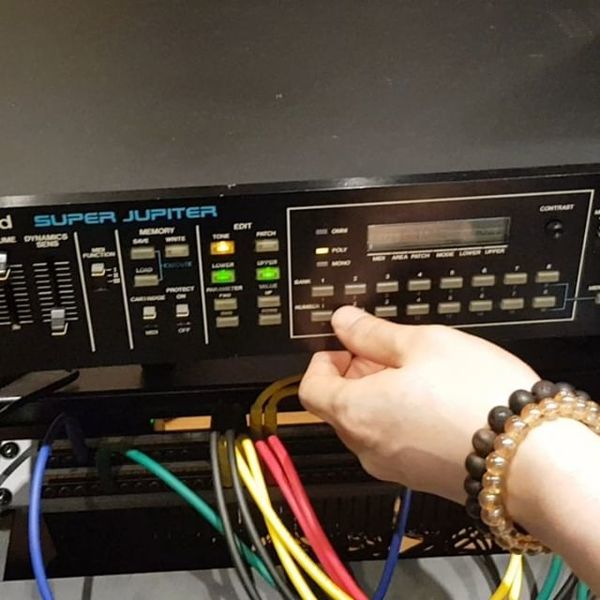


"I'm using a rack system, composed of two Oberheim DPX-1 sample players, which play Mirage, Prophet, and Emulator disks. I've also got a rack-mounted DX7, a Roland digital piano module, a Roland Super Jupiter module, and a Roland DP-5 multi-effects unit. It's all controlled by a Simmons computer mixer, which has about 64 programs in it. Through that mixer I change all the MIDI channels on all the modules. I control the mixer through a Roland MIDI MKB-200 keyboard controller. You can assign split points to the keyboard, so I do that for a lot of songs where there is, say, a piano, a koto, then a trumpet sound. Rather than take an Emulator and things like that on the road, I wanted a very easy live setup, so that I could do most of the work beforehand. That's another reason for having those two Oberheim sample players. An Emulator disk takes a long time to load, and you can't say, "Sorry, Madison Square Garden, I've gotta load this disk." We've worked out a system where we can keep switching back and forth [between the DPX-1s]. The only other alternative would be to use something like a hard disk, which I don't really want to do because the hard disk has to be installed in the Emulator and is notoriously unreliable on the road. The good thing about having a rack system is that it can be well protected. You can throw it off the back of the truck and nothing will happen to it."
Album Usage
The Roland MKS-80 Super Jupiter has been featured on the following albums:


Genre Usage
Based on how artists on Equipboard use this gear, it is most commonly found in the following genres.
Used With
Based on how musicians on Equipboard use Roland MKS-80 Super Jupiter, it is most commonly used with the following gear.


Similar
Add recommendation3 alternative and related items for Roland MKS-80 Super Jupiter, curated by the Equipboard community.

$7.53 - $479.99
The JP-08 offers an affordable, 4-voice, DSP-based take on the classic Roland Jupiter sound.

$19,535.25

$4,295.00
More Roland Sound Modules
-m.webp?v=1783238222)
$350.00
in Sound Modules Rank


$1,200.00 - $1,999.99
in Sound Modules Rank


$1,350.00
in Sound Modules Rank


$298.54
in Sound Modules Rank


$630.00
in Sound Modules Rank


$119.00
in Sound Modules Rank


$500.00
in Sound Modules Rank


$1,250.00
in Sound Modules Rank


$500.00
in Sound Modules Rank


$199.99
in Sound Modules Rank


$200.00
in Sound Modules Rank


$30.00
in Sound Modules Rank


$330.00
in Sound Modules Rank


$349.00
in Sound Modules Rank


$575.00
in Sound Modules Rank


$140.00
in Sound Modules Rank


$154.00
in Sound Modules Rank


$59.71
in Sound Modules Rank


$1,699.99
in Sound Modules Rank


$200.00
in Sound Modules Rank


$200.00
in Sound Modules Rank


$627.41
in Sound Modules Rank


$200.00
in Sound Modules Rank


$125.48
in Sound Modules Rank


$2,248.00 - $2,899.99
in Sound Modules Rank


$15.00
in Sound Modules Rank


$1,045.69
in Sound Modules Rank


$2,450.00
in Sound Modules Rank


-m.webp?v=1783238730)


Community setups


Most Popular Sound Modules
Most Popular Brands
-
Added to Equipboard on by
 michael
Gear IQ 42641
-


