

Pricing and availability
We compare 600+ stores and found this item at 1 store. Prices updated .
Store
Reviews
Price




* Product prices and availability are updated by Equipboard every 24hrs and are subject to change. Equipboard may receive compensation for purchases made at participating retailers linked on this site. This compensation does not affect what products or prices are displayed, or the order of prices listed. For more information, please refer to our affiliate disclosure.
Description
Released in 1984 the MKS-80 is basically a refined Jupiter 8 in a module. It is called the Super Jupiter and it is very fat and very analog! Its great sound is due in part to the classic analog Roland technology in its filters, modulation capabilities and a thick cluster of 16 analog oscillators at 2 per voice. It comes in a 2 space rack-module - no keyboard here. Tons of editing capabilities, although editing is tedious. It's got all the classic sounds of the Jupiter synths and so much more. An excellent choice for ambient drones, pads, blips, buzzes and leads.
Product specs
| Brand | Roland |
| Model | MKS-80 Super Jupiter Rackmount Sound Module with MPG-80 Programmer |
| Year | 1984 - 1989 |
| Made In | Japan |
| Categories | Analog Synths, Rackmount Synths |
| Analog / Digital | Analog |
| MIDI I/O | MIDI Input, MIDI Output, MIDI Through |
| Polyphony | 8 Voices |
FAQs
-
Is the Roland MKS-80 Super Jupiter polyphonic or monophonic?
-
The Roland MKS-80 Super Jupiter is a polyphonic synthesizer with 8 voices, allowing for rich, layered sound production.
-
What type of synthesis does the Roland MKS-80 use?
-
The Roland MKS-80 utilizes analog synthesis, providing warm and classic synth tones characteristic of the 1980s era.
-
Can the Roland MKS-80 Super Jupiter be controlled via MIDI?
-
Yes, the Roland MKS-80 features MIDI Input, Output, and Through, making it compatible with various MIDI controllers and sequencers.
-
What is the main advantage of using the MPG-80 programmer with the MKS-80?
-
The MPG-80 programmer offers hands-on control over the MKS-80's parameters, making it easier to tweak and customize sounds in real-time.
-
How does the sound of the Roland MKS-80 compare to other Roland synthesizers from the same era?
-
The MKS-80 is known for its powerful, versatile sound, often compared to the Jupiter-8, but in a rackmount format, offering a wide range of classic analog tones.
Videos

Espen Kraft
Roland MKS-80 Super Jupiter | Analog 80s Power!
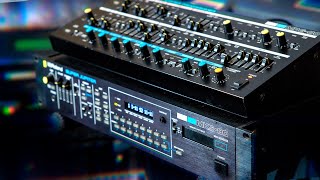
Roland MKS-80 Super Jupiter | Analog 80s Power!
Espen Kraft
Roland MKS-80 Super Jupiter - Favourite patches

roboticrealm
Roland MKS-80 Super Jupiter (Rev4) ALL STOCK PATCHES - NO TALKING

MR TUNA Music
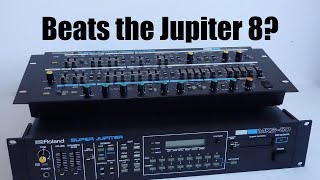
7 mins of Roland MKS80 Sounds - Uninterrupted! #SuperJupiter

Andy Whitmore
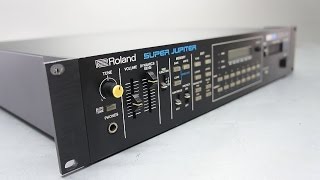
Roland MKS-80 Super Jupiter Analog Synthesizer - Synth-Pop Demo, by al l bo

Alexander Biber
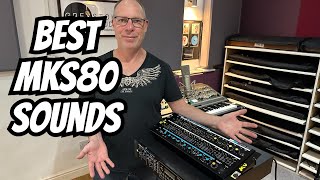
Super Jupiter: Unlocking the Best MKS80 Sounds
Andy Whitmore
Reviews
PROS
-
V4 version offers unique sounds not replicable in V5 due to circuitry differences
-
Deeper sound at the XLR connector compared to other Roland synths
-
Considered a generational improvement over the Jupiter-8
-
Offers functionalities Jupiter-8 lacks: Unison solo, Unison detune, Last note priority
-
Allows different key modes for upper and lower in split mode
-
Cross mod depth controlled by ENV 1 adds versatility
CONS
-
V5 MKS80's sound quality and circuitry not preferred by some users
-
Not a discrete instrument like the JP8, which may affect tonal quality for purists
Owner Insights
We analyzed real musician discussions from forums and Reddit to find what players love, question, and tweak about Roland MKS-80 Super Jupiter.
Setup and maintenance
Comparisons
-
Despite owning a Jupiter-6 and Juno-106, owners find the MKS-80 distinct with its unique character when paired with the MPG-80 programmer.
Source
Features and functionality
-
The MPG-80 programmer uses sysex, not MIDI, offering a tactile programming experience unique to the MKS-80.
Source -
Envelope key follow on the MKS-80 shortens decay and release times as you ascend the keyboard, enhancing expressiveness.
Source -
The MKS-80 includes velocity sensitivity, a highly underrated feature that adds dynamic control to its vintage sound.
Source
User experience
Critic Reviews
5.0 out of 5
Based on 0 Reviews and 8 Ratings
Artist usage
Add artist
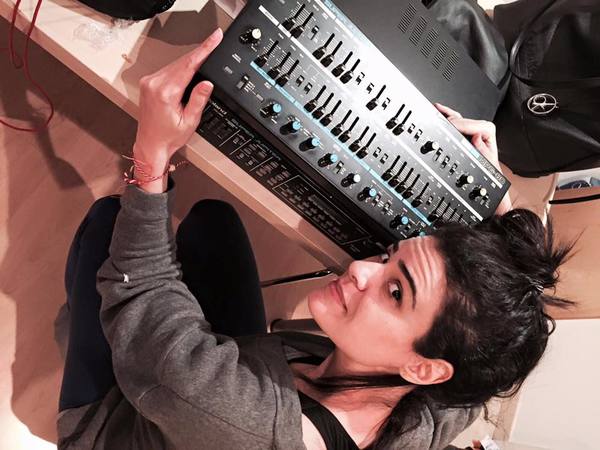
"Welcome home Super Jupiter, luv you already ??" In her home studio March 7, 2016


Although boasting a lush sound, the album was recorded largely at Paul's Rhythm Ranch studio on a single tascam 16-track with a Studiomaster desk. Synths used include: Roland D-50, Akai S1000 and S3000, Kork M1R, Waldorf Microwave, Roland Super Jupiter module, Oberheim Matrix 1000, Yamaha TX802, Minimoog, MIDIMoog, Oberheim Two-Voice, Roland Jupiter 8 and SH-101.


Roland MKS80 Super Jupiter is included in the list of synths at Daniel Miller's home studio.

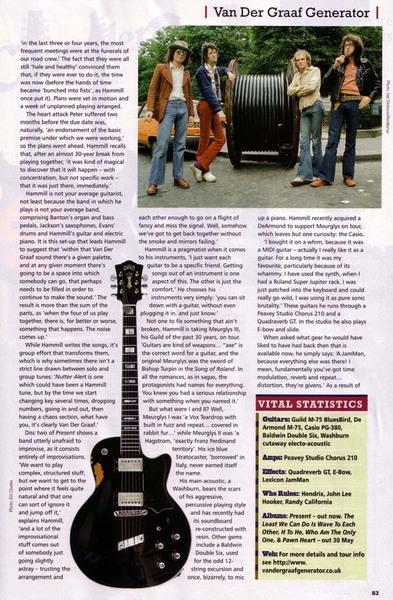
In a photo from Vandergraafgenerator, Peter Hammill is shown using a Roland MKS-80 Super Jupiter, highlighting its role in his setup.

In this recorded podcast uploaded to youtube, Ed Upton of DMX Krew talks through the process of making a track using his studio equipment. He starts to talk about the Roland MKS-80 at 25:16.
"This is a synth called a Roland MKS-80 Super Jupiter - which is a rack mount from their very famous Jupiter range of synths. It sounds a little bit like a Jupiter 8 and a little bit like a Jupiter 6, but not exactly like either of them. It's got quite an aggressive, almost digital sound for an analogue synth. And er, It's the only polyphonic analogue synth I own, which means it's the only one you can play chords on. I've got digital stuff you can play chords on, but this is the only old school analogue job. And I feel like making some kind of thin sawtooth sound to play some chords on, so let's have a little play. I've got a programmer attached to it, which is also made by Roland, which let's you programme it very simply using sliders."


In a video by Point Blank Music School titled "Style Guide: House - Part 2 (Making a House Track in Ableton Live)," the Freemasons are seen using the Roland MKS-80 Super Jupiter synthesizer.


Keyboards and synthesizers feature in Morcheeba's studio, and the collection includes a Roland Super Jupiter MKS80, a Novation BassStation, a Hammond organ and a Wurlitzer electric piano. But first prize for pure weirdness goes to the EMS Synthi A -- a 1970s beast in a box that was originally designed as a teaching tool and a portable version of the desktop VCS3 which features so heavily on Dark Side Of The Moon.


Taken from Arjen's website, Info tab: Studio Equipment.


Stephin is credited using this equipment in the liner notes for 69 Love Songs.


The man behind Burn Burn Satellite creation (the English translation of SSS), Tony James, has five channels of bass on stage Di'd for the FOH sound and played through a pair of Ampeg SVT stacks for stage monitoring: a Roland synth bass guitar with foot controller providing a balanced XLR stereo output, a Roland Super Jupiter (MKS-80) with another balanced XLR stereo output and a Yamaha DX-7.


The tenth photo shows his studio and is captioned: "Marius de Vries now does most of his programming work in his own room at London's Strongroom studios. The large rack at left contains, from top, Alesis DM Pro drum module, Korg O1R/W sound module, Roland MKS80 Super Jupiter synth with MPG80 programmer, Studio Electronics MIDIMoog synth, two Akai S3200 samplers, Emu Vintage Keys and Morpheus sound modules, Kurzweil K2000R sound module, Roland MKS50 and JV1080 sound modules."


Album Usage
The Roland MKS-80 Super Jupiter has been featured on the following albums:


Genre Usage
Based on how artists on Equipboard use this gear, it is most commonly found in the following genres.
Used With
Based on how musicians on Equipboard use Roland MKS-80 Super Jupiter, it is most commonly used with the following gear.


Similar
Add recommendation3 alternative and related items for Roland MKS-80 Super Jupiter, curated by the Equipboard community.

$7.53 - $479.99
The JP-08 offers an affordable, 4-voice, DSP-based take on the classic Roland Jupiter sound.

$19,535.25

$4,295.00
More Roland Sound Modules
-m.webp?v=1783238222)
$350.00
in Sound Modules Rank


$1,200.00 - $1,999.99
in Sound Modules Rank


$1,350.00
in Sound Modules Rank


$298.54
in Sound Modules Rank


$630.00
in Sound Modules Rank


$119.00
in Sound Modules Rank


$500.00
in Sound Modules Rank


$1,250.00
in Sound Modules Rank


$500.00
in Sound Modules Rank


$199.99
in Sound Modules Rank


$200.00
in Sound Modules Rank


$30.00
in Sound Modules Rank


$330.00
in Sound Modules Rank


$349.00
in Sound Modules Rank


$575.00
in Sound Modules Rank


$140.00
in Sound Modules Rank


$154.00
in Sound Modules Rank


$59.71
in Sound Modules Rank


$1,699.99
in Sound Modules Rank


$200.00
in Sound Modules Rank


$200.00
in Sound Modules Rank


$627.41
in Sound Modules Rank


$200.00
in Sound Modules Rank


$125.48
in Sound Modules Rank


$2,248.00 - $2,899.99
in Sound Modules Rank


$15.00
in Sound Modules Rank


$1,045.69
in Sound Modules Rank


$2,450.00
in Sound Modules Rank


-m.webp?v=1783238730)


Community setups


Most Popular Sound Modules
Most Popular Brands
-
Added to Equipboard on by
 michael
Gear IQ 42641
-


