You need to sign in or sign up before continuing.
This page about Steiner-Parker Synthacon is a stub. You can help improve it:


Pricing and availability




* Product prices and availability are updated by Equipboard every 24hrs and are subject to change. Equipboard may receive compensation for purchases made at participating retailers linked on this site. This compensation does not affect what products or prices are displayed, or the order of prices listed. For more information, please refer to our affiliate disclosure.
Description
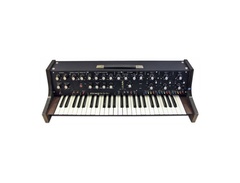
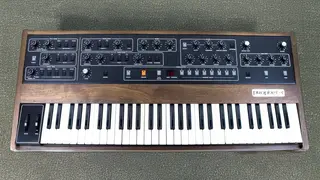
Steiner Parker is proud to announce their newest synthesizer, a small, extremely versatile unit designed for live performance and also for studio use, called the Synthacon. The Synthacon's extreme versatility is realized through the use of switching to achieve function interconnections.
No patch cords are necessary to route signals and voltages from one area to another. This switching system makes it possible to achieve over 35 billion different sounding set ups, without ever turning a knob or depressing a key on a keyboard!!! A brief summary of the unit's major features is listed here.
WAVEFORMS: Sawtooth, triangle, square wave, pulse, sine wave, and two types of noise (white and pink). OSCILLATORS: Three Voltage Controlled Oscillators plus a White/Pink Noise Generator. CONTROLS: 26 knobs, 3 trimmers and 43 switches. SECTIONS: Ten; KBD/PWR, Sample and Hold, Trigger Generator, Dual Envelope Generator, Voltage Con trolled Amplifier,
Three Mode Filter, Noise Generator, VCO No. 1, VCO No. 2, VCO No. 3. OSCILLATOR RANGES: From less than 1/10 cycle per second (Hertz) to greater than 20,000 cycles per second. FILTER MODES: Low Pass, Band Pass, High Pass. FILTER CONTROLS: Resonance (Q), Frequency, Mode.
EXTERNAL INPUTS: Four-Through the Sample and Hold, Through the Keyboard, in parallel with the Trigger Generator, and direct to the Filter (control voltages only). FILTER: The three mode variable Q filter can be switched in or out separately for each sound source.
KEYBOARD: 4 octaves, 49 keys (shown), playable over 8 octave range by use of range switch. BACK PANEL OUTPUTS: DC Ground and all operating voltages, plus keyboard control voltages. These out puts can be used to run optional modules with the SYNTHACON, (such as sequencers, etc.) which are manufactured by STEINER-PARKER as well as many optional units manufactured by other companies (using special adapter cables). Back panel connectors are also provided to allow connection to an external sound source for amplifying the Synthacon's output as well as connections for all the external inputs.
The unit is portable and features a self oscillating filter that has a reverse polarity which makes the filter keep consistent volume as the resonance is increased.
Once again the Synthacon features the same electronics as the bigger SynthaSystem including white and pink noise with multiple modulation points. It also has a 49 key keyboard built in as well as various knobs, buttons, and, switches.
Videos

Melbourne Electronic Sound Studio
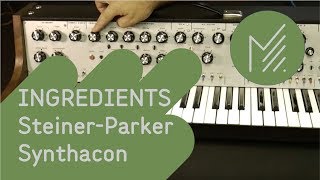
Steiner-Parker Synthacon - MESS INGREDIENT
Steiner-Parker Synthacon - MESS INGREDIENT
Melbourne Electronic Sound Studio
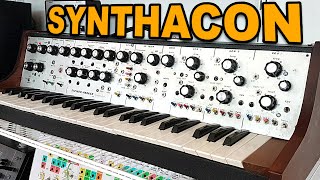
STEINER-PARKER SYNTHACON - Analog Synth Demo | Experimental Sounds

synth4ever
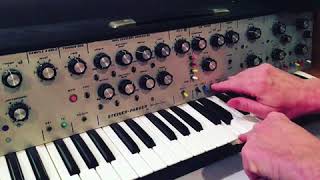
Steiner-Parker Synthacon Variations

Todd Barton
Steiner Parker Synthacon - Quick Example Demo

Chris Whitten
Steiner-Parker Synthacon Demo Ft. Samatha Glass

Switched On
EMEAPP SONIC TEST DRIVE: STEINER-PARKER SYNTHACON Feat. DON SLEPIAN

EMEAPP
Steiner Parker Synthacon vintage synthesizer

johnnyangel69
Reviews
Owner Insights
We analyzed real musician discussions from forums and Reddit to find what players love, question, and tweak about Steiner-Parker Synthacon.
Features and functionality
-
The Synthacon includes a 2-pole resonant filter capable of lowpass, bandpass, and highpass functions, known for its potent resonance and chaotic modulation capabilities.
Source -
Its three VCOs offer a wide tuning range that many modern synthesizers lack, providing unique sound exploration opportunities.
Source
User experience
-
The filter has a narrow sweet spot, requiring careful adjustments to achieve desired sounds, a challenge noted by users familiar with its operation.
Source -
The numerous switches for signal routing make it highly interactive, allowing quick adjustments and experimentation.
Source -
The modern Synthacon by Robbie Connolly, priced at $4,000, replicates the original's circuit and sound, with enhanced MIDI and IO options.
Source
Other
-
Only a few hundred units were produced, making it a rare collectible with historical significance in synthesizer design.
Source
Comparisons
-
The PolyBrute, with its feature-rich design and Steiner filter, can emulate some Synthacon characteristics but offers broader sound capabilities.
Source -
The MicroFreak, initially underwhelming to some, reveals versatility over time, serving well in diverse setups but not directly comparable to the Synthacon's unique sound.
Source
Based on 0 Reviews and 0 Ratings
Artist usage
Add artist



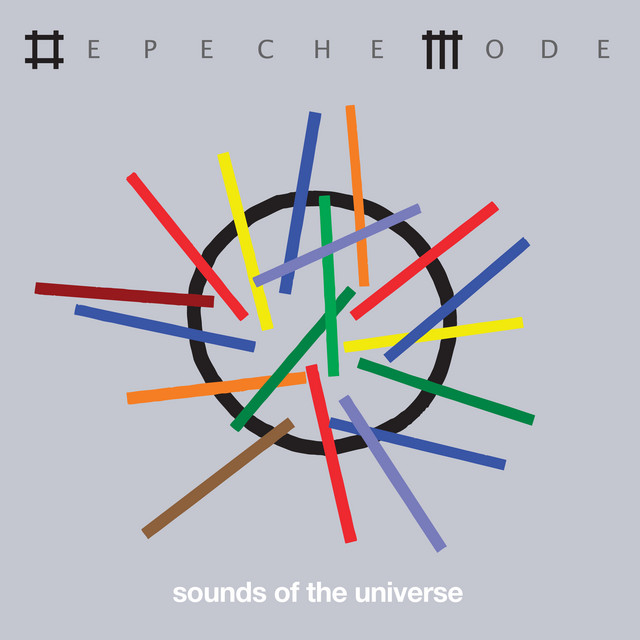
A MKI monophonic unit was on Sounds of the Universe, as is visible in this photo from a March 2009 teaser for the May 2009 Keyboard interview it is specified in.
KeyboardMag.com, March 2009, "Depeche Mode Behind the Scenes - Part I"
DM Studio Shot 2: Here’s a view of the same room from a different angle, showing the Matrix 12 at dead center. At right foreground, a Rhodes Mk. I Suitcase electric piano is holding up an extremely rare analog synth, the Steiner-Parker Synthacon.
Keyboard, May 2009, "Exploring Deeper Space on Sounds of the Universe"
One of the rarer synths that I managed to acquire was a Steiner-Parker Synthacon, which made quite a few appearances on this album. It’s got some weird note-stealing thing, if you hit it right, you can play a three-note chord — it’ll actually play all three notes at once.

Mentioned in the summary for Season of Joy on Souther's official website.
Early in the 1970's, I began exploring the world of electronic music. "The Steiner Synthacon" was the first synthesizer I ever played and it traveled the globe with me. Fast forward to 2005, my wife & I moved to the Heber Valley in Utah, where we met its inventor, Nyle Steiner. We became friends and started performing together. We never play a song the same way twice. For a couple years we had talked about doing a Christmas project... 2010 we finally put it together
Used during the era of The Two Who Do Duets, as described in the "Tom on Harold N’ Stuff" section of the liner notes booklet for The Lowest Form of Music. This is reported in the thesis "Los Angeles Noisescapes: Culture and Aesthetics in the Early Twenty-First Century Experimental 'Noise' Scenes." by Daniel L. Munoz.
The origins of their name came from a duo describing themselves as The Two Who Do Duets. Originally these two were Tom Recchion and Harold Schroeder and they began in March 1975. Recchion and Schroeder rented an 800 square foot office space as their studio for sixty-five dollars a month in the rundown “Raymond Building” at 35 South Raymond Avenue in Old Town Pasadena. “We were practically the only people in the deserted building, so we had the run of the place.”[201] Other artists followed suit, including Chip Chapman, Paul McCarthy, Phranc, and Anton Kaprow (Allan Kaprow’s son). Schroeder played a Steiner-Parker Synthacon synthesizer while Recchion played drums and other percussion and a newly acquired Farfisa organ.
Album Usage
The Steiner-Parker Synthacon has been featured on the following albums:
Genre Usage
Based on how artists on Equipboard use this gear, it is most commonly found in the following genres.
Similar
Add recommendation1 alternative for Steiner-Parker Synthacon, curated by the Equipboard community.

$279.10
The filter in the MiniBrute is based on that of the Synthacon, with oversight from Nyle Steiner himself. This is explained in The Synthesizer by Mark Vail: https://pdfcoffee.com/mark-vail-the-synthesizer-pdf-free.html
The Synthacon’s filter isn’t unique; Arturia successfully implemented—under Steiner’s guidance—this type of filter in the MiniBrute analog monosynth (2012). You can also duplicate this positive feedback response with any synth that allows you to route the filter’s output back into its input.
(...) Among the many notable features of Arturia’s affordable MiniBrute monosynth is a new version of the positive-feedback self-oscillating resonant filter Nyle Steiner created for the Steiner-Parker Synthacon. To assure they did it right, Arturia engaged Nyle himself to approve the MiniBrute’s multimode filter. Yves Usson designed its analog circuitry, and Axel Hartmann arranged the layout of its controllers.
More Steiner-Parker Synthesizers


$3,276.47 - $3,499.99
in Synthesizers Rank


$469.00 - $699.99
in Synthesizers Rank


$20,282.71
in Synthesizers Rank


$439.00 - $545.00
in Synthesizers Rank
.jpeg?v=1784917540)
.jpg?v=1784893209)

$3,333.00 - $3,499.99
in Synthesizers Rank


$999.00 - $1,084.00
in Synthesizers Rank


-m.webp?v=1784905194)
$1,100.00
in Synthesizers Rank

-m.webp?v=1784933057)
$379.00 - $499.99
in Synthesizers Rank


$715.00 - $2,398.00
in Synthesizers Rank


$2,000.00
in Synthesizers Rank


$411.00 - $699.99
in Synthesizers Rank


$277.00 - $349.00
in Synthesizers Rank


$2,199.00 - $2,950.36
in Synthesizers Rank


$1,481.52 - $1,899.00
in Synthesizers Rank


$298.61 - $652.00
in Synthesizers Rank


$1,358.25 - $1,839.99
in Synthesizers Rank


$379.00 - $549.99
in Synthesizers Rank


$492.36 - $899.99
in Synthesizers Rank


$279.00 - $449.99
in Synthesizers Rank


$230.09 - $749.99
in Synthesizers Rank


$279.10 - $1,763.18
in Synthesizers Rank


$79.99 - $495.44
in Synthesizers Rank


$325.00 - $1,332.49
in Synthesizers Rank

.jpeg?v=1784891088)
-m.webp?v=1784957805)
$1,790.00 - $1,899.00
in Synthesizers Rank


$482.44 - $699.00
in Synthesizers Rank


$499.99 - $719.99
in Synthesizers Rank


$304.92 - $915.00
in Synthesizers Rank


$3,999.00 - $4,999.00
in Synthesizers Rank


$1,469.00 - $2,159.99
in Synthesizers Rank

$290.00
in Synthesizers Rank


$479.99 - $1,099.00
in Synthesizers Rank


$166.00 - $274.95
in Synthesizers Rank


$350.00
in Synthesizers Rank


$382.00 - $449.99
in Synthesizers Rank


-m.webp?v=1784905108)
$963.47
in Synthesizers Rank

$6,600.00 - $10,444.00
in Synthesizers Rank

$29.95 - $69.99
in Synthesizers Rank


$740.00
in Synthesizers Rank


Community setups


Gear Guides






.webp)

Most Popular Synthesizers
Most Popular Brands
-
Added to Equipboard on by
 eyeseeofficial
GearIQ 161580
-


