

Pricing and availability
We compare 600+ stores and found this item at 6 stores. Prices updated .
Store
Reviews
Price








Average Price: $61
Budget/Beginner
$149
$350+
Price Tier
Budget
Standard
High-end
Price History
Based on price data from 4 merchants for "Behringer Abacus Eurorack Module". Prices shown reflect NEW condition. Tracking began Apr 2, 2026.
* Product prices and availability are updated by Equipboard every 24hrs and are subject to change. Equipboard may receive compensation for purchases made at participating retailers linked on this site. This compensation does not affect what products or prices are displayed, or the order of prices listed. For more information, please refer to our affiliate disclosure.
Description
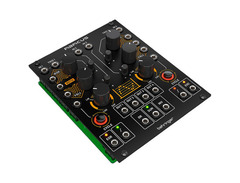
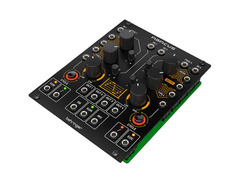
Transform your soundscapes with the Behringer Abacus Eurorack Module, a versatile addition to your modular synthesizer setup. Inspired by legendary Buchla models, this module serves as a mathematical analog processor, enabling a rich tapestry of sound design possibilities. Whether you're crafting intricate envelopes or generating LFOs, the Abacus offers exponential, logarithmic, and linear functions that cater to both triggered and continuous modulation needs.
The dual function generators come equipped with adjustable attack, decay, and curve characteristics, allowing you to sculpt sounds that range from subtle to explosive. With the ability to process and manipulate up to four control voltages (CVs) simultaneously, this module excels in blending and transforming incoming signals, making it a robust tool for both beginners and seasoned synth enthusiasts.
The Abacus doesn't just stop at modulation; it also integrates seamlessly into any Eurorack system with its 20HP size, offering LED indicators for real-time visual monitoring. Whether you seek to amplify, invert, or add effects like lag and slew to your CVs, the Abacus has the features to bring your sonic visions to life.
Key Features:
- Dual-channel function generator and CV processor
- Adjustable attack, decay, and curve settings
- Capable of generating envelopes and LFOs up to 25 minutes long and 1kHz
- 4-channel bipolar mixer for internal and external signals
- Includes outputs for signal, sum, inverted sum, and logic OR
- Power consumption: 60 mA (+12 V) / 50 mA (-12 V)
- Width: 20 HP, Depth: 24 mm
Product specs
| Type | Function Generator Module |
| Analog/Digital | Analog |
| Controls | Rise, Fall, Response, Attenuverter, Cycled |
| Analog Inputs | 4 x CV, 4 x Trig, Rise (1, 4), Fall (1, 4) |
| Analog Outputs | 1 x 1/8", 4 x CV, |
| Other I/O | OR, SUM, INV f (1,4), 1 EOR, 4EOC |
| Depth | 0.94" (2.4mm) |
| HP Size | 20HP |
| Power Usage | +12V/60mA, -12V/50mA |
| Power Supply | Requires Eurorack case and power supply |
FAQs
-
What functions does the Behringer Abacus Eurorack Module offer?
-
The Behringer Abacus is a versatile function generator module that acts as an envelope, LFO, slew limiter, attenuator, envelope follower, logic, and mixer, making it ideal for a wide range of modulation tasks in Eurorack systems.
-
How does the Behringer Abacus compare to the Make Noise Maths module?
-
The Behringer Abacus is a 1:1 clone of the Make Noise Maths, offering similar functionality and versatility as a dual-function generator with a range of modulation capabilities, but at a more affordable price point.
-
Is the Behringer Abacus suitable for beginners in modular synthesis?
-
Yes, the Behringer Abacus is user-friendly, providing a comprehensive introduction to function generators with its clear layout and versatile features, making it suitable for both beginners and experienced users in modular synthesis.
-
What are the power requirements for the Behringer Abacus Eurorack Module?
-
The Behringer Abacus requires a Eurorack case and power supply, with power usage specifications of +12V/60mA and -12V/50mA.
-
What are the main control features of the Behringer Abacus?
-
The Behringer Abacus features controls for Rise, Fall, Response, Attenuverter, and Cycled functions, allowing for detailed modulation shaping and signal processing.
Videos

Penishead
Behringer Abacus vs. Make Noise Maths THE COMPARISON review by Penishead
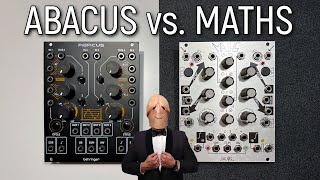
Behringer Abacus vs. Make Noise Maths THE COMPARISON review by Penishead
Penishead
Reviews
PROS
-
Excellent affordability for a Maths clone, ideal for budget-conscious musicians
-
Offers function generator, LFO, and envelope capabilities for versatile sound design
-
Great entry point for beginners exploring modular synthesis
-
Matches functionality of Make Noise Maths at a fraction of the price
-
Fits well within existing Eurorack setups, especially those with budget constraints
-
Provides creative modulation and control signal processing
-
Can be used for both live and studio electronic music production
-
Available in black, matching many modular synth setups
CONS
-
PCB-mounted jacks may lead to durability issues over time
-
Small, cramped attenuverter knobs can be uncomfortable to use
-
Lacks additional features beyond being a direct Maths clone
-
Ethical concerns over cloning existing products without innovation
-
Build quality perceived as flimsy by some users
Owner Insights
We analyzed real musician discussions from forums and Reddit to find what players love, question, and tweak about Behringer Abacus Eurorack Module.
Build quality
-
The module's build quality is seen as adequate, though not exceptional, with no significant functional issues reported by users.
Source -
Criticism arises over the Abacus's aesthetic design, with some users finding it unattractive compared to other Eurorack modules.
Source -
Abacus's attenuverter knobs are described as loose and less tactile, impacting precise adjustments during live performances.
Source
Comparisons
-
Functionally, the Abacus operates comparably to the Make Noise Maths, offering a more budget-friendly alternative without notable performance differences.
Source -
The Abacus is seen as a viable substitute for the Make Noise Maths, with users noting that Maths can be HP-heavy for basic envelope/LFO tasks.
Source -
The Abacus is compared unfavorably to the Make Noise Maths in terms of the attenuverter functionality, which is crucial for expressive patching.
Source
Use cases and applications
-
The Abacus is particularly recommended for beginners looking to explore patching, CV behavior, and applying gates, clocks, LFOs, and envelopes efficiently.
Source -
Despite its capabilities, some users prefer alternative modules like After Later Audio Tilt and Sylph Shutters for the same HP space due to additional logic functions.
Source
Value and pricing
-
For those unwilling to spend $500 on a module, the Abacus provides similar functionality as a Maths for significantly less, around $100, making it a popular budget choice.
Source -
Despite its lower price, the Abacus's lack of unique features compared to other clones raises questions about its value proposition.
Source
User experience
-
Owners report that purchasing the Abacus led to further investment in other modular gear, including Make Noise products, indicating it as a gateway to deeper modular synthesis engagement.
Source -
Some players find the mini knobs on the Abacus challenging, impacting playability, especially for functions like attenuverters.
Source -
Users report static noise issues with the Abacus outputs, implying a cheaper build quality compared to Maths.
Source
Features and functionality
Critic Reviews
Based on 0 Reviews and 0 Ratings
Genre Usage
Based on how artists on Equipboard use this gear, it is most commonly found in the following genres.
Used With
Based on how musicians on Equipboard use Behringer Abacus Eurorack Module, it is most commonly used with the following gear.


Community setups
Show yours
More Behringer Modular Synthesizers

$279.90 - $469.00
in Modular Synthesizers Rank


$77.00 - $85.00
in Modular Synthesizers Rank


$74.00 - $123.53
in Modular Synthesizers Rank


$1,175.00 - $1,899.00

$47.00 - $62.90

$81.00 - $109.00

$155.00 - $350.00


-m.webp?v=1784638430)


Accessories & Related Items


Artist usage


Similar


Gear Guides
.jpg)







Most Popular Modular Synthesizers
Most Popular Brands
-
Added to Equipboard on by
 equipboard
GearIQ 4934
-


