

Pricing and availability
We compare 600+ stores and found this item at 1 store. Prices updated .
Store
Reviews
Price




Average Price: $1,718
High-end/Boutique
$400
$1001+
Price Tier
Budget
Standard
High-end
* Product prices and availability are updated by Equipboard every 24hrs and are subject to change. Equipboard may receive compensation for purchases made at participating retailers linked on this site. This compensation does not affect what products or prices are displayed, or the order of prices listed. For more information, please refer to our affiliate disclosure.
Description
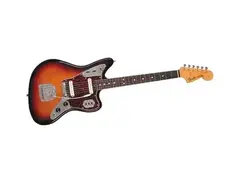
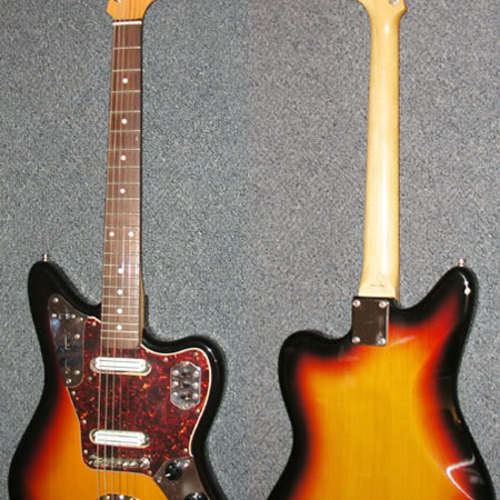
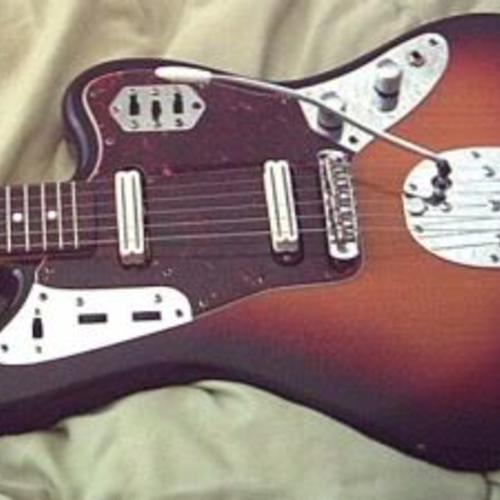
Step into a time machine with the Fender '62 Jaguar Reissue Electric Guitar, a meticulously crafted homage to Fender's innovative era. This solid body electric guitar captures the rebellious spirit of the 1960s with its iconic offset body design and legendary sound. Known for its distinct sonic versatility, the Jaguar reissue is equipped with dual single-coil pickups that deliver a crisp, punchy tone, perfect for surf rock, punk, and everything in between. The vintage-style Lead and Rhythm Circuitry provide you with a palette of tonal textures, making it easy to switch between jangly rhythms and gritty leads.
The Jaguar’s short-scale neck offers unmatched playability and comfort, allowing for intricate chord work and rapid-fire solos without breaking a sweat. Its floating tremolo system invites creative expression, letting you explore shimmering vibratos and dive-bomb effects with ease. With a classic sunburst finish that’s as visually striking as its sound, the Fender '62 Jaguar Reissue is more than just an instrument—it's a statement.
Whether you're a seasoned pro or an aspiring musician, this guitar offers a perfect blend of vintage aesthetics and modern reliability, making it a standout addition to any collection.
Key Features:
- Offset body design for vintage appeal
- Dual single-coil pickups for versatile sound
- Short-scale neck for enhanced playability
- Lead and Rhythm Circuitry for tonal variety
- Floating tremolo system for expressive playing
- Classic sunburst finish
Product specs
| Brand | Fender |
| Model | American Vintage '62 Jaguar |
| Finish | 3-Color Sunburst, Black, Candy Apple Red, Dakota Red, Fiesta Red, Ice Blue Metallic, Inca Silver, Ocean Turquoise, Olympic White, Sherwood Green Metallic, Surf Green |
| Year | 2000 - 2012 |
| Made In | United States |
| Categories | Solid Body Electric Guitars |
| Body Material | Alder |
| Body Shape | Double Cutaway |
| Body Type | Solid Body |
| Bridge/Tailpiece Type | Tremolo Tailpiece |
| Color Family | Black, Blue, Brown, Green, Red, Silver, White |
| Finish Pattern | Sunburst |
| Finish Style | Gloss, Metallic |
| Fretboard Material | Rosewood |
| Fretboard Radius | 7.25" |
| Model Family | Fender Jaguar |
| Neck Construction | Bolt-On |
| Neck Material | Maple |
| Number of Frets | 22 |
| Number of Strings | 6-String |
| Nut Width | 1.65" |
| Offset Body | Offset Body |
| Pickup Configuration | SS |
| Right / Left Handed | Right Handed |
| Scale Length | 24" |
| Series | Fender American Vintage |
| Wood Top Style | Plain |
FAQs
-
What is the neck profile like on the Fender '62 Jaguar Reissue Electric Guitar?
-
The Fender '62 Jaguar Reissue features a vintage-style neck profile with a 7.25" fretboard radius, providing a comfortable and fast-playing experience suitable for a variety of playing styles.
-
What kind of tones can I expect from the pickups on the Fender '62 Jaguar Reissue?
-
The Fender '62 Jaguar Reissue is equipped with single-coil pickups that deliver a bright, cutting tone with a distinct twang, making it ideal for genres like surf rock, punk, and indie.
-
Is the Fender '62 Jaguar Reissue suitable for beginners?
-
While the Fender '62 Jaguar Reissue is a high-quality instrument with unique features, its vintage-style setup and shorter scale length may appeal more to intermediate and advanced players familiar with its specific tonal and playability characteristics.
-
How does the shorter scale length of the Fender '62 Jaguar Reissue affect playability?
-
The 24" scale length of the Fender '62 Jaguar Reissue makes it easier to execute complex chords and bends, providing a slinkier feel that is particularly beneficial for players with smaller hands or those looking for a faster playing experience.
-
Does the Fender '62 Jaguar Reissue Electric Guitar have a tremolo system?
-
Yes, the Fender '62 Jaguar Reissue features a vintage-style tremolo tailpiece, allowing for smooth vibrato effects and adding to its classic surf rock sound.
Videos

The Fellowship of Acoustics
TFOA review - Fender Jaguar '62 Reissue 1987
TFOA review - Fender Jaguar '62 Reissue 1987
The Fellowship of Acoustics

Demo of a 1997 Fender Jaguar '62 Reissue

The Local Pickup
Reviews
PROS
-
Exceptional craftsmanship and fit, resembling pre-CBS originals
-
Versatile tone range suitable for various music genres
-
Unique floating bridge offers innovative playing style
-
Premium feel with high-quality electronics and tremolo
-
Stunning finish options and vintage aesthetics
-
Dual electronics provide extensive control options
-
Comfortable short scale neck with excellent playability
-
Durable construction, great for long-term use
-
Highly resonant with rich harmonic overtones
-
Distinctive Jaguar sound with characteristic "bite"
CONS
-
Tremolo arm may not fit securely
-
Original pickups could be microphonic and tinny
-
Machine heads may require replacement for durability
Owner Insights
We analyzed real musician discussions from forums and Reddit to find what players love, question, and tweak about Fender '62 Jaguar Reissue Electric Guitar.
Mods and upgrades
-
Staytrem bridge and trem arm/collet enhance playability; Kluson Supreme staggered 1:18 tuners improve tuning stability, especially for low E string.
Source
Features and functionality
-
The Cobain switch mod involves a short shaft toggle switch and potentially maintaining a high pass filter for easier tonal control.
Source
User experience
Setup and maintenance
-
Kluson Supreme tuners provide a better tuning experience, though low E and G strings may still tune sharp or flat without careful adjustment.
Source
Use cases and applications
-
The rhythm circuit can emulate an archtop jazz guitar sound with gain pedals, while the lead circuit can achieve classic 60s tones.
Source
Build quality
Comparisons
-
The Johnny Marr signature model is highly recommended for its versatility and quality, considered superior to standard reissues by some players.
Source
5.0 out of 5
Based on 2 Reviews and 8 Ratings

2937
Another rock solid axe from Fender Japan
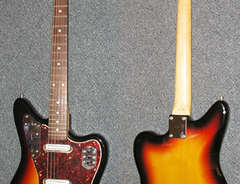
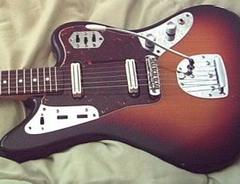
I bought my Jaguar in December of 2005, it's a 1998 Model built at the Dyna Gakki plant for Fender Japan in December 97' (Neck Date), and January 98' (Body Date). I bought mine already customized.
SPECIFICATIONS (STOCK)
NECK: Maple neck, 24" scale, 22 Vintage frets, pearl dot inlays 7.16" Fretboard radius, Kluson Ping replication tuning machines
BODY: Basswood, or Alder (mine's Alder) Jaguar style body with vintage routing
PICKUPS: 2 Fender 62' Jaguar reissue single coils, 6.4K Each, Alnico V or Ceramic Magnets
CONTROLS: Separate Rhythm and Lead Circuits, Rhythm volume, Rhythm Tone, Rhythm/Lead Selector Switch, neck pickup on/off (Lead), bridge pickup on/off (lead), Strangle/Bass Cut (lead), Lead volume, Lead tone
BRIDGE/TAILPIECE: Fender Floating Vibrato with rocker bridge with adjustable string spacing
COLORS AVAIL/COLOR COMBOS 3 Tone Sunburst w/ Tortishell Pickguard Olympic White w/ Tortishell Pickguard Candy Apple Red w/ W/B/W pickguard and Matching Headstock 3-Tone Sunburst Foto Flame (fake Flame Kodak overlay on body under finish) w/ red Tortishell White Blonde finish w/ Red Tortishell Pickguard and gold hardware
Mine came from the Guitar Hangar in December 05' with an unbranded Jaguar/Jazzmaster hardshell case, modified with a pair of Seymour Duncan SCR1B Cool Rails, 500K pots in the lead circuit (tone being a push/pull coil split for the cool rails), and a Gibson ABR-1 Tune-O-Matic filed down to fit the fretboard radius.
The original Cool Rails were found to sound so close to Jaguar pickups in timbre with the 500K pots I chose to leave those in, and put cut-off Jaguar pickup covers and Jaguar claw side-pieces onto them - all that did was redistribute the magnetic field a bit just bringing the tone more inline with a Jaguar, but with hum cancellation.
I also took out that crappy Tune-O-Matic that was chopping my hand up and eating up the strings (I use the vibrato on this guitar, HARD and OFTEN), and replaced it with a bridge identical to the one that the Japanese Jaguars regularly come with. I did, however, take some time learning the hows and whys of the Jaguar bridge on my own and came up with my own way of dealing with said bridge and it's so laughably simple. Basically, I play my Jaguar with .009's on it - most people say to put 11's or higher on them because they are short scale and heavier strings stay in place - but they actually don't because beyond a certain point, the strings being too big for the slots (especially the Low E which is the #1 culprit in this problem) can cause them to jump the saddles even more than light strings would at lighter tension because there is less material deep enough to hold them in place.
The second problem with this bridge that people misunderstand is the breakover angle, anything 10 degrees and over is sufficient enough string tension, the real problem is tolerances. The looser tolerances of guitar production say versus, something NASA would have made, are what really causes all the problems people think goes with breakover angle. Mastery gets around this by putting deeper saddles into their bridges as well as a pair of fixed allen key adjustments on a pivot for each pair of saddles. and Staytrem just uses Mustang-style saddles that are only rounded on top, cut to the radius of the guitar, and have nylon-embedded fixtures meant to hold them still. I do this on the Jaguar by cutting a strong humbucker spring in half - putting one half on the low E, the other on the High E, and angling the E string saddles upward on one side to wedge them in. Doing this makes it rock solid stable even without a shim or a breakover over 10 degrees, and it keeps the extra behind-the-bridge ringing that I love so much.
So far though, in the 10 years I've played this guitar, it's been an unstoppable companion. It's only broken one string at a gig, it's never broken down or spent a period of time in limbo due to parts. I did have to fix one grounding issue with the rhythm circuit and I replaced the tuners just as they were wearing out because those Ping manufactured Kluson copies just don't last - I put Kluson Revolutions in as I prefer seald gear durability but wanted to retain the split shafts and vintage look. I've hard the stock pickups these guitars have, honestly, mine more closely matches a Classic Player with the stock 60's wiring or a Squier VM due to the hotter bridge pickup.
And you'd think with all the pickup/electronics mods it'd sound different, but to tell you the truth, the Jaguar offers so much uniqueness in it's overall design that it sort of has a sound that transcends the pickups put in it because much of it's sound, the attack, the decay, the resonance, all the harmonic overtones from behind the bridge - are the result of that bridge system. All the pickups really do is amplify those things more if they are hotter. The cool rails just make it sound like a noiseless Jaguar. And sustain? I can make this thing sustain for days at stage volume using controlled feedback, and even then, plugged in, sustain is not really a problem at all on this guitar.
The only real cons are the original pickups I hear were not so great - microphonic, and tinny, probably due to incorrect construction, and the machine heads are crap. The rest of the complains most people have about the Jaguar I can look past because I know how to work with them or very frugally "fix" them in a way that does not affect the guitar or change it from what it is into another boring blahcaster. The EQ of the Cool rails might be what's making the 500K's work so well - aside from being quality switchcraft pots - as the Cool Rails have a tonal profile similar to a Jaguar except in ways that the 500K pots would help exaggerate to keep pushing the "overwound single coil" sound they are trying to emulate. Split I get more of a Goya/Teisco/Kawai/Sansui guitar sound, plinky, ice pickey, it's like 2 Jaguars in one - a Pre CBS with hot pickups (the first Jaguar I ever played), and a later CBS era model where they started winding them a bit less as hot.
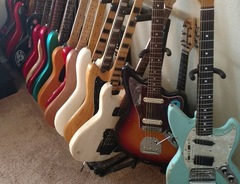
And I'm not giving the 62' Reissue Jaguar high stars for mine alone. I've played quite a few other Japanese "62' Reissues" over the years and they have all been consistently great instruments. That's why the Jaguar became my #1 "off the rack guitar" - it's just buying my first one meant cutting cost by buying one modified, and then finding modding it back won't make any change serious enough to make it worth the money, leaving me with a bit of an "easter egg" from the previous owner via those Cool Rails.
And for those wondering on the Sound. The Typical Jaguar sound consists of a very balanced sounding neck pickup, and a very snarly, yarly, coarse sounding single coil in the back with tight lows and very present highs, together it sounds a bit like a Tele, but a little sweeter and floppier due to the shorter scale, a bit more harmonically rich. The Jaguar does have a fitting name, because, in the bridge especially, it has a very good "Bite" to it, especially when the gain is pushed, almost like a Gretsch with heavy overdrive, just not as sthick in the lower mids.
If you are used to a traditional setup, the Jaguar might be something you'd want to try out before buying because it does feel and play a bit differently, as well as the "duffy" or "tchak" type attack is not of the traditional electric guitar ilk in a lot of ways. It does not play like a Gibson or a Fender - it plays like a Jaguar, it's it's own thing capable of bringing something extra to all those it can emulate, and that's what I like about it.




218
Well made vintage style Jaguar
I purchased mine used, a 90's Japanese domestic market model, and I have yet to play an American made Jaguar that functions better than mine. With a neck shim, raising the bridge a bit, and securing some things with teflon tape and bending the tremolo arm up, it works perfectly the way I want it to. I've found a guitar I will never part with. It stays in tune well with heavy tremolo use, it has those cool sound artifacts from the strings ringing behind the bridge, not a ton of sustain, just a perfect sound for me. A very comfortable short scale, and still an adequate amount of string tension with .12 gauge strings on it.
Artist usage
Add artist

As seen in pictures and gigs. According to Premier Guitar interview. this guitar also has the Lollar pickups and M1 Mastery Bridge.


In the video "Royel Otis — Linger (The Cranberries Cover) [Live @ SiriusXM]" on YouTube, Royel Maddell can be seen using a Fender '62 Jaguar Reissue Electric Guitar.


In this photo, Joel Pott can be seen playing a Fender Jaguar electric guitar in sunburst finish. The single coil bridge pickup appears to have been replaced with a humbucker, and the guitar does not have a floating tremolo. He's performing on stage for On Blackheath festival at Blackheath Common on September 14, 2014 in London.
The original image source is Getty Images.


Genre Usage
Based on how artists on Equipboard use this gear, it is most commonly found in the following genres.
Used With
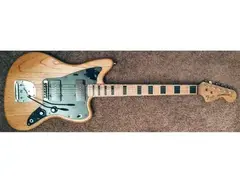
Based on how musicians on Equipboard use Fender '62 Jaguar Reissue Electric Guitar, it is most commonly used with the following gear.
-s.webp?v=1785018971)


Community setups
Show yours


More Fender Solid Body Electric Guitars

$779.00
in Solid Body Electric Guitars Rank

.png?v=1784946700)


$995.00
in Solid Body Electric Guitars Rank


-m.webp?v=1784991990)
$1,499.99
in Solid Body Electric Guitars Rank


$615.93 - $849.99
in Solid Body Electric Guitars Rank


$999.99 - $1,146.78
in Solid Body Electric Guitars Rank


$2,165.99 - $3,077.00
in Solid Body Electric Guitars Rank


$1,799.99 - $2,499.00
in Solid Body Electric Guitars Rank


-m.webp?v=1784905334)
$875.00
in Solid Body Electric Guitars Rank


$2,199.00 - $2,599.99
in Solid Body Electric Guitars Rank


$619.00 - $719.99
in Solid Body Electric Guitars Rank


$1,250.00
in Solid Body Electric Guitars Rank


$484.99 - $679.99
in Solid Body Electric Guitars Rank


-m.webp?v=1784981972)
$609.99 - $799.99
in Solid Body Electric Guitars Rank


-m.webp?v=1785020728)
$1,460.21 - $1,999.99
in Solid Body Electric Guitars Rank


$764.00 - $1,899.00
in Solid Body Electric Guitars Rank


.png?v=1785006102)

$1,200.00
in Solid Body Electric Guitars Rank


$400.00
in Solid Body Electric Guitars Rank


$499.99 - $879.99
in Solid Body Electric Guitars Rank


-m.webp?v=1784991526)
$1,458.22
in Solid Body Electric Guitars Rank


-m.webp?v=1784991505)
$939.99 - $1,469.99
in Solid Body Electric Guitars Rank


$1,250.00
in Solid Body Electric Guitars Rank


$1,399.00 - $1,849.99
in Solid Body Electric Guitars Rank


$795.00
in Solid Body Electric Guitars Rank


$750.00
in Solid Body Electric Guitars Rank


$1,479.99 - $1,999.99
in Solid Body Electric Guitars Rank


$1,412.99 - $1,839.99
in Solid Body Electric Guitars Rank


$1,655.25 - $1,999.99
in Solid Body Electric Guitars Rank

$1,191.99 - $1,499.99
in Solid Body Electric Guitars Rank


$1,066.55
in Solid Body Electric Guitars Rank


$1,049.99
in Solid Body Electric Guitars Rank


$400.00 - $645.00
in Solid Body Electric Guitars Rank


$2,100.00 - $2,699.99
in Solid Body Electric Guitars Rank

$499.00 - $679.99
in Solid Body Electric Guitars Rank


$1,460.21 - $1,999.99
in Solid Body Electric Guitars Rank
.jpg?v=1784895999)

$765.00
in Solid Body Electric Guitars Rank


-m.webp?v=1785020513)
$2,190.00 - $2,899.99
in Solid Body Electric Guitars Rank


$695.00
in Solid Body Electric Guitars Rank


$879.99 - $1,890.00
in Solid Body Electric Guitars Rank
Accessories & Related Items


Similar


Gear Guides







Most Popular Solid Body Electric Guitars
Most Popular Brands
-
Added to Equipboard on by
 equipboard
GearIQ 4934
-


