CreepingNet
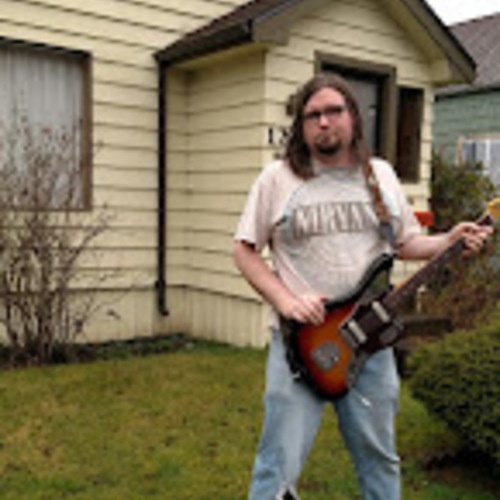
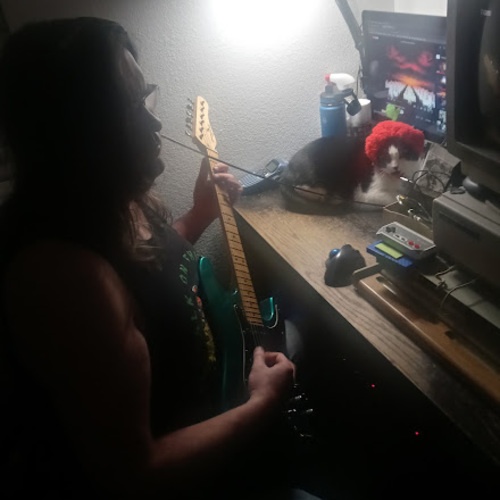
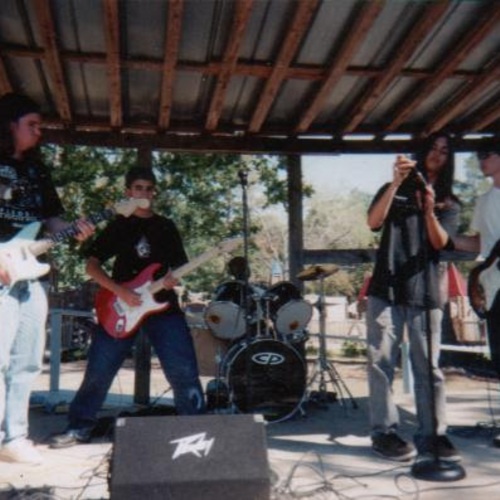
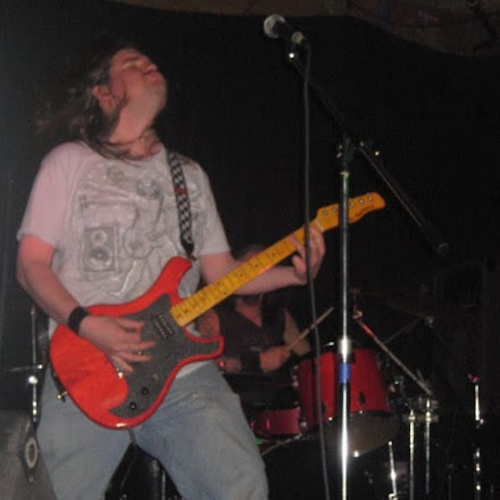
Underground virtual unknown guitarist since 1995, still making music solo now, have been in a lot of bands and recorded on some other stuff.
Every rig tells a story. Start yours.
Catalog your gear, wishlist what's next, and share the setups behind your sound — free.
Create your EquipboardGuitars 42
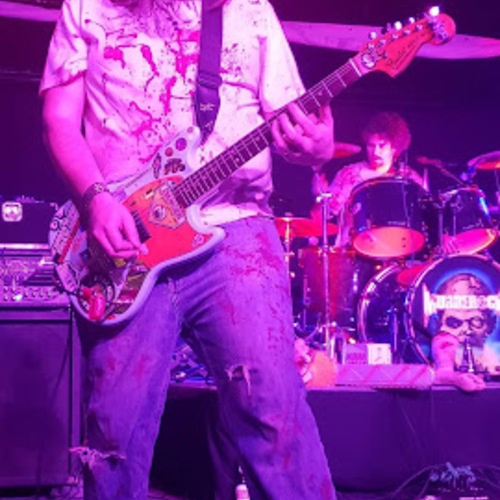
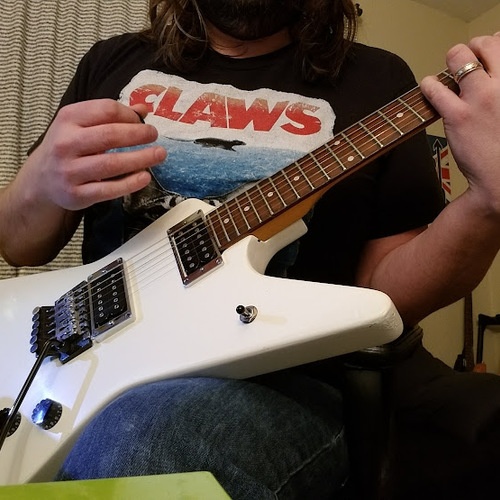
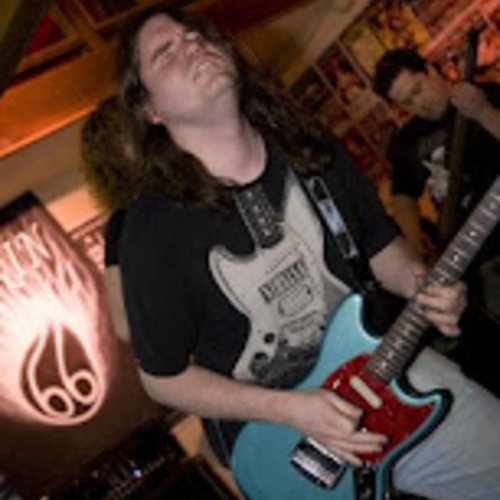
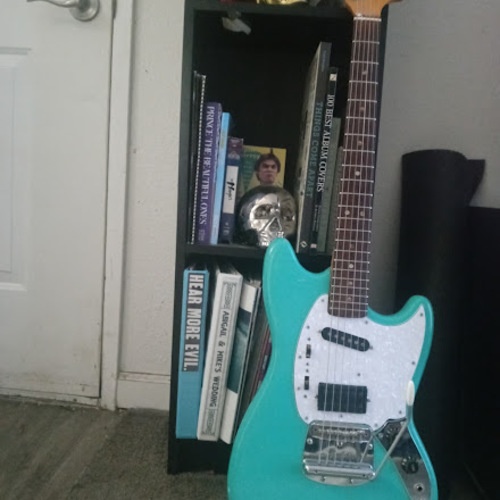
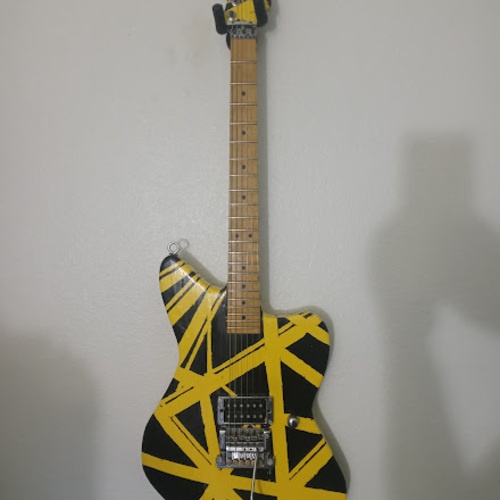
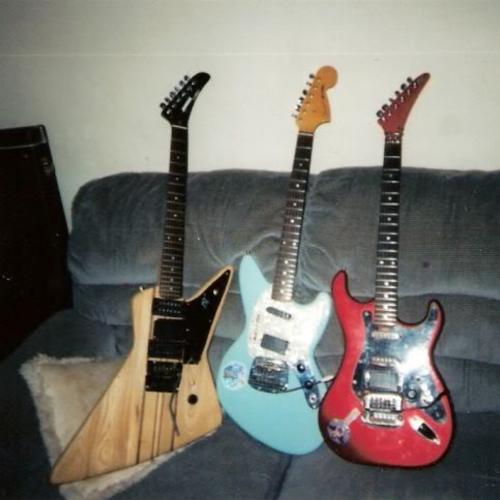
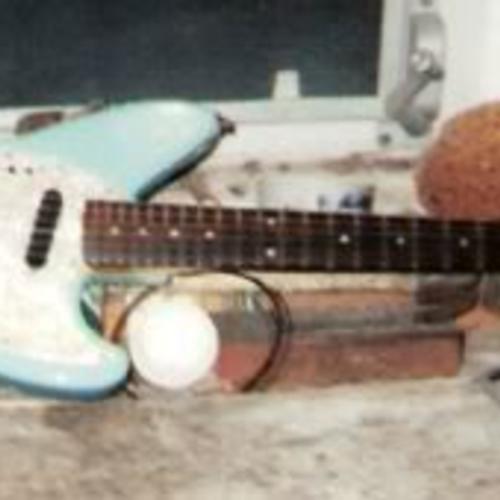
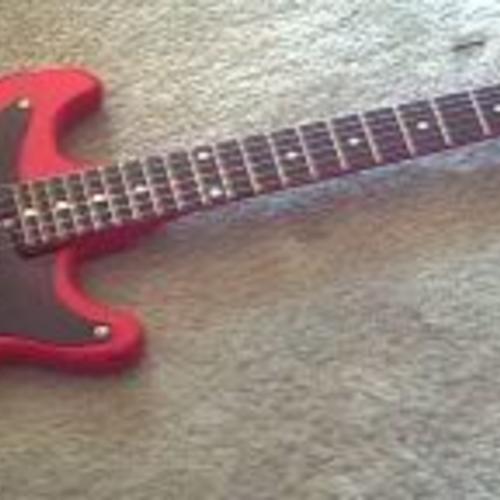
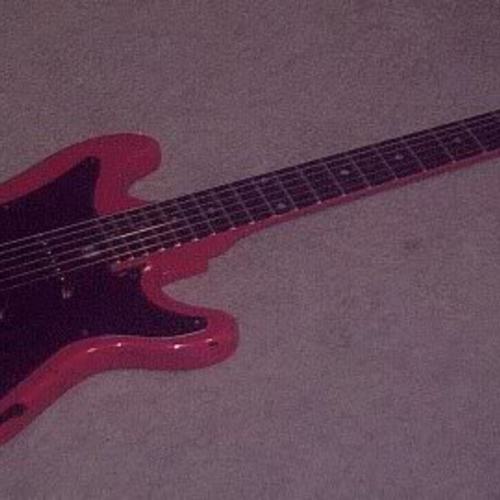
The Fender Jag-Stang in it's stock form is a decent enough guitar, but I play one with EMG pickups in it that I got on my 17th birthday that has been my favorite "go-to" ever since, and she's got the scars to show for it.
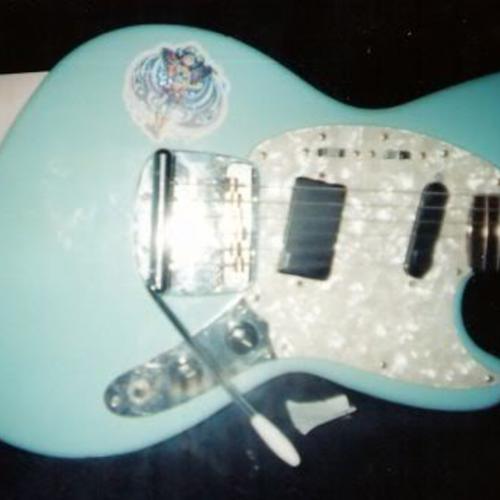
In it's stock Format, the Jag-Stang is a quality instrument built from Fujigen Gakki (1995-1997) or Dyna Gakki (1997-2001, 2003-2006) in Japan for Fender Japan. Despite being a "unfinished" design as the second prototype was to go to designer and Nirvana frontman Kurt Cobain the day he died that fateful day in 1994, it's surprisingly great. It's only real shortcomings only being the bridge pickup which is a bit anemic at 7.4-8.2K ohms on the earlier models (which had a DiMarzio sourced H3 or H8 humbucker) - the later Alder bodied variants featured a Fender Santa Ana humbucker that addressed all these tonal issues. In my case, the previous owner replaced the original pickups with an EMG SA in the neck, and an EMG 81 in the bridge sometime about 1998 per date code on the pickups (my Jag-Stang is a 1995 1st run model with the 60th Anniversary and "Designed by Kurt Cobain" stickers on the back of the headstock, confirmed by body and neck build dates).
The early Jag-Stangs were made of basswood, which tends to absorb extreme highs and mids a bit, making it a much woolier guitar. Playing an alder model gave a more balanced response due to a thicker wood density. This also affects finish durability - my 95' is a literal relic, dents, dings, scratches everywhere, all of them from 17 years of hard gigging and studio work. It does not help that the paint on these, particularly the early ones, was just one giant thick glopping coat of sonic blue or Fiesta Red.
Now to one of my favorite features, the vibrato. The Fender Dynamic Vibrato is one of my favorite units of all time. It's smooth, like a Kahler, but I don't need to drag an entire pile of hex keys with me to tune, or make small adjustments. It's also more economically sound than a Floyd Rose because replacment parts are cheap, and I burn through things like pivot points and knife edges a LOT less as fast as I do on my Floyd Rose guitars. I can whammy all day on this thing and it never goes out of tune.
However, in 17 years, I have made some mods and improvements. The EMG Pickups in this thing sound amazing - TBH, I've only ever played one out of the hundreds of guitars I've played that matched the Jag-Stang with that particular set of pickups, and it was a Fender Prodigy. I added a Pi2 Phase inverter preamp to allow me to still get the out-of-phase sounds the Jag-Stang is somewhat known for having (but minus the volume loss), added tone recovery cap brought to an extreme, giving me more tonal versitiliy, no-load tone control. All of these turned the Jag-Stang from a great "grunge" guitar into a Pensa Suhr terrifying, Tom Anderson scaring tonal chameleon. It makes an EXCELLENT platform for hopped up circuitry once you figure out how those 3-way switches work. Also, my modification improved on the pickup selection on-the-fly because I designated one switch to pickup selection and the other to tonal edits.
17 years of everyday hour or more play on this thing and of course I had to replace some parts. I had to replace the tuners in 2006 because the originals wore plum out from all the tuning changes I do, CGDGBE, Drop-D, whole step down, 1/2 step down, and back again a lot. The Ping sourced Kluson copies are just not up to the task for a lifetime, I ultimately got a set of proper fitting Kluson Revolutions on there and had my split shaft sealed gear cake and eat it too.
Another thing is that Cobain bumped into the perfect combination of size and shape on this by accident (with help of Fender Custom Shop luthier Larry Brooks) - the result is a guitar that looks a little odd at first glance but is extremely comfortable despite not having contours, and the way the shape sits makes it not look stupid on hulky tall guys like me - like I've been told Mustangs tend to do to me.
Basically put, the Jag-Stang is a well balanced (especially the later stock models), fast playing, great sounding guitar with a few quirks that are easily ironed out. Sure some might want to ride the Nirvana legacy to death, but after picking up a pre-modded version, I felt like taking the Jag-Stang into it's own place, which it also can do just as well as any Strat or Telecaster.
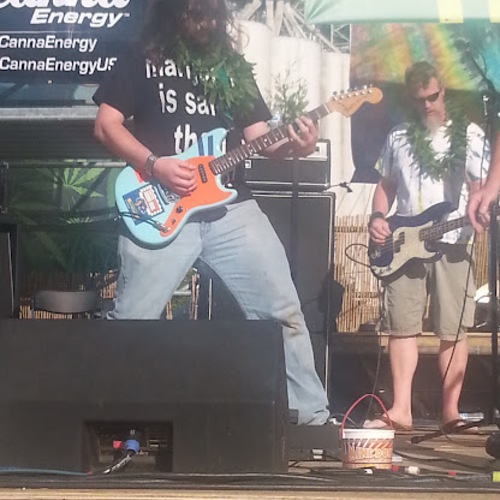
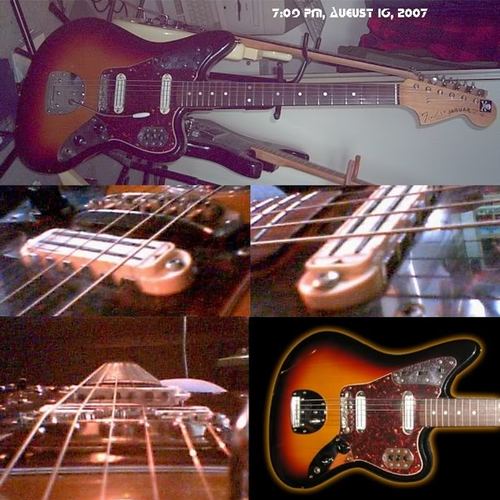
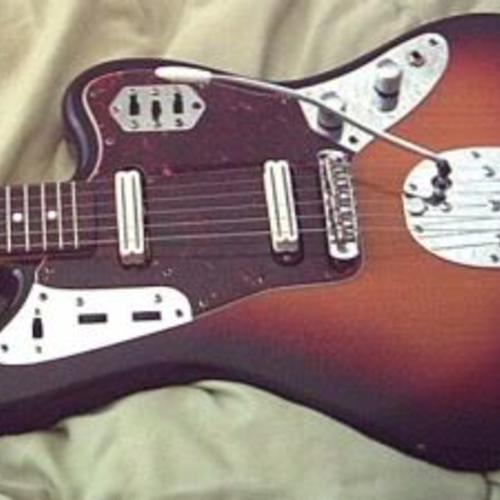
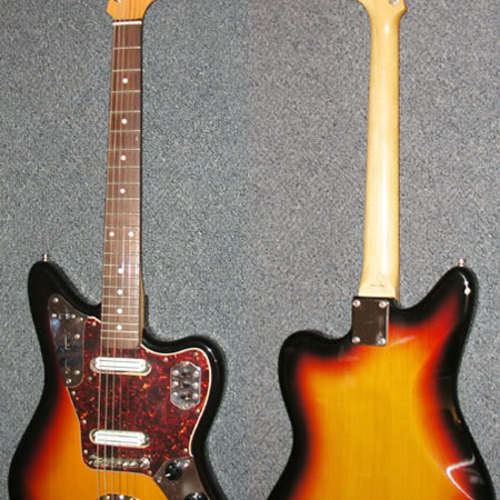
I bought my Jaguar in December of 2005, it's a 1998 Model built at the Dyna Gakki plant for Fender Japan in December 97' (Neck Date), and January 98' (Body Date). I bought mine already customized.
SPECIFICATIONS (STOCK)
NECK: Maple neck, 24" scale, 22 Vintage frets, pearl dot inlays 7.16" Fretboard radius, Kluson Ping replication tuning machines
BODY: Basswood, or Alder (mine's Alder) Jaguar style body with vintage routing
PICKUPS: 2 Fender 62' Jaguar reissue single coils, 6.4K Each, Alnico V or Ceramic Magnets
CONTROLS: Separate Rhythm and Lead Circuits, Rhythm volume, Rhythm Tone, Rhythm/Lead Selector Switch, neck pickup on/off (Lead), bridge pickup on/off (lead), Strangle/Bass Cut (lead), Lead volume, Lead tone
BRIDGE/TAILPIECE: Fender Floating Vibrato with rocker bridge with adjustable string spacing
COLORS AVAIL/COLOR COMBOS
3 Tone Sunburst w/ Tortishell Pickguard
Olympic White w/ Tortishell Pickguard
Candy Apple Red w/ W/B/W pickguard and Matching Headstock
3-Tone Sunburst Foto Flame (fake Flame Kodak overlay on body under finish) w/ red Tortishell
White Blonde finish w/ Red Tortishell Pickguard and gold hardware
Mine came from the Guitar Hangar in December 05' with an unbranded Jaguar/Jazzmaster hardshell case, modified with a pair of Seymour Duncan SCR1B Cool Rails, 500K pots in the lead circuit (tone being a push/pull coil split for the cool rails), and a Gibson ABR-1 Tune-O-Matic filed down to fit the fretboard radius.
The original Cool Rails were found to sound so close to Jaguar pickups in timbre with the 500K pots I chose to leave those in, and put cut-off Jaguar pickup covers and Jaguar claw side-pieces onto them - all that did was redistribute the magnetic field a bit just bringing the tone more inline with a Jaguar, but with hum cancellation.
I also took out that crappy Tune-O-Matic that was chopping my hand up and eating up the strings (I use the vibrato on this guitar, HARD and OFTEN), and replaced it with a bridge identical to the one that the Japanese Jaguars regularly come with. I did, however, take some time learning the hows and whys of the Jaguar bridge on my own and came up with my own way of dealing with said bridge and it's so laughably simple. Basically, I play my Jaguar with .009's on it - most people say to put 11's or higher on them because they are short scale and heavier strings stay in place - but they actually don't because beyond a certain point, the strings being too big for the slots (especially the Low E which is the #1 culprit in this problem) can cause them to jump the saddles even more than light strings would at lighter tension because there is less material deep enough to hold them in place.
The second problem with this bridge that people misunderstand is the breakover angle, anything 10 degrees and over is sufficient enough string tension, the real problem is tolerances. The looser tolerances of guitar production say versus, something NASA would have made, are what really causes all the problems people think goes with breakover angle. Mastery gets around this by putting deeper saddles into their bridges as well as a pair of fixed allen key adjustments on a pivot for each pair of saddles. and Staytrem just uses Mustang-style saddles that are only rounded on top, cut to the radius of the guitar, and have nylon-embedded fixtures meant to hold them still. I do this on the Jaguar by cutting a strong humbucker spring in half - putting one half on the low E, the other on the High E, and angling the E string saddles upward on one side to wedge them in. Doing this makes it rock solid stable even without a shim or a breakover over 10 degrees, and it keeps the extra behind-the-bridge ringing that I love so much.
So far though, in the 10 years I've played this guitar, it's been an unstoppable companion. It's only broken one string at a gig, it's never broken down or spent a period of time in limbo due to parts. I did have to fix one grounding issue with the rhythm circuit and I replaced the tuners just as they were wearing out because those Ping manufactured Kluson copies just don't last - I put Kluson Revolutions in as I prefer seald gear durability but wanted to retain the split shafts and vintage look. I've hard the stock pickups these guitars have, honestly, mine more closely matches a Classic Player with the stock 60's wiring or a Squier VM due to the hotter bridge pickup.
And you'd think with all the pickup/electronics mods it'd sound different, but to tell you the truth, the Jaguar offers so much uniqueness in it's overall design that it sort of has a sound that transcends the pickups put in it because much of it's sound, the attack, the decay, the resonance, all the harmonic overtones from behind the bridge - are the result of that bridge system. All the pickups really do is amplify those things more if they are hotter. The cool rails just make it sound like a noiseless Jaguar. And sustain? I can make this thing sustain for days at stage volume using controlled feedback, and even then, plugged in, sustain is not really a problem at all on this guitar.
The only real cons are the original pickups I hear were not so great - microphonic, and tinny, probably due to incorrect construction, and the machine heads are crap. The rest of the complains most people have about the Jaguar I can look past because I know how to work with them or very frugally "fix" them in a way that does not affect the guitar or change it from what it is into another boring blahcaster. The EQ of the Cool rails might be what's making the 500K's work so well - aside from being quality switchcraft pots - as the Cool Rails have a tonal profile similar to a Jaguar except in ways that the 500K pots would help exaggerate to keep pushing the "overwound single coil" sound they are trying to emulate. Split I get more of a Goya/Teisco/Kawai/Sansui guitar sound, plinky, ice pickey, it's like 2 Jaguars in one - a Pre CBS with hot pickups (the first Jaguar I ever played), and a later CBS era model where they started winding them a bit less as hot.
And I'm not giving the 62' Reissue Jaguar high stars for mine alone. I've played quite a few other Japanese "62' Reissues" over the years and they have all been consistently great instruments. That's why the Jaguar became my #1 "off the rack guitar" - it's just buying my first one meant cutting cost by buying one modified, and then finding modding it back won't make any change serious enough to make it worth the money, leaving me with a bit of an "easter egg" from the previous owner via those Cool Rails.
And for those wondering on the Sound. The Typical Jaguar sound consists of a very balanced sounding neck pickup, and a very snarly, yarly, coarse sounding single coil in the back with tight lows and very present highs, together it sounds a bit like a Tele, but a little sweeter and floppier due to the shorter scale, a bit more harmonically rich. The Jaguar does have a fitting name, because, in the bridge especially, it has a very good "Bite" to it, especially when the gain is pushed, almost like a Gretsch with heavy overdrive, just not as sthick in the lower mids.
If you are used to a traditional setup, the Jaguar might be something you'd want to try out before buying because it does feel and play a bit differently, as well as the "duffy" or "tchak" type attack is not of the traditional electric guitar ilk in a lot of ways. It does not play like a Gibson or a Fender - it plays like a Jaguar, it's it's own thing capable of bringing something extra to all those it can emulate, and that's what I like about it.
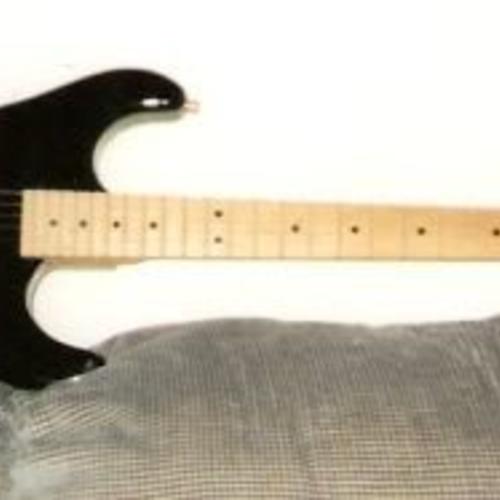
The Hondo Paul Dean series guitars are guitars designed by Canadian rock guitarist Paul Dean (obviously), best known for this work in the band Loverboy.
Paul had a 64' Fender Stratocaster he smashed and rebuilt imitating Pete Townshend back the late sixties/early seventies, and after it's intentional destruction, it was rebuilt and had amazing resonance - that guitar became Paul's favorite, but also became the basis upon which these Hondo Designer Series guitars were derived from from a sonic standpoint.
The Hondo Paul Dean II version of this guitar features a Sen Ash 2 piece, non-bookmatched and specially tuned body with a tapered, unplated, 4-bolt neck joint for easy upper-fret access, a 3 piece maple neck with a maple 21 fret fingerboard, featuring a pair of 1/4" resonance slots routed parallel to both sides of the truss rod, and a 10 degree headstock tilt and straight string path to avoid the need for string trees. It also features a single volume, tone, and 3-way switch setup, ABS plastic haircell textured black "Anti-scratch" pickguard, Leo Quan Badass-style wraparound bridge, and the choice of the base level Hondo 7.4K Ohm ceramic humbuckers, or for $60 more you'd get DiMarzio DP104 Super II Humbucker pickups just like the ones the original Odyssey version came with.
The Hondo Paul Dean II's biggest draw would be the sound of this guitar. It's very unique, very thick and warm like a Gibson, but the Spank and clarity of a Fender, with a hollow upper midrange "yowl" to single notes that gives solos sort of a vocal like quality, almost like a slow-moving Wah Wah pedal. There is a small difference between the stock and upgrade pickups. The stock pickups are a bit thinner sounding due to the lighter wind, more inline with a Fender sound like a Jazzmaster, while the Super II's add more bottom end to the mix but the sharp crystalline highs are retained and there's a small spike in the midrange.
One impressive thing about this guitar though is the neck. If you like fat necks, don't bother, this is probably the skinniest neck of ANY production guitar I've ever played or heard about - only 1" at the nut! And the back profile from fretboard to neck back is very thin as well. While out of the box the fret leveling leaves some to be desired, if you give a Paul Dean a good fret level, it will give back in spades. AFter doing this, the action was lowered to PRS levels - with about 2/8" at the 21st fret.
Despite the thin profile of the neck, and the fact it has a tilt headstock with no volute, it surprisingly is an EXTREMELY Strong neck. Stringing this guitar up with .013's does not even pull the neck enough to need more than 1/8 turn on the truss rod to keep the relief just right. Most of the time it just stays perfectly straight and just barely tightening the truss rod will put it in good territory for .009s. Too loose though and the nut will rattle, so some might not handle light gauges (.010 or less) very well - which is how I Found out Hondo actually DID the "resonance slots" like Paul designed, that rattling nut makes it sound like there's hornets living in your neck, LOL.
I bought mine in 2010 and it's got to be one of the most well built guitars in my collection. I've only set it up twice in the years I've had it and it does not need to settle at all. I've gigged it multiple times and the only thing holding me back from gigging it more often is how bleedingly rare these guitars are (I'm working out plans to build a few copies of this one, with some special updates). It only seems more Paul Dean II's and even the Odyssey versions came out of the woodwork as soon as I started posting a bunch about them on social media and forums in reply to curious guys looking for Paul Dean's guitar tone or looking to figure out what that "Fender Lead III looking thing" was that he was playing on the 2nd and 3rd Loverboy records/tours.
I find also this guitar, with the Super II pickups, does GREAT for metal. With the low action, skinny neck, and good medium output pickups, it really growls, shreds, and sings with the best of them. And the sustain happy string path, paired with the chambering, make this guitar almost like a "poor man's sustainer" at stage volumes.
The only downsides are no whammy (Which could be worked around using the Schaller Les Trem or similar non-destructive to install device), the electronics (pots, jack, switch) are not the best quality, but they are not bad either, and the original hardshell these came with was the same Korean cheap junk Hondo sent out with their Plywood strats. Also, the pickguard does have a tendency to warp under the stress of the pickup springs in some cases, mine had this when it had the original pickups in it.
Otherwise, great guitar, 5 out of 5, highly recommend, assuming you can even find one.
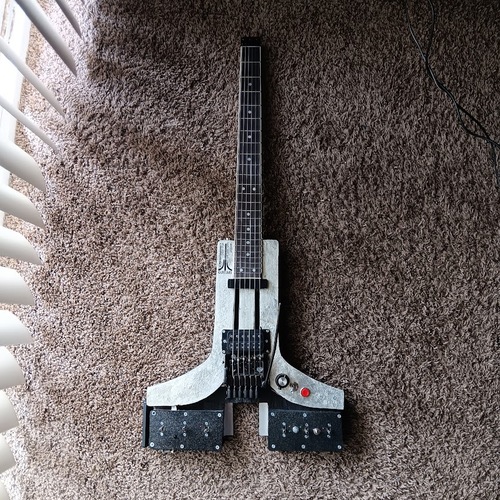
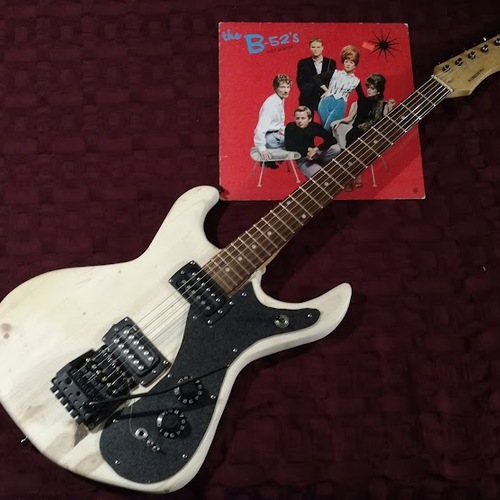
The inspiration for this guitar was Kurt Cobain's Univox Hi Fliers and Mosrite Gospel, and the Mosrite Ventures and Mosrite Mark V that Ricky Wilson was using in the B-52's early days (R.I.P. dude). I had a Kay KE-17 neck laying around, and no body for it, and I felt it would make a great neck for a Mosrite inspired guitar.
SPECS
NECK: 2004 Kay KE-17 neck, Kluson Revolution Tuners, 25.5" Scale, 22 Vintage frets, skinny profile
BODY: Pine multi-piece table bank sandwhich body inspired by the Mosrite Mark V and Ventures
PICKUPS: First Act Humbuckers, an 8.4K in the neck, and a 16.8K Jammed right up against the bridge
CONTROLS: 1 Volume, 1 Tone, 3-way pickup selector, and a tone switch for each pickup allowing for split/humbucker/parallel operation, giving a wide array of tones from thin and twangy to thick and grungy
BRIDGE: Washburn Wonderbar/Shift 2001 vibrato unit compensated to act as a poor-man's trans-trem
PICKGUARD: TAP Plastics ABS Haircell Plastic pickguard based on a Mosrite Mark V style guard
FINISH: Bare Pine .), I've been making quite a few small tweaks/refinements as needed that would damage putting a permanent finish on it
HARDWARE: Black
CASE: None, yet, plan to build one
STRINGS: currently using Dunlop .009-.042's as those were what I used to set it up, might move to Ernie Ball Paradigms to test next
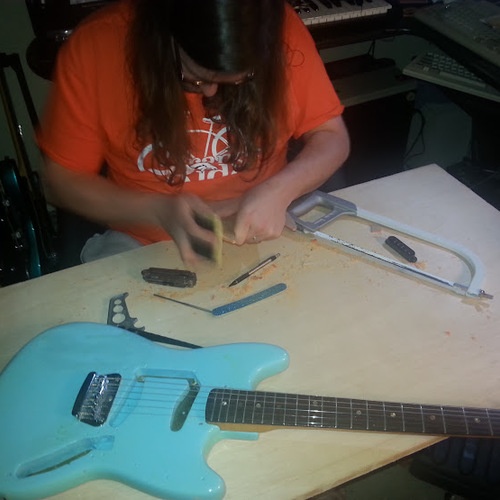
I built this guitar on a whim. I wanted a body for that neck, so I went to Lowes for some unrelated things, and looked around the lumber section, and found a large chunk of pine sticks glued together that could be cut in half and made into a guitar body by sandwhiching the layers. I bought a pull-saw, and a coping saw - the whole mess cost me $15.00 total. Not bad. I've made other bodies out of pine before - but those were with power tools - this was in an apartment with HAND TOOLS - well, until the final shaping part and the final routing that was thicker than half the body thickness.
I came up with the shape by going through my giutar collection and matching lines of my other guitars up with photos of Ricky Wilson and Kurt Cobain's guitars I pulled up via google image search. I started off like Semie Moseley did for the original Ventures shape - tracing a Stratocaster backwards. Then refinements came by some free-hand alterations, adding in some Jaguar and Harmony H-802. The resulting shape was very much Mosrite-ish, but with some small differences.
The body contained some various experiments in construction. After the top half was cut out with the pull saw, it was glued and screwed to the back half using some coarse wood screws. Before doing that, I cut the neck slot using the coping saw.
When I was done, I did some of the initial pickup routing using a Chisel, but later went to using a router to refine everything. There were some mistakes on this body though, pickup routes were too wide because I had not decided weather I was going to use Univox style, Mosrite style, or some other pickups I had, I even toyed with using EMGs at one point ( an H and a 60 - both vintage 80's models). I finally decided to go with a pair of orphan First Act pickups I had laying around that never sounded that great in other guitars, but somehow wound up sounding PERFECT in this one. Possibly the biggest jack-up though was the neck slot, which has been under various tweaking from the start - but desipte, sustain and resonance on this guitar is crazy good. I've been filling it in, and reshaping with Basswood, and had to move the front shelf forward and cut the end of the rosewood board on the Kay neck flat to make sure it intonates properly - now this sucker is dead on and by god does it resonante now.
There are some key things in this guitar that makes it sound the way it does. The Pine body absorbs some of the lows and some of the highs, giving a balanced midrange effect - pair that with a big, monster pole equipped 16.8K Ceramic humbucker at the bridge, and it's like a super-high-gain mosrite kind of tone I'm getting out of it, even when full humbucker, it's still got that twang to it, just noiseless, and with a rididulously good amount of distortion - with a large amount of bite and a low end that never gets flappy or muddy, but is very thick.
The neck position is perfectly balanced, it compensates for it's very close position to the neck heel with less winds, smaller poles, and a lower ohms reading (8.4K, more in the traditional PAF vein). Split it does the whole Ricky Wilson/Ventures/Surf thing really well - in full humbucker it's like Insta-Bleach.
Overall though, it has kind of it's own unique voice, sort of like a shredder's surf dream, or a surfer's metal weapon. Which was the whole goal. so mission accomplished.
The last, and another interesting part of this things construction, was the use of a Washburn Wonderbar vibrato - a really weird old also-ran that competed with the Floyd Rose and Kahler vibratos in the 80's (originally called the Shift 2001 vibrato), and best noted for no need of routing to be useful.
But one neglected thing about this vibrato unit is it's ability to transpose chords around on at as many as 4 strings at a time, as a result of a set of "jaws" behind the tension rollers that change the rate of pitch drop each string recieves. So far I've gotten it close enough it's usable almost like a trans trem - which saves time for tuning down at concerts/gigs/etc. I'm working out a way to make all SIX work that well that way as the primary problem is the amount of pitch drop on the high E just can't get close enough - need something that matches up with a .009 gauge high E better in tension. Once I have that figured out - I might break my GAS for a Steinberger Trans Trem equipped axe of my own design.
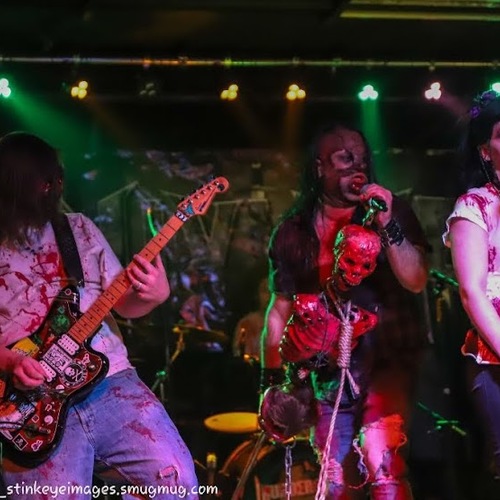
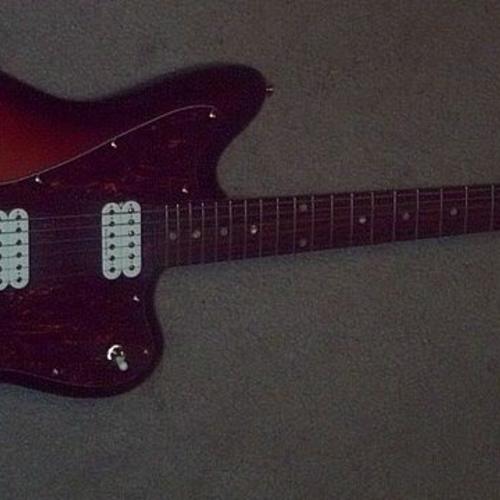
It was 2009, Hipster-dom was riding high, and Jazzmasters were starting to go for a premium. and I wanted one because I always loved the Jazzmaster since playing a Foto Flame 1994 MIJ model with Seymour Duncan pickups. When the only Jazzmaster you can find costs at least $800 - why spend it all at once when you can spend it gradually over time.
But Jazzmasters had some things with them that I did not like, in particular, only 21 frets, out of the box the bridge usually needs some work, the fretboard radius is a bit too round for the scale length, the tuners are flimsy on some of hte reissues, and the bridge pickups on every Jazzmaster I ever played were anemic and/or imbalanced to the neck (ie, the hotter pickup always was in the neck for some reason).
So this was my attempt to tweak the Jazzmaster into what I think a modern Jazzmaster should be. A Jazzmaster that can rock out with the best of them but not lose any of the unique traits that made the Jazzmaster such a special sounding, playing, and feeling guitar.
I started off with a Swamp Ash body, so as to have a pretty finish, light weight, and some dampening for the high frequencies - basically to absorb some of the "Ice Picky-ness" of the Jazzmaster but not lose the highs so much it sounds less like a Jazzmaster and more generic.
The next thing addressed were the electronics, in particular, the pickups. In the bridge is a Alnico 2 10% overwound Pickup Wizards Jazzmaster pickup, measuring in at 8.8K Ohms resistance, with a Alnico V AVRI 62' Jazzmaster pickup in the neck to add a little more spank and sparkle to the neck position whilst keeping that signature Jazzmaster sound to it. The pickups are NOT RWRP as Fender and Pickup Wizards seemed to have done it differently.
These two are wired into a standard Jazzmaster wiring harness wired with cloth wire - 50's style - with no alteration from the standard Jazzmaster schematic at all. The Jazzmaster is rather versitile to begin with so no need to fix what's not broken to begin with. When you play one, you have to think with a bit of inverse logic of other guitars though - on the lead circuit, you want to turn the volume DOWN to warm things up and increase the gain, not the tone, and turn it up if you want to clean things up and gain more twang. The sweet spot is around 7 - gives it a very P-90-like output, flat out sounds like a Pissed off Telecaster on steroids with more bass and naturally scooped mids.
I forewent a vibrato unit with the Trem Lock both for budget reasons and that I've never had to use that feature on any offset I've ever used with this vibrato, and I use my own special setup that increases the vibrato range, bringing it into first album Van-Halen territory - that's right, I use this guitar to dive bomb - people said it could not be done, so I looked at the mechanics, figured it out, and did it!
I used the much maligned stock bridge, one of the import variants. I did the same mod to it I did to my Jaguar, 2 thicker springs on the outer E saddles to box the middle ones in, and angled the Low E saddle upward to lock the low E string in place and prevent it from jumping. Works just as great, and it increases sustain from both the scale length and the "3rd bridge" behind the bridge - which is like having a whole second instrument there - either that or a built in reverb tank made of sympathetic vibrations - one of my favorite features of the Jaguar/Jazzmaster vibrato setup. The main problem with these bridges has almost always been part tolerances rather than breakover angle.
The Neck was the other major upgrade to the design - I wanted something skinny, with a flat radius, 22 frets, and something that looked late 70's/early 80's - so what I wound up with is a Tommy's Custom Bodies and Necks 22 Fret Maple neck with maple fretboard and a CBS Fender headstock. I put a CBS Fender Decal on it just to see how many people would think this was a custom shop build, LOL. I'm planning to remove it in the future and put my own waterslide on there (just a sponge away from that). The flat 12" Radius and bi-directional truss rod has allowed this guitar to be probably one of the fastest playing Jazzmasters ever made - J.Mascius would HATE this thing I'm sure, strung up with .009's and only something like a 10th of an inch between the 22nd fret and the strings with little to no buzzing if you play light and fast like a metal player. The added 22nd Fret means I can do some mondo bends up to F#-A on the high E at the 22nd fret, effectively pushing the guitar's overall pitch range up a little bit too.
That said I have had some improvements to make to it. The original selector switch I used was a tad junky, had to re-bend the leafs inside the switch to keep contact. Switched to a Gibson switch and the problem went away. Have been toying with installing a "Super Switch" on it at some point to add even more tonal options like series/parallel/phase reversal. Another change soon coming is Kluson Revolution tuners because I found the Kluson Tone Pros I originally used are a bit too flimsy for frequent gigging as I played this guitar out a lot and found those tuners made the tuning stability a bit of a crap shoot - but I've been testing the Revolutions and they sound better as they add a little more mass to the headstock, and also are a LOT more stable, less drifting, and no play in the keys.
Either way, I've toyed with building small batches of hand-built guitars and I consider this a prototype to my own tribute to the original Jazzmaster. Sort of the Caroll Shelby Jazzmaster if you will - looks like a production guitar because at it's core, it is, but has all the right tweaks in the right places to make it play fast, stay in tune, and be versitile enough to not be limited to just being a Grungy Fuzzer and a Surfy Plinker. It's just as at home growling out UFO and Scorpions songs as it is getting fuzzed up for some Bush, Sonic Youth, and Dinosaur Jr, or dripping in reverb and taking the classic Ventures route, or the wacky B-52's route.
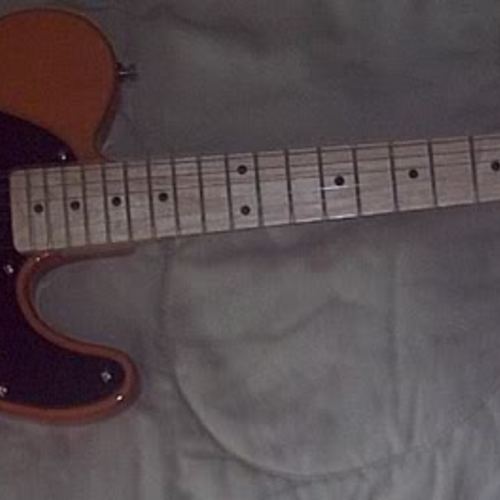
It was the Spring of 2007 - I had just gotten a bonus for saving the local Cell company a bunch of money with their tower testing and was looking to gift myself of a certain Squier Jagmaster that caught my eye at Kennelly Keys a few weeks before only to find it sold, but then I looked at the rack and saw this little Butterscotch Blonde Squier Affinity Telecaster - something I'd never seen before - hanging on the rack, fresh out of the box only 5 minutes. I picked it up, played it, and I could feel that with the right setup, this guitar had some "magic" to it that some guitars just have with certain people.
I pitted it up against 3 other guitars - a 1952 Telecaster Reissue, and a Custom Shop Telecaster, and a Telecaster Custom. The Affinity won out. Not sure if they are all like this, but this one had that inxplicable thing all great guitars have. The sound was there, the feel was there, I just felt this puppy sick from it's sea-faring adventure in a cardboard box needed some TLC and a good setup and it' would be a screamer - so for $158.99, I bought it, my first Brand New, never been owned or used before guitar - basically, the first "Virgin" guitar I'd ever laid hands upon that was not something I'd made in my own shop.
So I took it home, set it up, wax potted the pickups (whilst watching Crossroads, fitting movie to watch when wax potting Telecaster pickups), threw on my standard set of .009's and proceeded to use this guitar as one of my main guitars ever since.
Now here we are 10 years later, the only things I've had to change on it are the tuning keys and strings. The original pin-mount bolt-bushing sealed gear tuners started to drift after the pins broke after eight years of being played in the studio and live and used hard every time. Now it wears a set of Kluson Tone Pros with split shafts - which are way better tuners than what it came with originally, no more pricklies. It's well on it's way to looking like a good Bar Crawling 52' Telecaster now.
My only gripes with this model aside from the tuners is how the strings load - which is a problem on a LOT of chinese budget guitars - it has that messed up rear-loading thing that First Act used on their Wal-Mart guitars that makes getting strings up and over the saddles hard. I have plans to convert it to a through-body setup with a vintage-style lighter mass bridge once I decide what parts provider to go with.
Overall though, I'd say in this rather short review, that this guitar is great value for the money. I find them all the time in pawn shops for cheap and if I was more of a Tele guy I'd probably buy a few more as they are a great workhorse that does not cost a lot - they're like the Ford Ranger of electric guitars. - simple, solid, reliable, inexpensive, and easy to fix when they do have issues.
Memphis guitars was a badge brand associated with a Chicago music store in the sixties, and are best known as being one of those "Pawn Shop" brands. Over the course of the 1970's they did all the same things most of the Japanese guitars did, lawsuit copies (including apparently one of the best Les Paul Lawsuit copies of the era), but by the mid 1980's, Memphis had become a bargain basement brand.....except one thing.....their humbuckers!
The Memphis 302HB had 2 production runs actually - there's the earlier Matsamoku built Japanese production run, which was basically the same guitar as a Hondo Deluxe or Fame series fat strat model, and then there's this version, the later Korean made variant that shares the same body, hardware, and tooling with the Kramer KS400 and Harmony H-80T Strat copy.
- NECK: Maple Neck, Rosewood board, 21 Jumbo frets, plastic inlays, cheap tuners, tilt back pointy headstock, plastic Gibson style nut. The neck has a wide and slightly chunky profile.
- BODY: Plywood strat style body, open space between spring cavity and bridge humbucker from the factory, it's a slightly wider and boxier shape than a regular strat, as the edge roundover is not as extreme as an actual strat.
- PICKUPS: 2 tall Matsamoku style Strat pickups in the neck and middle positions, and a very amazing 12.7K Ceramic humbucker in the bridge on par with a DiMarzio Super Distortion, surprisingly these were lifted from the earlier Japanese version.
- WIRING: 5-way selector, 1 volume, 2 tones, and a coil split switch
- BRIDGE: What appears to be a Stratocaster copy vibrato, but with a twist, instead of a standard "intertia block" in the back, the intertia block is really a C shaped plate with a threaded collar welded to it for the whammy bar. On a lot of these it sits a bit further from the back of the pickguard than is aesthetically pleasing.
- FINISH: These came in black, cobalt blue metallic (which ages to a Ocean Turquoise sort of color if under UV light too much), and red. The red and black seems more common than the cobalt blue, it may have been available in more colors.
- TRIM: B/W/B plastic scratchplate with black plastic hardware and chrome metal hardware
- HARDSHELL Case with Locks
The upside is this is an amazing sounding guitar, especially when you consider the money. It's very much on the Van-Halen end of things through an appropriately voiced amp and is not very microphonic at all, something I don't exactly expect out of a Korean mid-80's copy guitar. It also stays in tune amazingly well despite a janky stock vibrato and those classic "el-cheapo" machine heads.
That said, these do have a few flaws from the factory, making them good guitars for learning to mod/fix guitars on.
- The necks on these are NOT level at the fretboard. Most of them have some action issues because the fretboard needs leveled and so do the frets. That said, doing a "redneck" level did get it into acceptable territory (a redneck level is using 800 grit on a 3M sanding block and a sharpie). I replaced mine with one from a Behringer strat copy with Kluson REvolution tuners on it, much better.
- The tuning keys tend to have play for 1/6th a turn but at least they hold tune
- The vibrato unit is a luck of the draw. Some of them are properly placed, some are too far forward or back. Also, that collared piece in the inertia block should be welded at the top, bottom, and sides from the factory, or it will break if you use the vibrato bar with any frequency (I use it all the time). In the end, I replaced it with a 2 point Korean unit (fittingly) with larger mass to compensate for the lighter metal used in the replacement. The guitar gained a few more points through that modification.
- Also, the pickups are either out of phase in the neck and middle positions to the bridge, or the factory was wiring the humbucker up the wrong way. These humbuckers typically work by grounding off the series link between the coils but on the Memphis pickups it works more like a EMG Select in that you have 3 wires, one for single coil mode, one for humbucker, and one for ground, and the switch switches between the two (it's a SPDT switch obviously). The Choice of 500K pots was a very smart move on this guitar, which allows that bridge humbucker to crunch and has a tone very close to old Van-Halen, not too bassy, not too thin, just nice, tight, brown sound.
Usually these can be picked up for as little as $10 and as much as $200 depending on condition, and who is selling. I tend to think the $50-150 range is perfect for these, with $150 being a perfect 10 in new condition, and $50 being for a really beat and broken one in which the pickups are still functional and the rest of the guitar can be whipped into shape.
So I was moving my now wife in with me back when we were dating and during a purge of junk we did not need to the trash bin, I open the bin and find a guitar case, and in that guitar case, was this black 2008 Epiphone Les Paul Special II........with all six strings still on it, and some kind of rock glued to a hole on the top. It gave me a conflict of conscience for most of the morning.....
Well, I left and went to drop some stuff off at my place and came back to find said guitar now sitting in it's case, outside the bin, with the case open - a-ha! An Omen. I talked to my girlfriend (now my wife) and she said "Go get it! Are you nuts! Free Guitar!" - so I got the Epiphone and brought it in the house. That evening proceeded with a teardown and cleanup of the Les Paul.
Now here we are, 7 years later and I've been using that same guitar off/on when I feel like something omre "Gibson-ish". To understand my tastes, I'm more of a fan of bolt-on necks - that's one thing I have an issue with on most Les Pauls or pretty much anything Gibson - being a techie and being the kind of guy who sets his guitars up to a certain level of perfection, I prefer bolt-on necks - who needs that much Sustain anyway? I get just as much out of my Paul Dean, and this guitar is almost the same in that category as well.
The Epiphone Special II Les Paul, as it was in 2008, was a maple necked, basswood bodied Les Paul Special style guitar with 2 humbuckers, a 700R in the neck at around 8.4K Ohms, and a 700T in the bridge at around 14.6K Ohms resistance, very very hot pickups. Despite these crazy values and a bolt-on neck, it really does deliver a rather official sounding Les-Paul-Like tone. Everything is stock.
About my only complaint about this guitar is the machine heads. They don't hold tune very well live and tend to slip, which is probably why it was thrown out. I have plans in the future to put on a brand new set of Kluson Revolution machine heads to fix this issue, other than that, it plays extremely well, with action on par with a Les Paul Custom worth about $3400 more than what I paid for it, which is hilarious considering I got this thing drenched in beer and probably vomit from a dumpster for the best price in the world - FREE.
The only upgrades this guitar really got was a pair of chrome pickup rings, some stickers, and a new set of strings.
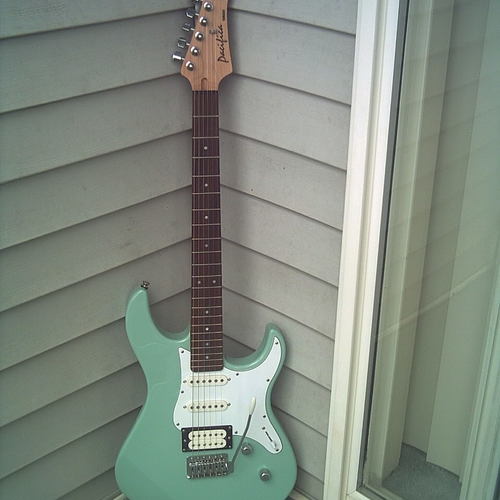
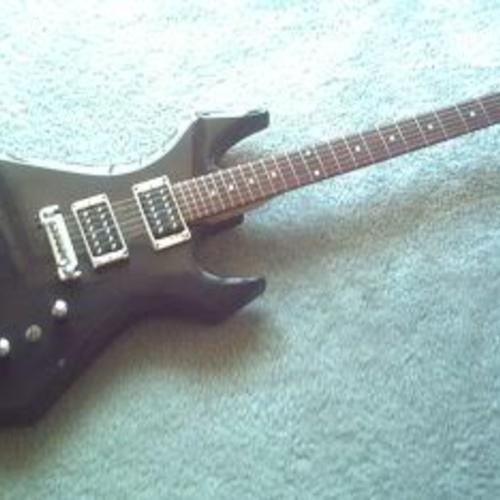
I bought my ME-437 at a pawn shop for $55 on a whim back around 2007 or so. In stock form, it's quite comparable to other First Act Models at the time.
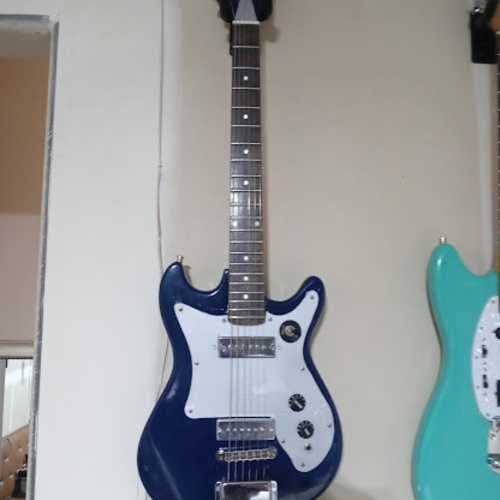
The ME-437 is basically First Act's Wal-Mart available attempt at an Offset Style guitar, combining lines of the Jag-Stang with lines of something like a Mosrite. I think the idea was a inexpensive to produce budget offset that they could sell at Wal-Mart for around $75-150.
First impressions were pretty much on par for First Act. These Wal-Mart grade First Acts were rather under-rated instruments. They have solid wood bodies (poplar I believe), a pretty good maple neck, decent fretboard (not sure what material, looks like ebony but I'm, pretty sure it's either dark rosewood or some other rosewood substitute), 22 modern frets, a 12" fretboard radius off the bat, a decent 8.4K Ceramic humbucker at the bridge, decent enough electronics, and a decent tilt-back headstock. The version in the picture has the six-inline (which I prefer), but mine has a 3x3 on it (I think earlier versions of the ME437 had that setup).
The pros are for the prince it's a rather nice guitar and plays fairly well out of the box so-as-long as you are capable of doing your own setup. Fretwork isn't perfect, but for a $55 guitar I can't complain at all, because it's on par with most Squier Affinities of the period. With some leveling and re-crowning of the frets I'm sure I could get the action pretty low. For a "student guitar" though it does have a surprisingly wide and thick neck. You'd think they'd be copying the skinnier Fender Mustang-esque profile more popular on this style of guitar, but I guess they needed to save $$ on tooling so they just used their standard radius that they also use on the ME-537 (a LP-sh design that shares the same neck), and ME-636 (I've owned all three of these models at one point). I have gigged the other models using the same electronics and honestly, it did a great job on stage. It stayed in tune, it played rather well, and was fun to play, though I gave it my best pro-grade setup before bringing it up there. The fit and finish for something sold at Wal-Mart is also surprisingly above par. Not a single crooked route, screwy mistake, or lack of conformity in shape anywhere.
The cons of these are really only the machine heads and the bridge. The machine heads are your standard fare for a guitar in this price range at the time, and the bridge is one of those cheap Stratocaster copy hardtail bridges where the strings feed in from the back and have the difficult task of feeding them THROUGH the saddle and over the top. I find these SUPER Annoying to restring because it means I have to push the string up using a jewlers screwdriver or small hex wrench or something like that to force it up at the right angle to get through the middle of the saddle if I don't want to have to turn the saddle sideways and then feed the string through, and flip it down. Also, these saddles don't feel that solid.
Mine has some upgrades since then though. The wife decoupaged the generic black finish with a 70's motif. I put in a GFS Lipstick Tube Humbucker which gives it a crazy Hair-Metal-Meets-Danelectro quality, with a three mode coil split allowing me Tele and position 4 Strat sounds from the one pickup. I also routed it out by hand watching Mad Max movies with some Daiso store chisels for a Pro-Tone six screw Strat whammy which stays in tune great even with the 3x3 Headstock.
I always loved the Harmony H-804, and the H-802 especially with it's wacky chrome pickups of mysterious origin.
So what I did here was took a Harmony H-804 body, with a more stable neck (well, mostly, might replace it eventually wiht a different neck as the Memphis neck has it's issues), and a pair of H-802 pickups by putting one in the stock neck position, and the second in the bridge - sscrewed into the wood - where this guitar body once hosted a humbucker.
Those H-802 pickups have a magic all their own, with a very thick low-end, sort of like a P-90, but a little rattier and raspier, and a very twangy, metallic din to the high end, sort of like hitting a metal bowl with a metal pen. Distorted it sounds glorious and thick, but clean it sounds very warm and balanced. What's shocking though, is that it's not very noisy or microphonic, which is the antethisis of what a lot of reviews of the H802 would lead you to believe. When wired right, it has that thrashy garage rock quality to it - but with some class to it.
I built out the pickguard by tracing the one from my 02813 and cutting it out for just one pickup. All the other aesthetics are the same. I used TAP Plastics ABS Anti-Scratch acrylic on it like I did my mad-rite prototype.
The whole shindig is wired up using a replacement 3-way pickup switch and the original Harmony H-802 wiring harness from the 1970's/1980's - which was in amazing shape. The bridge is an ABR-1 style Tune-O-Matic, and it has a 02815 stamped clamshell tailpiece on it (I will be replacing that with the bigger mass tailpiece of the H-802 later as they make reissues of them on E-bay for stupid cheap).
The resulting guitar was quite satisfactory, it came out giving a sound somewhere between a Les Paul Special and a Telecaster - it's twangy, but it's thick. It's not piano-like like a Jazzmaster, but not ice-pick like a lower-output Jaguar. It sounds absolutley crazy with high gain.
Currently I'm looking into turning my Harmony 02813 into a THREE pickup variant of this using another trio of old H-802 pickups.
Bass Guitars 7
While more recently wideley accepted as a "Deluxe Bass" - it seems in the years prior to the past few, this bass was a "whatchamacallit" - is it a Baritone? A Bass? Both? The answer is Yes.
I sold my Fender Mustang guitar and Bass and replaced it with this after seeing Phil-X demo a few vintage ones on Youtube, and at the time, on a huge B-52's kick - I started looking more and more at this as a possible solution to try some "Ricky Wilson-Esque" things out along with the alternate tuned guitars thing I was already latching onto. In the end, I found a shocking jack of all Trades.
The Bass VI is a 30" Scale Six String Bass with a timbre more like a guitar thanks to a trio of Alnico V magnet 6.4K Ohm Fender Jaguar pickups in all three positions. With a skinny fast neck, split shaft tuners, and a Jaguar-like circuit, a Jag-a-holic like me could not resist. Anyting that can lay down some bass tracks, go battle the Rock Lobster, and then go hang around in Korn-ville like a 7-string can with some creativity and extra tightness makes it now my current go-to bass - and with 3 pickups and rather responsive volume and tone controls, it can emulate just about everything else - this bass basically replaced 4 bass guitars in my collection.
Prior to this bass, I used a 1987 B.C. Rich Ironbird NJ, a 1986 Segovia Bass Guitar, a 2009 Fender MIJ Mustang Bass, and a 2008 Epiphone EB-0 bass - out of all those, the Mustang was my favorite but it just did not have the "kick in the ass" of the B.C. Rich or the Segovia, and the EB-0 was just an awful piece of crap that would not stay in tune and was really just a one-trick pony - and it's rare I'll trash a Bass or guitar, but the EB-0 I feel is deserving of it.
The Bass VI can be like a Danelectro longhorn bass in the bridge, a Jazz Bass with both bridge and middle on, does a fairly interesting P-Bass rendition in the middle somewhere between a P-Bass and A Mustang or Musicmaster Bass, and the neck position has all the tonal character I did sort of like in the EB-0, but this one actually stays in tune and is not a one-trick pony due to an overbearing 32K ohm mudbucker in the neck. As a bass, very versitile, I find my Segovia does not get played much anymore because the VI does a tighter version of that sound with careful EQ.
As a baritone, this thing nails that Ricky Wilson "Rock Lobster" tone in the bridge position like a champ. Apply distortion and it can range from being the sonic version of a concrete drill, to being able to roam around in Nu-Metal/Death Metal/Doom & Gloom sludge lands with ease, and enough frets (21) are there to get up in the Guitar range for some decent soloing - and on top of it, it has a decent tremolo bar!
I mostly play lead guitar and I have used this thing on several recordings.since 2014, including Zombie Jihad's "You Will See Demons" and my own Mad-Mike stuff on Soundcloud. It's also going to be playing an expanded role in a future metal project of mine. I've been considering now doing some arrangements using 2 Bass VI's where they interleave between bass and guitar ranges. It's just been quite a catalyst for creativity because it's an instrument that is so undefined on a specific role or pigeonholed by a specific artist, leaving an open door for all sorts of interpretations on how to play it creatively.
Effects Pedals 31
When most people see my equipboard, they must think I'm some weird bastard offspring of Nirvana, The Cars, and Loverboy - most espeically Nirvana with the offsets and THIS thing on my board, but make no mistake, while I do pay probably too much homage to my musical heroes on the gear side, and while certain sounds draw me to different products at times - THIS is something different.........
About nine years ago, in another band, I went through a bit of a quest for my perfect chorus - and Chorus is one of the most original elements of my sound. The way I prefer to use it, and how I mix it in with more modern sounds. Basically put, I like a good Chorus pedal that's "out front" enough to be noticed if you pay attention, but not so "out front" that it overbears the sound too much - I want it to be an element of my sound that adds some complexity and depth/3-D elements to my sound. I'm extremely particular about this, and so far, the best chorus units I've used in my home studio were that on the BOSS ME-6 Multi Effects pedal, and that on the Behringer V-Amp Pro, but unfortunatley, I had yet - until very recently, not been able to find something I was 100% happy with.
Thus far, prior, I've owned a Starcaster Chorus (really bad), a EHX Stereo PolyChorus (yep, another Cobain pedal, liked the sound but it was not exactly what I wanted), and had toyed with just buying a BOSS ME-6 and A/Bing it with my regular pedals just for the chorus, plate reverb, and delay alone....
Then one day I'm at Guitar Center and they have THIS badboy in the shop for $75 used. I was a bit reluctant at first because between a Jag-Stang, Jaguar, and several HSS Strats, my rig was starting to look like a attempt at a budget Nirvana cover band setup. So I try it out, and well......it had THAT sound I was looking for - no, not that knob-wall the way up chorus warble everyone likes to imitate "Come AS you Are" with - and sure enough it has that......but it had that 3D, spatial, expanding, barely noticeable unless it's not there sound that makes my guitar sound huge and "in yo face" - Basically, I took the EHX SmallClone, and did exactly the OPPOSITE of what Kurt Cobain did and got my intended result. Now how's that a twist....
The EHX SmallClone is a one-knob wonder, and most of the time I just leave the rate knob at 0 and use the depth switch to switch between a slow, wavering chorus that sounds like a tank full of water during a light richter scale earthquake, and then a very light, smudgy, whoosh witth the Depth switch off that gives some extra treble, clarity, depth, and some background movement that makes my guitar sound very 3-D. If I do get the whim to do something more warbly, it's there, and i have used it as a vibrato before with the Depth switch off and the knob up as well. It has become my favorite mono chorus of all time.
Ah, Behringer, best known for their plastic effects devices that sound great but have the structural integrity of an overly moist birthday cake.
But not this one....
This one has a metal enclosure, it's built like a tank, and it's been a mainstay on my pedalboard since 2009. I bought it when my sister gave me $50.00 for X-mas and told me to buy something I want on Amazon with it - so I did - this was it.
What I was looking for in a phaser was that Van-Halen MXR Phase 90 sound, not too overbearing, just adds some background movement to the sound. Well, THIS gets that tone for 1/4 or less than what an EVH Dunlop MXR Phase 90 would cost, and it has a bit more to it.
The upsides of this unit is that it has a durable plastic casing, the switch adds further versitility to it, and the range of Phaser goes from that Van-Halen modulation thing like he does on his solos, all the way up to a nice, warbly, thick 1970's style phaser perfect for running a Rhoads Piano through for those late 70's sitcom sound moments. Also, I've had it for eight years and it has yet to fail - which is kind of shocking considering some elements of the design, how long and hard I've used it for, and how much I paid for it new.
The downsides to this Phaser is it does eat batteries quite a bit, also, everything INSIDE the box is an SMD device, including the potentiometer, which does not make for the best internal durability. Also, the footswitch got noisy for awhile. But other than that, this thing is a bloody STEAL for $35.00.
One of the most difficult parts of assembling my rig was finding the right Flanger. I had a very particular kind of Flanger sound in mind, sort of that low-end "woof woof" thing that Paul Dean had on the early Loverboy records. I wanted to adopt that sound for my own use as I had several nifty applications for it (but with my own tone). By the end of 2016, I'd tried darn near everything, a Modded DOD Flanger I tweaked the LFO sweep on, I'd found that sound on the Behringer V-Amp Pro's built in Flanger but it was VERY tricky to dial-in, and it seemed everything that had it was either expensive or did not work - even an old broken MXR DelayLine Flanger that got close but was totally unusable because of a very rare, out-of-production I/C on the board that I could not buy anymore to fix it.
So when my DOD FX-75B died, I decided to go on a nice little "Flanger quest" and it just so happened about that time a fellow I met through my youtube channel was asking me what I used to get that Flanger sound on the Loverboy covers I'd posted (using a Behringer V-Amp Pro) and said he had talked to Paul Dean in person and found out he had used a "Loft 450G DelayLine Flanger" (not far from that MXR unit I trashed a long time back because it was pretty much trashed). So I looked those up and they are like $500.00 - so well...crap, what am I to do?
I decided to go look at cheap Flangers on E-bay and look up demos of them, by the time I was done, I had a line on 3 different flangers, some strange old Arion-like unit that was located in Japan but had that sound by default, some obscure cheapo plastic Flanger that had the same sound, and then this, the Digitech TurboFlange.. the lower left-hand setting has it.
But what's nice about this Flanger is it has THAT sound, plus my old flanger sounds, plus a few new ones where the shift only goes up or only goes down, making it a non-one-trick-pony - while yes, the majority of the devices on my pedalboard were picked because I knew XX played on in XX band back in 19XX and got XX sound from them - another KEY element is that I actually have a reason to USE the knobs and switches on the pedal, get my money's worth out of it.
Unlike it's 2 competitors in the lineup, this one had a metal body (I HATE plastic pedals, I kill Behringers like cockroaches for example), it had the ability to go stereo if I wish, it has more than one operating mode, one of which is that low-swoop jet-flange thing Loverboy used, and it works with a standard power supply (unlike my old DOD pedals which needed an Atari 2600 style 9 volt adapter to be powered - ie 1/8" Mono Phono Plug vs. the current Barrel Jacks BOSS pedals use).
Currently I use this in a 90's cover band that does some 2000's covers too, and I found that mode 7 "Loverboy" setting works GREAT for covering Rage Against the Machine's "Killing in the Name Of" on the intro, sounds bloody HUGE.
What more can I say, it has the sound I want plus a bunch of new ones, it's durable, it's quiet, I've had little trouble with it in the eight months I've been using it, and it's become my favorite flanger.
So this story starts while I was in Zombie Jihad. I bought this thing off the other guitarist for $50.00 when he basically wanted us all to have the same tuner - and me, for over 20 years, had used my own ears to tune my guitar, and it always worked great, never a tuning issue in any of the previous bands....but this one, we relied on BOSS TU-2s for everything.
So I wound up adding it to my board for $50 and it's been well worth it and become a handy tool for intonating my guitars. I usually just keep it in the chromatic mode because not everything I use is in EADGBE - as I use Drop-D, Drop CG, Ricky Wilson (B-52's) tunings, and tune a Bass VI and regular basses and build/setup my own and friend's guitars and do the intonation with this as well.
My only problem is I've found with my big clodhopper feet is I can have a tendency to knock it into the wrong mode when playing live if I get a bit uh.....wild on stage. It's happened a few times, currently I'm not as reliant on it because most bands I use my ears to so I can compensate a few strings for specific songs using my ears and my touch. Something a lot of guitarists don't realize is a guitar is not a perfect instrument and no guitar is 100% perfectly in tune, you have flat and sharp spots all over the fingerboard - unless you buy one of those $500 compensated fretboards - even an Earvana Nut or Buzz Feiten system won't give you 100% accuracy on a guitar as the nature of it's design lends to sharp/flat notes. Also, like all BOSS pedals, it has a Buffer in it so it comes AFTER my custom-built FazzFuzz prototype pedal on my board to prevent dynamics/input issues.
So yeah, handy tool, just remember it does not fix the limitations of guitars and always put a Fuzz BEFORE it or you might have some problems with the behavior of your fuzz devices.
...to complexity my life. Really, I can build guitars and basses, work on outdoor power equiptment, technology, household handyman stuff.....now I'm starting to get this good at electronics....WTF, thanks for making my choices of what to do with my life even harder now.
This project started upon joining the Eddie Sweaters in early 2017, I found that since we are a 90's cover band and 90's bands are a bit, uh "Grungy", and my amp setup is setup for clean, biting, crisp, toasty brown tube-driven overdrive, I kind of needed a muddy, noisy, chaotic fuzz pedal of some kind to get some of that "Grunge" back in my life....
So I assessed the cost of buying a new Fuzz Pedal, in particular, the BOSS FZ-2 Hyper Fuzz, and thought to myself...."Why do I want to pay $150.00 for $55 of parts and a nameplate.....if it works for guitars, maybe it works for pedals too". The final thing was seeing DIY Guitar Pedals on Youtube make a fuzz pedal in 5 minutes.
So $99 in my pocket and that kind of extended alone-time needy project wants and I started work on my biggest project in a long time - building my first pedal. And of course, like always, I dream big, and take on what would be more than anyone could chew for most people.
Over the course of 3-4 months, I breadboarded up my own fuzz, using several circuits such as DIY Pedals 5 minute Fuzz, the Big Muff (various versions), Univox Super Fuzz, and the Fuzz Face, as a guide, but not at all copying them. Instead of Germanium transistors sourced from a reputable pedal supplier - I sourced all my stuff from Vetco in Bellevue WA.
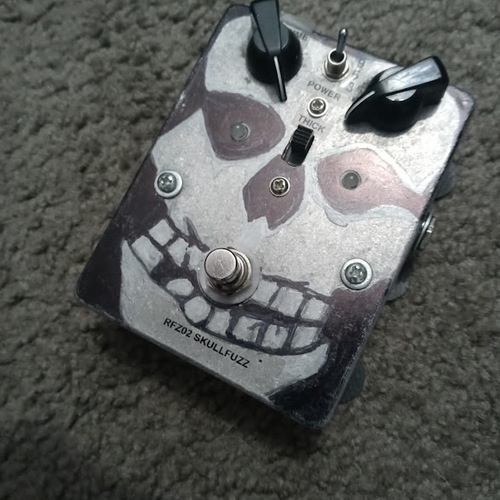
The pedal got it's name "FazzFuzz" or "FNaF Fuzz" or "Freddy Fuzzbear's Pedal" off the fact that during development, the ultimate final number of Transistors became a total of 5 - which just so happens to match the number of Homocidal Animatronics in the Scott Cawthon modern indie classic computer game Five Nights at Freddys, so each Transistor is named after an Animatronic, and all but Freddy can be taken out of the circuit, giving a wide variety of sounds, and the adjustable voltage and currents applied to such give some insane versitility. the Transistors consist of 3 50,000 hFE BC517's and a pair of 300 hFE BC333's - giving a sound like no other pedal on the planet as I've never heard or seen a design that uses this many transistors, let alone these specific variants.
So let's talk now about how this pedal works and why I'm so happy with it.....
The controls are as follows from Left to Right
TOP ROW: Jumpscare (Volume), Negativity (-Voltage or Q2-Q5 to Ground off Emitter), Freddy (Freddy's Input Voltage - Q1), Power (The Total Voltage going into the Pedal), and Teeth (Gain)
MIDDLE ROW: these 4 switches either direct the Emitter of Q2-Q4 to a fixed value resistor, or the Negativity control - Golden Freddy (Q5), Foxy (Q4), Chica (Q3), and Bonnie (Q2) from Left to Right.
BOTTOM ROW: Far Right Slide Switch controls the input capacitor giving the pedal a more "distortion" like voice or a more "fuzz" like voice. The Far left slide switch changes how the Volume contrll roll-off works by retaining the treble frequencies or not, allowing the volume to also act as a tone control, which works well as this pedal is EXTREMELY hot in output.
BUTTONS: Left = Permanant On/Off, Middle = Switches between Permanant and Momentary Operation, Right = Momentary On/Off, later versions I plan to omit the center button because I figured out a way to make this work without a "mode" switch. There is a bright red Indicator LED I sourced from a dead VCR in the middle above Bonnie's head on the artwork (center) that indicates when the pedal is off or on.
The pedal can run off of 5-15VDC at 1mA or lower either off a 9V battery, or off a Power Supply. Currently I'm using a 9VDC at 300mA power supply on it, center positive - which I need to reverse for my pedalboard and to meet standard BOSS pedal requirements if I'm ever to start making these for sale.
The amount of sounds this thing can get, due to the variable positive/negative current flow and voltage levels, and all the input/output options provided makes for a very versatile device ranging from a great booster to a insane noise machine that would make someone like Trent Reznor or Captain Beefheart proud. So it's a bit more than just your regular, run-of-the-mill Fuzz Pedal.
Using just the input stage gives a very traditional fuzz that can range from slightly lower output with good crispiness with full voltage, to muddy, angry, dark grungy fuzz with a nice even gain. HIgh output pickups really drive this thing to crazy levels, especially active pickups. And because the gain is not so over-the-top it can also be stacked or layered over other pedals or a already great sounding Tube Amp to add some "mud" or some other tonal chracteristics unattainable any other way.
The Bonnie switch switches between a resistor and the variable positive switch. Bonnie creates these frantic blippy computer-like oscillations that would be good to use as some kind of junky lo-fi sequencer setting, or some kind of broken synthesizer sound. Turning the negativity up and down makes his more or less extreme or changes the behavior quite a bit.
The Chica Switch acts more as a stabilizer. The set resistor is a 1Meg Resistor that basically adds a hair more gain and takes away some presense. However, the negative control is a bit more useless on this setting up to a certain point ebcause it basically cuts the whole signal off or sends it to ground, I plan to fix this by putting another 1MEG between the switch and the pot so that I can have up to 2MEGs of control on the negative side making the pot more useful.
The Foxy and Freddy Switches Add more gain and an alement of chaos to the pedal. In set mode the pedal becomes more quiet but a bit more aggressive as well.
And combining these can do all sorts of things from raspy, distorted, messy industrial sounds, to an almost perfect square wave, to strange Atari-2600-Arpeggiator effects added to the note decays. Messier and glitichier settings filled with noisy artifacts can be controlled by using the momentary footswitch to turn the pedal on as needed, weather you want to add an Atari-2600 type decay to the end of a guitar solo, or create brief chaotic sound bytes to add texture to a piece.
That said, very satisfied with my first pedal and first original pedal design. It has it's quirks, flaws, and some revisions I need to make to make the next one better - but despite it's been a very usable, very fun, and crazy tool and toy in my effects setup since I built it. I plan to build more of these.
Amplifiers 14
The Bugera 333XL is a creation of Behringer corporation in the late 2000's to cash in on the desire for decent Tube Amplifiers at an accessible cost. The original lineup consisted mostly of copies of Peavey's most popular models such as the 5150/6505, the JSX (this one, the 333XL), and the XXX (333). These amplifiers were designed to fit into the lower-mid priced price bracket.
These amps started to ship in late 2007 and within 5 or so months, the issues with these amps started to come to light.
I bought my 333XL in this 5 month period in March of 2008, for just shy of $1000 w/ Bugera 4X12 cabinet. The main draw was that the head itself had 3 channels, decent reverb, a noise gate, had amazing tone (especially considering the price), and was exactly what I wanted for cheaper - as I was not ready to fork $3000+ for a Marshall TSL JCM2000 setup.
However, problems became apparent quickly. The main problems with these amps were....
- The high power input transformer that supplies power to the tubes is connected via a nylon molex connector not up to the job of supplying such a voltage for the duration of many gigs and rehearsals. What happened was the Molex connector gets hot from shoving 120 Watts of 120VAC 60 Hz current into a quartet of EL34s (or 6L6's) and a quartet of 12AX7's, eventually reaching the nylon melting point, severing the connector from it's pins, cutting power to all tubes, and creating the problem where you turn on the amp, the tubes don't light up, you get no sound. This was resolved by me desoldering the original pin connector and then soldering lengths of wire down the traces on the other side of the board to make sure the solder could not get hot enough to cut-connection to the tubes.
- The next problem is footswitches, especially now. The FSB104B footswitch does NOT have a modular cable. The cable is a proprietary mini-Din 5 pin connector with a L-shaped key so it only fits the right way. The cable is not up to the task for gigging for over 2 years and can break. Since it's not removable from the footswitch, it the cable is bad, you either have to replace the whole pedal, or go through a specialty electronics shop to buy the proper connector, then buy your own 5-6-wire cable to cobble your own setup. Once I could no longer replace these pedals - as Bugera I spose' expects us all to go throw $500+ down on a new Infineum model of this amp - I took matters into my own hands, and rewired it for D-SUB 9 pin Serial port connectors and use Serial port extension cables - so now I can go 31' away from the amp live with the footswitch, or scale it down for smaller stages, reducing tripping hazards - now THAT is a solution.
- The input jacks can break under frequent use. When I first bought this amp - I was playing 3-5 shows a week with an original rock band and relied on this amplifier to work every night. That meant a LOT of cable installation and removal. Eventually the plastic anchors that hold the connectors to the chassis broke off, and I had to replace them. Ultimatley, my other main tonal Behringer product - a V-Amp Pro I bought in 2004, at 11 years old, blew up, and so I had some OEM replacement parts to cannibalize from that.
Since then, the amp has not been any trouble thankfully. I'm looking at buying up one or two more dead 333XL's to fix up as backups.
That said, the sound it makes makes all this trouble worth it. Some amps just have a "magic" about them, and this amp has some kind of sonic magic to it.
Cleans have very high headroom - I have put this thing on 12 before, and it does NOT break up even with a set of EMG actives pounding the shit out of the preamp. Very Fendery, even with EL34s. Bright top end sparkle. I think the Tone Stack was designed to appeal to those of us who like Fender Twin Reverb-like cleans.
The Crunch channel is classic Marshall. Nice midrange and upper mid spike, with a bit of a lay-back on the lows. With the XL switch engaged it gives a nice wider bass boost to things giving a slight Van-Haleny effect to the down. It can get pretty distorted, most of the time I run this around 5.
The Lead Channel is much like Crunch, but with a lot more saturation. It does have a "slight" fizz to it if you manipulate the tone stack too much with the active EQ. I don't actually use this for a lead channel so much as to push the gain up on my single-coil guitars.
The biggest feature though to me - for leads - is the FX loop - which also works as a volume boost for solos. This is perfect for my style since when I play solos I don't like my tone to change at all, just get about 3 or so db louder so that I can be heard. This takes a load of work off the Soundman, and takes a load of worry off myself because how do you expect your average sound guy at a dive bar to know exactly when your guitar break is if this is the first time he's heard you.
Since addressing these issues, it's become a rather reliable amp and I've not needed a backup for over 2-3 years, including a period of about 2 years where I was gigging 3-5 shows a week again after all repairs. My ex-bandmates Egnater was more trouble than this amp.
One of the most vital parts of my "tone quest" was over as soon as I found this cabinet for $114, beaten and road-worn, in a Everett WA Pawn Shop in 2008. The shop did not know what it was, the only spot on the entire cab that said "Peavey" on it was the nameplate in back, it had heavy duty casters all grungy and beaten suggesting decades of hair metal, grunge, punk, and other hard rocking shows.
The 412M in the picture is the newer version, I have the older VTM series version from 1988 - these 412Ms came with 4 Celesion GK-85S speakers - precursor to the GK-100. Honestly, after having a Line6 Cabinet with a GK-100 in it, I prefer the GK-85s better, they are a bit warmer, and have midrange, and that midrange is in EXACTLY the right spot for my tonal preferences. Need an idea of the kind of midrange I like - go listen to Eddie Van-Halen, George Lynch during hte Under Lock & Key era Dokken, Elliot Easton on the early Cars records, or George Kooeymans in pretty much any decade of Golden Earring - THAT is where this cab sits tonally - with a 120 watt Bugera 333XL head with EL34s and 12AX7's pushing the speakers.
It's a tough as nails cab too. Last band I was in, this thing got regularly loaded into an old panel van and beaten around on it's way to gigs. Our rhythm guitarist had a Marshall cabinet just as old, and his looked like HELL! This thing's tolex could stand up to a nuclear blast, only had to glue one patch of it. All 4 casters still work despite being rolled up and down western Washington streets for the better part of 3-4 decades. Will never let go of this cab.
And just a hint on the other variatns this cab has....
The 1988 version is what I have which came with the old Peavey VTM series amp heads - a set of amps with Dip-Switch "modification" circuit tweaker stuff.
Then in 1989-1990ish, Eddie Van-Halen joined Peavey and the 412M became his cabinet of choice for the 5150, except with Sheffield Speakers.
I think later these got equipped with the GK-100 speakers sometime after the 6505, correct me if I'm wrong.
I'd been shopping for more than a year for a decent, smaller, modeling amp for practicing and lugging around to jam at other places. One of these was this amp - the Blackstar IDCORE Stereo 10. Typically retailing at Guitar Center and Kennely Keys for $100. But I found one for $30 when the pawn shop I was at could not locate the power supply, or find one that worked.
The power supply is the major failing point of these amps - so much so here's a few pieces of wisdom I've been sharing online for awhile. To start, the original 6.5V 2.5ma power supply these came with has a tendency to burn out some internal connections to the transformer severing power connection. As a result, Blackstar started selling these with the 12V power adapter for the bigger versions of these amp (the IDCORE 20 and IDCORE 30 I presume?). Me - in my typical thrift-shop DIY fashion, I visisted 3-4 different stores and wound up locating a suitable power supply at goodwill - for a IOMEGA ZIP Drive! Only $0.99. I've been running it a megaton ever since, and have not experienced any problems at all.
The main thing drawing me to this amp was that it kills 2 birds with one stone - I get a good amp modeler I can use for home direct recording, and I get a practice amp I can lug around to various situations where a little 10 watt amp is more than sufficient. It being able to emulate my Bugera 333XL head in a smaller format is another part of why I chose this amp. The Crunch and Super Crunch are very close to that EL34 based sound if I dial it in just right. And it's plenty loud enough for my needs.
The Amp models on this amp include the following, and what I think they sound closest to.....
- Clean Warm has more of a Tweed Era Fender sound and broken up it gets a little bluesy. I use this for Bass quite a bit as it works great at emulating a Fender Bassman 410 Tweed, which is the sound I've preferred for my recording Bass sound for years - think 1980-1981 era Bucky Ballard (Billy Squier band) sound, like off of Rich Kid or The Big Beat. It gives out a nice growl when the gain is pushed, but it can be very clean as well.
- Clean Bright I suspect is aimed more toward the glassy, high-headroom, Fender Twin Reverb-esque sound. Think Robert Cray, or another good example would be the Roland JC-120 Jazz Chorus. Only thing is it WILL break up if pushed, giving it an extra realm of versitility, so it's not exactly as high headroom as I initially mentioned.
- Crunch - The classic rock-amp sort of tone. I'd liken it to sounding a lot like a dimed Plexi or a older JCM800 amp - which is EXACTLY in the realm of what I want tone-wise. The first time I tried one of these out, I used Crunch with a Squier VM Jaguar and kicked on chorus, very light 550ms stereo delay, and plate reverb and I was right at my sound right there in the store. This is also very close to the crunch channel on my 333XL head - which is part of why I bought this amp (a big part actually).
- Super Crunch - More gain than crunch, same general timbre, I liken it to the lead channel on my 333XL head. I usually use this to push more gain when using single coil guitars like my Jazzmaster, Tele, Harmony H-802, or a regular 3 single coil Stratocaster.
- OD1 - Hot Rodded Master Volume Overdrive - This is very much in the realm of a scooped-mid tone. One kind of interesting surprise was being able to dial in the tone I used back in my Nu-Metal days toward the end of high school. Not a lot of mids - more of a Godsmack/And Justice Era Metallica/Saliva type tone here. Has more of a response to me like a Mesa Boogie or a Krank, with a hint of Carvin X60A/X100B tone to it. Also great for Sabbath. Sort of in the angry KT-88/6L6 realm. It also works great for getting a good Kurt Cobain distortion emulation.
- OD2 - Mid Boosted Overdrive - This is more of a classic 80's metal kind of tone here, not in the Van-Halen crunch vein, but Early Metallica, Obsession, Slayer, Loverboy's guitar sound, very HiWatt but without that bluesy blattiness that a Hiwatt would normally have, either that or a modded/tweaked JCM800/JCM900 type amp. Dialed in just right it's a bloody doppleganger for Paul Dean's early 80's tone though - another pair of close relatives are W.A.S.P., Invasion of your Privacy era RATT, Under Lock and Key era Dokken....all great tones.
So there are 5 amp models, quite versatile considering how much stuff I can emulate not to mention recreate my own sounds from previous rigs I've had. It ISF control allows some rather quick fine-tuning of the sound rather than bugging around with a graphic EQ, turning it down gives more of a Warmer, Aggressive, USA type voice, turning it up gives a more "woody" "English" type voice.
The next part are the effects - you have 3 classes of effect on this amp, and only one variant of each may be used at a time - Modulation (Phaser, Flanger, Chorus, Tremolo), Delay (Linear/Analog/Tape/Multi), and Reverb (Room/Hall/Spring/Plate).
The Modulation was a huge thing because of two key effects I like, that very light, yet noticeable when present, chorus sound. A similar effect is the Eventide Harmonizer "Jape" setting that Edward Van-Halen used from Van-Halen II onward. It basically gives a bit of depth to the sound. But the chorus can do everything from that to full on "Come AS You Are" warbles if desired. The other sound was that low-tone-sweep Flanger sound that I get out of a Digitech TurboFlange or as Paul Dean of Loverboy got out of the Loft 450G rackmount Delay-Line Flanger in the 80's - Having those two things without external hardware is incredibly useful since I use both of them. The Phaser and Tremolo are great as well. Just having those two particular sounds alone that I use a lot was well worth over the $30 I paid for this thing.
For Delays, I tend to use the Multi and Linear the most - usually the Multi. The Multi-Delay is kind of neat in that a sort of "rhythmic" delay pattering outside (but in step with) the rhythm of what you are actually playing can be induced using the "Tap" button.
For Reverbs, I tend to prefer plate. An interesting note on most, if not all the reverbs on this amp, is their effect through the speakers - it really has a 3D type effect to it, I remember getting rather self-conscious both at the store and at home playing this thing through it's own speaker and hearing things coming from my left or right rather than from the amp like "WTF is that". I've seen this with quite a few of the Blackstar IDCORE series amps and it's quite impressive they could pull that off. That was one of those things this amp and it's bigger relatives impressed me with - the spatial-ness of this amp is something beyond compare to my ears.
Other features....
- It can act as a digital recording interface for various software. Actually, I reccommend that over using Line-in as the Line-in is grainy and a bit closer in quality to my old Behringer V-Amp Pro that I used for 11 years for home recording.
- The Line-in on it allows passthrough of other instruments so if you use a cheap, crappy, line-in based recording setup at home for making demos (one of the main reasons for this amp to kill 2 birds with one stone). I pass my keyboard through it to save all the plugging/unplugging of my gear all the frickin' time since it's more capturing inspiration than making some kind of album recording (though I can do that well as well).
- An upside and a downside is the IDCORE Software, you need it to update the firmware, and you need an older flip-phone mini-USB cable to do it (I luckily still had one from my Motorola W375 Net10 Phone from 12 years ago, glad I stashed that outdated piece of kit for future use). However, the software is reliable, it does not mess up your presets when saving them, and it offers a more intuitive interface with finer control over presets than setting them through the amp directly - but one thing I must say about presets via the amp itself - there's almost NO way to make this thing sound terrible (unless you're just terrible or very limited as a player). This is a long way away from what I started out on 22 years ago - when "practice amp" meant some 15 watt 2 channel combo based off a LM386 op-amp with just clean and overdrive channels that sound similar except one has a distortion pedal built into it.
Either way, my new favorite of the sub 20 Watt amplifier genre.
The Boss Katana MkII head was a major draw for me after my Bugera 333XL started giving me problems again and I talked to some musician friends about what everyone is using live these days. "A lot of modeling amps" seemed to be a big part of the concensus.
So I started looking at modeling amps - modern ones. I looked at everything I could find from Line6 Spiders, Marshall Codes, Behringer V-Amp products, Fender Mustangs, and then the BOSS Katana. This particular amplifier line started to check all the marks the more I read about it.
In years past, I had to have at least TWO rigs...
One rig was usually a digital effects modeler plugged into a computer used for multi-track recording. In this case, it'd be the Line6 HD500 plugged into a late 2015 iMac 21.5".
The other rig would be the one I would use in a live situation. In this case, it was a Bugera 333XL into a Peavey 412M 4x12 with Celestion GK85 speakers in it, and a SKB PS-45 powered pedalboard with a mix of analog and digital pedals, including a couple home built ones.
And both rigs shared the same stable of guitars which ranged from 5K ohm single coils to a 17K humbucker. And I wanted to get the same amount of distortion out of both without bending the character of the guitar's sound too much.
What appealed to me right off the bat was consolidation - I could remove several pedals, and basically use ONE amplifier for everything. The next thing was I knew I wanted a head. I love the sound of that Peavey 4x12 cabinet that I found at a rinky dink Seattle pawn shop for $114 in the fall of 2008. So I wanted to keep that for the "big volume" part of the equation. Lucky me the heads were 100 Watts across the generations, across the board. I could record with it at home (more on that later), I could practice on it and rock out in the house without blowing the roof off the place or precariously keeping the volume at 3 or under, and I could definatley go out and play a live show with it cranked up.
What lead me to the mkII head was a couple of things. First off, a good Gen 3 Artist or Gen 3 head would cost me about $500 - about the same as the Bugera. Sure, I'd get Bluetooth and the new "Bloom" feature, but that never was a big part of my sound or overall technological style anyway. A Mk1 is fine, and I compared the Mk1 and MkII to each other and found I'd probably be fine with either.
So I looked at our local Guitar Center and as luck would have it they had the MkII head there used for about $264-ish. So I went over, tried out a quartet of similar guitars to mine through it (J.Mascius Jazzmaster, the worst setup Squier Tele in the world, a $1000 Snakebite James Hetfield model, and a Squier Mustang). Within 2 minutes I had my sound dialed in, and I tried out the 5" speaker on it which sounds surprisingly great considering it's jammed inside of a amp head. So basically, these are a 0.5w/30w combo that also doubles as a 0.5w/50w/100w head. Nice.
The built in effects have me currently testing and tweaking and deciding which pedals go, and which pedals stay.
Among the real jewels of the built-in effects are of course the Chorus, Delay, and Reverb effects, as well as the EVH style Phase 90 effect. So that took a Small Clone, Behringer PH9, and a BOSS DD7 Digital Delay off my board already, as well as a Behringer Noise Gate.
The Pitch Shifter, however, in typical BOSS Fashion, was not something I'd be using the same way, so the EHX Pitch Fork stays put. I use my Pitch Fork like I did my old WH4 Whammy pedal, 5ths usually (ie single string power chords that I can layer over each other using power chords, or add 5ths to regular chords for some big, pretty sounding stuff). However, it has it's own purpose in the setup that matches will with the Pitch Fork as I remember trying a BOSS PS-2 pitch shifter in the 90's and loving the whole feedback knob effect I got from it back then. That said, it is a downside I can't really remove that pedal from the board and have one MIDI Floorboard, but you can't have everything.
I don't really have a need for Fuzzes or Overdrives since I use my own home-made Fuzz pedals which are on my equip board. But it's nice to know I have more options.
One big feature is the "Boost" feature. My 333XL had an Effects Loop with adjustable gain so I used to use that as a booster for solos. This has that as well. It requires a separate foot switch except I think some MIDI Pedals allow for control of 1/4" phone jack which is in my future plans.
Being able to control via MIDI was important because I looked at the footswitch options. While the GA FC and GA FC EX are both nice looking footswitches in their own right, they seem a bit limited compared to the functionality that this amplifier is capable of. Lucky me I have the MIDI Controller port so I can pick from one of many various MIDI Controllers for it which is a source of research to improve the QOL of my guitar-life.
Through the 5" speaker, yes, you will get some "blat" with bass-heavy tones, but that's to be expected, this is a high-wattage, high gain amplifier with a 5" built-in speaker intended as a quiet late-night jamming option. It's not meant to be a tonal marvel, meant to be a tool for practice and jamming out for fun.
Recording through the computer is a bit of an interesting scenario. See, I'm an I.T. guy by trade, I work with Windows, Linux, and MacOS and am familiar with all three...here's my view of the landscape...
The BOSS Katana has pretty decent support across all three but has some caveats I think people need to be aware of...
First off, the headphones are MONO only. So you don't get that cool stereo separation you'll get over USB. However, recording, you WILL Get stereo and it sounds spatial and awesome when dialed in right.
For Mac and Windows you can edit patches on the amplifier using Boss Tone Studio which is downloadable via their website. It requires downloading a driver. That said, it does have one downside in that you are limited to one of eight signal chains, and those signal chains might not be to your liking....or fit what you want necessarily....
Which brings me to Linux. Linux has FxFloorBoard, an unofficial program that allows you to do more in-depth editing of patches including changing up the signal chain in any order you choose. This make it somewhat incompatible with BTS and means you might need to choose one or the other as patches might get corrupted by the official software.
Some of the smaller models might not allow for as many stored patches as the head does, which allows for eight + a "panel" button that allows it to be used like a regular guitar amplifier via the adjustments on the top. Which is 5 more "channels" than my old Bugera has. However, having limited patches is an advantage because one problem I learned through having eight setlists of 16 banks of four patches each on the HD500, or the Behringer V-Amp pro with it's crazy total of 100 patches (or more), was I would sometimes get a form of "option paralysis", or wonder why I'm only using 2 banks of patches 90% of the time with so much space. Because my use-case is my own sound, and my own sound only. I'm not looking to copy famous people anymore. I found my own tone long ago.
So the pros of this unit is that it can indeed be a consolidation of your musical gear needs into one head that can do it all acting as a digital recording device for your PC, a home practice amp, and then take it to a gig with a 4x12 and melt faces with it. Also the chorus, delay, reverb, and having a lot of other stuff prewired into the amp helps a lot with reducing pedal board sizes, which with the reducing sizes of local stages these days is a real plus to not need to navigate 10 stompboxes that take up the space of a toilet stall.
The cons are that the headphone jack isn't stereo, and in order to monitor the stereo output you need to use a program like Ardour or GarageBand with the monitor on. This is somewhat negated in that there's no latency even on my ancient iMac, but it is kind of a pain to need to open up a DAW just to hear the amp in it's full stereo glory. The footswitch is separate and costs about $140 - which is kinda' expensive considering it only has five buttons and you still need to purchase separate footswitches and expression pedals for other functions like boost, wah, or volume. However, for about the same price or less you could buy a cheap FCB1010 Behringer MIDI board and run the whole amp if your programming skills are up to it (one of the options I'm seriously considering). Linux support is spotty at best, with me spending a lot of time in Pulse and Alsa dicking around with the settings to get a sound, while Mac is probably the best platform for adjusting the outputs on it (we all know how wacky modern Windows audio can be).
But overall, it checks on average 9-10 marks from someone like me who demands a lot from his equipment at a price lower than some Squiers, and at $264 used that's a friggin steal. It's small, it's light, it's loud, I can practice or record with it, and then go down the street and terrorize the open Jam Night with a thumping monster guitar tone. 100% what I was looking for. And the fact it has MIDI Negates a lot of the negatives about the footswitch.
DAWs 6
I started off recording on PC before it was even popular using TwoTrak freeware on a 486 (and god that was a PITA to get working), then using QuartzAudiomaster Freeware for awhile, and then when Quartz went belly-up in 2007 and their website disappeared, I needed to look for a new DAW, and I found REAPER and it has stayed mine ever since.
I've seen REAPER as an excellent DAW both for beginners and pros alike. I'm kind of a "savant" of sorts with this stuff, I never studied mixing, I never learned how to master or how to even USE a DAW, but I figured out REAPER on my own enough to recreate the functionality of Quartz AudioMaster Free years ago and have used it ever since to the point that I've actually learned a lot through using it making demos, recordings for YouTube and elsewhere, and whatnot.
I did have some problems using it at first because my computer was older (an eight year old Pentium III with half a gig of RAM running WIndows 2000), but I found out that switching to a better soundcard caused the metronome and tracks to sync properly.
And even then, I had a period using a Pentium-D using Windows 7 x64 and 4GB of RAM with it where it would go out of synch but was easy to fix everything so no biggie there.
But since about 2012 I've been golden. For awhile I even used an even older PC with it (Pentiium 4 2.8GHz w/3GB of RAM and an SSD) and it performed well there too. Currently I'm using a custom home-built box for it now where hardware is not a concern.
And $60 to use it commercially is a real steal TBH. When a guy who was learning from a major producer tells you he's amazed how your demo tracks you bring to the band sound like actual album production tracks, you know you're using the right DAW.
Studio Equipment 7
Other Gear 21
So one day I was browsing Youtube and the adaptive advertising came on talking about these new strings showing everyone from Paul Gilbert to Kirk Hammett to John Petrucci beating the ever loving shit out of their guitars with these installed. Knowing how hard I am on guitar strings....I sweat buckets, I pick attack like a beast, I use my whammy bar like some kind of weapon, and my systems are not even locking systems......let's just say being the open minded sort of guy I am, I decided to give these a try on my two main - and probably the most uncomventional guitars to install these on - my old 1995 Fender Jag-Stang and 1998 Fender Jaguar.
Well, that was February of this year, and both guitars are still wearing those same first packs, both are still rather bright, not at all dead, and I've only had to tune them a few times since buying these....it's a very funny feeling to come to rehearsal and gigs and kick the BOSS TU-2 and find out you're not tripping that your guitars are in as good a tune as a guitar can get.
I'm a very hard player, I play with Dunlop Jazz III picks and Dunlop Big Stubbys and other thick picks, I hit the strings like I'm trying to kill someone, as music is also my aggression outlet, and I play with wimpy little .009 gauge strings.
Prior to this I was trying out the Jag-Stang using the blue "super Slinky" .008-.038 strings, moving up a gauge to .009's from that for these was not much of a change, I swear, these feel like .008s! Only difference is I don't need to finesse the low E at all with these. Prior to that I was running Fender Super Bullet 350XLs, .009-.042, since 2005 when Fender discontinued the stainless .009-.040 sets. I bend, twist, tremolo pick like a nitrous powered lawn mower with guitar picks on the blade, and it stays in tune. I treat that Fender Dynamic Vibrato harder than most people treat their Floyd Rose tremolos, and it and the Paradigms just do whatever extreme madness I choose to get myself into that day.
The Jaguar I do a lot of picking behind the bridge - hard - which can break strings on a Jag. Has not done so yet. Another problem with Jaguars, which was why I used Bullets for so long with my Jaguar - the windings on regular strings like Super Slinkeys and D'Addarios and Dunlops would unravel under the constant whammying I do with that Beach Boy's approved Floating Tremolo (think if EVH was forced to use a Jaguar for a set and you'd get what I do with a Jaguar vibrato). These, the Jag is like a fine tuned, well oiled machine, and due to the lower bar travel and the stronger feel of tension due to the bridge system the Jaguar employs, it has only really needed tuned once since then.
This sounds like a very overly positive review, well, it is. I've used everything from .008-.038's to my own custom .014-.060 gauge sets (yes, in standard tuning, with a Floyd Rose - ripped it outta' my Kramer after awhile TBH), and the Jag-Stang's best on string age has been 9 months on a pack of Fender bullet .009's - well, now it's been 9 months and the Paradigms are doing even better than the Bullets did and I swore by those Bullets for years, and then Fender discontinued the stainless .009-.040 set I loved so much, and I started having problems with the bullets coming off on my Jaguar and Jazzmaster - negating the whole reason I used them on those guitars in the first place, so I started looking to new strings, I think I've found them. And if they last with a guitar-bashing whammy-holic with a penchant for vintage hardware like me, they should do at least pretty good for someone else.
That said, I've read other reviews claiming broken strings and other issues. I've noticed a lot of people don't install their strings properly and that's where I could see these issues coming up. Kink any sort of metal wire - it will break. Wrap them badly around the capstans, of course they won't stay in tune. I could write a book on all the sins I've seen/heard/fixed from people's faulty restringing jobs. But that's a bit too much for a review on strings.
I swear these things should be a standard feature on all new guitars. They have been a permanent and important installation on ALL of my guitars since 2000....bought, built, modified, however I got them or use them, these are standard equipment. I watched a friend make a lawn dart out of his brand new B.C. Rich Warlock imitating CC Deville - if he'd had these, I never would have had to re glue the headstock on it! Performers and musicians - were a crazy lot who do a lot of stupid things with our instruments from time to time - I consider this insurance against accidents involving strap failures.
My #1 problem with headphones is I'm HARD on them - it seems the only stuff that holds up well is either vintage stuff, or rather robust/ruggedized stuff. Well, I think I found it in these.
These headphones are not like a modern pair of headphones, they are not really an audiophile devices so much as they are great - at least to me - for Mixing. Because They give a very, sort of in the middle sound quality, which works well for mixing things down and making them sound good on crap. One of the best recordings I ever mixed was back in 2006 using a pair of cheap dollar store headphones. I think I found something almost as good but much better built here, as I like my mixes to sound great on a midrangey little device like a cell phone or an old transistor radio, as I would on a 3D stereo enabled system.
Synthesizers 13
Wishlist 8
Gear Photos 58
Top artists 28
The artists CreepingNet has added the most gear to.
Showing the top 12 of 28 artists.