


Pricing and availability




Average Price: $150
Standard/Professional
$100
$501+
Price Tier
Budget
Standard
High-end
* Product prices and availability are updated by Equipboard every 24hrs and are subject to change. Equipboard may receive compensation for purchases made at participating retailers linked on this site. This compensation does not affect what products or prices are displayed, or the order of prices listed. For more information, please refer to our affiliate disclosure.
Description
For those who crave precision and a touch of vintage charm in their recordings, the MXR M-113 Digital Delay might just be your new best friend. As a staple in the realm of effects processors, this unit offers an impressive range of delay times, from a crisp 20 milliseconds to a lush 800 milliseconds. This flexibility allows you to craft anything from tight slapback echoes to expansive soundscapes.
The M-113 is known for its all-analog signal path, which ensures that your tone remains uncolored and true, even as you experiment with its wide delay capabilities. It's designed with an intuitive interface, making it user-friendly whether you're a seasoned producer or a budding enthusiast. The rugged construction ensures it stands up to the rigors of both studio and live environments, while the classic MXR aesthetic keeps it looking sharp on your pedalboard.
One of the defining characteristics of this processor is its ability to seamlessly integrate into any setup. Whether you're working with a complex rig or a simple home studio, the M-113 adapts effortlessly, making it a versatile addition to your signal chain. With its unique charm and reliable functionality, it's no wonder this delay unit has become a favorite among musicians who value both tone and versatility.
Key Features:
- Offers delay times ranging from 20ms to 800ms
- All-analog signal path for uncolored tone
- Intuitive controls for easy operation
- Rugged construction for durability
- Seamlessly integrates with any setup
Product specs
| Brand | MXR |
| Model | MX-113 Digital Delay |
| Finish | Blue |
| Year | 1976 - 1979 |
| Made In | United States |
| Categories | Delay Pedals |
| Color Family | Blue |
| Pedal Format | Rackmount |
FAQs
-
What are the core features of the MXR M-113 Digital Delay?
-
The MXR M-113 Digital Delay is a rackmount effects processor from the late 1970s, known for offering adjustable delay times and feedback control, allowing for a range of delay effects from subtle echoes to complex soundscapes.
-
How does the MXR M-113 Digital Delay compare to modern delay pedals?
-
The MXR M-113 Digital Delay provides vintage digital delay sounds with a unique character that differs from modern digital pedals, which often offer more features and higher fidelity. Its classic design appeals to those seeking a retro aesthetic and sound.
-
Is the MXR M-113 Digital Delay suitable for live performances?
-
Yes, the MXR M-113 Digital Delay can be used in live performances, especially for those who appreciate its vintage digital sound. However, being a rackmount unit, it may require additional setup compared to modern pedalboard-friendly delays.
-
What is the typical delay range of the MXR M-113 Digital Delay?
-
The MXR M-113 Digital Delay offers a range of delay times, typically from a few milliseconds to several hundred milliseconds, suitable for creating various echo and delay effects.
-
Can the MXR M-113 Digital Delay be used with instruments other than guitars?
-
Yes, the MXR M-113 Digital Delay can be used with a variety of instruments, including keyboards and synthesizers, making it versatile for different studio and live applications.
Videos

Synth Tailor Electronics
MXR Pitch Transposer M-129 + MXR Digital Delay M-113 + Roland TR808 Demo
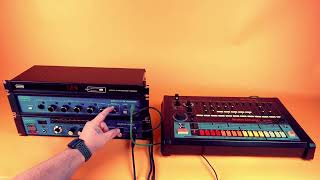
MXR Pitch Transposer M-129 + MXR Digital Delay M-113 + Roland TR808 Demo
Synth Tailor Electronics
Reviews
PROS
-
Iconic piece of gear from 1976, the first digital delay ever produced
-
Offers a vintage sound that evokes tones from the 70’s and 80’s
-
Known for its historical significance in music production
-
Great for achieving Jaco Pastorius' bass tone
CONS
-
Units can run hot, potentially affecting delay time
-
Buying a working unit can be expensive compared to faulty ones
Owner Insights
We analyzed real musician discussions from forums and Reddit to find what players love, question, and tweak about MXR M-113 Digital Delay.
Setup and maintenance
-
Intermittent issues may be related to a crusty "external delay control" jack; cleaning it with contact cleaner can stabilize performance temporarily.
Source -
Grounding the path to pin 14 on J6 can effectively bypass malfunctioning modulation controls, isolating issues in the modulation section.
Source -
Utilizing freeze spray can assist in diagnosing heat-related intermittent issues in components such as opamps or transistors like Q6 PNP.
Source
Features and functionality
-
The modulation section's "width" and "freq" controls can malfunction despite being set to minimum, causing persistent ring-mod-like effects.
Source
Mods and upgrades
-
Replacing opamps A6 and A7, particularly the 4558 model, is suggested for resolving persistent modulation issues, though this might not always solve frequency knob responsiveness.
Source
Comparisons
Use cases and applications
4.0 out of 5
Based on 2 Reviews and 5 Ratings

655
Great Original AD/DA Rack Delay Unit!
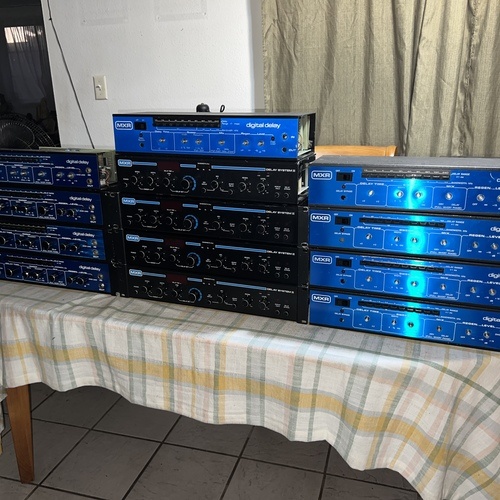
I have several of these units since buying one working unit is as much as buying four bad units. This one is the System I, which came out in 1976, until it was superseded by System II. Watch out as these units can run hot, affecting your delay time!

Artist usage
Add artist
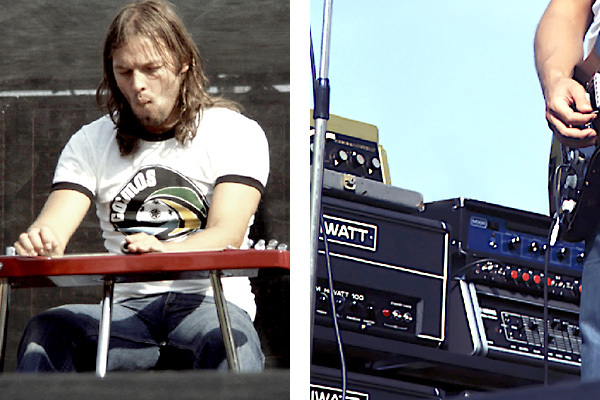
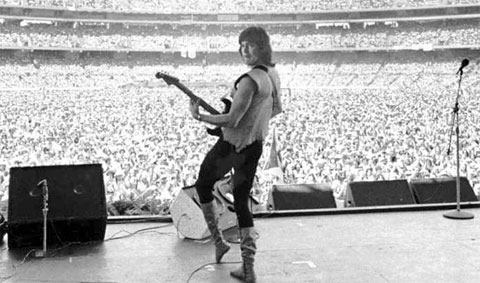
David's MXR Digital Delay rack mount is seen in this photograph from the '70's.
"We also have an old MXR DDL digital delay unit built into a rack unit. It has a digital readout, but it's really nowhere close to being accurate. Dave likes it because even though it's a digital unit, it still sounds a little dirty, like a tape unit." - Phil Taylor, David Gilmour's guitar tech.


This vintage effects processor was sold on Billy Corgan’s official Reverb.com shop.
.jpeg?v=1784640199)
.jpeg?v=1784640199)
In 1977, Roger Waters, along with the band, transitioned from using Binson Echorec 2 units to MXR M-113 Digital Delay devices. These rackmount digital delays typically featured a 320 ms delay chip, with an expansion model offering up to 1.28 seconds of delay. While specific details about Waters' setup aren't mentioned, it's noted that David Gilmour's rig included two MXR Digital Delay units and two upgraded MXR Digital Delay System II units, highlighting the band's integration of advanced delay effects during that period. This information is sourced from Watersish.com.

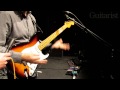
As seen in this video, Eric Johnson runs a rack-mount MXR Digital Delay that feeds into one of his Marshall Amplifiers. According to Johnson, the Delay unit "feeds the top cabinet for dirty rhythm," he says at (2:20).


I've got an MXR Digital Delay, which I put through one amp, leaving the other amp clean [...]

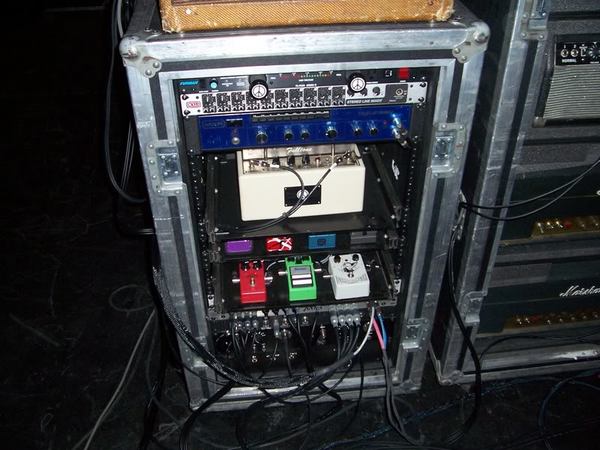
In this pic you can spot the MXR Digital Delay


In the video "Melvins @ UCLA 3/3/1993 (FULL SHOW)" filmed by HORNSS, Buzz Osborne can be seen using the MXR M-113 Digital Delay, visible at the very top of his equipment rack.


Used with Parliament and Funkadelic, as mentioned by Collins in this excerpt from a 1979 Guitar Player interview as transcribed TalkBass here and here from a reprint in Bass Heroes: Styles, Stories & Secrets of 30 Great Bass Players.
What kind of amps do you use in your setup?
The entire system is divided into three different parts - high, mid, and low. But we're not just talking about amplification, we're talking about the effects in each part. On my highs I use a Big Muff fuzz, a Mu-tron III [envelope-following filter], an MXR digital delay, a Morley Fuzz/Wah, a Morley Power Wah, and an Eventide Harmonizer. The Harmonizer sits in a case that looks like R2D2 from Star Wars. It looks just like a little robot, so I call it R2FunkU. There's a sign hanging on it that says, "Can I Play?" Inside of it, there's also a keyboard for the Harmonizer that enables me to preset harmonized intervals to what I'm playing. That way I can play a note and have a fifth or a third coming out at the same time.
All of that equipment just for the highs?
Right. For the mids, I have a Big Muff fuzz, a Mu-tron III, and an MXR digital delay. On the lows, I use a Mu-tron Octave Divider, two Roland Space Echos, a Big Muff fuzz, and a Mu-tron III. I keep all my effects in one box called the Space Case. The highs and mids each have an Alembic preamp, two Crown DC-300A amps, and four Cerwin-Vega speaker cabinets.
What's in each cabinet?
The cabinets used for the highs are called V-32s. They have two 12s, one midrange horn, and two tweeters. The midrange cabinets are basically the same, except there's one 15" speaker instead of two 12s. Those are called V-34s. On the bottom end are three Acoustic 370 heads and six Cerwin-Vega cabinets. Two have one 18" speaker and one 12", two more have an 18 and a 10, and two have one 18" and an 8.
Isn't that a lot of equipment for onstage?
I don't play it that loud. I've just got it there so that I don't have to strain the equipment and everybody can hear. As a matter of fact, the whole stage is set up like that. The guitar player, the keyboard player, everybody is set up like that so there is no real strain.


The MXR Digital Delay can (quickly) be seen as the camera pans up at 6:46 in this video with Future Music Magazine.


"MXR Digital delay:
Apparently used in a live show at the Palladium to replace the EC-3 that was "rather noisy"".


Musical artist quickly, quickly uses the MXR M-113 Digital Delay, as evidenced by a post on Instagram by user qqitemstorage with the caption "Current Station."

Genre Usage
Based on how artists on Equipboard use this gear, it is most commonly found in the following genres.
Used With
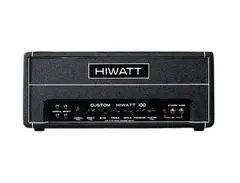
Based on how musicians on Equipboard use MXR M-113 Digital Delay, it is most commonly used with the following gear.






Community setups
Show yours
More MXR Effects Processors


$1,500.00
in Effects Processors Rank


-m.webp?v=1784559394)
$640.00
in Effects Processors Rank


$203.84
in Effects Processors Rank


$1,799.00
in Effects Processors Rank


$1,549.00
in Effects Processors Rank


$1,999.00
in Effects Processors Rank


$749.99 - $833.00
in Effects Processors Rank


$137.00
in Effects Processors Rank


$1,450.00
in Effects Processors Rank


$3,799.00 - $4,985.00
in Effects Processors Rank


-m.webp?v=1784732292)
$40.00 - $2,999.00
in Effects Processors Rank

$5,777.00 - $6,999.00
in Effects Processors Rank
.jpg?v=1784591665)


$1,153.00 - $2,635.00
in Effects Processors Rank


.jpg?v=1784637724)

$3,570.64 - $4,750.00
in Effects Processors Rank


$892.96 - $1,799.95
in Effects Processors Rank


$220.00
in Effects Processors Rank


$624.99
in Effects Processors Rank

$69.95
in Effects Processors Rank


$199.99 - $299.00
in Effects Processors Rank


-m.webp?v=1784559423)
$320.00
in Effects Processors Rank


$419.99 - $1,179.99
in Effects Processors Rank


$749.99 - $4,999.00
in Effects Processors Rank


$1,710.00
in Effects Processors Rank


$2,999.00 - $3,250.00
in Effects Processors Rank


$629.99 - $849.00
in Effects Processors Rank


$35.72 - $199.00
in Effects Processors Rank


-m.webp?v=1784732439)
$309.56 - $936.00
in Effects Processors Rank

$2,555.00 - $3,225.00
in Effects Processors Rank


-m.webp?v=1784732389)
$450.00 - $699.00
in Effects Processors Rank


$4,999.00 - $8,054.01
in Effects Processors Rank
Similar


Gear Guides








Most Popular Effects Processors
Most Popular Brands
-
Added to Equipboard on by
 julianwolf2
GearIQ 13060
-


