This page about Sony PCM-F1 is a stub. You can help improve it:


Pricing and availability




* Product prices and availability are updated by Equipboard every 24hrs and are subject to change. Equipboard may receive compensation for purchases made at participating retailers linked on this site. This compensation does not affect what products or prices are displayed, or the order of prices listed. For more information, please refer to our affiliate disclosure.
Description
The Sony PCM-F1 is a classic piece of studio recording gear that has left an indelible mark on the world of portable recorders. Originally released in the early 1980s, this device was among the first to bring digital recording technology to the masses, making it a beloved choice for musicians and audio engineers alike. Its design reflects a commitment to quality, with a focus on capturing audio with unparalleled clarity and precision. The PCM-F1 pairs with the Betamax and VHS formats, allowing for extended recording times, which was revolutionary for its time.
With the PCM-F1, users can enjoy the simplicity of direct digital recording, providing a reliable platform for capturing audio without the noise and degradation typical of analog systems. This recorder was known for its use of the Pulse Code Modulation (PCM) technology, which was cutting-edge at the time and set a new standard in audio recording. Its interface is straightforward, allowing users to focus on creativity rather than the complexity of operation. Whether you're capturing live performances or conducting studio sessions, the PCM-F1's precision and flexibility make it an invaluable tool.
Key Features:
- First-generation digital portable recorder
- Compatible with Betamax and VHS formats for extended recording
- Utilizes Pulse Code Modulation (PCM) technology for superior audio quality
- Provides direct digital recording to maintain audio integrity
- Simple and intuitive interface for ease of use
- Ideal for both live and studio recording applications
Videos

Tim F's Tinkering Channel
How many times can a 16-bit Sony PCM-F1 recording on VHS be copied?
How many times can a 16-bit Sony PCM-F1 recording on VHS be copied?
Tim F's Tinkering Channel
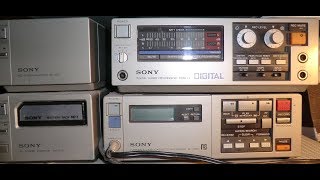
Experiments with PCM F1 digital audio recordings.

video99.co.uk
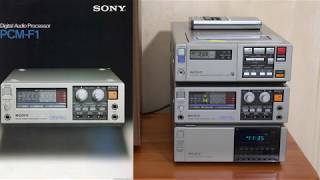
Sony PCM-F1 with SL-2000 Betamax Recorder Playback Test (Apr 2021) 4K

Gregory Botha
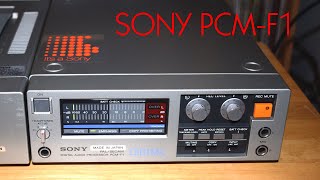
Making a perfect digital recording with a SONY PCM-F1 and a cheapo VHS Video recorder.

Matthew North Music
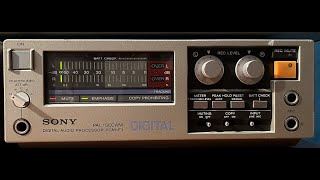
Playing with a Sony PCM-F1 Digital Audio Processor

Tim F's Tinkering Channel
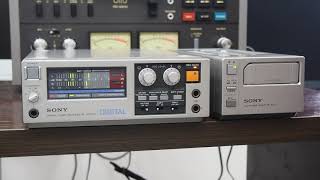
SONY DIGITAL AUDIO PROCESSOR PCM-F1

Elite_Japan_Audio
Can you record from a Sony PCM-F1 on a DVD Recorder? Unexpected Result.
Tim F's Tinkering Channel
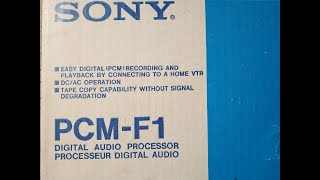
Sony PCM-F1 and SL-F1 - Part 4/4 - F1/C9 Betamax companion. Let there be POWER!

MrBetaByte
Reviews
Owner Insights
We analyzed real musician discussions from forums and Reddit to find what players love, question, and tweak about Sony PCM-F1.
Features and functionality
Comparisons
-
The PCM-F1, when paired with Betamax for digital audio, offers quality close to CD, surpassing S-VHS Hi-Fi stereo analog tracks.
Source
Use cases and applications
-
The PCM-F1 was particularly attractive for prosumers and home recording enthusiasts due to its compatibility with portable Betamax decks.
Source
User experience
-
Owners note that the PCM-F1, paired with a Beta recorder, offers a compact alternative to professional U-Matic setups.
Source
Critic Reviews
Based on 0 Reviews and 0 Ratings
Artist usage
Add artist

"Well, it's a Soundcraft one-inch 16-track and the little Soundtracs 16-in, 16-out desk which is great value money-wise and for what it can do. It's pretty much the ultimate for home studios and I suppose it's just about workable as a commercial studio. That's my basic set-up, with Dolby Noise Reduction on the 16-track, Little Red monitors and a Quad amp. I don't have many mics, just the UH7, C451 with C85 capsule and a PZM. I've got a few other things in operation, but as it's basically a one-man operation, I'm unlikely to need more than those three mics. If I'm doing drums I have to beg, borrow or whatever. I've also got a Drawmer compressor/limiter and Drawmer Gates - which are the best - and an Ursa Major Space Station, a Rebus rack and a couple of gates and a delay package. Then there's a Dimension D, a TC stereo parametric, Klark Technik Graphic and a Sony PCM F1 for mastering."

"The album was mastered using a digital PCM-F1 system, which is wonderful. When I bought the 38 I had considered getting a PCM-F1 and two video machines and recording by bouncing back and forth and overdubbing, but now I'll probably buy an F1 for mastering."


"I've been investing in the studio as I go along. I have a Sony F1 digital 2-track, which is quite inexpensive, although I would prefer to have a high quality analogue 2-track."


In this interview he talks about using the Sony PCM-F1.


"When we made the original albums, the first album Kissing To Be Clever was made only with vinyl in mind, there was no such thing as CD. It was recorded on analogue 24-track, and as half-inch was only just starting to be used, the majority was mixed onto quarter-inch. The second album was recorded 48-track on analogue, and mixed onto Sony PCM F1 [an early stereo digital recorder based around a Betamax video transport]. I did mix some of it on half-inch, but actually the F1 at the time was superior as the format was new, and that was my only master. I immediately transferred it digitally to Sony 1610 [a professional and very expensive early stereo digital recording and editing system based around a U-matic video transport] at Advision Studios, one of the only places to offer that service at the time, and having listened to the tapes again, the F1/1610 master still sounds superior. The third album was recorded digitally throughout, using a 24-track Sony 3324 digital machine, and mixed onto 1610."


Mentioned as a part of the equipment used on Visage's 1984 album "Beat Boy", according to Egan's 1984 interview with Electronic Soundmaker & Computer Music.

"It involved a New England Digital’s Synclavier II PSMT system, and early MOTU’s Performer sequencer running on Apple Macintosh SE-30, both controlling an impressive array of tone modules via MIDI exclusively. All synths were mixed through an Allen & Heath Brenell 20-channel desk directly to a Sony PCM-F1 digital stereo system, no tape machine in between, and absolutely no sampling involved (neither Digital Performer, nor ProTools existed yet)."


Absolutely everything in the studio goes direct into a patch-bay rather than the Soundtracs 16-8-16 mixer, even the Linn Drum. His effects range from a few Rebis modules, to a Ibanex HD1000 DDL, MXR Graphic Equaliser, and Electro Harmonix Instant Replay unit. There are also about five cheap and noisy effects pedals. Monitoring is via a pair of the ubiquitous Auratones whilst his latest purchase, a Sony PCM F1, has relegated his Revox B77 to the role of tape echo. The Sony is "a very neat little video machine. Betamax is much better than VHS because you can freeze frame upon frame which is great for me because I like working with pictures. It's brilliant for outdoor work too — it's lighter than a Uher and when you add a camera its a video!"

"I was going to get a Fairlight, but since working alongside Nigel Bates at Ambiance Studios near Brighton and seeing what he does on his PPGs, I've cancelled my Fairlight order and I'm getting a PPG - it's much better. I used the Fairlight for some of the stuff I've done recently with a band called Touch, and really the PPG is so much better - the sound sampling, everything is so superior. The sounds Nigel gets are brilliant. I love walking around with my battery-powered Sony PCM F1, sampling all manner of sounds then storing them on the PPG disks."
Album Usage
The Sony PCM-F1 has been featured on the following albums:

Lament (2024 Steven Wilson Mix)
Ultravox & Tigerlily (2024)
Toms Diner
Suzanne Vega (2018)
Rumble Fish (Original Soundtrack)
Stewart Copeland & Stewart Copeland (1992)
They Live - Expanded Original Motion Picture Soundtrack 20th Anniversary Edition
John Carpenter & Alan Howarth (1989)
From Luxury To Heartache
Culture Club (1986)
Beat Boy
Visage (1984)
Walk Into Light
Ian Anderson (1983)
Colour By Numbers
Culture Club (1983)
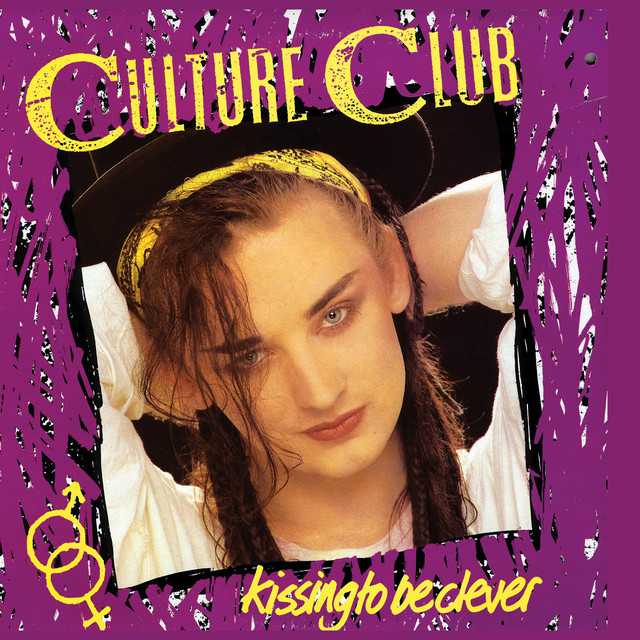
Kissing To Be Clever
Culture Club (1982)
Genre Usage
Based on how artists on Equipboard use this gear, it is most commonly found in the following genres.
Used With
Based on how musicians on Equipboard use Sony PCM-F1, it is most commonly used with the following gear.


More Sony Portable Recorders

$1,292.19
in Portable Recorders Rank


$294.00 - $377.00
in Portable Recorders Rank

$379.34 - $499.99
in Portable Recorders Rank

$575.08 - $898.00
in Portable Recorders Rank


$244.00 - $259.00
in Portable Recorders Rank

$72.00 - $289.96
in Portable Recorders Rank


-m.webp?v=1783336210)
$249.99 - $499.99
in Portable Recorders Rank


$190.50 - $279.99
in Portable Recorders Rank


$169.99 - $219.99
in Portable Recorders Rank


$49.00
in Portable Recorders Rank


$100.00 - $179.99
in Portable Recorders Rank


$299.00 - $379.95
in Portable Recorders Rank


$219.00 - $599.99
in Portable Recorders Rank


$69.00 - $94.00
in Portable Recorders Rank


$54.00 - $119.99
in Portable Recorders Rank


$176.60 - $299.99
in Portable Recorders Rank


$419.00
in Portable Recorders Rank


$235.00
in Portable Recorders Rank

$118.22
in Portable Recorders Rank


$191.00 - $383.99
in Portable Recorders Rank


$99.99 - $119.99
in Portable Recorders Rank


$69.71 - $383.99
in Portable Recorders Rank


$63.49 - $69.99
in Portable Recorders Rank


$75.00 - $129.99
in Portable Recorders Rank


$199.99 - $269.99
in Portable Recorders Rank


$71.00 - $129.00
in Portable Recorders Rank


$92.40 - $169.99
in Portable Recorders Rank
.jpg?v=1783065525)
Community setups


Similar


Gear Guides




Most Popular Portable Recorders
Most Popular Brands


