



Pricing and availability
We compare 600+ stores and found this item at 8 stores. Prices updated .
Store
Reviews
Price





Average Price: $332
High-end/Boutique
$75
$201+
Price Tier
Budget
Standard
High-end
Price History
Based on price data from 5 merchants for "Strymon Zelzah Multidimensional Phaser". Prices shown reflect NEW condition. Tracking began Apr 2, 2026.
* Product prices and availability are updated by Equipboard every 24hrs and are subject to change. Equipboard may receive compensation for purchases made at participating retailers linked on this site. This compensation does not affect what products or prices are displayed, or the order of prices listed. For more information, please refer to our affiliate disclosure.
Description
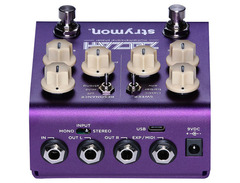
Strymon Zelzah Multidimensional Phaser is not just your average phaser pedal. It is an immersive sonic experience designed for the adventurous musician. This powerful tool offers two fully independent phasers that can be operated separately or in unison, providing a multitude of sound possibilities. From phasing to flanging to chorus, the transition of effects is smooth and adjustable with an abundance of resonance.
The Zelzah boasts a 6-stage phaser and a 4-stage phaser, each with its own unique sweep modes. The 6-stage offers a classic mode, featuring a traditional rising and falling LFO, while the 4-stage presents three distinct modes: Classic, Barber, and Envelope. These modes give you the power to tailor and tweak the tone to your liking, creating a sound that is unmistakably yours.
The 'Voice' control feature allows you to morph between phasing and flanging/chorus, adding a new layer of versatility to your sound. True Bypass ensures your tone remains uncolored when the pedal is not in use.
Key Features:
- Two fully independent phasers: operate separately, in series, in parallel or splitted
- 6-Stage phaser: Smooth transition from phasing to flanging to chorus with adjustable resonance
- 4-Stage phaser: Offers 3 unique sweep modes (Classic, Barber, and Envelope)
- 'Voice' Control: Morphs between phasing and flanging/chorus
- True Bypass: Ensures your tone remains true when the pedal is not in use
- Input Mono/Stereo switch: Allows for versatile connections
- LED Indicators: 6-stage on, 4-stage on
- Footswitch: 6-stage bypass, 4-stage bypass
- Mono/stereo input: 6.3 mm stereo jack
- Mono/stereo output: 2x 6.3 mm stereo jack
- EXP In: 6.3 mm stereo jack
- Expandability: Connection of a Strymon MiniSwitch or a Strymon MultiSwitch Plus for access to presets or a MIDI controller for access to 300 preset memories
- Power supply: 9 V DC mains adapter (included)
Product specs
| Pedal Type | Phaser |
| Analog/Digital | Digital |
| Effects | 4/6-stage Phaser |
| Inputs | 1 x 1/4" |
| Outputs | 2 x 1/4" (L/mono, R) |
| MIDI | USB |
| USB | 1 x Type C |
| Other I/O | 1 x 1/4" TRS (expression/MIDI) |
| True Bypass | Yes, Switchable to Buffered |
| Bypass Switching | Relay Based |
| Power Source | 9V DC power supply (included) |
| Height | 1.75" |
| Width | 4" |
| Depth | 4.5" |
FAQs
-
What makes the Strymon Zelzah Multidimensional Phaser unique compared to other phaser pedals?
-
The Strymon Zelzah offers both 4-stage and 6-stage phasing, allowing for a wide range of modulation effects. Its multidimensional design provides rich, complex soundscapes, making it versatile for electric and acoustic guitars, synths, and keyboards.
-
Can the Strymon Zelzah Multidimensional Phaser be used with MIDI controllers?
-
Yes, the Strymon Zelzah features MIDI connectivity via USB and a 1/4" TRS input, allowing seamless integration with MIDI controllers for expanded control options.
-
Does the Strymon Zelzah Multidimensional Phaser support stereo output?
-
Yes, the Strymon Zelzah has two 1/4" outputs for stereo applications, providing left/mono and right channels to create expansive stereo effects.
-
What power supply does the Strymon Zelzah Multidimensional Phaser require?
-
The Strymon Zelzah requires a 9V DC power supply, which is included with the pedal, ensuring it is ready to use right out of the box.
-
Is the Strymon Zelzah Multidimensional Phaser suitable for live performances?
-
Yes, with its robust construction, true bypass switching, and versatile sound options, the Strymon Zelzah is well-suited for live performances, offering reliable and dynamic modulation effects.
Videos

strymon
Strymon Zelzah Modulation Pedal – In-Depth Tour with Sound Designer Pete Celi
Strymon Zelzah Modulation Pedal – In-Depth Tour with Sound Designer Pete Celi
strymon
Strymon Zelzah Phaser Pedal - Modulation Like You've Never Heard Before

Andertons Music Co
Strymon Zelzah – Modulation Pedal – Audio Examples – Demo
strymon
Strymon Zelzah – Modulation Pedal – Intro
strymon
Strymon Zelzah

Mike Hermans
Strymon Zelzah: a Phaser Pedal BEAST!

Chords Of Orion
Strymon Zelzah Multidimensional Phaser Pedal Demo

Sweetwater
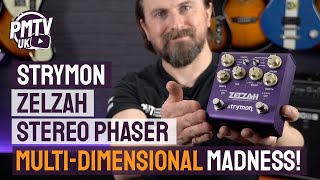
Strymon Zelzah Multi-Dimensional Stereo Phaser - The Only Modulation Pedal You'll Ever Need?!?

PMTVUK
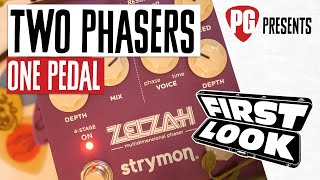
First Look: Strymon Zelzah Multidimensional Phaser

Premier Guitar

Strymon Zelzah | The Best New Phaser Pedal on the Multidimensional Market

Alamo Music Center
Reviews
PROS
-
Multifunctional; offers phaser, flange, chorus, and more
-
Analog-like warmth with digital clarity; no tone suck
-
Highly responsive to playing dynamics and instrument input
-
Offers unique routing and stereo options for creative flexibility
-
Subtle to dramatic effects range; from clean to ooey-gooey sounds
-
Saves space and money by replacing multiple pedals
-
MIDI compatibility for preset management and complex setups
-
Highly sensitive knobs for precise sound shaping
-
Solid build quality and visually appealing design
-
Compatible with guitar, bass, and keyboards for versatility
CONS
-
Might sound overly clean for analog purists
-
Limited immediate preset recall without additional accessory
-
Learning curve to fully exploit its features and routing options
Owner Insights
We analyzed real musician discussions from forums and Reddit to find what players love, question, and tweak about Strymon Zelzah Multidimensional Phaser.
Features and functionality
-
The Zelzah allows for simultaneous use of two phasers, reminiscent of the Mutron Biphase, providing a dual-phaser experience in a compact form.
Source -
It includes unique sweep settings like Barber and Envelope, offering different phasing effects beyond the traditional automatic sweep.
Source -
While the Zelzah excels in stereo applications, it lacks a dual synced phaser tap function, a feature some users miss.
Source -
The Zelzah can emulate flange and chorus effects, appealing to those interested in versatile modulation options beyond phasing.
Source
Comparisons
-
The Zelzah is a DSP-based phaser on a new ARM platform for Strymon, distinguishing it from typical SHARC-based designs.
Source -
The Zelzah's introduction highlights a previous gap in Strymon's modulation lineup, specifically for phaser effects.
Source -
The Zelzah offers dual phaser options not seen in competitors like the Source Audio Lunar, despite the higher price point.
Source
Value and pricing
-
While typically priced at $299, some speculate a price increase to $349 due to industry-wide cost changes.
Source
Software and compatibility
-
The DSP-based nature and USB-C port suggest potential for software updates or connectivity features, indicating advanced digital integration.
Source
Use cases and applications
Critic Reviews
5.0 out of 5
Based on 1 Review and 1 Rating

665
Not just a multidimensional phaser!
I used to think Strymon pedals weren't for me. I have nothing against boutique pedals, far from it, but for me, Strymon was like a Rolex, a sign of success, no doubt, but not really the idea of something exciting, something gritty... especially since I like pedals with a maximum of three or four knobs where you can immediately find the sound you want and hardly ever change it.
But it turned out I was traveling in a mid-sized city in the United States, and the store right across from where I was staying was THE Strymon dealer in the region. Was I going to cave in? Well, yes: after trying an Ultraviolet (great), a Lex (also great, but not really for me), I walked out with this marvel on which I got a $50 discount (still quite expensive, though!).
So, what is the Zelzah and why did I give in? Well, in fact, while the pedal presents itself as a dual phaser (4 stages on one side, 6 stages on the other), it offers much more than that.
On the left, the 4-stage section. We're in Phase 90 or classic Small Stone territory. A typical '70s sound, but that's not all. Strymon offers some out-of-the-ordinary options. First, there's the mix knob, which ranges from unaltered sound to pure phaser (midway) to vibrato (the phaser sound, but not mixed with the clean sound). This already allows for a wide palette of sounds. But that's not all because there's also a selector that switches from classic phaser to a "barber" option (instead of going up and down, the phaser sound seems to eternally rise... like watching a drill bit spin endlessly, to give you an idea). Then there's the "envelope" option, where the phaser starts sounding like an envelope filter with the depth adjusting the filter sensitivity and the speed its range. So, you get a sort of auto-wah. On the right, the 6-stage section, there are even more options with a "voice" knob that shifts from phaser to flanger (12 o'clock) then to chorus (fully turned) and everything in between. It's absolutely incredible. There's also a "resonance" switch, reminiscent of the Small Stone, that enhances the phaser's feedback effect with different outcomes depending on where the voice is set. So, you get an infinite variety of modulation sounds, not just two phasers, but – to recap – flanger, chorus, vibrato, and auto-wah. Plus, both sides are independent and can be combined. Add to this stereo capability, a USB port for MIDI control, the possibility of adding an expression pedal, etc., and you have the modulation pedal to end all modulation pedals. I'm not saying you have a CE-2, a VB-2, and an Electric Mistress at your fingertips... but the range of possibilities is still very extensive.
And yet, the designers have done everything to make the settings intuitive so that it is easy to find highly satisfactory sounds. In addition, whatever the settings on the left and right, they naturally blend into each other. No position is ugly or too extreme. It's as if all possible configurations (hundreds, no doubt) were designed to remain musically relevant.
In the end, the only flaw lies in the very quality of the product: you switch from one sound to another and you always want to change (the auto-wah is, in my opinion, the most fun effect... it sounds like Jerry Garcia's Mu-tron, but it can also be set to make a kind of cocked wah for playing "Kiss" by Prince, you get the idea).
In short, apart from the fact that you need to shell out at least 300 euros for this type of pedal and my lack of interest in some of the possible options (yes, you can edit almost everything, update the firmware, etc.), I think I have the most amazing modulation pedal I've ever played. A real Swiss army knife and not just "the Strymon phaser."
Preferred Settings + Usage:
Here's the problem: there are just TOO MANY good settings but at the moment I'm on a quite conservative phaser on the left side (depth and mix about noon, and rate between 9 and 10 o'clock) and on the right side, it's between flanging and chorusing (depth at 10, rate at 11, voice between 2 and 3 o'clock).
Artist usage
Add artist

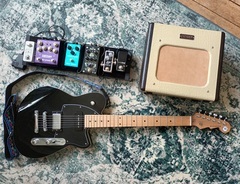
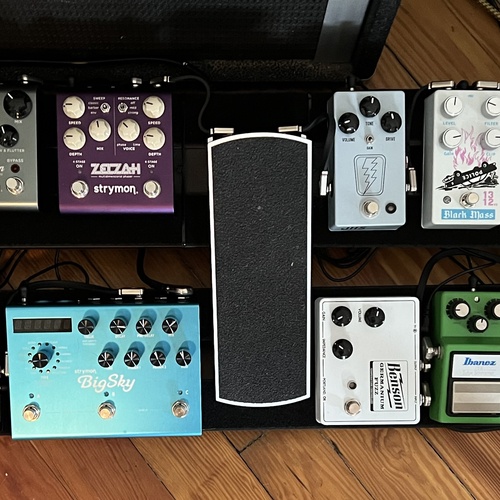
Noel Gallagher is seen using the Strymon Zelzah Multidimensional Phaser in a user-uploaded photo, captured between his use of the Morning Glory pedal and the Strymon BigSky reverb.

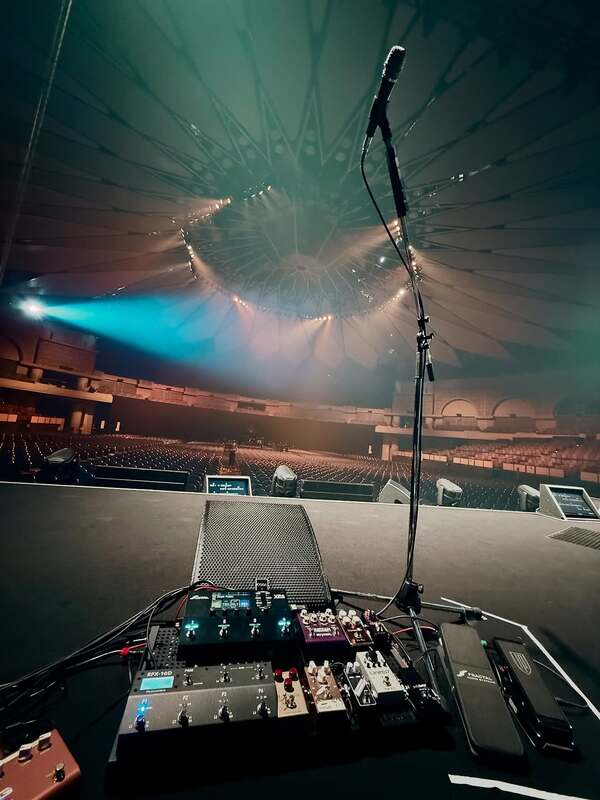
In an Instagram post by Pete Thorn, a Strymon Zelzah Multidimensional Phaser is visible on his pedalboard. The post, captioned "Kagoshima night 2 coming up...." is published by @petethornguitarist.


In the video titled "Toshiki Soejima × Kyohei Ariga Live in Kimama Studio 2024 (Neo-Soul Guitar)" on YouTube, Toshiki Soejima is observed using a Strymon Zelzah Multidimensional Phaser as the second effect on his pedalboard, confirming his use of this specific gear.


In the video "My Synth Studio Revealed | Studio Tour 2025" by Anthony Marinelli Music, at the 13:14 timestamp, a Strymon Zelzah Multidimensional Phaser pedal is clearly visible on a pedalboard connected to the Oberheim OB-X synthesizer as part of Anthony Marinelli's studio setup.
Genre Usage
Based on how artists on Equipboard use this gear, it is most commonly found in the following genres.
Used With
Based on how musicians on Equipboard use Strymon Zelzah Multidimensional Phaser, it is most commonly used with the following gear.
-s.webp?v=1784585449)


Community setups
Show yours
More Strymon Phaser Effects Pedals
-m.webp?v=1784586623)
$89.00 - $99.99
in Phaser Effects Pedals Rank


$149.99 - $172.00
in Phaser Effects Pedals Rank


-m.webp?v=1784586657)
$129.00 - $142.00
in Phaser Effects Pedals Rank


-m.webp?v=1784585910)
$143.17 - $159.99
in Phaser Effects Pedals Rank


$129.00 - $200.00
in Phaser Effects Pedals Rank


$109.08 - $119.00
in Phaser Effects Pedals Rank


$129.99 - $149.00
in Phaser Effects Pedals Rank


$67.90 - $169.99
in Phaser Effects Pedals Rank


$131.00
in Phaser Effects Pedals Rank


$113.39 - $142.99
in Phaser Effects Pedals Rank


-m.webp?v=1784586851)
$54.99 - $83.50
in Phaser Effects Pedals Rank


$60.00 - $315.00
in Phaser Effects Pedals Rank


$700.00
in Phaser Effects Pedals Rank


$56.00 - $88.90
in Phaser Effects Pedals Rank


$44.01 - $56.00
in Phaser Effects Pedals Rank


$199.00
in Phaser Effects Pedals Rank


$159.99 - $307.78
in Phaser Effects Pedals Rank


$22.90 - $28.90
in Phaser Effects Pedals Rank


$88.90 - $109.99
in Phaser Effects Pedals Rank


$29.75 - $34.99
in Phaser Effects Pedals Rank


$190.00 - $219.99
in Phaser Effects Pedals Rank


$199.00 - $224.99
in Phaser Effects Pedals Rank


$120.79
in Phaser Effects Pedals Rank


$175.00
in Phaser Effects Pedals Rank


$129.00 - $142.00
in Phaser Effects Pedals Rank


$2,000.00
in Phaser Effects Pedals Rank


$193.99
in Phaser Effects Pedals Rank


$199.00
in Phaser Effects Pedals Rank


$67.90 - $145.00
in Phaser Effects Pedals Rank


$199.99 - $209.00
in Phaser Effects Pedals Rank


$400.00
in Phaser Effects Pedals Rank


$140.00
in Phaser Effects Pedals Rank


$115.00
in Phaser Effects Pedals Rank


$88.90 - $129.00
in Phaser Effects Pedals Rank


$153.91
in Phaser Effects Pedals Rank


$274.05
in Phaser Effects Pedals Rank


$190.00
in Phaser Effects Pedals Rank
.png?v=1784556311)


$204.46
in Phaser Effects Pedals Rank


$800.00
in Phaser Effects Pedals Rank


$45.00
in Phaser Effects Pedals Rank


Accessories & Related Items


-s.webp?v=1784559828)


Similar


Gear Guides




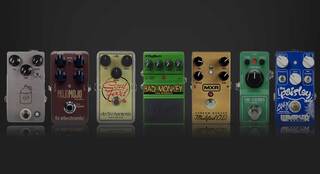




Most Popular Phaser Effects Pedals
Most Popular Brands
-
Added to Equipboard on by
 nick_09
GearIQ 573
-


