-s.webp?v=1754871264)
-xl.webp?v=1754871264)
Pricing and availability




* Product prices and availability are updated by Equipboard every 24hrs and are subject to change. Equipboard may receive compensation for purchases made at participating retailers linked on this site. This compensation does not affect what products or prices are displayed, or the order of prices listed. For more information, please refer to our affiliate disclosure.
Description
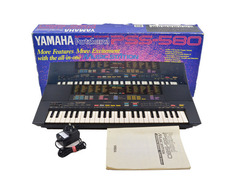
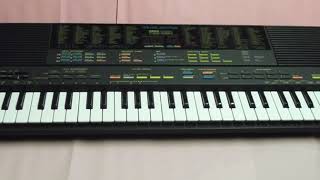
The Portasound PSS-580 by Yamaha is a japanese vintage portable keyboard synthesizer , released in the late 1980s.
It was used by many professional musicians, including the likes of Depeche Mode, The Cure, and New Order.
The PSS-580 is a monophonic synthesizer with a built-in sequencer and a variety of sound-shaping features.
It has a two-octave keyboard, a built-in speaker, and a headphone jack. It also has a built-in arpeggiator, a pitch-bend wheel, and a variety of sound-shaping controls.
The PSS-580 also has a built-in chorus effect and a built-in reverb effect.
The PSS-580 is a relative of the 480, 680, and 780, with the same voices and most of the same features in common. The 680/780 boast a couple more features, but the editable FM synthesizer parameters are common to all these keyboards, with control from the front panel of the keyboard over attack, decay, frequency, feedback and modulation for 2 operators
Specifications Year released: Mid to late 1980’s. Price when new: £99? Type of keyboard: Synthesizer Analogue/Digital: Digital Sound generation: Frequency Modulation (FM, Main Voices), Pulse Code Modulation (PCM, Drums) Number of keys: 49 Key size: Mini Touch Sensitive: No, but will respond to velocity via midi while in “Sound Source Mode” Battery backup: Yes, features a rechargeable battery for remembering custom voices, is recharged when the keyboard is connected to a power source Storage: 5 sound banks for storing custom voices, 1 custom drummer bank and 10 banks for the built in sequencer (5 melody and 5 auto accompaniment) Expandable Storage: The Keyboard does not have any expandable storage, however, settings and custom voices can be dumped to a computer or MIDI recorder as “System Exclusive” (SysEx) files. Polyphonic: Yes, 12 notes for the main voice, 8 for drums. Mono mode: The keyboard does not feature a mono playback mode, but it can be simulated using the “Harmonise” feature. Volume control: 1 Master volume control + digital volume controls in “Keyboard Assign” mode, volume can be controlled via midi velocity commands in “Sound Source Mode”. Changing the digital volume control effects the value of the “Velocity” data that is transmitted over MIDI from the keyboard. Synth Edit: Yes (Only some parameters can be edited directly on the keyboard. A special program like “PSS-Edit” is required to edit the rest of them.) Stereo: The main FM sound chip is mono, however the drum chip is capable of panning the drum sounds. Sound chip: Unknown but I suspect that it is the same as the PSS-480 (YM3420AD)*1 CPU: Unknown, but I suspect that it is the same as the PSS-480. MIDI Ports: In, Out Built in Sequencer: Yes Pitch Bend Wheel: No, but the synth can respond to pitch bend via MIDI (Sound Source Mode only and pitch range is fixed to 2 octaves) MIDI Specifications: Velocity: Auto accompaniment section transmits velocity data in “Keyboard Assign Mode”, keyboard will respond to velocity data in “Sound Source Mode” SysEx support: Yes Multi-timbral: Yes, the keyboard can transmit on MIDI channels 1 – 16 in “Keyboard Assign Mode” and receive on MIDI channels 1 – 16 in “Sound Source Mode” Drums controllable via MIDI: Yes, Drum channel is fixed to 16, auto accompaniment can be synchronised with external sequencers by setting the MIDI Clock to external Volume controllable via MIDI: No MIDI Channels: 1 – 15 FM voice channels, 16 fixed to Drums. While the keyboard can receive on MIDI Channels 1-16 only 12 FM voices can be played simultaneously due to the 12 note poly limit. The keyboard can also be set to ignore certain MIDI channels. MIDI Clock: Can be set to internal or external Parameters editable via MIDI: Parameters can be edited by altering System Exclusive files via a special program like “PSS Edit”. The synth does not support editing synth parameters in real time. MIDI thru via MIDI out: Sort of. I've found that the keyboard applies it's settings to the MIDI data which is forwarded out via the MIDI Out i.e. if you set the MIDI transmit channel to 3 on the keyboard, then all MIDI data that is forwarded will be sent on channel 3 etc. This only works in Keyboard Assign Mode Playable note range via MIDI: C0-C7 MIDI Patch range: 0-99 preset voices, 100 – 105 custom voices Voice Generation: 2 Operator FM Synthesis Bulk dump support: Yes, the settings for the custom drummer, built in sequencer and custom voices can be dumped to a MIDI recorder. Sound Generation The PSS-580 generates its voices via “Frequency Modulation” (FM) Synthesis. It is a basic 2-operator FM synth with feedback.
There is a bit of distortion and digital quantisation noise from the FM chip, which is most likely caused by a low bit depth. I’m not 100% sure what bit depth that the FM chip operates at but I suspect that it is around 8 – 12 bits.
An LFO can be used to modulate the pitch and amplitude of both operators. Its waveform is fixed to a triangle wave and the frequency cannot be altered. The modulation depth as well as an LFO delay can be altered using a special program like “PSS-edit”.
The drums are generated via “Pulse Code Modulation” (PCM) and is the only part of this keyboard that can operate in stereo. I suspect that the sampling rate for the drum samples is around 22khz.
The PSS-580 operators can use the following waveforms for both the Carrier and Modulator: Sine wave, Squared Sine Wave, Sine Half Wave and Squared Sine Half Wave (See image below). An image showing the Operator waveforms the keyboard can produce Editable Parameters
Note some parameters can only be edited using a special program such as “PSS-Edit”. These parameters will be in italic. Parameters with an asterisk (*) indicate that they can be applied to both the Carrier and Modulator individually.
Envelopes:
Attack* Decay 1* Decay 2* Release* Sustain Release*
Waveform:
Sine wave* Squared Sine wave* Half Sine wave* Squared Half Sine wave*
LFO:
PM (vibrato) Sensitivity (Depth) AM (tremolo) Sensitivity (Depth) Vibrato enable Amplitude Modulation on/off*
Other Parameters:
Sustain Enable Feedback Key-scaling (Low)* Key-scaling (High)* Fine detune* Coarse detune* Frequency Multiplication* Total Level Modulation Level Drums The PSS-580 has a total of nine PCM drum sounds. These are:
Kick drum Snare Rim Shot Tom Low Tom High Hi hat closed Hi hat open Ride cymbal Crash cymbal
As a separate sound chip generates the drum sounds, playing a drum doesn’t reduce the number of FM voices that can be played. The drum chip is capable of playing 8 notes at once.
The drums are mapped to the “Yamaha Standard Voice” MIDI standard but due to the low number of drum sounds available (9) some sound are repeated.
Below shows which MIDI note corresponds to each drum sound. D1: Snare D#1: Not used E1: Not used F1: Not used F#1: Not used G1: Not used G#1: Kick Drum A1: Kick Drum A#1: Rim Shot B1: Low Tom C2: Low Tom C#2: Snare D2: Low Tom
D#2: Rim Shot E2: Snare F2: Tom High F#2: Not used G2: Not used G#2: Not used A2: Hi Hat Closed A#2: Not used B2: Hi Hat Open C3: Crash Cymbal C#3: Crash Cymbal D3: Ride Cymbal D#3: Ride Cymbal MIDI Modes The PSS-580 has two MIDI modes in which it can operate in: “Keyboard Assign Mode” and “Sound Source Mode”. Keyboard Assign Mode:
Keyboard Assign Mode is the default mode that the keyboard normally starts up in.
This mode is intended for using the keyboard for controlling other MIDI instruments as well as using it as a stand alone keyboard.
The keyboard will respond to all MIDI channels, however only one voice can be played. The drums can be sequenced on MIDI channel 16. An additional octave higher can be played on this keyboard via MIDI in this mode.
The auto accompaniment can be synchronised via MIDI by setting the MIDI clock to “external”. The keyboard also transmits a MIDI clock signal when the MIDI clock is set to “internal” for synchronising other MIDI instruments and drum machines.
The melody data stored in the built in sequencer is also transmitted over MIDI. The MIDI channel that each part transmits on corresponds to the current transmit channel that was set on the keyboard while recording, so setting the keyboard’s MIDI transmit channel to 1 and then recording part 1 will then transmit that part on MIDI channel 1 etc.
The auto accompaniment notes are also transmitted via MIDI, the MIDI channels which each part transmits on is written on the top right of the keyboard.
Sound Source Mode:
Sound Source Mode is mainly used for operating the keyboard as a multi-timbral sound source. When in this mode, local control is turned off so if you press a key, you won’t hear any sound. The keyboard does, however transmit MIDI data.
The majority of the buttons on the keyboard e.g. the auto accompaniment and sequencer etc. do not work in this mode.
The keyboard can respond on MIDI channels 1 – 16 and can play a total of 12 voices simultaneously. MIDI channel 16 is fixed to the drums.
Sending velocity commands via MIDI can control the volume of each note. The keyboard does not respond to channel volume controls however.
Despite not having a pitch bend wheel, the keyboard can respond to pitch bend commands via MIDI in this mode. The pitch bend range however is fixed to 2 octaves and cannot be changed.
Custom voices cannot be edited directly on the keyboard in this mode, it can receive SysEx files containing custom voice data. The keyboard does however pause for a brief second while receiving SysEx data so it is not feasible to send custom voices to the keyboard on the fly.
Playing Range The PSS-580 is capable of playing notes from C1 to C5 with an additional octave playable via MIDI in “Keyboard Assign” mode. In “Sound Source Mode” the keyboard will respond to notes C0 to C7.
An image showing the octave playing range directly on the keyboard or via an external MIDI controller
Voice List
The PSS-580 has a total of 105 voices (100 preset voices plus 5 user banks which can store custom voices). The preset voices corresponds to the “Yamaha Standard Voice” set and the are listed below.
00 Synth Brass 01 Jazz Organ 02 Pipe Organ 1 03 Piano 1 04 Harpsichord 1 05 Electric Piano 1 06 Celesta 07 Vibraphone 08 Marimba 1 09 Steel Drum 1 10 Violin 1 11 Cello 12 Jazz Guitar 13 Rock Guitar 1 14 Wood Bass 1 15 Trumpet 16 Trombone 17 Horn 18 Soprano Sax 19 Clarinet 20 Flute 21 Oboe 22 Harmonica 23 Whistle 24 Music Box 25 Honky-tonk Piano 26 Toy Piano 27 Transistor Organ 28 Tremolo Organ 29 Small Church Organ 30 Funky Clavi 31 Accordion 32 Glockenspiel 33 Hawaiian Guitar 34 Banjo 35 Bowed Bass 36 Acoustic Guitar 37 Harp 38 Picked Bass 39 Slap Bass 40 Ukulele 41 Strings 42 Alpenhorn 43 Bagpipe 44 Mute Trumpet 45 Tenor Sax 46 Jug 47 Panflute 48 Ice Block 49 Reed Organ
50 Electronic Organ 51 Pipe Organ 2 52 Piano 2 53 Harpsichord 2 54 Electric Piano 2 55 Glass Celesta 56 Bandoneon 57 Street Organ 58 Synth Bass 59 Marimba 2 60 Steel Drum 2 61 Chimes 62 Tubular Bells 63 Hand Bell 64 Carillion 65 Synth Tom 66 Timpani 67 Violin 2 68 Rock Guitar 2 69 Tremolo Guitar 70 Rock Guitar 3 71 Pedal Steel Guitar 72 12 String Guitar 73 Classic Guitar 74 Mandolin 75 Sitar 76 Koto 77 Shamisen 78 Jamisen 79 Mute Bass 80 Electric Bass 81 Wood Bass 2 82 Electric Trumpet 83 Wow Trumpet 84 Tuba 85 Alto Sax 86 Bass Clarinet 87 Bassoon 88 Recorder 89 Ocarina 90 Piccolo 91 Samba Whistle 92 Brass Ensemble 93 Woodwind Ensemble 94 Human Voice 1 95 Human Voice 2 96 Human Chorus 97 Kazoo 98 Musical Saw 99 Sine Wave
Style List: The PSS-580 features 100 auto accompaniment styles which I have listed below.
00 Rhythm & Blues 1 01 Rhythm & Blues 2 02 Slow Blues, 03 Gospel 04 Disco 05 Rap 06 Safari 07 Fusion 1 08 Fusion 2 09 16Beat 1 10 16Beat 2 11 Techno Rock 1 12 Techno Rock 2 13 Funk 1 14 Funk 2 15 Funk 3 16 Funk 4 17 Rock’n Roll 1 18 Rock’n Roll 2 19 Rock’n Roll 3 20 Rock-a-Ballad 21 Hard Rock 22 Heavy Metal 23 Speed Metal 24 Pop Rock 1 25 Pop Rock 2 26 Rock Baroque 27 Christmas Rock 28 Oriental Rock 29 Brass Rock 30 Swing Guitar 31 Swing Piano 32 Swing Organ 33 Swing Vibraphone 34 Big Band 1 35 Big Band 2 36 Big Band 3 37 Big Band (Waltz) 38 Modern Jazz 39 Jazz Waltz 40 5/4 Swing 41 Jazz Ballad 42 Shuffle 43 Boogie Woogie Piano 1 44 Boogie Woogie Piano 2 45 Boogie Woogie Piano 3 46 Boogie Big Band 1 47 Boogie Big Band 2 48 Dixieland Combo 49 Dixieland Banjo
50 Jazz Baroque 51 Bossa Nova 1 52 Bossa Nova 2 53 Samba 1 54 Samba 2 55 Samba 3 56 Salsa 1 57 Salsa 2 58 Salsa 3 59 Tango 60 Habanera 61 Mambo 1 62 Mambo 2 63 Mambo 3 64 Rhumba 65 Cha-Cha-Cha 66 Conga 67 Merengue 68 Calypso 1 69 Calypso 2 70 Son Afro 71 Reggae 72 Cuban 73 Beguine 74 Island Folklore 75 Mariachi 76 Argentine Folklore 77 March 1 78 March 2 79 Majestic March 80 Fanfare 81 Lullaby 82 Baroque 83 Baroque (Waltz) 84 String Quartet 85 Viennese Waltz 86 Polka 87 Bolero 88 Flamenco 89 Classical Guitar 90 Ragtime Piano 91 Country 92 Country Piano 93 Country Steel Guitar 94 Bluegrass 95 Street Organ 96 Hawiian 97 Mandolin Band 98 Chanson 99 Barbershop Quartet
More Infos in the Operation Manual.
Owner's manual
Yamaha Portasound PSS-580 User ManualProduct specs
| Analog/Digital | digital |
Videos

Alfonse
Yamaha Portasound PSS-580 FM keyboard
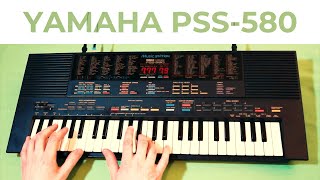
Yamaha Portasound PSS-580 FM keyboard
Alfonse
![Video thumbnail for [DEMO] YAMAHA PortaSound PSS-580 by TakuwanGum](https://img.youtube.com/vi/XZNv0ugQseE/mqdefault.jpg)
[DEMO] YAMAHA PortaSound PSS-580

TakuwanGum
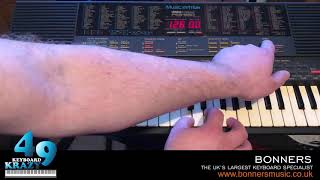
Yamaha PSS-580 Portasound Keyboard - Tutorial

KeyboardKrazy49
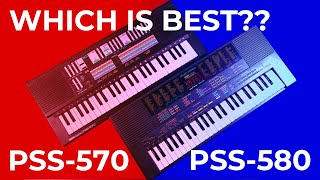
Yamaha PSS-570 vs. PSS-580 - Which sounds better?!
Alfonse
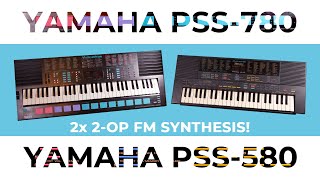
Yamaha PSS-780 plus PSS-580 - Double Portasound FM action!
Alfonse
Yamaha PSS580, PSS380, DD-10 - Deep House on Vintage 80's Yamahas

ChrisLody
Yamaha Music Station Portasound PSS-580 (Circuit Bent by BAUM)

Baum Inventions
Yamaha PSS-580 FM MIDI synth - Reverb sale

StudioSoba
YAMAHA PSS-580 (1989)

KEYBOARDS NOSTALGY
Reviews
Based on 0 Reviews and 0 Ratings
More Yamaha Synthesizers

$279.00 - $449.99
in Synthesizers Rank


$57.95 - $495.44
in Synthesizers Rank


$290.00
in Synthesizers Rank


$3,999.99 - $5,624.99
in Synthesizers Rank


$55,770.09
in Synthesizers Rank


$1,999.99 - $2,000.00
in Synthesizers Rank


.jpeg?v=1783200117)


$153.14 - $1,999.99


-m.webp?v=1783177180)


Artist usage
Community setups


Similar


Gear Guides









Most Popular Synthesizers
Most Popular Brands
-
Added to Equipboard on by
 hashimoto
Gear IQ 14698
-


