
Pricing and availability
We compare 600+ stores and found this item at 1 store. Prices updated .
Store
Reviews
Price




Average Price: $350
Standard/Professional
$100
$401+
Price Tier
Budget
Standard
High-end
* Product prices and availability are updated by Equipboard every 24hrs and are subject to change. Equipboard may receive compensation for purchases made at participating retailers linked on this site. This compensation does not affect what products or prices are displayed, or the order of prices listed. For more information, please refer to our affiliate disclosure.
Description
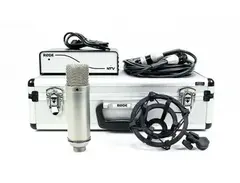
Ideal for both professional and home studio environments, the Rode NTV condenser microphone is a studio powerhouse that delivers exceptional audio quality. Featuring a large diaphragm design, the NTV is engineered to capture nuanced performances with remarkable clarity and detail. Whether you're recording vocals, acoustic instruments, or even capturing ambient soundscapes, this microphone ensures that every subtlety is preserved.
The NTV is equipped with a hand-selected 1" HF2 capsule, which provides an ultra-wide frequency response, making it versatile for various recording applications. Its cardioid polar pattern helps minimize background noise and focuses on the sound source, ensuring accurate and isolated recordings. The internal shock mounting and external power supply further enhance its performance by reducing mechanical noise and providing stable, consistent power.
This microphone is also renowned for its vintage tube warmth, thanks to the inclusion of a premium-grade 6922 twin-triode valve. This feature adds a touch of classic analog warmth to your recordings, making it a favorite among audiophiles and recording professionals alike. The Rode NTV is a testament to quality craftsmanship, with its durable construction and high-quality components promising years of reliable use.
Key Features:
- Large diaphragm condenser microphone
- Hand-selected 1" HF2 capsule for ultra-wide frequency response
- Cardioid polar pattern for focused sound capture
- Internal shock mounting reduces mechanical noise
- External power supply for stable performance
- Includes premium-grade 6922 twin-triode valve for vintage tube warmth
- Ideal for vocals, acoustic instruments, and ambient sound recording
Product specs
| Brand | RODE |
| Model | NTV Large Diaphragm Cardioid Tube Condenser Microphone |
| Finish | Nickel |
| Year | 2000s |
| Made In | Australia |
| Categories | Microphones |
FAQs
-
What is the polar pattern of the Rode NTV microphone?
-
The Rode NTV features a cardioid polar pattern, which is ideal for capturing sound sources directly in front of the microphone while minimizing ambient noise from the sides and rear.
-
Is the Rode NTV suitable for vocal recording?
-
Yes, the Rode NTV is highly regarded for vocal recording due to its large diaphragm and tube design, which provides a warm and rich sound quality.
-
Does the Rode NTV require phantom power?
-
The Rode NTV is a tube condenser microphone and does not require phantom power. Instead, it comes with its own power supply unit.
-
How does the Rode NTV compare to other tube microphones?
-
The Rode NTV is known for its warm and smooth sound, making it comparable to other high-end tube microphones but often at a more accessible price point, offering excellent value for studio recording.
-
What type of applications is the Rode NTV best suited for?
-
The Rode NTV is best suited for studio applications, including vocal recording, acoustic instruments, and any situation where a warm, detailed sound is desired.
Videos

Aram Bajakian
Rode NTV Tube Comparison: Genalex Gold Lion 12AX7 vs JJ ECC81
Rode NTV Tube Comparison: Genalex Gold Lion 12AX7 vs JJ ECC81
Aram Bajakian
Reviews
Owner Insights
We analyzed real musician discussions from forums and Reddit to find what players love, question, and tweak about Rode NTV.
Features and functionality
Critic Reviews
5.0 out of 5
Based on 2 Reviews and 3 Ratings

49
Warm, detailed, transparent, sensitive.
RODE NTV: TRUE CONDENSER VALVE MICROPHONE
RODE microphones, which are designed and manufactured in Australia and distributed in the United States by Event Electronics, have earned an honorable BY ROGER HAYCOCK PUBLISHED: 11/01/1999 Mix online
RODE microphones, which are designed and manufactured in Australia and distributed in the United States by Event Electronics, have earned an honorable position among recording professionals since emerging on the market just a few years ago. The company’s first three models, the Classic, NT1 and NT2, have all been adopted by leading studios and the newest model, the NTV, a cardioid tube condenser microphone priced at $1,199, appears well positioned to follow in the footsteps of its predecessors. DESIGN AND CONSTRUCTIONThe NTV is shipped in a package that leaves no question that this is a serious recording instrument. Opening the box, I was greeted by a heavy-duty aluminum flight case. Inside, foam pockets secured the various components, including the dedicated power supply and power cord, a 30-foot double-shielded oxygen-free multicore cable with custom-tooled, military-grade gold-plated connectors, a stand-mount, a birdcage shock-mount suspension and, of course, the microphone itself. The RODE NTV is a substantial microphone. The instrument’s body is milled from high-grade stainless steel and incorporates two grill meshes. The inner headscreen is tightly woven and, even without the use of a pop filter, provides reasonable protection from plosive sounds caused by close-proximity miking. The NTV employs a 1.15-inch gold-sputtered, edge-terminated Mylar diaphragm that is suspended in the capsule by its edges. This new 1-inch edge-connected design is significant, because without a center wire, the capsule is able to move more freely, resulting in far more natural extended low-frequency response. It is this single design characteristic that enables the RODE NTV to deliver a very pleasing warmth and transparency not found in many other microphones. Every aspect of the NTV’s design indicates there were no shortcuts taken. The unit incorporates a hand-selected, low-noise, twin-triode ECC81 valve combined with high-end, audiophile-grade capacitors from Solen and Wima, all of which feed a custom-made Jensen output transformer. The sum total of these components yields some impressive numbers. The microphone’s sensitivity is rated at 15 mV/Pa while maximum sound pressure level is a very respectable 130 dB. The NTV’s noise rating is less than 19 dBA, and its output impedance is 200 ohms. SESSION PREPARATIONThe NTV’s power supply is solidly built and clearly labeled. It should be noted that the unit will operate on both 120- and 220-volt AC supplies, so it is wise to check the setting before powering the unit. The cable that connects the microphone to the power supply is solid in every aspect: Both ends are of the multipin (gold-plated for optimum signal quality), threaded variety that secures into place by twisting the ring until it is tight. The NTV’s power supply provides an Earth Lift switch to reverse polarity in the event of a ground loop. After connecting the microphone to the power supply, all that’s left is to run a high-quality XLR cable from the power supply to your console or preamp-ideally, one that is as short as possible. Powering the unit lights is a blue LED on the front panel of the power supply. (The LED’s drive circuit feeds off the filament voltage of the microphone’s valve and thus becomes brighter as the microphone approaches its operating level, providing a visual indication when the NTV is ready for use.) As stated earlier, the NTV ships with both a stand-mount and a shock-mount support, each supplied with an inner ring adapter to fit European-style mic stands. Even though both supports are constructed of an industrial-grade PVC-type plastic, I found that the larger shock-mount unit secured the microphone much better than the more basic stand- mount adapter. In fact, I twice discovered that by the time I had connected the cables and power supply to my console, the basic stand-mount adapter had allowed the microphone to shift position ever so slightly. Given the price of the instrument, the stand- mount support did not exactly inspire confidence. I retired the stand-mount and relied on the considerably more solid shock-mount (which worked flawlessly) for the remainder of my evaluation.
The microphone itself is quite large and hefty, and secures to both supports by resting in the base of the support while the supplied cable attaches from the underside and locks the mic into place. This certainly works, but it appears to me a somewhat rigid method of securing the microphone. Shock-mount suspension systems from Shure, AKG and others provide considerably gentler microphone handling. SESSION USEI began my evaluation by using the microphone for dialog recording. After checking to ensure that I was indeed receiving signal, I began experimenting with positioning. It became immediately apparent that the NTV is extremely sensitive and its single cardioid pattern is very clearly defined. For close-proximity dialog recording, I found the microphone did a wonderful job, particularly when the instrument was positioned at a side angle with the voice-over talent speaking across the mic as opposed to directly at it. As mentioned earlier, the NTV’s headscreen actually has an outer and an inner mesh, with the inner mesh functioning as something of a pop filter. I recorded the readings both with and without a dedicated pop filter to see just how much reduction in plosive sounds I could achieve. Although either set of recordings was more than sufficient for my project, I ultimately chose to work with the takes that had been recorded using the pop filter. I found that the takes with the pop filter exhibited fewer plosives, and those plosives that were objectionable were easier to clean up. In terms of sound quality, I found the microphone provided a pleasant low-end fullness that gave the dialog a warm, rich quality without sacrificing the mid or high frequencies. The NTV’s performance was very even and balanced, with no sound coloration. I also had the opportunity to try the microphone in a small chamber hall. Here, I recorded acoustic guitar and flute, both individually and collectively. By positioning the NTV approximately six to eight feet from the guitarist, I was able to capture a fairly direct sound, yet there was also enough distance to pick up some of the refractive sound energy from the hardwood floor. In this environment, the NTV delivered a clearly defined performance, along with all the guitar harmonics that Heitor Villa-Lobos’ compositions are famous for. I could distinguish fingerpickings while still gaining a sense of spaciousness that is characteristic of the room. My experience in recording the flute was equally successful. In this case, the NTV’s internal mesh enabled me to position the microphone fairly close without being disturbed by all the breath and plosives common to the instrument. I found the microphone captured both the instrument and the acoustic characteristics of the hall very accurately and without any harshness. In this case, the slight fullness in the lower frequencies did a nice job of making the recording seem big and full. Priced at $1,199, the RODE NTV is a well-balanced recording instrument that provides exemplary performance under a variety of applications. I would feel confident using this microphone for ensemble recording, vocal work, piano and other acoustic instruments, as well as overhead miking of percussion. Its tendency to slightly round out the lower frequencies of a recording without coloring the sound adds a depth that many will find beneficial. The fact that the microphone offers only one polar pattern (cardioid) was initially somewhat disappointing, but I consider this to be a reasonable trade-off in light of the price. Aside from my experience with the stand-mount support and the mounting method in general, the new RODE NTV is a well-made, quality instrument that will make a fine addition to any recording studio’s microphone arsenal.

41013
A stand out fixed cardioid mic from the millennial budget tube mic boom.
I've owned this microphone for a little under 20 years and though I once replaced the 12at7 it's been a worry free workhorse for me. It's got a really uniquely open high end, probably due to its edge terminated capsule (every other capacitor mic you come across is center terminated in yheneumann tradition). At the time I bought this I had a few other fixed pattern triode based condensers including an ADK A51 and a cheapo mxl v69m. This mic stayed. It has it's own personality and excellent noise specs. It's got a real lack of useful features basically relegating it to lead vocal duties but in that role it's a real heavyweight. It's also a good choice for a center kick in M/S when recording stereo acoustic instruments or group backing vocals. It makes a nice mono acoustic guitar mic as well for a big folky sound on singer songwriter material. It's a shame they don't make the ntv anymore. I wish they would reissue it as a multipattern with a variable pad. It's not a vintage tube mic at all sporting a lush but modern sound. Amongst modern dual triode based mics I really don't think there's a more original sounding design and it has the best headroom and least self noise of any of these affordable triode models of the era. It's a great, open sounding microphone that holds its own with affordable pentode models on vocal but its versatility is hampered by a lack of pad and high pass. I like that it's not trying to use an affordable dual triode to cop a 47, 67, C12 or 251 sound. A great addition to an existing collection but don't expect to use it all the time. Even on vocals it flatters some singers more than others.
Genre Usage
Based on how artists on Equipboard use this gear, it is most commonly found in the following genres.
More Røde Condenser Microphones

$149.00 - $250.02
in Condenser Microphones Rank


$303.00 - $419.00
in Condenser Microphones Rank


$177.89 - $269.00
in Condenser Microphones Rank


$565.00 - $829.00
in Condenser Microphones Rank


$149.00 - $250.02
in Condenser Microphones Rank


$518.00 - $619.00
in Condenser Microphones Rank


$137.75 - $887.99
in Condenser Microphones Rank
.jpeg?v=1783346561)


$109.00 - $139.00
in Condenser Microphones Rank


$193.76 - $449.00
in Condenser Microphones Rank


$189.00 - $570.00
in Condenser Microphones Rank


$294.50 - $339.00
in Condenser Microphones Rank
.jpg?v=1783870174)


$143.00 - $190.97
in Condenser Microphones Rank


$459.00 - $619.00
in Condenser Microphones Rank


$303.00 - $398.98


$479.00 - $529.00


$225.36 - $419.00


$559.00 - $729.00


$193.76 - $449.00


$159.00 - $319.99

$85.00 - $149.00

$159.00 - $887.99


$176.19 - $569.00


Accessories & Related Items


Artist usage


Community setups


Similar


Gear Guides







Most Popular Condenser Microphones
Most Popular Brands
-
Added to Equipboard on by
 roisto_
GearIQ 129
-


