

Pricing and availability
We compare 600+ stores and found this item at 1 store. Prices updated .
Store
Reviews
Price




Average Price: $261
High-end/Boutique
$50
$176+
Price Tier
Budget
Standard
High-end
* Product prices and availability are updated by Equipboard every 24hrs and are subject to change. Equipboard may receive compensation for purchases made at participating retailers linked on this site. This compensation does not affect what products or prices are displayed, or the order of prices listed. For more information, please refer to our affiliate disclosure.
Description
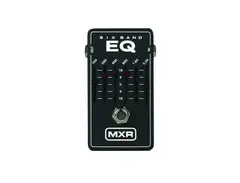
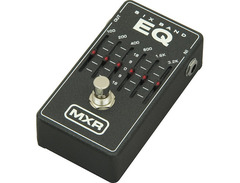
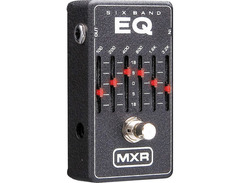
Step into the world of precise sonic customization with the MXR M109 6-Band Graphic EQ. This pedal is a guitarist's secret weapon, providing the power to tailor your sound without needing a sound engineer by your side. Whether you're crafting scooped metal tones or bass-rich blues sounds, the MXR M109 puts you in control. With an impressive 18dB of cut/boost, this EQ pedal allows for meticulous tone-shaping, ensuring your guitar always stands out in the mix.
Key Features:
- 6-band EQ for precise sound shaping
- Provides 18dB of cut/boost for each band
- Ideal for creating a wide range of tones, from scooped metal to bass-heavy blues
- Compact and sturdy design, perfect for any pedalboard
- Powered by a single 9V battery or AC adapter
- Easy to use sliders for quick adjustments on stage or in the studio
Product specs
| Brand | MXR |
| Model | M109 Six Band EQ |
| Finish | Black |
| Year | 2000s |
| Made In | United States |
| Categories | EQ Pedals |
| Pedal Format | Standard |
FAQs
-
What does the MXR M109 6-Band Graphic EQ do?
-
The MXR M109 6-Band Graphic EQ allows you to shape your guitar's tone by adjusting six frequency bands, ranging from 100Hz to 3.2kHz. This can help create scooped-mid rhythm tones, add warmth to acoustic pickups, or provide a lead boost in your effects loop.
-
Is the MXR M109 6-Band Graphic EQ suitable for live performances?
-
Yes, the MXR M109 is designed to be durable and reliable for live performances, allowing you to easily adjust your guitar's tone on stage and eliminate feedback issues.
-
Does the MXR M109 6-Band Graphic EQ introduce noise into the signal?
-
While some users report noise at higher gain settings, the MXR M109 is generally quiet when used with moderate settings. Properly managing your pedalboard's power supply and cable connections can help minimize any potential noise.
-
Can the MXR M109 6-Band Graphic EQ be used with bass guitars?
-
Yes, the MXR M109 can be used with bass guitars, though its frequency bands are optimized for guitar. Bass players might consider using the MXR 10-Band EQ for a broader range of frequency control.
-
What power supply does the MXR M109 6-Band Graphic EQ require?
-
The MXR M109 requires a standard 9V DC power supply, and it can also operate using a 9V battery for convenience.
-
How does the MXR M109 6-Band Graphic EQ differ from a 10-band EQ?
-
The MXR M109 focuses on six essential guitar frequency bands, while a 10-band EQ offers more detailed control over a wider frequency range, which can be beneficial for bass guitars or extended range instruments.
Videos

Ola Englund
NERDIEST DIME VIDEO EVER - MXR 6-band EQ Comparison (Dimebag tone chasing)
NERDIEST DIME VIDEO EVER - MXR 6-band EQ Comparison (Dimebag tone chasing)
Ola Englund
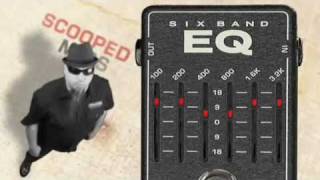
MXR M-109 6 Band EQ Pedal Video Demo

tunnelvisionmusic
MXR EQ demo by Awaking Mercury

Awaking Mercury Music
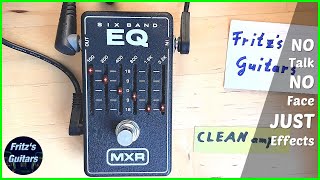
MXR - M109 - Six Band EQ EQUALIZER

Fritz's Guitars
Reviews
PROS
-
Allows precise tone shaping across essential guitar/bass frequencies
-
Offers a significant boost/cut (18 dB) for each frequency band
-
Can transform any amp's sound, making it versatile for various music genres
-
Ideal for removing onstage feedback or boosting signal in large pedal setups
-
Rugged build quality with a bypass switch and illuminated sliders
-
Enhances sound quality without losing tone
-
Facilitates quick guitar swaps on stage by adjusting EQ instead of amp settings
-
Can create unique sounds, including scooped mids or massive lows
CONS
-
May introduce fuzz when daisy-chained with other pedals, requiring additional setup to fix
Owner Insights
We analyzed real musician discussions from forums and Reddit to find what players love, question, and tweak about MXR M109 6-Band Graphic EQ.
Features and functionality
-
The 10-band version includes volume and gain sliders, providing more headroom and flexibility, especially useful for bass tones.
Source -
The MXR 6-band focuses on the most essential guitar frequencies, making it compact and effective for guitarists needing basic EQ adjustments.
Source -
The MXR Analog Chorus is praised for its simplicity in achieving a desired tone, with users finding it easy to dial in settings to suit their needs.
Source -
The MXR 10-band EQ includes two outputs, allowing for more versatile routing options compared to the 6-band version.
Source
User experience
-
Owners report that the MXR M109 6-band EQ has a solid build with sliders that offer a nice hefty resistance.
Source -
Users mention that placing the EQ before overdrive pedals can drastically alter the character of dirt pedals, simulating different pedal types.
Source -
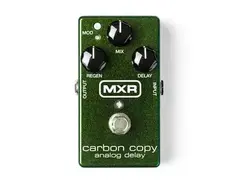
Owners appreciate the aesthetic of the MXR pedal line, particularly noting the unexpectedly attractive sparkle paint finish on the Carbon Copy model.
Source -
Owners describe using the 200 Hz band on the 6-band EQ to reduce muddiness in the signal, particularly useful for clean tones.
Source -
Users note that pushing the 6-band EQ too much can introduce noise, suggesting its best use is for subtle tonal adjustments.
Source
Use cases and applications
-
Running the EQ in the FX loop of an amp can shape the sound more effectively, enhancing tonal control.
Source -
Placing the MXR M109 6-Band EQ at the beginning of an effects loop can enhance clarity and focus, especially for effects like chorus and delay.
Source -
Running the MXR M109 6-band EQ at 18v, despite the manual recommending 9v, is reported to enhance the sound quality.
Source
Comparisons
-
The 6-band EQ is cheaper and smaller, allowing more space on a pedalboard compared to the more feature-rich 10-band version.
Source -
Users compare the MXR Analog Chorus favorably to Boss choruses, noting it sounds less swampy and provides a clean, distinct tone.
Source -
The 10-band EQ is likened to a scalpel for precise adjustments, while the 6-band serves as a cleaver for broader tonal changes.
Source
4.5 out of 5
Based on 12 Reviews and 78 Ratings

Carve, scoop, rumble, and shriek - all at the touch of a switch!
Completely reshape your sound or boost a wicked alternate lead tone that will jump out of the mix at will. Turn a problem signal into something that absolutely glows and helps you discover your own signature sound. The MXR EQ offers 6 bands covering all the essential guitar and bass frequencies, with each slider ready to deliver 18 dB's of cut or boost. Ideal for creating scooped mids or massive lows you never thought you could produce. It will also add natural-sounding warmth to a quacky acoustic pickup and instantly eliminate onstage feedback or boost your overall signal when using a massive chain of floor effects. Redesigns include a rugged bypass switch and "positive feel" illuminated sliders.


Sound Sculpting
Awesome pedal, Eliminate feedback, get some amazing sounds from your acoustic by creating massive highs and lows :-)


120
Tone sculptor
This little pedal helped turn my poopy combo amp tone into something halfway decent.

1120
MXR 6-Band EQ
This is a great pedal to get lots of various sounds out of, works great for Electric Guitar

Artist usage
Add artist

From Bellamy's guitar tech: "...the MXR EQ which we use for sort of a mid-boost in a couple of songs..."

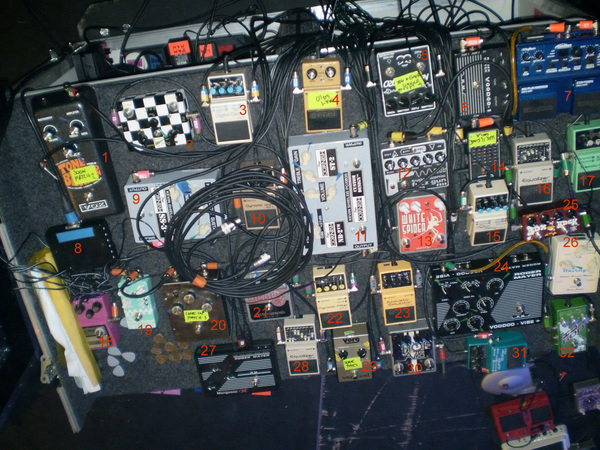
Kevin's MXR M-109 6-Band Graphic EQ can be seen in this image.


Billy uses the M109 Six Band EQ, according to his official artist page on Dunlop's website.


In the YouTube video titled "deftones – my mind is a mountain [stephen carpenter play-through]," Stephen Carpenter's pedalboard for 2025 is visible at the 1:21 mark, featuring the MXR M109 6-Band Graphic EQ.


At about 1:31 you can see the MXR M-109.

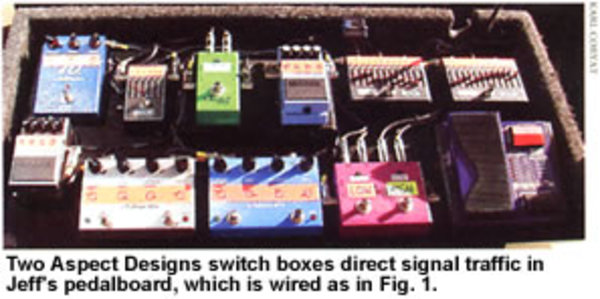
Can be seen on Jeff's pedal board at http://giventowail.com/site/img/gear/jeff/jeff_board.jpg


Dunlop features Ben Howard and their products that he uses, including the MXR M-109 6-Band Graphic EQ.

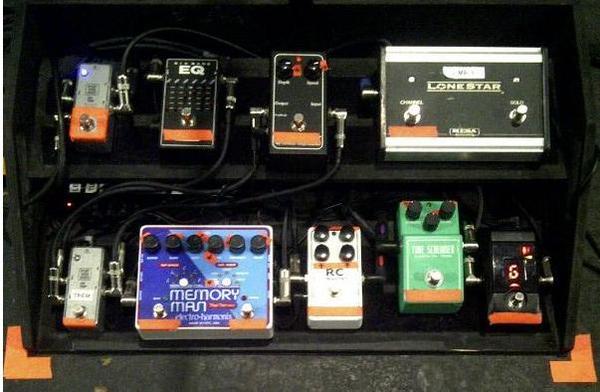
Alex Trimble of Two Door Cinema Club uses the MXR M-109 6-Band Graphic EQ on his pedalboard.

.jpg)


Juan Alderete is listed as a user of the MXR M-109 6-Band Graphic EQ, on this page of Dunlop's website.


During the Abominator Tour in 2015, I photographed Doyle Wolfgang von Frankenstein's pedalboard in Sioux Falls, SD, which included the MXR M109 6-Band Graphic EQ.

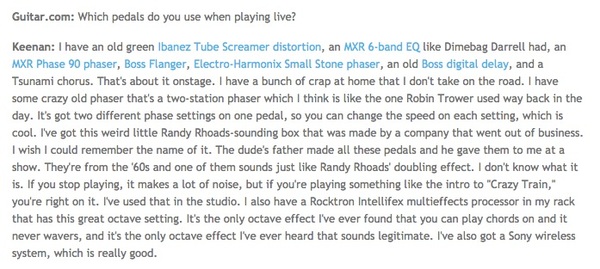
"I have an old green Ibanez Tube Screamer distortion, an MXR 6-band EQ like Dimebag Darrell had, an MXR Phase 90 phaser, Boss Flanger, Electro-Harmonix Small Stone phaser, an old Boss digital delay, and a Tsunami chorus." - The Hub (originally published through Guitar.com).
Album Usage
The MXR M109 6-Band Graphic EQ has been featured on the following albums:



Genre Usage
Based on how artists on Equipboard use this gear, it is most commonly found in the following genres.
Used With
Based on how musicians on Equipboard use MXR M109 6-Band Graphic EQ, it is most commonly used with the following gear.
-s.webp?v=1784957434)
-s.webp?v=1784958692)

-s.webp?v=1784957525)


-s.webp?v=1784957773)
Community setups
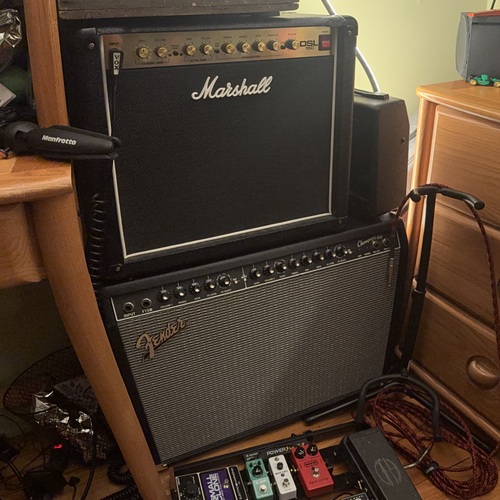
Show yours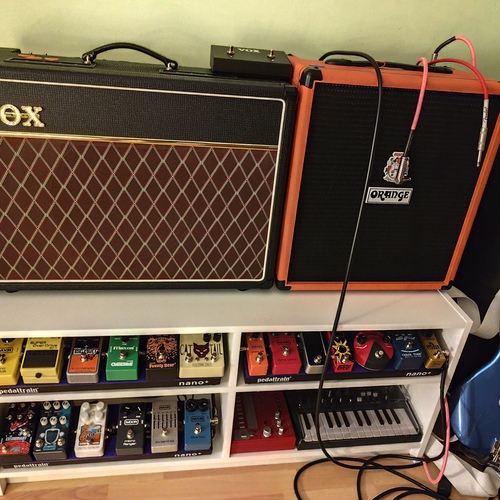


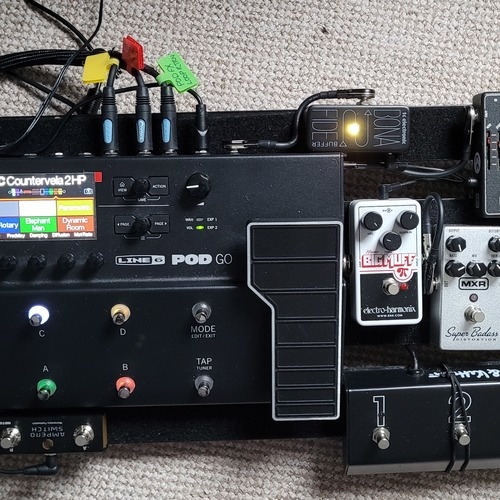

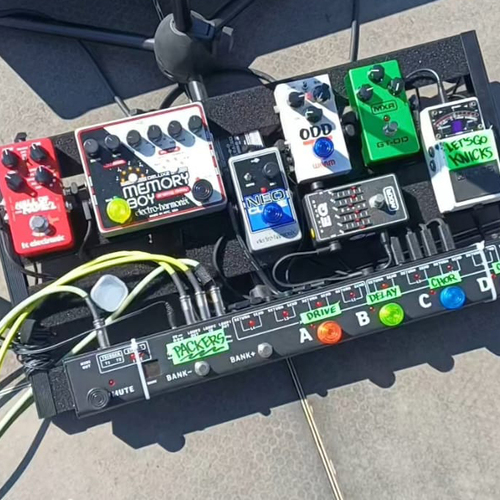
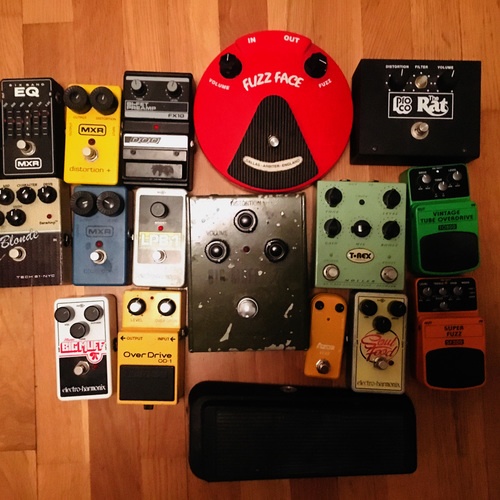

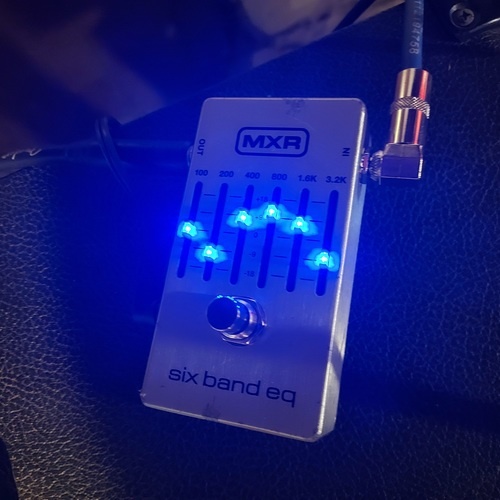
Similar
Add recommendation2 alternative and related items for MXR M109 6-Band Graphic EQ, curated by the Equipboard community.

$110.00 - $125.99

$37.79 - $37.99
More MXR Equalizer Effects Pedals

$10.00 - $159.99
in Equalizer Effects Pedals Rank
.jpeg?v=1784935806)


$79.00
in Equalizer Effects Pedals Rank


$110.00 - $125.99
in Equalizer Effects Pedals Rank


$118.57
in Equalizer Effects Pedals Rank


$79.00 - $125.99
in Equalizer Effects Pedals Rank


$79.00 - $159.99
in Equalizer Effects Pedals Rank


$79.00 - $159.99
in Equalizer Effects Pedals Rank


$100.50 - $131.99
in Equalizer Effects Pedals Rank


$59.99
in Equalizer Effects Pedals Rank
.jpg?v=1784922068)


$150.00
in Equalizer Effects Pedals Rank


$125.25 - $164.99
in Equalizer Effects Pedals Rank


.jpg?v=1784895999)

$137.08 - $216.00
in Equalizer Effects Pedals Rank


$150.00
in Equalizer Effects Pedals Rank


$49.00 - $55.00
in Equalizer Effects Pedals Rank


$218.50 - $252.99
in Equalizer Effects Pedals Rank


$275.00 - $289.00
in Equalizer Effects Pedals Rank


$18.17 - $31.90
in Equalizer Effects Pedals Rank
.JPG?v=1784934260)


-m.webp?v=1784957462)
$335.00 - $353.00
in Equalizer Effects Pedals Rank


$136.00 - $149.00
in Equalizer Effects Pedals Rank
.jpg?v=1784940345)

-m.webp?v=1784979265)
$55.00 - $83.90
in Equalizer Effects Pedals Rank


$42.18
in Equalizer Effects Pedals Rank


$205.00
in Equalizer Effects Pedals Rank


$251.19
in Equalizer Effects Pedals Rank

.jpg?v=1784782132)


$74.00
in Equalizer Effects Pedals Rank


$50.20 - $247.00
in Equalizer Effects Pedals Rank


$177.00 - $199.97
in Equalizer Effects Pedals Rank
.png?v=1784922061)


$199.00 - $229.00
in Equalizer Effects Pedals Rank
.webp?v=1784473994)


$116.42 - $139.99
in Equalizer Effects Pedals Rank

$95.61
in Equalizer Effects Pedals Rank


$1,200.00
in Equalizer Effects Pedals Rank


$39.99 - $52.40
in Equalizer Effects Pedals Rank

$37.79 - $37.99
in Equalizer Effects Pedals Rank

$264.00 - $369.95
in Equalizer Effects Pedals Rank


$56.00 - $63.00
in Equalizer Effects Pedals Rank


$133.00
in Equalizer Effects Pedals Rank


$338.00
in Equalizer Effects Pedals Rank

.jpg?v=1784891948)

$295.00
in Equalizer Effects Pedals Rank


$69.00 - $86.60
in Equalizer Effects Pedals Rank

$269.00 - $315.00
in Equalizer Effects Pedals Rank

$149.00 - $239.00
in Equalizer Effects Pedals Rank
Gear Guides





.jpg)

Most Popular Equalizer Effects Pedals
Most Popular Brands
-
Added to Equipboard on by
 equipboard
GearIQ 4934
-


