

Pricing and availability
We compare 600+ stores and found this item at 10 stores. Prices updated .
Store
Reviews
Price









Average Price: $780
Standard/Professional
$500
$1501+
Price Tier
Budget
Standard
High-end
Price History
Based on price data from 7 merchants for "Polyend Synth Multi-engine Polyphonic Synthesizer". Prices shown reflect NEW condition. Tracking began Apr 2, 2026.
* Product prices and availability are updated by Equipboard every 24hrs and are subject to change. Equipboard may receive compensation for purchases made at participating retailers linked on this site. This compensation does not affect what products or prices are displayed, or the order of prices listed. For more information, please refer to our affiliate disclosure.
Description
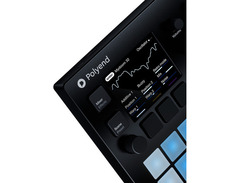
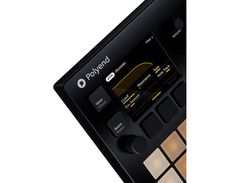
Dive into a world of sonic innovation with the Polyend Synth Multi-engine Polyphonic Synthesizer. This powerhouse offers eight distinct synth engines, allowing you to sculpt sounds from lush, vintage-inspired tones to cutting-edge digital textures. Whether you're in the studio or live on stage, its intuitive design and streamlined interface let you effortlessly switch between synth engines, adjust parameters, and layer effects. This instrument ensures that your creative process is both dynamic and fluid.
With its 60 RGB-backlit performance pads, the Polyend Synth brings your compositions to life with expressive control. These pads are not only velocity-sensitive but also feature polyphonic aftertouch, enabling nuanced expression with every touch. The Synth's three independent sequencers and arpeggiators provide endless possibilities for rhythmic exploration, while the customizable Smart Grid ensures that every note stays within the desired scale.
Polyend has crafted this synthesizer to be a versatile companion for musicians, sound designers, and performers alike. Its real-time visual feedback and comprehensive connectivity options, including USB and SD storage, ensure that your creative journey is as seamless as possible.
Key Features:
- Eight distinct synth engines, including phase distortion, physical modeling, and granular synthesis
- Three synth engines can be used simultaneously with 8-voice polyphony
- Built-in modulation, delay, and reverb effects
- Three independent sequencers and arpeggiators
- 60 RGB-backlit performance pads with velocity sensitivity and polyphonic aftertouch
- Customizable Smart Grid for scale and chord settings
- Real-time visual feedback
- Extensive MIDI connectivity with USB and microSD storage options (up to 16GB)
- 9 Combo Knobs for assignable parameter control
- Scene files for easy saving and recalling of setups
Product specs
| Type | Multi-Engine Polyphonic Synthesiser |
| Internal Sound Engine | 8 x Engines: VAP, PHZ, ACD, FAT, PMD, GRAIN, WAVS, WTFM |
| Screen | Hi-res LCD Display |
| Pads | 60 x Silicone Pads |
| Other Controllers | 9 x Parameter Knobs, Pitchbend Knob, Temp/Swing Knob |
| Polyphony | 8-voice |
| Sequencer | 3 x Independent 64-step Sequencers |
| Effects | 3 x Reverb, 5 x Delay, 4 x Mod |
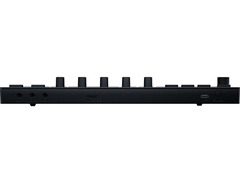
| Analog Outputs | 1 x 1/8" TRS (main/headphones) |
| MIDI I/O | 1/8" TRS In, 1/8" TRS Out, USB |
| USB | 1 x USB-C |
| Storage | 1 x MicroSD Card Slot (16GB card included) |
| Power Source | USB Powered (adapter included) |
| Height | 1.29" |
| Width | 11.1" |
| Depth | 8.14" |
| Weight | 2.64 lbs |
FAQs
-
What is the polyphony capability of the Polyend Synth Multi-engine Polyphonic Synthesizer?
-
The Polyend Synth Multi-engine Polyphonic Synthesizer offers 8-voice polyphony, allowing you to play up to eight notes simultaneously, each with its own voice architecture.
-
What types of sound engines are available in the Polyend Synth Multi-engine Polyphonic Synthesizer?
-
This synthesizer features eight different sound engines: VAP, PHZ, ACD, FAT, PMD, GRAIN, WAVS, and WTFM, providing a wide range of sound design possibilities.
-
Does the Polyend Synth come with built-in effects?
-
Yes, the Polyend Synth includes built-in effects such as three types of reverb, five delay options, and four modulation effects, enhancing your sound creation and performance.
-
What are the main connectivity options for the Polyend Synth Multi-engine Polyphonic Synthesizer?
-
The synthesizer includes 1/8" TRS analog outputs for main and headphones, 1/8" TRS MIDI In and Out, and a USB-C port for versatile connectivity.
-
How does the Polyend Synth integrate with a DAW?
-
The Polyend Synth can connect to a DAW via USB-C, allowing for seamless integration and MIDI control for your music production workflow.
-
Is the Polyend Synth suitable for live performances?
-
Yes, with its 60 silicone pads, 9 parameter knobs, and pitchbend knob, the Polyend Synth is designed for dynamic live performances, offering real-time control over your sound.
Videos

sonicstate
Presenting the Polyend Synth: Multi-Engine Polyphonic Synthesizer With Smart Grid
Presenting the Polyend Synth: Multi-Engine Polyphonic Synthesizer With Smart Grid
sonicstate
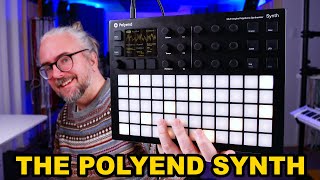
POLYEND SYNTH REVIEW // an innovative multi-engine synth that needs more firmware love

BoBeats
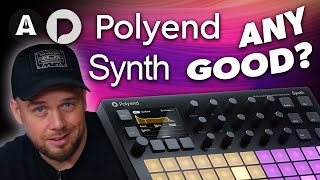
NEW Polyend Synth - Any Good?

Andertons Synths, Keys and Tech
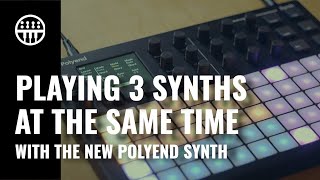
First Look At The New Polyend 'Synth' | Thomann

Thomann Synthesizers
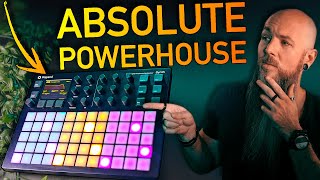
Why Polyend's $500 Synth is the BEST Value in Music Production Today

Vulture Culture
We should talk about the Polyend Synth...

Oscillator Sink
The Polyend Synth is absurdly fun

Slow Haste
NEW! The User-Friendly Multi-Synth We've Always Dreamed Of: POLYEND SYNTH

SpiralCasterPlaysPedals
Polyend Synth Overview - My Thoughts on this Multi-Engine Synthesizer

Aisjam
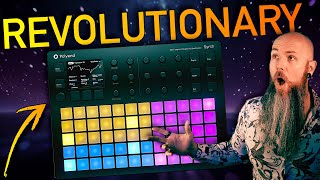
Polyend Synth Sound Design SECRETS Revealed LIVE!
Vulture Culture
Reviews
PROS
-
Eight distinct synthesis engines for a rich and diverse sonic experience
-
Ability to control up to three synth engines simultaneously for complex sound layering
-
60 RGB-backlit performance pads with polyphonic aftertouch for dynamic expression
-
Streamlined and intuitive interface allows for quick navigation and sound tweaks
-
Extensive MIDI connectivity for flexible integration into various production setups
-
Portable design can be powered via USB, ideal for on-the-go musicians
-
Customizable layouts and scenes enhance creativity and workflow
-
Chord + Follow mode for creating melodic and ambient music
-
Versatile implementation in various setups, yet powerful standalone
-
Easy learning curve for beginners, with depth for advanced sound design
CONS
-
CPU spikes with certain synth engines, causing note drops
-
No individual voice output; all voices are summed into one output
-
Firmware issues, including stuck notes and crashes, need resolution
-
Sensitive touch capacitive knobs may be unintentionally triggered
Owner Insights
We analyzed real musician discussions from forums and Reddit to find what players love, question, and tweak about Polyend Synth Multi-engine Polyphonic Synthesizer.
Comparisons
-
The Polyend Synth is compared to the Roland JDXi for its multi-timbral capability, though the JDXi is noted for being more of a preset player.
Source -
The synthesizer is often compared to Polyend's Tracker, with users expressing a desire for an all-in-one groove box solution combining features from both products.
Source
User experience
-
Despite potential, the synth is considered half-baked with a lack of long-term support, leaving users hesitant to purchase even at discounted prices.
Source -
Owners frequently encounter glitches when using three engines at once, with performance issues hindering the synth's potential.
Source -
Some users experience CPU overload when running three synth voices simultaneously, especially with demanding configurations like multiple granular engines.
Source -
Despite some minor MIDI bugs and CPU limitations, owners find the synth engaging and addictive for creating ambient scenes and jamming.
Source -
The synth's portability and ability to run on a 10,000mAh USB battery pack is highlighted as a significant advantage for mobile setups.
Source
Value and pricing
-
Significant discounts are noted across various retailers, possibly due to impending tariffs or efforts to clear inventory before new models are released.
Source
Build quality
-
Some owners have experienced menu navigation buttons getting stuck, impacting usability and prompting returns.
Source -
Users note the absence of an internal battery as a downside, requiring an external power source for portable use.
Source -
Some owners report issues with button quality, such as buttons not popping back up, leading to returns for defective units.
Source
Features and functionality
-
The synthesizer's CPU limitations are highlighted with a dedicated warning when the CPU limit is reached, restricting the use of all effects and engines simultaneously.
Source -
Users praise the synth's ability to create diverse soundscapes, from Moog-like basses to Juno-esque pads and FM sounds, showcasing its versatile sound palette.
Source -
The recent firmware update introduced the DWA oscillator engine, enabling use with samples, which users find exciting for expanded sound design.
Source -
Users find the lack of a built-in sequencer limits the synth's live performance potential, requiring external hardware to sequence effectively.
Source -
The internal sequencer allows up to 64 notes or rests, with options for arpeggiator and sequencer modes, providing flexibility for creative sequencing.
Source
Software and compatibility
Use cases and applications
-
The synth is favored for creating procedural chords and scale sequences when paired with a good external sequencer, enhancing complex live setups.
Source -
The synth is effectively used for jamming and live performance, often in combination with loopers and drum machines for dynamic improvisation.
Source
Critic Reviews
Based on 0 Reviews and 0 Ratings
Genre Usage
Based on how artists on Equipboard use this gear, it is most commonly found in the following genres.
More Polyend Synthesizers


$3,272.18 - $3,499.99
in Synthesizers Rank


$469.00 - $699.99
in Synthesizers Rank


$20,256.12
in Synthesizers Rank


$439.00 - $545.00
in Synthesizers Rank
.jpeg?v=1784640200)
.jpg?v=1784640202)

$3,333.00 - $3,499.99
in Synthesizers Rank


$999.00 - $1,084.00
in Synthesizers Rank


-m.webp?v=1784818786)
$1,100.00
in Synthesizers Rank

-m.webp?v=1784818754)
$379.00 - $499.99
in Synthesizers Rank


$600.00 - $2,398.00
in Synthesizers Rank


$2,000.00
in Synthesizers Rank


$411.00 - $699.99
in Synthesizers Rank


$277.00 - $349.00
in Synthesizers Rank


$2,199.00 - $2,946.49
in Synthesizers Rank


$1,479.42 - $1,899.00
in Synthesizers Rank


$298.22 - $652.00
in Synthesizers Rank


$1,356.47 - $1,839.99
in Synthesizers Rank


$379.00 - $549.99
in Synthesizers Rank


$491.72 - $899.99
in Synthesizers Rank


$279.00 - $449.99
in Synthesizers Rank


$230.51 - $749.99
in Synthesizers Rank


$279.12 - $1,763.18
in Synthesizers Rank


$79.99 - $495.44
in Synthesizers Rank


$325.00 - $1,332.49
in Synthesizers Rank

.jpeg?v=1784733415)
-m.webp?v=1784819396)
$1,790.00 - $1,899.00
in Synthesizers Rank


$481.81 - $699.00
in Synthesizers Rank


$499.99 - $719.99
in Synthesizers Rank


$304.94 - $915.00
in Synthesizers Rank


$3,999.00 - $4,999.00
in Synthesizers Rank


$1,469.00 - $2,159.99
in Synthesizers Rank

$290.00
in Synthesizers Rank


$479.99 - $1,099.00
in Synthesizers Rank


$166.00 - $274.95
in Synthesizers Rank


$350.00
in Synthesizers Rank


$382.00 - $449.99
in Synthesizers Rank


-m.webp?v=1784818702)
$962.10
in Synthesizers Rank


$6,600.00 - $10,444.00
in Synthesizers Rank

$29.95 - $69.99
in Synthesizers Rank


$740.00
in Synthesizers Rank


Accessories & Related Items

-s.webp?v=1784818703)


-s.webp?v=1784819380)




-s.webp?v=1784818754)



-s.webp?v=1784813424)




Artist usage


Community setups


Similar


Gear Guides






.webp)

Most Popular Synthesizers
Most Popular Brands
-
Added to Equipboard on by
 equipboard
GearIQ 4934
-


