

Pricing and availability
We compare 600+ stores and found this item at 6 stores. Prices updated .
Store
Reviews
Price







Average Price: $403
Budget/Beginner
$500
$1501+
Price Tier
Budget
Standard
High-end
Price History
Based on price data from 4 merchants for "Behringer Proton". Prices shown reflect NEW condition. Tracking began Apr 2, 2026.
* Product prices and availability are updated by Equipboard every 24hrs and are subject to change. Equipboard may receive compensation for purchases made at participating retailers linked on this site. This compensation does not affect what products or prices are displayed, or the order of prices listed. For more information, please refer to our affiliate disclosure.
Description
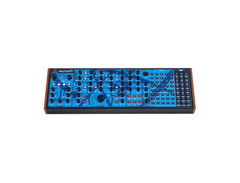
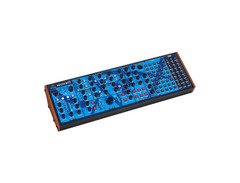
Unleash your sonic creativity with the Behringer Proton, an analogue semi-modular paraphonic synthesizer that bridges the gap between classic synth sounds and modern flexibility. Whether you're crafting lush soundscapes or intricate sequences, the Proton offers an expansive toolkit for both novices and seasoned synth enthusiasts. At its heart are dual oscillators with five available waveforms, allowing for extensive sound design possibilities. With a versatile patch panel featuring 40 inputs and 24 outputs, the Proton invites you to dive into the world of modular synthesis without the daunting complexity.
The Proton's paraphonic mode offers independent control over both oscillators, enabling multi-timbral sound creation that's perfect for evolving textures and complex harmonies. Its wave folder and four envelopes add further layers of modulation, giving you the power to shape your sound with precision. Designed for seamless integration, this synth can fit comfortably into a Eurorack housing (80 HP), making it a versatile addition to your studio or live rig.
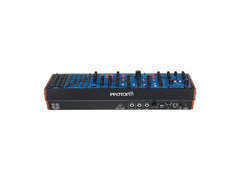
Connectivity is a breeze with MIDI In/Thru, USB 2.0, and multiple audio outputs, including a stereo headphone jack. Whether you're laying down tracks in the studio or performing live, the Behringer Proton is engineered to deliver rich, dynamic soundscapes with unmatched clarity.
Key Features:
- Analogue semi-modular paraphonic synthesizer
- Dual oscillators with 5 waveforms and sub-oscillator
- Paraphonic mode for independent oscillator control
- 40 patch inputs and 24 outputs with 3.5 mm mini jacks
- Wave folder and 4 envelopes for advanced modulation
- Compatible with Eurorack housing (width 80 HP)
- MIDI In/Thru and USB 2.0 for easy connectivity
- Stereo headphone output and multiple line inputs/outputs
Product specs
| Available since | August 2024 |
| Design | Desktop |
| Polyphony | 1 |
| Sound Generation | Analog, Synthesis |
| MIDI interface | 1x In, 1x Thru |
| Storage Medium | None |
| USB-port | Yes |
| Effects | Yes |
| Arpeggiator | No |
| Number of Analog Outputs | 1 |
| Digital Output | No |
| Display | No |
| Optional Expansions | 0 |
| Special Features | semi modular, Eurorack compatible |
FAQs
-
What type of synthesis does the Behringer Proton use?
-
The Behringer Proton utilizes analog synthesis, offering rich, warm sounds typical of analog instruments, with paraphonic capabilities for nuanced sound creation.
-
Is the Behringer Proton compatible with Eurorack systems?
-
Yes, the Behringer Proton is semi-modular and fully compatible with Eurorack systems, allowing for extensive modular patching and integration with other Eurorack modules.
-
Does the Behringer Proton have an arpeggiator?
-
No, the Behringer Proton does not include an arpeggiator, focusing instead on its dual VCOs, multi-mode VCFs, and extensive patch points for sound design.
-
How many patch points does the Behringer Proton have?
-
The Behringer Proton features 64 patch points, providing a robust platform for modular synthesis and creative sound experimentation.
-
What kind of outputs does the Behringer Proton offer?
-
The Behringer Proton has one analog output and does not include a digital output, maintaining a straightforward analog signal path.
Videos

Behringer
Introducing PROTON
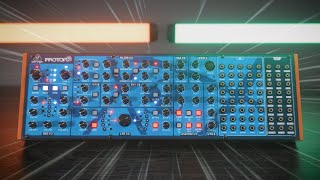
Introducing PROTON
Behringer
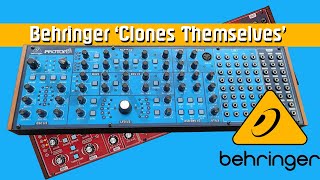
Behringer 'Clones Themselves' with the Proton

DECIMA1
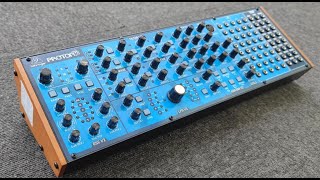
Behringer Proton

Pure Ambient Drone
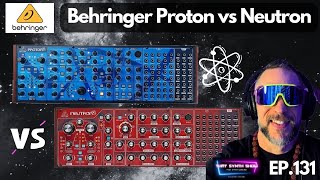
BEHRINGER PROTON VS NEUTRON ARE THEY DIFFERENT?? | THAT SYNTH SHOW EP.131

SYNTH SAMURAI
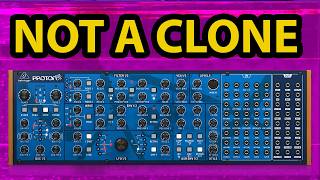
Behringer Proton
DECIMA1
Behringer PROTON

Echo Kraft
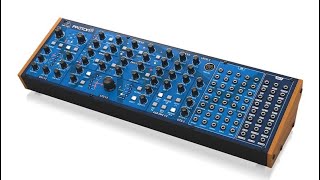
Behringer Proton, You Still Interested?

Todd Smith Music
Reviews
PROS
-
Dual filters and dual LFOs enable rich, complex sound design
-
Morphing multishape LFO/OSC offers creative modulation possibilities
-
Semi-modular design provides logical pre-patching and organized layout
-
Versatile sound capabilities, from warm and soft to harsh and resonant
-
CV-controllable resonances for both filters enhance modulation options
-
Compact size with well-balanced knob spacing for its feature set
-
Sub-oscillator mix control adds depth without overwhelming the main oscillators
-
Solid construction and robust build quality
-
Affordable addition to any modular or semi-modular setup
CONS
-
Initial setup issues with disconnected ribbon cable and missing US power adapter
-
Smaller potentiometers compared to Neutron may be less comfortable for some users
-
Lack of CV control for envelope attack/release limits modulation flexibility
-
Shift functions required for certain controls may hinder live performance intuitiveness
-
Fixed 12dB slope on filters limits flexibility in sound shaping
Owner Insights
We analyzed real musician discussions from forums and Reddit to find what players love, question, and tweak about Behringer Proton.
Features and functionality
-
The Behringer Proton lacks a sample and hold and noise source, which are often considered essential for modular exploration and randomness in sound modulation.
Source -
The Proton's dense UI may not be ideal for beginners, as it separates patch points from controls, making patching cumbersome and hard to read.
Source -
Proton’s semi-modular design allows sound generation without patching, offering a safe starting point while enabling complex patching for advanced exploration.
Source
Comparisons
-
The Proton is compared to Pittsburgh Taiga for its capabilities but is noted for its significantly lower price point, offering similar features at a third of the cost.
Source -
The Proton is often recommended over other Behringer models due to its original design and not being a direct clone of other instruments, unlike many other Behringer synths.
Source -
The Proton is suggested as an expansion option for those starting with Make Noise 0-Coast or Pittsburgh East Beast and West Pest, due to its design possibilities.
Source -
Alternatives like the Arturia MiniBrute 2S or Make Noise Ø-Coast are recommended for robust sequencer features or for west coast style synthesis.
Source
User experience
-
Owners of Behringer gear highlight issues with quality control, citing experiences with nonfunctional items and calibration problems straight from the factory.
Source -
Some users advise against Behringer products due to frequent troubleshooting issues and a tendency for their gear to fail within a year.
Source
Use cases and applications
-
The Proton is seen as a strong entry point into modular synthesis but may prompt users to quickly seek additional LFOs and function generators to expand functionality.
Source -
Proton is recommended to be used initially with dials before delving into patching, aiding understanding of component functions to ease frustration.
Source -
Proton can be sequenced with a MIDI keyboard, external sequencer, or DAW, but considerations about effects usage should be made prior to purchase.
Source
Critic Reviews
5.0 out of 5
Based on 0 Reviews and 1 Rating
Genre Usage
Based on how artists on Equipboard use this gear, it is most commonly found in the following genres.
More Behringer Synthesizers

$166.00 - $274.95
in Synthesizers Rank


$599.00 - $899.00
in Synthesizers Rank


$271.00 - $489.00
in Synthesizers Rank


$219.00 - $395.00
in Synthesizers Rank


-m.webp?v=1784387307)
$437.00 - $1,830.00
in Synthesizers Rank


.png?v=1784328024)


-m.webp?v=1784387234)


$88.10 - $237.00


-m.webp?v=1784387292)


$155.00 - $239.00


$129.00 - $349.00
-m.webp?v=1784387321)


$866.00 - $1,299.00


-m.webp?v=1784412913)

-m.webp?v=1784387567)


$90.20 - $149.00

$82.00 - $689.00


$239.00 - $399.00


Accessories & Related Items

-s.webp?v=1784352989)


-s.webp?v=1784379228)


-s.webp?v=1784378150)


-s.webp?v=1784374126)
-s.webp?v=1784353129)


Artist usage


Community setups


Similar


Gear Guides









Most Popular Synthesizers
Most Popular Brands
-
Added to Equipboard on by
 cobaltorder
GearIQ 1021
-


