
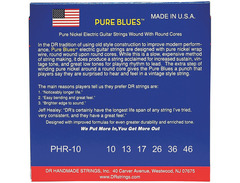
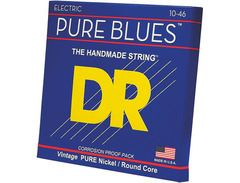

Pricing and availability
We compare 600+ stores and found this item at 6 stores. Prices updated .
Store
Reviews
Price




Price History
Based on price data from 5 merchants for "DR Strings Pure Blues Pure Nickel Wrap Round Core 10-46". Prices shown reflect NEW condition. Tracking began Apr 2, 2026.
* Product prices and availability are updated by Equipboard every 24hrs and are subject to change. Equipboard may receive compensation for purchases made at participating retailers linked on this site. This compensation does not affect what products or prices are displayed, or the order of prices listed. For more information, please refer to our affiliate disclosure.
Description
If you're chasing the soulful tones of classic blues and rock, the DR Strings Pure Blues Pure Nickel Wrap Round Core 10-46 might just be your ideal match. These strings blend vintage craftsmanship with modern precision, resulting in a set that's both a nod to the past and a tool for the present.
Crafted with a pure nickel wrap wire and a round core, these strings offer a distinctive warm, balanced sound with rich overtones. The meticulous roundwound process, though time-consuming, enhances sustain and delivers a uniquely vibrant tone that resonates with authenticity. Whether you're strumming rhythm or playing lead, these strings promise a punch that surprises and delights, making them perfect for everything from bluesy riffs to classic rock anthems.
Each glide across the fretboard feels smooth and responsive, allowing for a seamless playing experience. The gauges, ranging from .010 to .046, provide a versatile medium tension that suits a wide array of playing styles and guitars. Perfect for musicians who demand both traditional warmth and modern clarity, these strings are a testament to DR's commitment to quality and tone.
Key Features:
- Round core construction for enhanced vintage tone
- Pure nickel wrap wire for warm, rich overtones
- Gauges: .010, .013, .017, .026, .036, .046
- Designed for increased sustain and punchy sound
- Suitable for both rhythm and lead playing
Product specs
| Available since | July 2002 |
| String gauge | 010 - 046 |
| Strength of the strings | 0,010" – 0,046" |
| Material | Nickel |
| G-String Wound | No |
FAQs
-
What tone can I expect from DR Strings Pure Blues Pure Nickel Wrap Round Core 10-46?
-
These strings deliver a warm, vintage tone with a rich and full sound, thanks to their pure nickel wrap. They are perfect for blues, jazz, and classic rock styles, offering a smooth and mellow tone.
-
Are DR Strings Pure Blues 10-46 suitable for bending?
-
Yes, these strings are designed to provide a comfortable playing experience with good flexibility, making them suitable for bending. However, pure nickel strings might feel slightly stiffer compared to nickel-plated options.
-
How do DR Strings Pure Blues 10-46 compare to nickel-plated strings?
-
DR Strings Pure Blues offer a warmer, more vintage tone compared to the brighter sound of nickel-plated strings. They have a lower output and a rounder sound, making them ideal for players seeking a classic blues tone.
-
Are these strings suitable for all playing styles?
-
While DR Strings Pure Blues 10-46 are versatile, they particularly excel in blues, jazz, and rock genres due to their warm and rich tone. Players seeking a brighter sound for genres like metal might prefer nickel-plated strings.
-
What is the core material of DR Strings Pure Blues 10-46?
-
These strings feature a round core made from high-quality steel, wrapped with pure nickel, which contributes to their warm tone and smooth feel.
Videos

DR Strings
DR Strings Pure Blues Guitar String Demo

DR Strings Pure Blues Guitar String Demo
DR Strings

The Secret Behind the DR Strings Pure Blues | Thomann #shorts

Thomann's Guitars & Basses

Southern Style E 030 DR Pure Blues String Review

sccloser
Reviews
PROS
-
Delivers a warm, full, vintage sound with pure nickel wrap
-
Long-lasting with a very short settle-in time
-
Provides clarity and harmonic overtones, even with mushier distortion
-
Mellow, midrange-focused tone reduces overly bright highs
-
Suitable for various musical styles: blues, rock, and more
-
Consistent quality with minimal breakages reported by long-time users
-
Offers a great value for sound quality and longevity
-
Easier on the frets due to round core and pure nickel construction
-
Available in various gauges to suit different playing styles and guitars
-
Excellent for achieving vintage sound without being overly twangy
CONS
-
Reports of string breakage, particularly with B and E strings
-
Some users experienced a noticeable drop in quality after packaging change
-
Higher price compared to some competing brands
-
Rough feel and unevenness reported in certain strings
-
Requires proper installation due to round core nature to avoid breakage
Owner Insights
We analyzed real musician discussions from forums and Reddit to find what players love, question, and tweak about DR Strings Pure Blues Pure Nickel Wrap Round Core 10-46.
User experience
Comparisons
-
Users note DR Pure Blues have a distinct tonal warmth, making them preferable over nickel-plated strings for blues and classic rock styles.
Source
Setup and maintenance
-
Some players mention that DR Pure Blues strings require more frequent changes due to faster wear when compared to coated alternatives like Elixirs.
Source
Critic Reviews
5.0 out of 5
Based on 0 Reviews and 6 Ratings
Artist usage
Add artist

This May 23, 2014 article from Premier Guitar magazine, claims that Winter uses DR Pure Blues Pure Nickel 10-46 gauge strings.
Right-Hand Man
Paul Nelson is Johnny Winter’s supporting guitarist, producer, and manager, but his most important role is friend. If Nelson hadn’t made what was essentially a one-man intervention in Winter’s life nearly a decade ago, the guitar hero who ascended from Texas dive bars to the stage at Woodstock in a single year after recording his debut album would likely be pushing up posies instead of bending strings.
They met while Winter was cutting 2004’s I’m a Bluesman at Carriage House Studios in Stamford, Connecticut. “Johnny heard me playing some blues next door during a session I was doing for the World Wrestling Federation, and invited me to meet him,” Nelson recounts. He was recruited as a songwriter and second guitarist on the project, and when it was over Winter invited Nelson on the road.
“What he liked about me is that I was one of the few guitarists he played with who didn’t step all over his playing,” Nelson recounts. “Johnny said, ‘With everybody else, it was always a guitar war.’ I only do what needs to be done. If Johnny plays single notes, I play chords. If he plays low, I play high. It’s simple. I stay the hell out of his way and make everything sound bigger.
“Johnny took me under his wing and immediately started teaching me the blues riffs he’d learned from Muddy Waters,” Nelson says. “As I became more comfortable I started telling him the emperor had no clothes. He was singing and playing like crap, and practically falling asleep onstage. This had gone on for years with nobody trying to help him. So he asked me if I’d manage him. I said, ‘Yes, if you give up the drugs and drinking, start doing something about your health, and get back to being Johnny Winter.’ Believe me, there was a lot of screaming and fighting along the way, but he did it. There were huge changes the moment the drugs and stuff were gone—but try telling a rock star from the ’60s that!
“Some days,” ponders Nelson, “I wonder, am I his producer, his band mate, his manager, his pal? Or maybe I’m really the luckiest fan in the world.”
“It’s simple. I stay the hell out of his way and make everything sound bigger.”
Nelson was well into a successful career as a session player, producer, solo artist, and hard-rock guru with credits ranging from Leslie West to Los Lobos to Steve Morse when he signed on as Winter’s manager. As a youth, he was already enraptured by the playing of Winter, Billy Gibbons, Jimi Hendrix, Albert King, Jeff Beck, Wes Montgomery, and Larry Carlton when he attended Boston’s Berklee College of Music, then went on to study with Mike Stern, Steve Kahn, and Steve Vai. So Nelson had plenty of 6-string smarts and studio skills to apply to Winter’s 2011 album Roots, as well as the new album Step Back.
Both sets feature blues chestnuts and all-star casts, with the lineup on Step Back including Eric Clapton, Ben Harper, Brian Setzer, Leslie West, Billy Gibbons, Joe Perry, Dr. John, and harmonica demon Jason Ricci. Nelson also duets with Winter on “Killing Floor,” a song originally recorded by blues giant Howlin’ Wolf for Chess Records in 1964.
“When Johnny was ready to make this album, he picked the songs in 15 minutes,” says Nelson. “These are songs he’s loved all his life.” Nelson had the rhythm section learn the original version of each of the blues classics, and then had them learn another version recorded a few decades later before they worked with Winter on the album’s arrangements. “That way they’ve got perspective going into the session with Johnny,” he explains. When the basic tracks were done, they were sent to Winter’s handpicked guests, who added their parts.
To make the guest guitarists’ parts gel with Winter’s playing, Nelson duplicated the mic setups used by each player. “Clapton, for example, used a small amp and overhead mikes,” notes Nelson, “while Leslie West put a microphone right in front of his amp’s speaker. When I use the same approach to record Johnny, it sounds like they cut their guitar parts together in the same room.” Winter owes two more albums to Megaforce Records per his contract, and Nelson has also signed a deal to record solo for Megaforce.
Nelson says that winning a Grammy and being inducted into the Rock and Roll Hall of Fame top Winter’s bucket list. “He’s told me, ‘I’m at a point in my life where I love receiving awards. Give me awards.’”
Johnny Winter is known for his beloved Gibson Firebird, but he also plays a Lazer from Erlewine Guitars. He likes the Lazer because it stays in tune and sounds trebly like a Fender, but plays like a Gibson. He uses the Firebird primarily for slide and keeps it in open-D or G tuning.
All of this, and the fact that Winter is concentrating on recording and playing so many of the songs that first drew him into blues, makes him as happy as a 70-year-old kid in a candy store. “I never thought I’d reach this age, but I’m damn glad I did,” the high-speed string-slinger says. “I’d rather be old than dead. And I love playing the blues now as much as when I was 12. Maybe more. I could make albums of songs by Gatemouth Brown and Jimmy Reed and Muddy until I drop.”
Winter still has a bucket list: “I’d like to write some more original numbers,” he says, “but I haven’t had any song ideas since 2004. I’d also like to win a Grammy for one of my own records. And I’d like to go to Egypt—not even to play music, but just to see the pyramids and stuff. The Rock and Roll Hall of Fame would be nice, too, but I’d rather have the Grammy. And I want to get it for playing good blues.”
Johnny Winter's Gear
Guitars
1963 Gibson Firebird
Dean “Z” series Johnny Winter signature model
Amps:
- Music Man 4x10 combo
Effects
- Boss CE-2 Chorus
Strings and Picks
Strings, Picks and Slides
DR Pure Blues .010–.046 gauge
Fender medium thumb picks
Dunlop Johnny Winter Texas Slider
Another complaint Winter airs is that he considers his early records more rock than blues: “I really wanted to play blues, but in the early ’60s the white people didn’t want to hear us play that, especially in Texas, so when we started out it was more rock and R&B. It was frustrating, because I was in love with blues.”
Winter attended his first blues show at age 14: a Ray Charles concert at the Municipal Auditorium in his native Beaumont, Texas. Three years later he had a pivotal experience at that city’s Raven club. “I went to see B.B. King play for about 1,500 to 2,000 people—all black. It was great music, nobody bothered us, and after I met him, B.B. let me play,” he recounts. “It felt great to get a standing ovation from an all-black audience. I felt like I had to be playing the music right. B.B. didn’t even know if I could play. If I was in his place I don’t think I would have let me. He’s one of the nicest people in the world.”
By that time Winter’s oddball, lightning-strike thumb-and-forefinger picking style was already well developed. “It seemed to come naturally to me,” he observes. “A lot of the older black guys played with thumbpicks, but I started using one because I liked Chet Atkins and Merle Travis. Chet got his style from Merle. They probably influenced my speed, too. I’ve always played hard and fast. After all these years, I still play the way I did when I was 15. And my gear hasn’t changed much since 1970 when I got my Firebird.”
Winter acquired that iconic instrument at a festival, where a guitar dealer from St. Louis brought it and a clutch of other 6-strings to sell to the musicians on the bill. “I was already playing Les Pauls and Stratocasters,” Winter recounts. “The first really good guitar I’d gotten was a Black Beauty ‘fretless wonder,’ but when I saw that Firebird I thought, ‘I’ve got to try that!’ The neck’s been broken four or five times over the years. I keep getting it fixed. But everything is stock. I always thought it was fine the way it was, so I never messed with it.”
Winter still plays the Music Man 4x10 combo amps that Muddy Waters turned him onto during their ’70s collaborations, favoring those over the Fender Super Reverbs he’d used until then due to their higher wattage. His settings: volume and treble on 10, everything else at zero. And Winter’s one effect remains an old Boss CE-2 chorus pedal, “just to make things a little fuller.”
Waters was also a major influence on Winter’s slide playing, which is as much a signature as his ripping single-note solos. “Muddy, Elmore James, Robert Johnson, Son House—they got me interested in slide,” Winter explains. “I use a Dunlop slide that’s snug on my finger, so I can fret with the slide and move faster and more exactly.” He favors open D and G tunings, and sometimes A. “It all depends on where my voice is,” he says.
Because the upper range of his voice dissipated after decades of howling “rock ’n’ roll” into microphones to kick off his sets and growling like a frisky badger for the rest, Winter started dropping his standard tuning down a whole step to a D about 20 years ago. “Otherwise, I’m pretty much doing the same kind of thing I’ve done all my life: playing the same kind of music I love—the blues—the same way I always have.”
As Winter reflects on his career, it’s obvious that Muddy Waters remains his brightest musical beacon. “I played with a lot of people over the years,” he says. “Jimi Hendrix. Eric Clapton. But without a doubt, Muddy was the most important for me. I met him for the first time when we opened for him at the Vulcan Gas Company, where all of the psychedelic bands, like the 13th Floor Elevators, played. So the psychedelic sound got into my playing as well. But Muddy was it. His name and ‘blues’ were inseparable to me. And I feel the same way that Muddy felt about the music. When people come to see me I want them to know they’re going to hear good blues and that I play what makes me feel good, and that I’m interested in sharing that good feeling with them.”
Sure, director Greg Olliver’s rock-doc Johnny Winter: Down and Dirty provides a through-the-Winnebago-windshield view of the life of the Texas guitar legend as he travels the U.S. and Japan, and reminisces about his adventures with Jimi Hendrix, Janis Joplin, and his idol, Muddy Waters. But it also busts myths about his health and history, thanks to Winter’s relentless candor.
Early in the movie, which premiered at this year’s South By Southwest Film Festival, we see Winter receiving a visit from a physical therapist and struggling through exercises designed to strengthen and lengthen his back muscles, atrophied from years of bad posture, chemical abuse, and general neglect.
“Not everybody would allow a filmmaker to show them being vulnerable like that,” says Olliver, who also directed the critically heralded 2010 documentary Lemmy, about Mötorhead’s Lemmy Kilmister. “Johnny isn’t a rock star. He’s a real person and one of the most frank and open people I’ve ever interviewed, which made the two years I spent working on Down and Dirty really fun. Not once did he ever hold back.”
But viewers also see Winter enjoying life—horsing with his friends and his accomplice, manager/guitarist Paul Nelson, and taking pleasure in simple, but deep, pleasures like spinning a Robert Johnson record on a phonograph. There’s also plenty of live performance footage and cameos from Billy Gibbons, Joe Perry, Derek Trucks, and others commenting on the power and durability of Winter’s influence and legacy.
Olliver says his decision to train his lens on Winter came organically. Like the 6-string legend, Olliver was born and raised in Texas and grew up on the sound of blues from its originators and well as Lone Star heroes the Fabulous Thunderbirds and ZZ Top. When Olliver approached Winter and Nelson, they readily accepted.
Once Olliver got on the Winnebago, he discovered another bond with Winter: a love of horror and science-fiction films. “Johnny loves to stay up late at night on the bus watching B movies,” Olliver recounts. His taste varies widely. Two favorites are the 1956 classic Forbidden Planet and the hideously bad 1972 Ray Milland vehicle Frogs, which, to borrow Olliver’s description, “is about a bunch of frogs hopping around a plantation killing people.”
Olliver’s own project between Lemmy and Down and Dirty was Devoured, a genuinely creepy horror film that’s just been released in the U.K. “Johnny said that he loved it,” Olliver notes.
The glue between his two documentaries and Devoured is Olliver’s gift for storytelling. But there are some stories that didn’t make the final cut of Down and Dirty. “When we were in Hong Kong, Johnny said, ‘Hey, we should find some opium, and then we’re gonna put it up our butts.’ I said, ‘Johnny, if there are two things I’m not going to do on this trip, it’s find opium and put it up my butt.’
“When I told [veteran Winter and Double Trouble bassist] Tommy Shannon that story, he said, ‘You know, there was a time and a place when that sort of thing was perfectly acceptable.’”
For updates on the film’s availability, check johnnywinterdownanddirty.com.

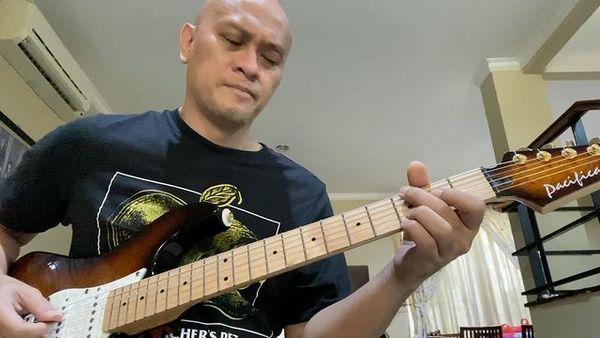
In his instagram, he mentioned "#drstringpureblues"


Album Usage
The DR Strings Pure Blues Pure Nickel Wrap Round Core 10-46 has been featured on the following albums:


Genre Usage
Based on how artists on Equipboard use this gear, it is most commonly found in the following genres.
More DR Strings Strings

$7.50 - $8.49
in Strings Rank


$23.99 - $29.00


$10.99 - $29.99
.jpg?v=1784922057)
.jpeg?v=1784986244)


.jpeg?v=1784891088)


$39.99 - $46.00


$23.99 - $41.00


$23.99 - $29.00


$6.49 - $7.99


$24.99 - $34.00


$8.20 - $8.99


$24.99 - $31.00


$24.99 - $29.00


$8.99 - $13.99


$13.91 - $32.99


$33.99 - $41.00


$11.99 - $12.99


$39.99 - $49.00


$23.99 - $29.00


$11.40 - $14.99

$29.99 - $35.00


$32.99 - $46.00


$11.99 - $12.60


$29.99 - $35.00
Accessories & Related Items



Community setups


Similar


Gear Guides








Most Popular Strings
Most Popular Brands
-
Added to Equipboard on by
 gerald_findley
GearIQ 90
-


