

Pricing and availability
We compare 600+ stores and found this item at 8 stores. Prices updated .
Store
Reviews
Price





Price History
Based on price data from 4 merchants for "Ernie Ball Power Slinky Bass Strings (55-110)". Prices shown reflect NEW condition. Tracking began Apr 2, 2026.
* Product prices and availability are updated by Equipboard every 24hrs and are subject to change. Equipboard may receive compensation for purchases made at participating retailers linked on this site. This compensation does not affect what products or prices are displayed, or the order of prices listed. For more information, please refer to our affiliate disclosure.
Description
Ernie Ball Power Slinky Bass Strings are the go-to choice for bassists seeking to create a powerful, low-end sound that doesn't compromise on clarity or quality. For more than half a century, rock musicians have relied on these strings, thanks to their impressive tone and unbeatable reliability.
These strings are crafted using a unique combination of materials, with nickel-plated steel tightly wound around a tin-plated steel core. This combination results in a sound that's punchy yet balanced, with a slight hint of top-end sizzle that lets the core tone shine through. Perfect for rock, metal, and any genre where a solid bass presence is a must.
Ernie Ball has been a pioneer in the world of rock strings, and the Power Slinky Bass Strings hold true to this legacy of quality and performance. Every set is precision-made, using the freshest raw materials and state-of-the-art manufacturing processes. The result? Unparalleled consistency and playability, right out of the pack.
Key Features:
- Nickel-plated steel windings wrapped around a tin-plated hexagonal steel core for a powerful, punchy tone.
- Balanced and articulate sound with a slight top end sizzle, allowing for clear articulation.
- Precision-made using the freshest raw materials and state-of-the-art manufacturing processes for consistent quality.
- Gauges of .055", .075", .090" and .110" for a diverse range of sound possibilities.
- Trusted by legendary artists and today's top bassists alike.
Product specs
| Guitar Type | Electric Bass |
| Number of Strings | 4 |
| Coated | No |
| Gauges | .055, .075, .090, .110 |
| Winding Type | Round Wound |
| Core Material | Hexagonal Steel |
| Winding Material | Nickel Plated Steel |
| Scale Length | Long |
FAQs
-
What kind of tone can I expect from Ernie Ball Power Slinky Bass Strings?
-
Ernie Ball Power Slinky Bass Strings provide a bright, full-bodied tone with a strong low end, making them ideal for rock and blues genres.
-
Are Ernie Ball Power Slinky Bass Strings suitable for downtuning?
-
Yes, the thicker gauge of the Power Slinky strings (.055-.110) makes them well-suited for downtuning, providing stability and maintaining tone quality.
-
What is the winding type of Ernie Ball Power Slinky Bass Strings?
-
Ernie Ball Power Slinky Bass Strings are round wound, which contributes to their bright and articulate sound.
-
Are Ernie Ball Power Slinky Bass Strings coated?
-
No, these strings are not coated, which allows for a natural feel and direct string-to-finger contact.
-
What is the core material of Ernie Ball Power Slinky Bass Strings?
-
The core of these strings is made from hexagonal steel, providing strength and durability.
Videos

29-ый
How does new ERNIE BALL Nickel Wound Slinky Power 55-110 strings sound on a jazz bass. DGCF-tuning.
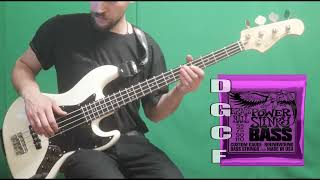
How does new ERNIE BALL Nickel Wound Slinky Power 55-110 strings sound on a jazz bass. DGCF-tuning.
29-ый
Reviews
Owner Insights
We analyzed real musician discussions from forums and Reddit to find what players love, question, and tweak about Ernie Ball Power Slinky Bass Strings (55-110).
Setup and maintenance
-
Adjusting the truss rod by 1/4 to 1/2 turn can address tuning stability when switching between standard and down tuning.
Source -
Owners mention that a 110 gauge string might require widening the nut slots on some basses, though it's not universally necessary.
Source -
Using 55-110 strings in standard tuning may require truss rod adjustments and potentially filing the nut and bridge to accommodate the thicker gauge.
Source -
It's crucial to perform a complete setup, including adjustments for neck tension, to handle the increased string gauge effectively.
Source -
Transitioning from 45-105 to 55-110 gauge strings often requires truss rod tightening and possible nut slot widening, especially for E and A strings.
Source -
Frequent string changes (3-4 times a year) often necessitate minimal truss rod and saddle adjustments to maintain optimal playability with heavier gauges.
Source
Use cases and applications
-
Power Slinkys are suitable for tuning down to B standard, but might require more effort in D standard compared to lighter strings.
Source -
The use of 110 gauge strings in standard tuning is validated by noting that Billy Sheehan reportedly uses a 110 E string without issues.
Source -
Players using 55-110 gauge strings for D standard and drop C tuning report successful application without significant tuning stability issues.
Source
User experience
Comparisons
-
DR Hi Beam heavy strings (50-110) are mentioned as comparable to Power Slinkys in providing stability for standard tuning and facilitating downtuning.
Source
4.5 out of 5
Based on 8 Reviews and 30 Ratings

77
Very good tone
This strings have a great tone for heavy music. The only problem I had with them, was that my G string broke when I was tuning it for the 1st time. But it happened only 1 time with Ernie Ball, so I'm pretty confident with this strings

139
I use these with my band
Well I don't have that big of a knowledege regarding strings, but these are good for stability in tunings such as B standard, which is really something on a bass. They're huge so you're gonna need to take care of your bass and be careful with how you set it up, otherwise it might really wear out the neck.

296
Solid, dependable. What you expect from EB.
Bought these in my more heavy handed days, dependable as you'd expect from Ernie Ball if a little too heavy for me, so I'll probably be downgrading to regulars again. In my hubris I've been using these for standard tuning, I would recommend these more for down tuning.

664

212
Extremely Good Quality!
Ernie Ball strings have always been my favorite. These have good quality and were used by Paul Gray.


580
Versatile
I use these strings on my bass, and they work well for a lot of stuff. Especially drop tunings, such as Drop D, Drop C, and even Drop B

1276
great dynamics
warm tone, suitable for down tuning, but rusts quickly
Artist usage
Add artist
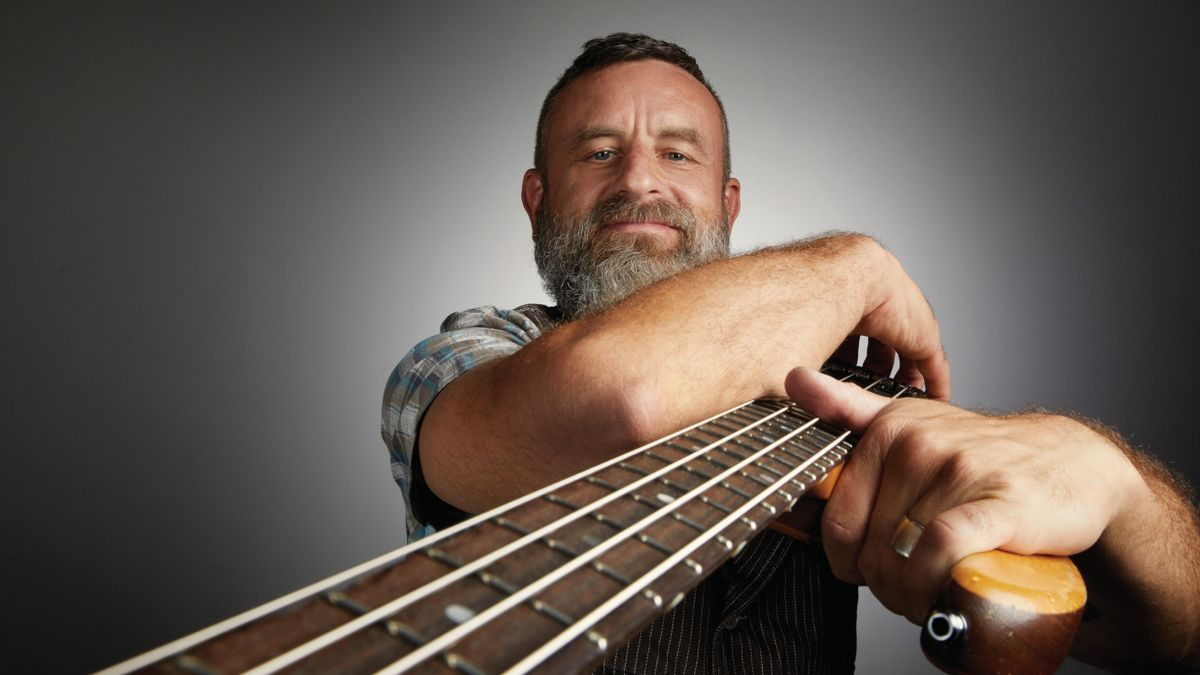
He uses the .110 from this set in conjunction with the .045 .065 and .085 from the Hybrid slinky set, ditching the .105 He's been quoted on this multiple times and it many interviews.
.jpg?v=1785107577)
.jpg?v=1785107577)
Paul Gray was known to use the Ernie Ball Slinky Bass Strings.


As for the ABIIOR era, Ernie Ball lists in this blog post that "On bass, they use Power Slinky bass strings."


"Bassist falls in line with the guitarists and only uses one type of bass—a Fender American Standard Precision Bass that is strung up with Ernie Ball Power Slinky Bass .055–.110." rig rundown article.


In this video from Fearless Records, we see one of the bass guitarist of Pierce The Veil, Jaime Preciado, showing his touring rig. At this point in the video, he shows us his 3 Ernie Ball Music Man Stingrays basses.


fluff uses ernie ball power slinky bass strings on any basses he may use. Fluff is endorsed by ernie ball

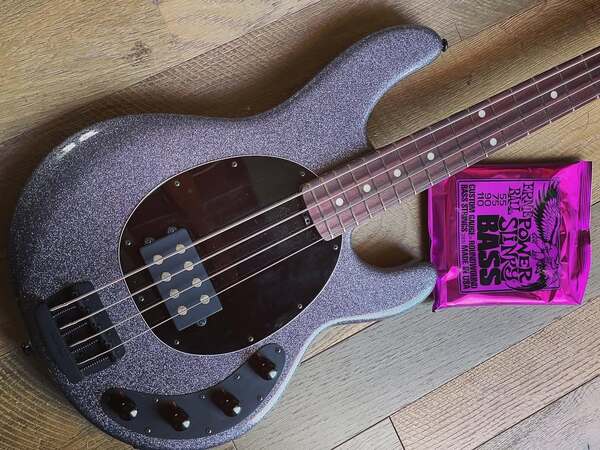
In an Instagram post by Scott Shriner, he shares an image featuring a packet of Ernie Ball Power Slinky Bass Strings (55-110), captioned, "Let’s try some bigger strings for D tuning to drop C. Kids just want to play Rammstein songs. Thanks always @ernieball."


The boys of @Sum41 know that when it comes to guitar and bass tone, Slinky strings are All Killer, No Filler. Join the legacy. #iplayslinky

.jpg)
In this Post on his Instagram Dave explains that he uses ernie ball strings on his basses


Along with Using Ernie Ball Music Man basses, Josh uses Ernie Ball strings. Josh uses "the purple pack" of Ernie Ball strings. He likes to have his strings changed often because he doesn't like a dead and/or clunky sounding strings. while on tour his strings are changed every 2 or so days on his main bass, and every 4 or so days on his backups


Genre Usage
Based on how artists on Equipboard use this gear, it is most commonly found in the following genres.
Used With
Based on how musicians on Equipboard use Ernie Ball Power Slinky Bass Strings (55-110), it is most commonly used with the following gear.


-s.webp?v=1785107577)


Community setups
Show yours


More Ernie Ball Strings

$4.99 - $8.99
in Strings Rank


$5.00 - $8.99
in Strings Rank


$5.49 - $8.99
in Strings Rank


$5.04 - $15.98
in Strings Rank


$5.30 - $8.99
in Strings Rank


$17.84 - $40.84
in Strings Rank

.jpeg?v=1785065168)


$5.87 - $17.60
in Strings Rank


$5.40 - $8.99
in Strings Rank


$17.97 - $22.90
in Strings Rank

.jpeg?v=1785070563)


$9.49 - $11.99
in Strings Rank


$4.00 - $10.99
in Strings Rank
.jpg?v=1784984771)


$16.42 - $17.99
in Strings Rank


$24.99 - $28.00
in Strings Rank


$7.37 - $9.99
in Strings Rank


$14.19 - $17.99
in Strings Rank


$7.40 - $9.99
in Strings Rank
.jpeg?v=1785065168)

$9.99 - $16.99
in Strings Rank


$17.83 - $28.99
in Strings Rank


$22.70 - $27.99
in Strings Rank


$4.81 - $8.99
in Strings Rank


$9.99 - $15.95
in Strings Rank


$5.99 - $17.98
in Strings Rank


$4.00 - $9.99
in Strings Rank


$9.64 - $11.99
in Strings Rank


$6.99 - $8.99
in Strings Rank


$29.20 - $39.99
in Strings Rank


$10.23 - $17.40
in Strings Rank


$8.95 - $14.99
in Strings Rank


$6.77 - $9.99
in Strings Rank


$10.99 - $13.75
in Strings Rank


$6.49 - $8.50
in Strings Rank
.jpg?v=1785070564)


$8.59 - $13.90
in Strings Rank


$10.00 - $16.99
in Strings Rank


$14.99 - $17.65
in Strings Rank


$11.97 - $15.99
in Strings Rank


$6.99 - $9.99
in Strings Rank


$28.50 - $39.99


$12.34 - $14.99


$6.90 - $18.99


Accessories & Related Items



Similar


Gear Guides






Most Popular Strings
Most Popular Brands
-
Added to Equipboard on by
 boom762
GearIQ 12239
-


