

Pricing and availability
We compare 600+ stores and found this item at 2 stores. Prices updated .
Store
Reviews
Price


Average Price: $2,376
High-end/Boutique
$300
$801+
Price Tier
Budget
Standard
High-end
* Product prices and availability are updated by Equipboard every 24hrs and are subject to change. Equipboard may receive compensation for purchases made at participating retailers linked on this site. This compensation does not affect what products or prices are displayed, or the order of prices listed. For more information, please refer to our affiliate disclosure.
Description
Marshall JMP Super Lead 100-Watt amp head
*The photo attributed to this entry is the original Marshall JMP Super Lead 100-Watt, and NOT the Marshall JMP MKII Super Lead 100-Watt. There is another model in the database for the MkII model.
Product specs
| Brand | Marshall |
| Model | JMP 1959 Super Lead 2-Channel 100-Watt Guitar Amp Head |
| Finish | Black, Red, White |
| Year | 1967 - 1975 |
| Made In | United Kingdom |
| Categories | Guitar Heads |
| Color Family | Black |
| Direct Output | No Direct Output |
| Electronics | Tube |
| Impedance | 16 ohms, 4 ohms, 8 ohms |
| Number of Channels | 2 Channels |
| Number of Inputs | 4 Inputs |
| Output Power (Watts) | 100 |
| Power Tube Type | EL34 |
| Reverb | None |
FAQs
-
What are the tonal characteristics of the Marshall JMP 1959 Super Lead 100-Watt?
-
The Marshall JMP 1959 Super Lead is renowned for its powerful, bright, and aggressive tone, often described as having a "crunchy" sound with a strong midrange presence. It's a classic choice for rock and blues, delivering the iconic "Plexi" sound.
-
Is the Marshall JMP 1959 Super Lead suitable for live performances?
-
Yes, the Marshall JMP 1959 Super Lead 100-Watt is ideal for live performances, particularly in larger venues. Its 100-watt output provides ample volume and headroom, making it perfect for cutting through a mix on stage.
-
How many inputs does the Marshall JMP 1959 Super Lead have?
-
The Marshall JMP 1959 Super Lead features four inputs, allowing for versatile connectivity options and the ability to bridge channels for a richer sound.
-
What type of power tubes does the Marshall JMP 1959 Super Lead use?
-
The Marshall JMP 1959 Super Lead utilizes EL34 power tubes, which contribute to its distinctive British tone and dynamic response.
-
Can the Marshall JMP 1959 Super Lead be used with different speaker impedances?
-
Yes, the Marshall JMP 1959 Super Lead is compatible with 4, 8, and 16-ohm speaker cabinets, offering flexibility in pairing with various cabinets.
Videos

Alsmusicfactory TV Searching The Good Tone
Marshall 1959 Super Lead 100W Original 10 April 1970
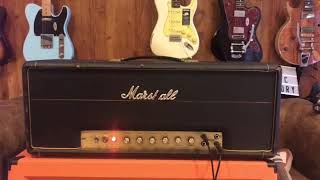
Marshall 1959 Super Lead 100W Original 10 April 1970
Alsmusicfactory TV Searching The Good Tone
Reviews
PROS
-
Distinct, unrivaled sound quality
-
Exceptional for achieving classic rock tones
-
Non-master volume provides unique feel and response
-
Capable of significant gain for various applications
-
Versatile sound suitable for recording and live gigs
-
Durable construction from iconic eras (60s-70s)
-
Can achieve classic Marshall sound across models
-
Compatible with power soaks for volume control
-
Noticeable difference in sound quality with de-modding
-
Bright, razorblade distortion characteristic
CONS
-
Extremely loud at low settings
-
Heavy and cumbersome to transport
-
May require modifications to achieve desired sound
-
Some models may sound overly bright with certain settings
-
Consistency issues due to tube variability
-
High cost, especially for vintage models
Owner Insights
We analyzed real musician discussions from forums and Reddit to find what players love, question, and tweak about Marshall JMP 1959 Super Lead 100-Watt.
Setup and maintenance
-
The chassis often contains a QC checklist with a date, which can help confirm the production year.
Source
Mods and upgrades
-
Owners often swap 6550 power tubes for EL34s to achieve a more authentic Marshall tone reminiscent of classic rock sounds like Hendrix or Zeppelin.
Source
Features and functionality
-
The JMP's power amp with 6550 tubes can be tighter, with distortion primarily from the preamp, unlike the EL34's break-up style.
Source -
Super Lead amps offer tonal variety through channel jumping, but require higher volume levels for breakup compared to the 2203.
Source -
The 2203's low input is often underutilized, offering clean tones with guitar volume adjustments similar to the Super Lead.
Source
Use cases and applications
Comparisons
Critic Reviews
5.0 out of 5
Based on 1 Review and 7 Ratings

41029
I wanna rock n roll all night
These amps are loud and bright at 1. I owned an early 70s metalface in purple tolex. We called her Barney. It had a sharper sound then my plexi reissue. More of a razorblade distortion rather than a creamy distortion. My friend owned a later pelxi RI and that sort of split the difference between the two sounds. I briefly owned a very late plexi front that was similar to this amp throughout and was very bright clean but smoothed out more turned up all the way. All of these superlead amps made between the 60s and late 80s are different and none of them has been equaled in a mass produced amp since. I'm more of a vox guy, but nothing sounds like these except maybe a laney supergroup. Its a shame so many metalfaces were modded out in the 80s because they are very cool stock. This sound is very much the sound of classic KISS and ACDC, if that's your bag. Tog et the ACDC sounds you need to sue the angus settings. If you try the all knobs on 10 with this the treble will take your head off, an EQ out front is not enough to tame this beast. It won't sound good with the plexi settings either where you turn up all the tone controls and kill the presence. Its just hairier and wilder without the tone shaping. These are getting expensive now :-(
Artist usage
Add artist

"This amp is LOUD! And sounds amazing. Used it exclusively on the upcoming Earthless record. It has 2 volumes: ones a treble/brighter volume and ones a bass/low end volume. It's a 4 input head so you can link the 2 volumes together by putting a cable in each the treble volume input and the bass volume input and you can now blend between both treble and bass volumes. A lot closer to what Hendrix would've used than my JMP. To have both in the arsenal is covering some very important bases tonally."


"Amps used on recording have varied almost as much, although the last few things we've done (Daitro split, Oath split, Funeral Diner split, Ringers split, and a couple of comp songs) I've played out of the JCM800 and JMP at the same time which works nicely."

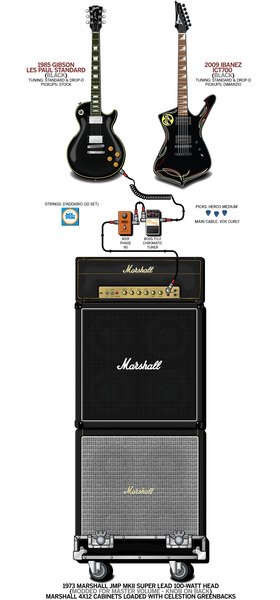
Mitch uses a 1973 Marshall JMP MKII amp head, according to this Guitar Geek rig diagram.

.jpg)
In an Instagram post, Taylor Young showcases his Marshall JMP 1959 Super Lead 100-Watt amplifier head, accompanied by a JCM cabinet, emphasizing a "less is more" approach.

In a YouTube video titled "Poison the Well - You Come Before You Studio Sessions," at 1:14, Derek Miller confirms that they used a Marshall JMP 1959 Super Lead 100-Watt, among other equipment, during the recording sessions for "You Come Before You." This information is provided by the channel FriendlyNotification.

.jpg)
In this image he can be seen playing through a Marshall JMP 1959 Super Lead (identifiable by metal toggle switches and white stitching), and a 1978-81 era Marshall JMP 1959 Mk II Super Lead (identifiable by large logo rocker & switches).


Todd, what amps did you use to get those giant guitar sounds? Youth: A 100-watt master volume JMP, which is the classic amp for hardcore...


Mike Pachelli mentions his appreciation for the Marshall JMP 1959 Super Lead 100-Watt amplifier in a Facebook post, expressing his fondness for its distinct sound.

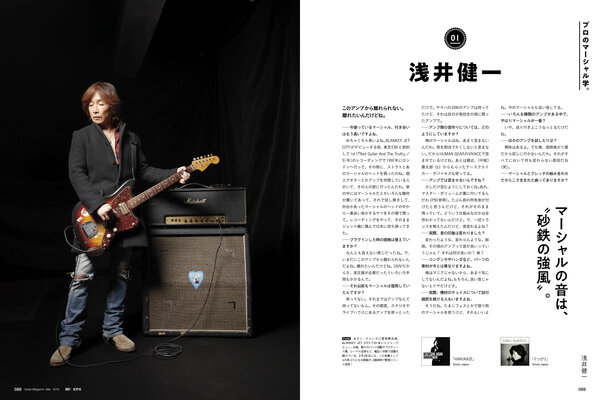
In the March 2019 issue of Guitar Magazine, Kenichi Asai discusses his use of the Marshall JMP 1959 Super Lead 100-Watt amp head, which he originally purchased in 1990 during the recording of Blankey Jet City's first album, "Red Guitar and the Truth," in London. Rather than relying on the amp's gain, Asai prefers to use pedals such as the Human Gear Vivace pedal and EarthQuaker Devices pedals.

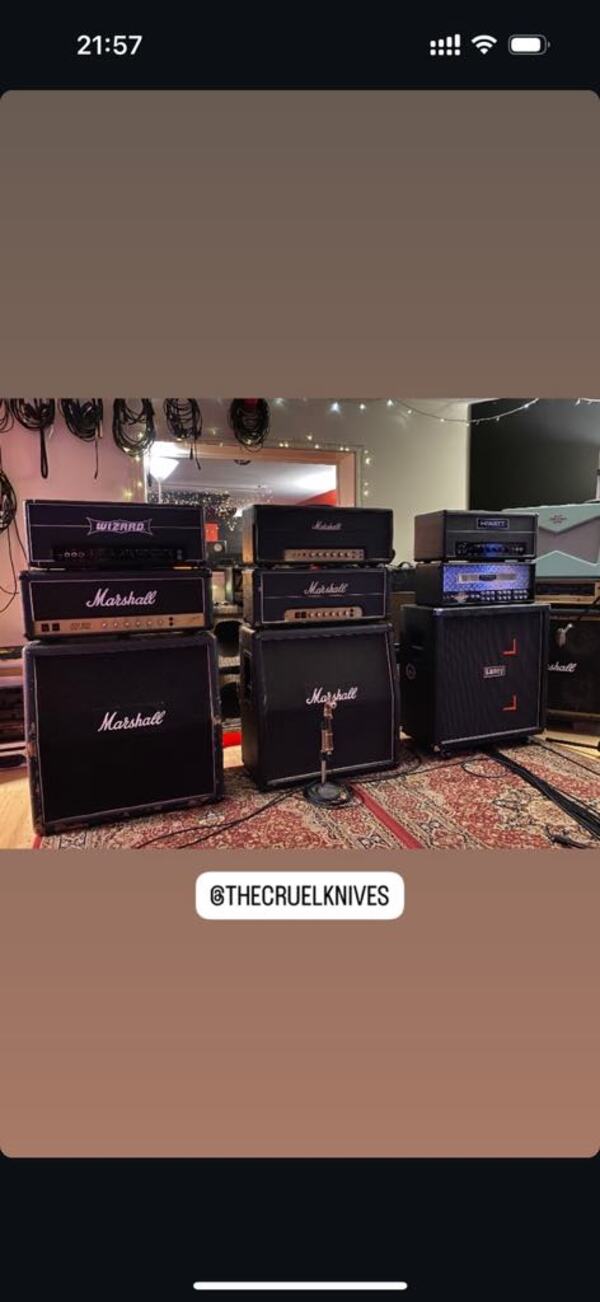
Small logo model 1959, so not exactly like the one on the Equipboard catalog. I haven't seen Sid bridge the channel on this amp, unlike hes 2203. Used with Heaven's Basement and The Cruel Knives as well.


Album Usage
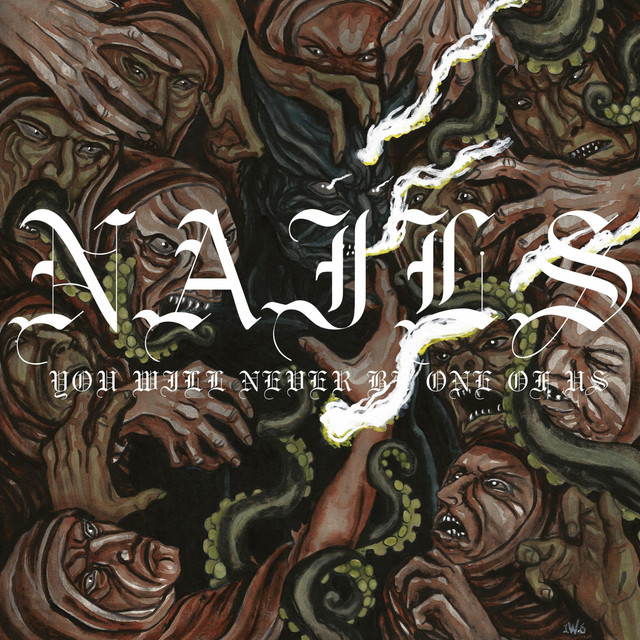
The Marshall JMP 1959 Super Lead 100-Watt has been featured on the following albums:


Genre Usage
Based on how artists on Equipboard use this gear, it is most commonly found in the following genres.
Used With
Based on how musicians on Equipboard use Marshall JMP 1959 Super Lead 100-Watt, it is most commonly used with the following gear.
-s.webp?v=1783403218)


Similar
Add recommendation2 alternative and related items for Marshall JMP 1959 Super Lead 100-Watt, curated by the Equipboard community.

$133.00 - $159.99
A new for 2025 amp in a box pedal, based on the Marshall 1959 Super Lead amplifier.

The Dirty channel features a tone stack voicing switch that delivers the sweeter JTM tone control voicing and balanced gain response in one position, and the more in your face JMP voicing in the other. The Gain control knob cascades through multiple tube gain stages in a unique way that starts out with Classic Plexi tones early on the dial giving way to scorching High Gain tones later on. The Gain Boost switch engages even more gain as well as kicking in our unique clipping diode circuit that gives you the sustain and precision of a ‘Jose’ but retains the organic Plexi clarity when backing off of the guitar’s volume control. See below for a description of each of the three individual amp voices available in the dirty channel.
More Marshall Guitar Amplifier Heads

$1,282.00 - $1,999.99
in Guitar Amplifier Heads Rank


-m.webp?v=1783422188)
$1,699.00 - $2,899.99
in Guitar Amplifier Heads Rank


$776.20 - $2,449.99
in Guitar Amplifier Heads Rank


$600.00
in Guitar Amplifier Heads Rank


$2,030.06 - $3,199.99
in Guitar Amplifier Heads Rank


$2,199.99 - $2,299.99
in Guitar Amplifier Heads Rank


$1,074.00 - $2,199.00
in Guitar Amplifier Heads Rank


$1,216.00 - $1,999.99
in Guitar Amplifier Heads Rank


$1,111.00 - $1,799.99
in Guitar Amplifier Heads Rank


$888.00 - $1,349.99
in Guitar Amplifier Heads Rank


$1,999.99 - $2,790.00
in Guitar Amplifier Heads Rank

.jpeg?v=1783323499)

-m.webp?v=1783422131)
$2,199.00 - $3,199.99
in Guitar Amplifier Heads Rank


-m.webp?v=1783423192)
$1,599.00 - $2,299.99
in Guitar Amplifier Heads Rank


.jpg?v=1783267404)

$1,739.56
in Guitar Amplifier Heads Rank


$899.99
in Guitar Amplifier Heads Rank


$697.13
in Guitar Amplifier Heads Rank


$1,731.52
in Guitar Amplifier Heads Rank


$214.20
in Guitar Amplifier Heads Rank


$1,378.92
in Guitar Amplifier Heads Rank

$557.70
in Guitar Amplifier Heads Rank


$320.68
in Guitar Amplifier Heads Rank


$2,207.37
in Guitar Amplifier Heads Rank


$469.99 - $599.99
in Guitar Amplifier Heads Rank


$1,880.00 - $2,899.99


$2,376.36


$1,282.00 - $10,199.95


$689.00 - $1,429.00


$1,915.78 - $2,299.99


$888.00 - $1,349.99


$811.00 - $1,349.99


$1,599.00

Accessories & Related Items


Community setups


Gear Guides







Most Popular Guitar Amplifier Heads
Most Popular Brands
-
Added to Equipboard on by
 austinmw
Gear IQ 5227
-



