

Pricing and availability
We compare 600+ stores and found this item at 5 stores. Prices updated .
Store
Reviews
Price


Price History
Based on price data from 4 merchants for "Waves Renaissance Reverb". Prices shown reflect NEW condition. Tracking began Apr 2, 2026.
* Product prices and availability are updated by Equipboard every 24hrs and are subject to change. Equipboard may receive compensation for purchases made at participating retailers linked on this site. This compensation does not affect what products or prices are displayed, or the order of prices listed. For more information, please refer to our affiliate disclosure.
Description
Transform your soundscapes with the Waves Renaissance Reverb, a versatile reverb plugin that brings the lush, atmospheric depth of 12 classic reverberation types right to your digital audio workstation. Whether you're looking to add warmth to vocals with a touch of plate reverb, create a sense of space for drums with room ambience, or infuse guitar tracks with iconic spring reverb vibes, this plugin covers it all. Its simple controls and intuitive graphic display allow for quick adjustments, letting you spend more time crafting your sound and less time navigating complex menus.
Designed with both seasoned producers and aspiring musicians in mind, the Renaissance Reverb offers a user-friendly experience without compromising on professional-grade quality. The plugin's de-correlation feature allows for subtle early reflections and fine-tuning, adding an immersive atmosphere to your tracks. With a negative predelay option, you can experiment with unique, ambient-rich effects that delay the dry signal.
Whether you're producing in mono or stereo, the Renaissance Reverb offers efficient performance across all your tracks, supporting up to 24-bit/96kHz resolution to meet the rigorous demands of modern audio production. Elevate your mixes with this studio-standard reverb plugin that seamlessly integrates into any workflow.
Key Features:
- 12 reverb types, covering classic styles
- Easy-to-use interface with graphic display
- De-correlation for subtle early reflections and atmosphere
- Negative predelay for ambient effects
- Supports up to 24-bit/96kHz resolution
- Mono-to-Stereo and Stereo components for flexible performance
Product specs
| Available since | October 2016 |
| Los artikel / bundelartikel | Los artikel |
| Delay | No |
| Dynamics | No |
| Effect Filter | No |
| Encoder/Decoder | No |
| Equalizer | No |
| Guitar amps/-effects | No |
| Channel Strip | No |
| Metering / Analysis / Correction | No |
| Modulation Effects | No |
| Multieffect / Plugin-Host | No |
| Overdrive/Distortion | No |
| Preamp / Saturation | No |
| Psychoacoustic tool / Enhancer / Exciter | No |
| Restauration | No |
| Reverb | Yes |
| Special FX | No |
| Summer / Mixing Consoles | No |
| Tape Simulation | No |
| Pitch Shifter / Harmonizer / Timestretching | No |
| Transient Processing | No |
| Vocoder / Vocal effect | No |
| Mastering Tools | No |
| Hardware Controller | No |
| Download | 1 |
FAQs
-
What type of reverb algorithms does the Waves Renaissance Reverb offer?
-
The Waves Renaissance Reverb provides 12 distinctive reverb algorithms, offering a wide range of reverb textures suitable for various musical and production needs.
-
Is Waves Renaissance Reverb suitable for both vocals and instruments?
-
Yes, Waves Renaissance Reverb is versatile and can be effectively used on both vocal tracks and a variety of instruments, enhancing the depth and space in your mixes.
-
Does the Waves Renaissance Reverb support any DAWs?
-
Waves Renaissance Reverb is compatible with all major DAWs, including Ableton Live, FL Studio, Logic Pro, and Pro Tools, ensuring seamless integration into your existing workflow.
-
Can I use the Waves Renaissance Reverb for live performances?
-
While primarily designed for studio use, Waves Renaissance Reverb can also be used in live settings to add professional-quality reverb to your live mix, provided your setup supports plugin hosting.
-
Does Waves Renaissance Reverb require a lot of CPU power?
-
Waves Renaissance Reverb is optimized to run efficiently, minimizing CPU load while providing high-quality reverb effects, making it suitable for use in complex projects without significantly impacting system performance.
Videos

Waves Audio
Reverb Mixing Tips: Sculpting with Waves R-Verb
Reverb Mixing Tips: Sculpting with Waves R-Verb
Waves Audio
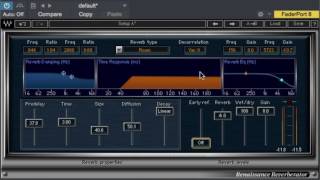
Waves Renaissance Reverb overview

Czar
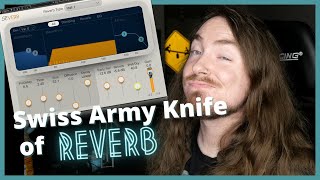
Renaissance Reverb from Waves || Tuesday Review Day

Topmop Productions
Reviews
Owner Insights
We analyzed real musician discussions from forums and Reddit to find what players love, question, and tweak about Waves Renaissance Reverb.
Comparisons
-
Users find Valhalla unable to replicate the nuanced chamber sound of Waves Renaissance Reverb, despite its strong reputation among reverb plugins.
Source
Use cases and applications
-
The chamber setting on Waves Renaissance Reverb is particularly valued and hard to replicate on other platforms, emphasizing its unique sound profile.
Source -
The Waves DeReverb plugin is highlighted as essential by users, outperforming more expensive alternatives like RX10's de-reverb in certain scenarios.
Source
Value and pricing
-
The plugin’s value is questioned when not on sale, highlighting its cost sensitivity compared to other plugins like Valhalla and TAL Reverb.
Source -
Waves plugins often become more affordable through third-party sales, with users suggesting everyplugin.com for significant discounts, making the update plan more palatable.
Source
Software and compatibility
-
Users struggle to find an affordable alternative that matches the specific tonal qualities of Waves Renaissance Reverb even after extensive tweaking.
Source -
Users on Mac may face compatibility issues with Waves plugins after OS updates, whereas Windows users report minimal problems, allowing older plugins to run smoothly.
Source
Features and functionality
-
The Waves Renaissance Collection, including Renaissance Reverb, remains prevalent in major albums, praised for its enduring utility rather than cutting-edge technology.
Source
4.5 out of 5
Based on 2 Reviews and 9 Ratings

2769
3D View how reverb works!
I use it everywhere and it gives me the flexibility to position my instruments or effects anywhere I want to in 3D field. Intuitive interface and very easy to use. It sounds very natural to my ears.

41029
little trick with r verb, it has one of the ebst algorithmic early reflections engines to my ear, try setting up an ALL ER send and then 2 separate sends with no ERs and all verb but with different tails on the same algorithm so you can mix and match tracks.... throw up an EMT plate IR (plates have no earlies) on a 4th send for another flavor and maybe set up another send with some tape slap that can feed all 4 axues to create timed pre-delay on all 4 verbs... and EQ the shit out of each send, maybe gate the plate in time with your 8th notes

Artist usage
Add artist

Used on "APESHIT", as stated by producer Stuart White in this September 2018 Sound on Sound interview.
The first four aux tracks feature SoundToys effects, namely Little Microshift, two EchoBoy delays, and a delay from the Little PrimalTap. Next are a Hall Reverb aux and a Church Reverb aux, both using Waves’ RVerb, an EMT plate from Audio Ease’s Altiverb, four aux tracks with the Waves H-Delay and various other plug-ins on them as well, and four more reverb auxes with the Avid Revibe II, two Avid D-Verbs and another RVerb.
White: “I use the Little Microshift in pretty much every mix, with the left-right micro pitch-shift effect that’s similar to the classic effect in the Eventide H3000 shift where you pitch one side down six cents and one side up six cents to create width. It’s a good way to get your vocals wider without them being out of phase. It thickens up vocals, and is kind of like a doubler. I do quite a lot of filtering on some of the EchoBoy delays, for example with the Waves REQ, and I am adding colour with the SoundToys Devil-Loc, which is great if you want to colour the delay so it is separate from the main vocal, and compress it with the UAD LA3A and mix that in to taste.”
(...) Jay-Z’s part consists of just two tracks, one lead, and one ad-lib, with an additional ‘reverse’ track, and a ‘jay clean’ track. White: “The main lead vocal track has the SSL E0-channel, Waves C4 multiband compressor for some control, FabFilter Pro-Q2 EQ, with a few notches, and McDSP AE400. Where Jay raps ‘Tell the Grammy’s fuck that 0 for 8 shit / have you ever seen a crowd goin’ apeshit?’, you can hear some stuff in the background, which is another example of me adding flair and energy. That actually comes from the third ‘Voice Sample’ track further up the session, on which I have some automated plug-ins, the ReVibe, Waves S1 Imager, and filter sweep from the EQ3. It’s subtle, but it gives you a little ear candy.”


Used on Rihanna's lead vocals for "SOS", as stated by mix engineer Phil Tan in this February 2007 Sound on Sound interview. An image of the settings can be found here.
Lead vocal: Waves Renaissance Reverb
"There's not a lot of reverb in the song, because it's up-tempo and quite packed, so there's not a lot of space. The reverb here is a room with a short length, 1.68S — a longer time would have gotten in the way. Sometimes you have to carve out a space for a reverb with EQ and by shaping the reverb characteristics — attack, release time, length, and so on — so that it does not interfere with the other frequencies in the song. I don't normally pay a lot of attention to exact reverb time, it's only with delays or reverb pre-delays that you want them exactly in time. Finding the right reverb is a bit of an unconscious process for me. It's an ongoing process of trying things out throughout the mix, until I find the right combination of ingredients."


Used on "Closer", as stated by producer DJ Swivel in this February 2017 Sound on Sound interview.
“All Halsey’s vocals apart from her hook vocals further down have tons of plug-ins and sends! The insert chain on these tracks is Auto-Tune, Waves Renaissance De-essser, Waves SSL Channel, Waves RVox, Waves RDe-esser and SPL Vitalizer, and on two tracks I add the Waves RVerb, and on the ‘Delay Chop’, which happens just one moment towards the end, the Valhalla Vintage Verb. Each of Halsey’s vocals here is EQ’ed slightly differently, and also the same with the de-essers. The first in the chain usually works as a normal de-esser, and the second functions more as corrective EQ. They each have different frequencies that they act on, with different thresholds and amounts, and they tend to correct small issues in just one word or so. It may be a harsh upper-mid thing, which female vocals can have, and I just carve out those frequencies with the RDe-esser. I don’t want to take it out of the entire performance, because that frequency may add energy to the overall vocals.
“I also like using the RVox as a second compressor, to really tame the vocal. It just brings it right out in front and sticks the vocal in your face. I usually am pretty subtle with the RVox, but every once and a while I’ll slam it and you get this really cool sound. I learned that from Pensado’s Place. Finally, the SPL Vitalizer again adds some sheen to these vocals. The ‘Halsey Delay’ track adds four delays at the end of the song, with the second one pitched down with Auto-Tune. You can get some cool things by pitching down the vocals in Auto-Tune and changing the throat length and things like that.
“In addition, all these tracks have tons of sends, going to the Lexicon plate reverb, in some cases the Lexicon hall reverb as well, and the H-Delay medium delay and the Doubler for more width. The ‘Halsey Lead 1’ track also has a send to the ‘Tape Delay’ track, on which I have a delay from the Waves Kramer Master Tape plug-in, which is set to a 15ips slap with not a lot of feedback. That delay adds a nice tonality and space. I also have several delay throws on certain words she sings, like in her opening line, where it goes ‘you... you’ on the upbeat.
“By comparison, there are very few treatments on Halsey’s hook vocals, which only have Auto-Tune, the SSL Channel, and the Doubler. Similarly, Drew’s backing vocals also have these plug-ins, and some Lexicon plate reverb. I’m using the SSL Channel to get rid of some high end on some of the tracks, because they were a little too bright, and had different effects on each of them to make sure they were not too similar.


Used for "How to Talk", as stated by mix engineer Kesha Lee in this December 2017 Sound on Sound article.
“The intro track was a voice note Uzi had recorded on his phone, and he played it in the booth on his phone, and we recorded it through the mic like that. It sounded really telephone-y, which we wanted, but I tried to take out some of the highs with the Waves OneKnob. All audio vocal tracks apart from the intro have Antares Auto-Tune as the first plug-in. Uzi hears his Auto-Tuned vocals in his headphones while singing. We used to just have it on default, with a Retune speed of 20, but lately he has been like: ‘Give me more Auto-Tune!’ so now we have the Retune Speed set to anywhere from 12 to 5. The ‘D’ after Auto-Tune is the Waves De-Esser, the ‘Q’ the Avid EQ3 seven-band, and the ‘1’ is the Waves C1 gate. All vocal audio tracks also have sends to the delay and the reverb aux tracks. The delay aux track has the Avid Mod Delay II set to half notes, with feedback at 43 percent, the Waves Renaissance Reverberator, set to ‘Hall 1’ reverb, with the highs cut on the reverb EQ, and the Waves S1 stereo imager. The reverb aux has the Renaissance Reverberator.
“All audio vocal tracks go to the vocal aux track. I had two vocal aux tracks in this session, because I wanted to try something different, using plug-ins I don’t normally use. That’s why one of the aux tracks is muted. The vocal aux track that I did use has the Waves De-Esser acting around 4230Hz, then the EQ3 seven-band which has a high-pass at 96.4Hz, and I’m dipping out muddiness at 200 and 500 Hz. I’m also adding some high end at 6.52kHz. I don’t normally add EQ with the seven-band, but Seth would add some high end on Future’s voice and that worked well, so I tried it here. Next is the Waves Renaissance Compressor, to keep the dynamics in check, and then the Waves SSL E-channel, on which I am again dipping out various frequencies. The latter plug-in is more for colour and character. The Waves CLA-3A is more for the sound, and the RN Digital Detailer made Uzi’s vocals sound fuller and wider.
"The final plug-in in the chain is the Nomad Factory MCL-2269 limiter and compressor, again for the sound and for more volume. We always go for a warm, full, loud, in-your-face vocal sound, also because we like the vocals to be louder than the beat. I always turn the beat down 1-2 dB. There are no plug-ins on the master track, because I used to work for a producer who didn’t want that, as the mix would go to the mastering engineer. So I’m still used to doing it like that. I turn the master volume down anywhere between -7 to -9 dB before it goes to mastering, so they have room to work with.”


It's used in the track "High Five!" As shown in the publicly available project.


Used on SZA's vocals for "All the Stars", as stated by producer Matt Schaeffer in this May 2018 Sound on Sound interview.
There are 12 SZA vocal audio tracks in total: two for the main hook, one second verse lead track, and nine verse backing tracks, which in fact provide emphasis and overdubs of single words. All SZA audio tracks have the Antares Auto-Tune 8.1 plug-in, the two hook tracks each also have the FabFilter Pro-Q2 equaliser, and the main SZA verse track also has a de-esser, while the backing vocals have two instances of the Waves RVerb and one of the same company’s H-Delay. Apart from Auto-Tune, most of the processing is done on the ‘SZA ?’ aux, to which all SZA audio tracks are sent.
Schaeffer: “The inserts of the sum track for SZA’s vocals consist of the EQ3 seven-band, Waves RComp, UAD Pultec EQP1A, UAD 1176E, Waves De-Esser, UAD LA2A, another Waves De-Esser, the Pro-Q2, yet another Waves De-Esser and the SoundToys MicroShift. The De-Essers affect 11400Hz, 15032Hz and 2000Hz respectively. I like stacking de-essers set to different frequencies. It works like narrow multiband compression. Sometimes I will in fact use a multiband compressor, like the Waves C4, but if the vocals have very specific harsh frequencies, I prefer to use several de-essers. They also are helpful as I like boosting high frequencies in vocals; here, the EQP1A boosts 16kHz. The EQ3 has a high-pass at 216Hz and cuts at 695Hz, and the Q2 lowers the high end to some degree. When a frequency bothers me, I usually sweep through [with a band set temporarily to boost] to find the frequency and then I cut. The MicroShift provides a little extra width and a slight ambience with the delay parameter, without actually making the vocal sound too stereo.
“The sends go to auxes called ‘SZA Verb’ and ‘DVerb’, both of which have the DVerb and EQ3 seven-band, two ‘SZA Delays’ with the Waves H-Delay, and the ‘SZA Chamber’, which has the Waves RVerb and again the EQ3 seven-band. I put an EQ after the reverb, because I don’t like too much low end in reverb. You get a cleaner sound by taking it out, and you make space for actual instruments to take up that spectrum. The delays are both set to eighth note, and one of them is set to ping-pong delay and also is automated to only come in on certain places.”


In this video at 5:20 we can see Waves Renaissance Reverb


Spotted on "Fred Falke In The Studio" with Futur Music Magazine.


Used for vocals on "Sum 2 Prove", as stated by mix engineer Tillie in this June 2020 Sound on Sound interview.
"All Lil Baby's vocals go through an aux track," says Tillie, "on which I have the Waves DeEsser, Avid EQ3 7-band, Waves SSL Channel and Compressor, Waves RCompressor, UAD J37 and the FabFilter Pro‑DS de-esser. There are two sends to reverb aux tracks and one to a half–note delay. The Waves DeEsser is there because I felt the vocal was too bright. The EQ3 has a pretty involved curve, with a low cut at 69.8Hz, notches at 184.7Hz and 425.2Hz, and me adding at 2kHz and high end at 5.37kHz, because I wanted some more presence. The SSL Compressor is not doing much, it's just there for vibe. I do the actual compression with the RCompressor.
"The J37 adds analogue vibe — it's one of my favourite plug–ins on vocals. It really brings them to life. I did all the heavy lifting with the first de-esser, and the Pro‑DS is just to catch anything that's the result of the EQ curve that I added. There's also a Vocal Parallel aux with the Softube Tube‑Tech CL‑1B to add more body and a bit of beef. I think that compressor just makes everything sound better. It gives you a different tonal character.
"The first send goes to the Verb aux track, which has the DVerb, set to a Large Hall, and an EQ3 7-band, taking out low end below 100Hz. The second send goes to the Verb 2 aux, with the Waves RVerb, the Waves REQ, again rolling off low end, and the Waves S1 Stereo Imager. I use the Imager on my reverbs probably 75 percent of the time. My style of mixing is very wide, so I tend to spread out my instruments and my effects, and I place things in different places in the stereo mix. I always like to add width and depth, so you can feel things and they are not necessarily right up in your face. But I leave the vocals to be the centre point of the mix."


Used for Quavo and Offest's features on Beyoncé and Jay-Z's "Apeshit", as stated by producer Stuart White in this September 2018 Sound on Sound interview.
The first four aux tracks feature SoundToys effects, namely Little Microshift, two EchoBoy delays, and a delay from the Little PrimalTap. Next are a Hall Reverb aux and a Church Reverb aux, both using Waves’ RVerb, an EMT plate from Audio Ease’s Altiverb, four aux tracks with the Waves H-Delay and various other plug-ins on them as well, and four more reverb auxes with the Avid Revibe II, two Avid D-Verbs and another RVerb.
White: “I use the Little Microshift in pretty much every mix, with the left-right micro pitch-shift effect that’s similar to the classic effect in the Eventide H3000 shift where you pitch one side down six cents and one side up six cents to create width. It’s a good way to get your vocals wider without them being out of phase. It thickens up vocals, and is kind of like a doubler. I do quite a lot of filtering on some of the EchoBoy delays, for example with the Waves REQ, and I am adding colour with the SoundToys Devil-Loc, which is great if you want to colour the delay so it is separate from the main vocal, and compress it with the UAD LA3A and mix that in to taste.”
(...) “The Migos vocals came in as seven audio tracks, with the Avid D-Verb on each of them. Putting a D-Verb on a track before EQ is not something I normally do, but it sounded great. So I adjusted them a bit, but otherwise left them as they were. The tracks also came in with the Aux track above, and the EQ3, with a high pass at 60Hz and notches at 430Hz and 1.41kHz and a high boost, the Waves API 2500 compressor, the RComp, the Waves Q10 EQ, following a slightly similar curve to the EQ3, the Waves De-esser, the Waves Aphex Aural Exciter, and the Avid Dyn3 expander/gate. I added the EQ3, with another high-pass filter at 144Hz, and the RComp, with a ratio of 10:1.”

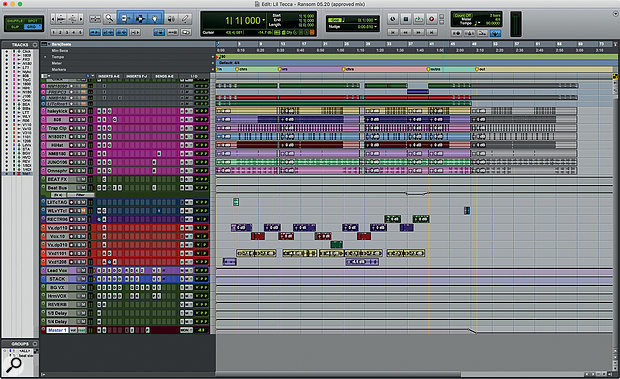
Used on vocals for "Ransom", as mentioned by mix engineer Joseph Colmenero in this November 2019 Sound on Sound interview.
"Many of the plug-ins on the vocal tracks came with the session. The vocal audio tracks all have Antares Auto-Tune Pro because the session came with Auto-Tune Live, and I didn't have my licence with me, so I put Auto-Tune Pro on. Without seeing the Live plug-in I had to use my ears to make sure that the settings were exactly right. They had recorded Tecca's vocals with Auto-Tune on, playing Auto-Tune like an instrument.
"All audio tracks go to the LeadVox bus, on which there is a stack of plug-ins. Again many of them came with the session. The chain starts with the Waves Q6 EQ, the FabFilter Pro-C2 compressor, then a Waves SSL Channel, two Waves De-Essers, a Waves RVox used as a noise gate, the SoundToys Decapitator for vibe, and a Waves C4 to bang down some peak frequencies. There's a track with distant ad-libs that goes to the Harmony Vox aux, which has some similar plug-ins, and adds a D-Verb for some extra reverb. There are sends on the vocal busses to the reverb aux, with the Waves RVerb, and delay quarter-note aux, with the Waves H-Delay. I also have the Avid EQ7 before the reverb, to take out the low end and high end. You don't want to have esses all over your reverb. The other two aux tracks that I did not use are part of the producer's template."
Album Usage
The Waves Renaissance Reverb has been featured on the following albums:
Enemy Brain
Fox Stevenson (2022)
Sum 2 Prove
Lil Baby (2020)

We Love You Tecca
Lil Tecca (2019)

Geography
Tom Misch (2018)
Black Panther The Album Music From And Inspired By
Kendrick Lamar & SZA (2018)
All The Stars (with SZA)
Kendrick Lamar & SZA (2018)

Bodak Yellow (feat. Kodak Black)
Cardi B & Kodak Black (2017)

Perfect Strangers
Jonas Blue & JP Cooper (2016)
Alone
Alan Walker (2016)

Closer
The Chainsmokers & Halsey (2016)
Banzai
Will K (2015)
From Zero To Hero
Repow (2013)
Dancing In My Head
Avicii & Eric Turner (2012)

There Is Love in You (Expanded Edition)
Four Tet (2010)
Genre Usage
Based on how artists on Equipboard use this gear, it is most commonly found in the following genres.
Used With
Based on how musicians on Equipboard use Waves Renaissance Reverb, it is most commonly used with the following gear.


-s.webp?v=1783316060)


More Waves Reverb Plugins

$33.00 - $39.99
in Reverb Plugins Rank


$33.00 - $39.99
in Reverb Plugins Rank


$34.99
in Reverb Plugins Rank


$33.00 - $39.99
in Reverb Plugins Rank


$33.00 - $249.00
in Reverb Plugins Rank


$33.00 - $39.99
in Reverb Plugins Rank

$219.00
in Reverb Plugins Rank


$33.00 - $34.99
in Reverb Plugins Rank


$29.99 - $99.00
in Reverb Plugins Rank


$179.00 - $199.00
in Reverb Plugins Rank


$34.00 - $349.00
in Reverb Plugins Rank


$141.00 - $149.00
in Reverb Plugins Rank


$99.00
in Reverb Plugins Rank


$59.00
in Reverb Plugins Rank

$49.00 - $99.00
in Reverb Plugins Rank


$77.00 - $282.00
in Reverb Plugins Rank


$6.00 - $29.50
in Reverb Plugins Rank

$68.00 - $299.00
in Reverb Plugins Rank


$299.00
in Reverb Plugins Rank


$299.00
in Reverb Plugins Rank


$144.00 - $149.00
in Reverb Plugins Rank

$253.00 - $299.00
in Reverb Plugins Rank

$129.00 - $149.00
in Reverb Plugins Rank

$99.00
in Reverb Plugins Rank


$14.99 - $129.00
in Reverb Plugins Rank


$69.00 - $169.00
in Reverb Plugins Rank

$58.00 - $69.00
in Reverb Plugins Rank

$74.25 - $99.00
in Reverb Plugins Rank

$94.00 - $99.00
in Reverb Plugins Rank

$381.00 - $474.00
in Reverb Plugins Rank

Accessories & Related Items


-s.webp?v=1783316885)


-s.webp?v=1783316602)

-s.webp?v=1783316979)


-s.webp?v=1783317103)


-s.webp?v=1783317036)


Community setups


Similar


Gear Guides








Most Popular Reverb Plugins
Most Popular Brands
-
Added to Equipboard on by
.jpg?v=1782968794) gchiaren
gchiarenGear IQ 37552
-