Pricing and availability
We compare 600+ stores and found this item at 1 store. Prices updated .
Store
Reviews
Price




Average Price: $100
Budget/Beginner
$500
$1501+
Price Tier
Budget
Standard
High-end
* Product prices and availability are updated by Equipboard every 24hrs and are subject to change. Equipboard may receive compensation for purchases made at participating retailers linked on this site. This compensation does not affect what products or prices are displayed, or the order of prices listed. For more information, please refer to our affiliate disclosure.
Description
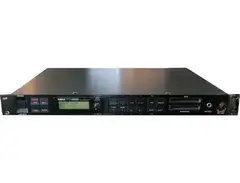
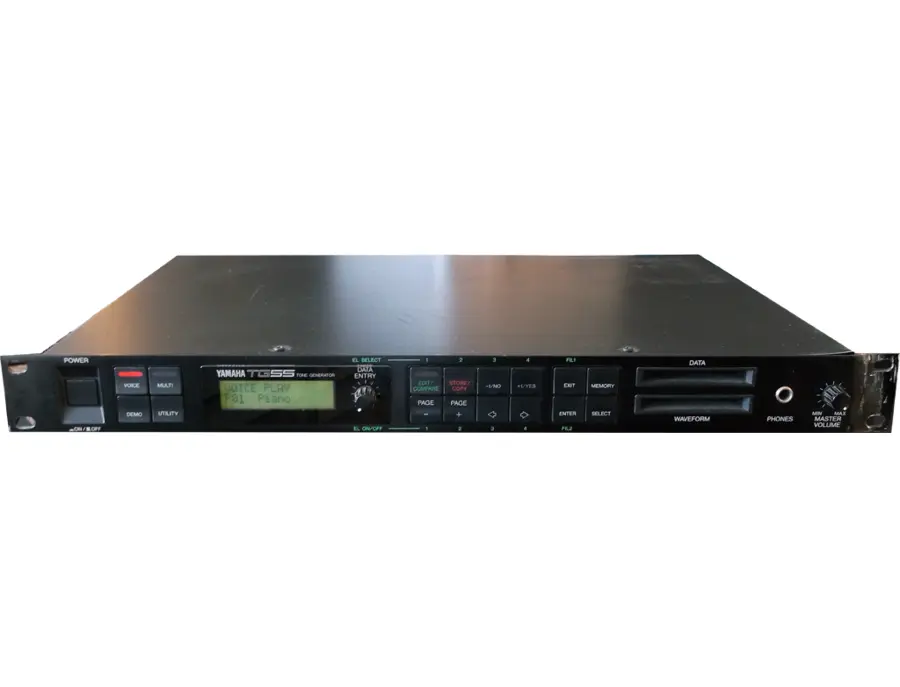
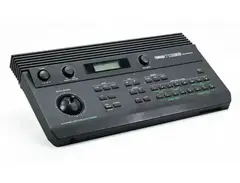
In the range of Yamaha’s late ‘80s - early ‘90s digital synths the TG (Tone Generator) line was the group of mainly rack-mountable instruments. Some of them were the module version of the SY-workstations (without keyboard and onboard sequencer).
The TG55 is basically a 16-bit sample playback based synth module – perhaps the first one from Yamaha employing this kind of sound generation, other than the old classic FM at DXs and TX modules - which appeared also in the same era like, e.g. the Roland U-220. This synthesis method used in the TG55 is called AWM2. The name stands for Advanced Wave Memory 2nd generation – it’s essentially Yamaha’s name for the PCM playback. The first original version of AWM had a 12-bit resolution, only the second version became 16-bit.
In its 2MB sample ROM, amongst 74 waveforms there are 50 acoustic instruments, 16 drum sounds, 8 digital waveforms – all of them are sampled in 16-bit depth and at 32 or 48 kHz sample rate.
The TG55’s sample oscillators are called "elements" - each patch consists of 1, 2, or 4 of them. The maximum polyphony is 16 voices. The factory sounds are those quite typical early nineties, but don’t judge it by only the presets. It has strengths like nice ambient pads, or new-age synths – they can sound crisp and clear. Considering its age, it hasn’t got the most realistic acoustic patches, but in case of deeper programming, this module is really capable of much more. It also has waveform and data expansion card slots for expandability.
What’s more, TG55 has 2 digital resonant filters (HP/LP, and LP - both with 12dB/oct), LFO with 3 possibilities (to amplitude, to pitch or to filter cutoff) , 3 Envelope Generators - 5 stages envelope, and 34 programmable digital effects (reverb 8-types, delay, stereo panning delay, gate and distortion) for shaping the sounds further.
Product specs
| Brand | Yamaha |
| Model | TG55 Tone Generator |
| Finish | Black |
| Year | 1990 |
| Made In | Japan |
| Categories | Digital Synthesizers, Rackmount Synths |
| Analog / Digital | Digital |
| MIDI I/O | MIDI Input, MIDI Output, MIDI Through |
| Polyphony | 16 Voices |
FAQs
-
What type of synthesis does the Yamaha TG55 Tone Generator use?
-
The Yamaha TG55 utilizes Advanced Wave Memory (AWM) synthesis, which is a form of sample-based synthesis that uses digital recordings of real instruments to generate sound.
-
How many voices of polyphony does the Yamaha TG55 offer?
-
The Yamaha TG55 provides 16 voices of polyphony, allowing you to play up to 16 notes simultaneously.
-
Is the Yamaha TG55 compatible with MIDI controllers?
-
Yes, the Yamaha TG55 is compatible with MIDI controllers and features MIDI Input, Output, and Through ports for connectivity with various MIDI devices.
-
Can the Yamaha TG55 be used in a rackmount setup?
-
Yes, the Yamaha TG55 is designed as a rackmount synthesizer, making it suitable for integration into professional studio setups or live performance racks.
-
What are the standout features of the Yamaha TG55's sound engine?
-
The Yamaha TG55's sound engine is known for its high-quality AWM samples and versatile sound-shaping capabilities, offering a wide range of tones suitable for various musical styles.
Videos

wolfgang S vukan
Yamaha TG55 (SY55) - 64 SynthCorner Presets Demo
Yamaha TG55 (SY55) - 64 SynthCorner Presets Demo
wolfgang S vukan
Yamaha SY55/TG55 - 64 Ambient & Analog Presets

LFOstore
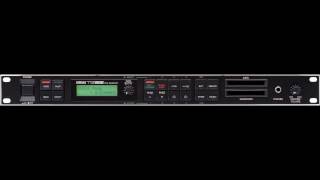
yamaha demo tg55

Roberto Brandi
Yamaha TG-55: A module that won't quit.

Gearfacts
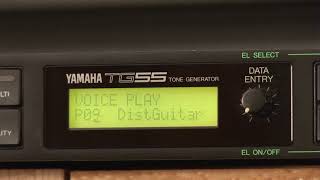
Yamaha - TG55 - Exploring the Presets - Part #1 - Midiverse - TV

Midiverse - TV
Reviews
4.5 out of 5
Based on 2 Reviews and 7 Ratings

63
The module that I mix with other expander to produce complex sound
In the range of Yamaha’s late ‘80s - early ‘90s digital synths the TG (Tone Generator) line was the group of mainly rack-mountable instruments. Some of them were the module version of the SY-workstations (without keyboard and onboard sequencer). The TG55 is basically a 16-bit sample playback based synth module – perhaps the first one from Yamaha employing this kind of sound generation, other than the old classic FM at DXs and TX modules - which appeared also in the same era like, e.g. the Roland U-220. This synthesis method used in the TG55 is called AWM2. The name stands for Advanced Wave Memory 2nd generation – it’s essentially Yamaha’s name for the PCM playback. The first original version of AWM had a 12-bit resolution, only the second version became 16-bit. In its 2MB sample ROM, amongst 74 waveforms there are 50 acoustic instruments, 16 drum sounds, 8 digital waveforms – all of them are sampled in 16-bit depth and at 32 or 48 kHz sample rate. The TG55’s sample oscillators are called "elements" - each patch consists of 1, 2, or 4 of them. The maximum polyphony is 16 voices. The factory sounds are those quite typical early nineties, but don’t judge it by only the presets. It has strengths like nice ambient pads, or new-age synths – they can sound crisp and clear. Considering its age, it hasn’t got the most realistic acoustic patches, but in case of deeper programming, this module is really capable of much more. It also has waveform and data expansion card slots for expandability. What’s more, TG55 has 2 digital resonant filters (HP/LP, and LP - both with 12dB/oct), LFO with 3 possibilities (to amplitude, to pitch or to filter cutoff) , 3 Envelope Generators - 5 stages envelope, and 34 programmable digital effects (reverb 8-types, delay, stereo panning delay, gate and distortion) for shaping the sounds further. It has a keyboard workstation brother called SY55 (that lacks the extra pair of individual outputs) released a year later. The TG55's successor, the TG500 had a much larger sample ROM and polyphony two years later. In the family of TG modules, somewhere between the rather tabletop vector-controllable AWM/FM TG33 module, and the flagship TG77 – which is a real monster with its AWM2/AFM capabilities – the TG55 (and later the TG500) is unique using pure AWM2 sound generation method. Nowadays, TG55 may seems a little dated but it’s also a quite underrated 1U module that still can produce interesting sounds. Although it’s a bit difficult to edit with only the onboard buttons, it has extensive voice editing functions. Since TG55s are very solid, well-built constructions, (plenty of them are still working good after more than 25 years) – while they are relatively cheap these days, they can be useful extensions for a synth setup of experimenter musicians.
74
Surprisingly flexible, easy to play, hard to edit on but supports SysEx. DAC showing its age.
Well thought out range of factory sounds, and the filters and digital delays are great - you can almost use this as a subtractive filter synth - but they do have the 90s digital character. Editing and combining voices is very very flexible but hard to think through using the front panel - better to use a SysEx editor. Never tried additional cards but I hear good things. Adamski got some good noises out of it for sure!
Artist usage
Add artist

As cited in the gear list of this May '92 feature in Music Tech magazine


Can be seen in the second picture on this page from Iwadare's old site.


"Peter Howell in Studio B. A pair of S550 samplers, a Proteus and a pair of DAT recorders can be seen in the rack to the rear. There's an Arp Odyssey on top of the left-hand rack, which also contains a CD player, D550, TX802 and a pair of TG55s."


The BBC Radiophonic Workshop utilized the Yamaha TG55 Tone Generator in their studio during the 1990s, as documented by Whitefiles.


In the YouTube video titled "TRIO KWEK KWEK - Tanteku," Trio Kwek Kwek can be seen using a Yamaha TG55 Tone Generator.


Genre Usage
Based on how artists on Equipboard use this gear, it is most commonly found in the following genres.
Used With
Based on how musicians on Equipboard use Yamaha TG55 Tone Generator, it is most commonly used with the following gear.



-s.webp?v=1784905105)
More Yamaha Synthesizers

$279.00 - $449.99
in Synthesizers Rank


$79.99 - $495.44
in Synthesizers Rank


$290.00
in Synthesizers Rank


$529.99 - $649.99
in Synthesizers Rank


.jpeg?v=1784891088)


$152.79 - $1,999.99


-m.webp?v=1784905247)


Accessories & Related Items


Community setups


Similar


Gear Guides






.webp)

Most Popular Synthesizers
Most Popular Brands
-
Added to Equipboard on by
sanveanGearIQ 63
-


