



Pricing and availability
We compare 600+ stores and found this item at 9 stores. Prices updated .
Store
Reviews
Price




Average Price: $226
High-end/Boutique
$80
$181+
Price Tier
Budget
Standard
High-end
Price History
Based on price data from 6 merchants for "JHS Packrat". Prices shown reflect NEW condition. Tracking began Apr 2, 2026.
* Product prices and availability are updated by Equipboard every 24hrs and are subject to change. Equipboard may receive compensation for purchases made at participating retailers linked on this site. This compensation does not affect what products or prices are displayed, or the order of prices listed. For more information, please refer to our affiliate disclosure.
Description
In 1978, the most versatile and influential distortion pedal of all time was invented in Kalamazoo, MI: the Proco RAT. Scott Burnham and Steve Kiraly first had the idea after playing, repairing and modifying all the available distortion pedals on the market. They wanted something that didn’t exist in the mainstream product lines like MXR, DOD and BOSS. They wanted a pedal that could go from overdrive to distortion and then all the way to fuzz. By 1979 Scott had perfected the circuit in his RAT-infested basement workshop, and the rest is history.
The PackRat is the ultimate tribute to the 40+ years of rodent evolution and its impact on the guitar’s sound. Artists from every genre have used the iconic tones in this unassuming black box to create their sounds, including Nirvana, John Scofield, Pink Floyd, Metallica, REM, the Eagles, Jeff Beck and Radiohead.
Building on our Multi-Mode pedal series that includes the Muffuletta and Bonsai, the PackRat uses the same unique digital runway system to direct the paths of 261 components through 40 individual switches. This means that when you choose one of the nine legendary or rare modes, you are playing fully analog circuits that perfectly replicate that mode, even down to the aging components (also known as component drift). If you purchased these nine hard-to-find pedals on the used market right now, you would pay around $4,000. When you put it that way, $249 sounds pretty reasonable.
Let’s take a look at the controls.
The operation of the PackRat is about as simple as it gets. The “Volume” control adjusts the overall volume of the pedal. The “Distortion” control lets you raise and lower the amount of gain or distortion that the circuit produces, and the “Filter” control allows you to brighten and darken the sound of the overall effect. This is effectively a simple, low-pass filter. Lastly, we have “Mode” control. This is a stepped pot that clicks into place as you scroll through the nine legendary versions of this circuit. As you change the mode, the analog circuitry is rewired, resulting in brand new values of resistors, capacitors, diodes and op amps.
DISCLAIMER:
Although I’ve put several years of research into the history, circuit topology and version history of the RAT, I know that my findings may still ruffle some feathers. I’m okay with that.
I have tracked down over 100 different RAT specimens for study, and I’ve performed almost twenty hours of interviews with former ProCo employees about the circuit design, evolution and production of this pedal series over the decades. And basically? A lot of the widely accepted “facts” about the differences in RAT versions, including some of my own beliefs, were wrong. Most assumptions about how specific RAT models sound different or better than the rest are, at best, misinformed. Generally speaking, they’re flat-out incorrect.
To find the facts and give this circuit the proper understanding it deserves, every RAT model ever made (and quite a few prototypes that never saw the light of day) were obtained and studied in great detail. I wanted to understand the exact production differences over the years, so we disassembled the units, analyzed them using state-of-the-art Audio Precision equipment, measured individual components, built comparison charts, traced each circuit and closely examined the branding, logos and other identifiers of change. As far as I know, no one has ever gotten close to the level of research that we performed between 2018 and 2021.
Reliable sites like Reverb.com had inaccurate timelines with incorrect pictures of the respective models. Even ProCo’s own history timeline was missing tons of details about the RAT variations that have been made over the past 40 years. And Wikipedia?… No. Just no.
There’s a reason for that.
A vintage unit is typically dated by reading the manufacturer codes on the back of the pedal’s potentiometers/knobs. Unfortunately, this is a flawed dating method. ProCo would have ordered thousands of potentiometers, and in doing so, many pedals were made with parts pulled from backstock at least two to three years older than the actual pedal being dated. In short, this means that you’ll see V1s, V2s, V3s with dates that overlap with each other’s true production years. Combine this with decades of people incorrectly “remembering” what RAT model sounds the best, and you have a historically inaccurate hot mess on your hands.
To properly build an accurate timeline and database of changes, I dated the pot codes, dated their components when possible, interviewed respective people involved in the eras of production and referenced over 1,000 online sales photographs, and studied the prototypes and the evolution of the engineers’ design ideas. I did everything possible to build an airtight case for my work and to not rely on any prior dates and timelines. The results may not be perfect, but they’re pretty darn close. See my full biographical timeline with photography and specific details of my work here.
The PackRat Modes
1. The OG V1 (1979-83)
The OG mode is a perfect recreation of the first production RATs ever made. This era of roughly four years covers what is referred to historically as the V1 models.
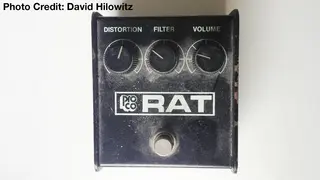
Early V1s are also known as the Fringe Logo model and can be identified by the letters R-A-T being in all capital letters with a slight fringe graphic coming from the typeface. The V1 also has small silver capped knobs and a Tone knob instead of the more familiar and later produced V2 Filter control labeling. From a circuitry standpoint, the V1 and V2 Big Box models are practically identical except that the V1's Tone control increases treble as you turn clockwise while the V2's Filter control decreases treble in that direction.
When switching to the OG mode, you are activating the exact circuitry of my 1979 V1 Fringe Logo model, including the accurate Tone control rotation and taper.
Let me take a moment here to clarify: the V1 and V2 models are the exact same circuit, and simple adjustments to the Tone/Filter control can achieve identical sounds from each unit.
I know that the super nerds are going to ask why we didn’t include a Bud Box mode. Basically, I’d consider the Bud Box RAT to be a V1, because it is almost identical other than having an input buffer as well as a couple of extra parts.
2. White Face V3 (1984-1986)
In 1984, the RAT transitioned into a smaller square enclosure with a new white rectangle logo. The word RAT was in all black caps inside the white rectangle; this model gained the “White Face” RAT nickname due to this aesthetic. In 1986, this same model had a logo change that simply inverted the white and black colors, resulting in the more familiar white rectangle outline and font on the black enclosure.
This “White Face” model has gained a reputation as one of the holy grail RATs, and it even spawned a reissue in the nineties. The irony is that it is the same exact circuit as the previous Big Box V2 and the following “Black Face” 1986, as well as the 1989 RAT2. The “White Face” V3 update was a purely cosmetic change due to screen printing errors that needed to be solved. ProCo knew that the world wanted smaller pedals in the wake of brands like BOSS, DOD and Ibanez gaining more and more market share, and they wisely cashed in on the trend.
With this said, why would I put this particular version in my PackRat if it is not any different than the OG? For one, nostalgia is a powerful thing, and secondly, this mode will switch to the reverse orientation V2-V3 Filter control with an entirely different feel and experience. In many ways it widens what many consider the sweet spot for the most beloved RAT tones.
Like you, I want to believe in magic models of my favorite pedals, but sometimes the magic is just because we like the look or the user experience of one version over the other. It’s okay to admit that and move on.
3. Turbo V5 (1989)
The heart of the RAT’s tone comes from a design technique called symmetrical hard clipping. In this approach, a simple amplifier circuit amplifies the guitar’s signal and pushes it across a pair of clipping diodes. The result is that these diodes clip off the top of the waveform of the guitar and create a type of square wave distortion. Every RAT until 1989 utilized a typical silicon diode, just like the DOD 250 and BOSS DS-1, but the new Turbo RAT used LEDs (Light Emitting Diodes). Yup, these are the same LEDs you see in flashlights, your car’s dashboard, DVD players and almost every other electronic device on earth. This technique was a first in pedals (the same clipping style was used in the Marshall Guv'nor) and offered a completely new RAT experience.
The silicon diodes in previous versions have a lower forward voltage, resulting in a faster and more extreme clipping of the waveform. You could say this type of diode creates a very saturated tone. The Turbo’s LEDs have a much higher forward voltage, so they don’t activate or clip the signal as fast or as hard. It takes more signal to reach the point where they will “cut off” the waveform, which causes the phenomenon we know as touch sensitivity. You can set the Distortion lower, and as you play lightly, you will have an overdrive tone; dig into your guitar and play hard, and hear more clipping/distortion.
It is also worth noting that this model was the first RAT that offered the sloped enclosure that we see today. It also featured the new on/off status LED that had made its debut one year earlier in the 1988 RAT2.
4. BRAT V6 (1997)
In 1997 ProCo got into the budget pedal game by releasing the BRAT and the Guitar Center exclusive, Roadkill. These two identical circuits with different and very nineties grunge aesthetics have the most changes so far in the evolution of this legendary circuit.
This design added an input buffer circuit and soft clipping (inside the loop of the op amp) on top of the standard hard clipping of the previous RATs. We also see a return to the opposite taper/rotation Filter control and several capacitor value changes that alter the frequency response and characteristics of the distortion.
5. Dirty V7 (2004)
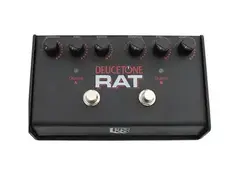
In 2002, ProCo released a 2-in-1 RAT pedal called the Deucetone. This pedal allowed you to have two completely separate RATs and activate them independently or stack them together. It also introduced two brand new sounds into the RAT topology: “Clean RAT” mode and “Dirty RAT.” Due to the popularity of the “Dirty RAT” mode, they released a single pedal called You Dirty RAT that featured that single setting in a standard sloped RAT enclosure. This circuit utilizes germanium diodes in the symmetrical hard clipping section of the circuit. This technique gives the most saturation and waveform clip-off of any version ever made.
In addition to the diode changes, this model has several different capacitor value changes resulting in a different distortion character and feel.
6. LA (1986)
In 1986, Ibanez released the 10 Series line of pedals that included three RAT style pedals. The Super Product and Fat Cat held the position of accurate and traditional RAT style pedals, while the quirkier LA Metal was, in my opinion, one of the best-modified RAT circuits of the eighties.
It includes a great input buffer, several key capacitor changes for frequency response, and no clipping diodes at all. The distortion is produced by overloading or “clipping the rails” of the op amp.
I don’t play LA Metal, and I’m guessing you don’t either, but I promise you will love this mode!
7. Landgraff MO’D (1999)
Between 1999-2000, a man named John Landgraff started building pedals by hand in Pensacola, FL. Each one painted with a unique swirl paint job and wired point to point; John’s pedals were and still are the true definition of boutique and gained a reputation for sounding amazing. His most popular pedal was the Landgraff Dynamic Overdrive, a take on the Ibanez Tube Screamer, but my favorite was his distortion pedal that he called the “MO’D,” a distant cousin of the RAT and a really fantastic pedal in its own right.
8. Caroline (2010)
A few years after starting JHS, I purchased a fascinating distortion pedal from a brand new company out of South Carolina. I remember jumping on the phone and geeking out with the designer and head of the company Philippe Herndon. We talked about the circuit, his love for RATs and his clever take on the circuit. That pedal was called the Wave Cannon and when I started the PackRat project, it was obvious that Philippe was the friend I should bring along for the ride.
9. JHS Mode
In 2003 I managed a tiny guitar shop in Northwest Alabama. One day a man walked in with a vintage Small Box RAT and said he wanted to sell it. When the shop’s owner said he wasn’t interested, I said I was. I bought that RAT for $15, and this is most likely the single event that led me down the pedal collecting rabbit hole. That pedal stayed on my board for a decade, and when I started modifying and building pedals in 2007, I opened it up, learned the circuit and modded it to reflect a different kind of sound. Parts of that modification became the now discontinued JHS All American and the long-running JHS PackRat modification that we performed on thousands of RAT pedals from 2008-2018. The JHS Mode lets me keep what makes the RAT unique and add in a few of my personal favorite mods.
Product specs
| Pedal Type | 9-mode Distortion, Overdrive, Fuzz |
| Analog/Digital | Analog |
| Inputs | 1 x 1/4" (instrument) |
| Outputs | 1 x 1/4" |
| True Bypass | Yes |
| Controls | Filter, Distortion |
| Power Source | 9V DC power supply (sold separately) |
| Power Usage | 100mA max |
| Height | 1.6" |
| Width | 2.6" |
| Depth | 4.8" |
FAQs
-
What are the different modes available on the JHS Packrat?
-
The JHS Packrat offers 9 distinct modes, allowing you to switch between various distortion, overdrive, and fuzz tones, emulating classic sounds like the Pro Co RAT and more.
-
Does the JHS Packrat work well with bass guitar?
-
Yes, the JHS Packrat is known for its versatility and can be effectively used with bass guitars, providing rich, full distortion without losing low-end clarity.
-
What power supply does the JHS Packrat require?
-
The JHS Packrat requires a 9V DC power supply, which is sold separately, and it has a power usage of 100mA max.
-
Is the JHS Packrat true bypass?
-
Yes, the JHS Packrat features true bypass switching, which ensures that your guitar's original tone remains unaltered when the pedal is not in use.
-
How does the JHS Packrat differ from the original Pro Co RAT?
-
The JHS Packrat expands on the original Pro Co RAT by offering 9 modes that replicate a variety of RAT-inspired tones, providing greater versatility and tonal options.
Videos

JHS Pedals
JHS PackRat: Every RAT Pedal You'll Ever Need!
JHS PackRat: Every RAT Pedal You'll Ever Need!
JHS Pedals

Can the RAT do all of these tones? (JHS PackRat)
JHS Pedals
The JHS PackRat vs. a Pack of Vintage Rats | Tone Report Demo

Reverb
JHS PackRat 9-way Analog Distortion Pedal Demo

Sweetwater
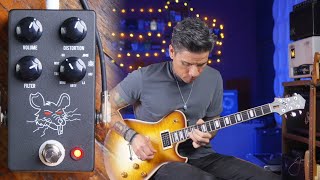
JHS PackRat Multi-Mode RAT distortion pedal

R.J. Ronquillo
JHS Pedals Packrat: A bunch of RATS 🐀

Living Room GD
JHS PackRat but also real rats

Emily Hopkins
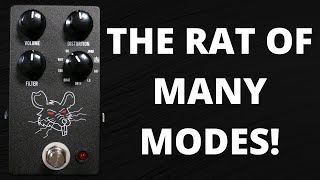
JHS Pedals PACKRAT "9 Mode" Distortion Pedal

Shawn Tubbs
JHS PackRat - Sound Demo (no talking)

Guitar Bonedo
JHS PackRat - An Honest Review and Demo

John Nathan Cordy
9 Modes of the JHS PackRat

JHS Fresh Clips
JHS PackRat Bass

Guitar Gear

JHS Pedals Pack Rat Demo by BuckNature

Empire Guitars
Reviews
PROS
-
Eliminates need for chaining multiple drive/distortion pedals
-
Offers a wide range of sound options and huge flexibility
-
Features multiple RAT circuit voicings for varied tones
-
Compatible and enhances other pedal setups (e.g., with Keeley Dark Side, Catalinbread Echorec)
-
High-quality sound that satisfies professional recording needs
-
Durable build quality, described as "built like a tank"
-
Versatile, from light drive to heavy distortion
-
Minimalist design with easy-to-use controls
-
Works well with different amps and guitar pickups
CONS
-
Higher price point compared to some other pedals
Owner Insights
We analyzed real musician discussions from forums and Reddit to find what players love, question, and tweak about JHS Packrat.
Features and functionality
Use cases and applications
User experience
-
Some users find that once they determine their preferred mode, they rarely change settings, reducing the perceived versatility advantage.
Source -
One user highlights its effectiveness on unconventional instruments, noting impressive results when used with synthesizers and drums.
Source -
A user who tried various RAT circuits found the Packrat offered the best overall sound and flexibility, describing it as the most premium option among their collection.
Source -
A few modes of the Packrat also perform well with bass guitars, expanding its versatility beyond standard guitar applications.
Source
Comparisons
-
Compared to ProCo's RAT2, the Packrat's higher price is justified by its multi-mode capabilities, but some prefer cheaper RAT clones like Joyo Splinter or Mosky King RAT.
Source -
Some users recommend the Donner Dark Mouse as a budget alternative with "classic" and Turbo modes, highlighting its affordability compared to the JHS Packrat.
Source -
The TC Electronic Magus Pro is noted for its compact form factor and top-mounted jacks, providing a cost-effective alternative with similar versatility.
Source -
The JHS Packrat is favored over mini-pedal formats like the Wampler Ratsbane due to its larger size and more diverse mode options.
Source
Mods and upgrades
-
Installing a 3-way clipping diode selector on a Pro Co RAT is highlighted as an easy mod for achieving greater versatility while keeping costs low.
Source
Critic Reviews
5.0 out of 5
Based on 0 Reviews and 2 Ratings
Artist usage
Add artist
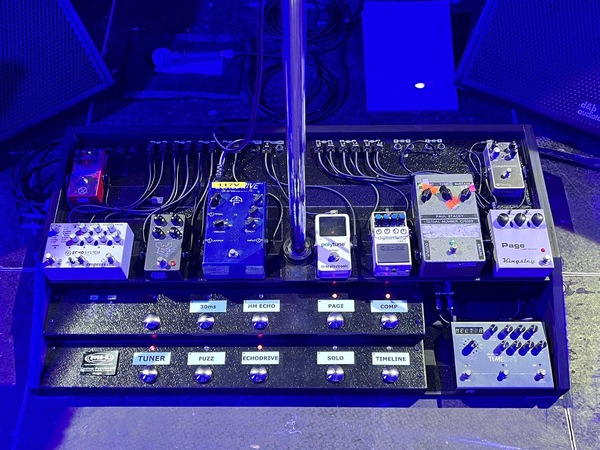
Noel Gallagher has been using the JHS Packrat since June 2023, labeled as "Fuzz" on the left-hand side of his pedalboard. This can be confirmed through various photos of his pedalboard, including a picture taken by Noel's photographer and friend Sharon Latham on her Instagram in June 2023 [https://www.instagram.com/p/CtWhKQeLs_9/?igsh=NzdwdGFqNDFlaDh5], and a post by Mike Hill Services on Facebook in November 2023, who constructed Noel's new pedalboard [https://images.app.goo.gl/CDsbtHX1mMA59shz9].

Mentioned in this February 11, 2023 video (filmed December 7, 2022) at 10:53.
Rob Scallon: I have your Rat pedal that you made.
Joshua Heath Scott: Packrat?
Scallon: The Packrat, yeah, I have the Packrat at home.

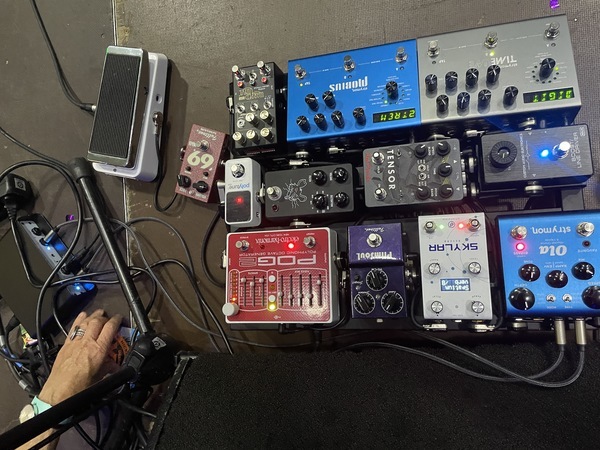
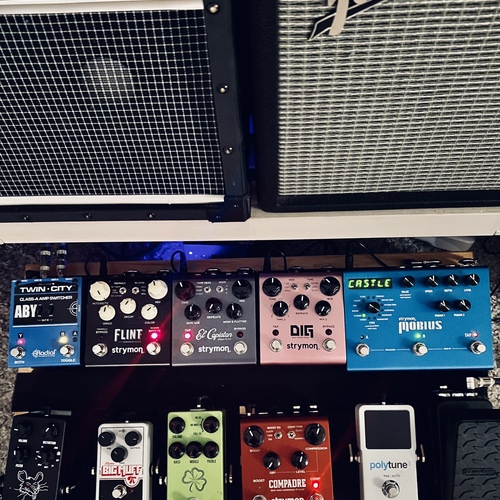
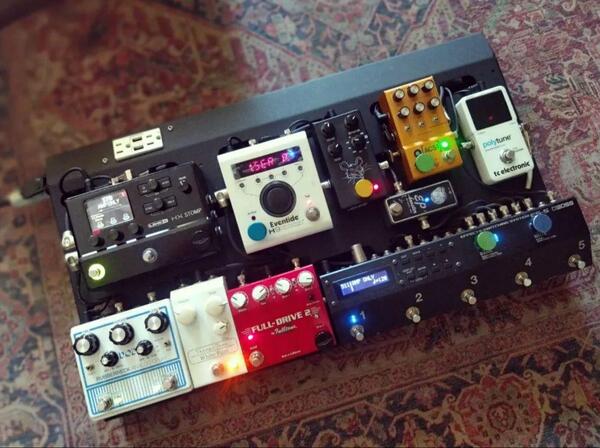
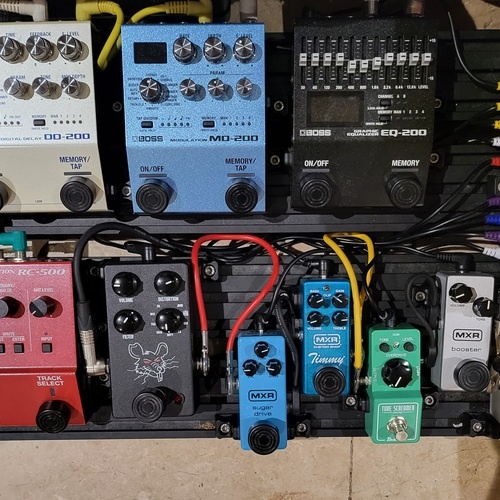
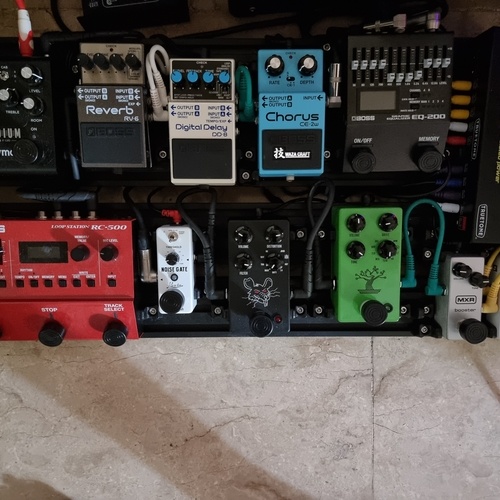
Can be seen at third pedal from the left in the middle of the pedalboard.

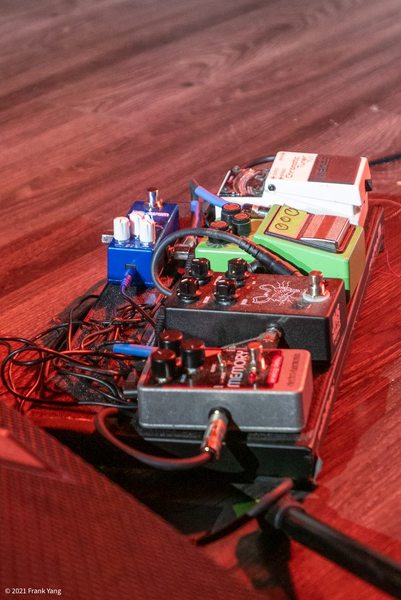
On this live picture from 2021, Mac McCaughan is using a JHS PackRat.


In a "Rig Rundown" interview with Premier Guitar, conducted by Chris Kies, Zach Person stated that the JHS Packrat is central to his sound, with settings dialed in to be fairly heavy and dirty.


In 34:20 you can see that pedal . They both often use Rat-style effects with their baritone guitars according to this interview .

Genre Usage
Based on how artists on Equipboard use this gear, it is most commonly found in the following genres.
Used With
Based on how musicians on Equipboard use JHS Packrat, it is most commonly used with the following gear.



Community setups
Show yours


Similar
Add recommendation20 alternative and related items for JHS Packrat, curated by the Equipboard community.
-m.webp?v=1784991616)
$139.00 - $159.99
With more gain, high end, and less midrange than the standard Rat, the Turbo is a featured mode on the JHS Packrat.

$34.80

$705.72
A reissue version of the classic Whiteface RAT, which is featured as a setting on the Packrat.

-m.webp?v=1784991572)
$66.24

$249.00
A Rat derived circuit, the Caroline Wave Cannon is featured as a mode on the JHS Packrat.
More JHS Distortion Effects Pedals

$195.00 - $199.00
in Distortion Effects Pedals Rank


$248.00 - $249.00
in Distortion Effects Pedals Rank


$159.20 - $239.00


$92.73 - $109.00




-m.webp?v=1785018971)
$79.00 - $88.95
in Distortion Effects Pedals Rank


$77.00 - $109.99
in Distortion Effects Pedals Rank


$139.00 - $159.99
in Distortion Effects Pedals Rank


-m.webp?v=1784991528)
$219.00 - $258.00
in Distortion Effects Pedals Rank


-m.webp?v=1784991673)
$106.00
in Distortion Effects Pedals Rank


$129.00 - $152.00
in Distortion Effects Pedals Rank


.jpg?v=1784940345)

$207.90 - $275.91
in Distortion Effects Pedals Rank


$41.00 - $62.90
in Distortion Effects Pedals Rank


$74.07
in Distortion Effects Pedals Rank


-m.webp?v=1785019352)
$90.00 - $99.99
in Distortion Effects Pedals Rank


$214.05 - $249.00
in Distortion Effects Pedals Rank


$329.00
in Distortion Effects Pedals Rank


$96.38 - $119.00
in Distortion Effects Pedals Rank


$99.00 - $139.99
in Distortion Effects Pedals Rank


$54.99 - $73.00
in Distortion Effects Pedals Rank


$95.80 - $125.99
in Distortion Effects Pedals Rank


$93.60 - $120.99
in Distortion Effects Pedals Rank


$122.00 - $199.99
in Distortion Effects Pedals Rank

$88.00 - $1,050.00
in Distortion Effects Pedals Rank


$200.00 - $249.00
in Distortion Effects Pedals Rank


-m.webp?v=1785020950)
$145.00 - $199.99
in Distortion Effects Pedals Rank


$89.10 - $125.99
in Distortion Effects Pedals Rank


Accessories & Related Items




Gear Guides
.jpg)





.webp)
.jpg)
Most Popular Distortion Effects Pedals
Most Popular Brands
-
Added to Equipboard on by
 ro5
ro5GearIQ 3579
-


