

Pricing and availability
We compare 600+ stores and found this item at 1 store. Prices updated .
Store
Reviews
Price




Average Price: $4,200
High-end/Boutique
$500
$1501+
Price Tier
Budget
Standard
High-end
* Product prices and availability are updated by Equipboard every 24hrs and are subject to change. Equipboard may receive compensation for purchases made at participating retailers linked on this site. This compensation does not affect what products or prices are displayed, or the order of prices listed. For more information, please refer to our affiliate disclosure.
Description
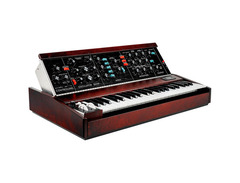
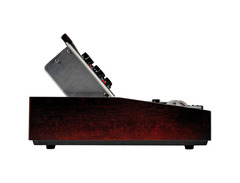
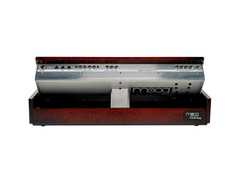
Step back into the golden age of analog synthesis with the Moog 1970s Minimoog, a vintage masterpiece that continues to captivate musicians and producers around the globe. Celebrated for its iconic sound and user-friendly interface, this legendary monophonic synthesizer stands as a testament to Moog's innovative spirit. The Minimoog was revolutionary for being one of the first non-modular synthesizers, making complex sound design accessible to the masses without needing an engineering degree.
Inside its robust casing, you'll find three unique oscillators, each capable of generating rich, warm tones that define the classic analog sound. These oscillators can be creatively manipulated, with one doubling as an LFO, allowing for a wide range of sonic possibilities. The intuitive layout invites both seasoned synthesists and newcomers to explore the depths of its sound-shaping capabilities with ease. From the studio to the stage, the Moog 1970s Minimoog remains a trusted companion for those seeking authentic analog warmth and presence.
Whether you're looking to recreate the distinctive sounds of the past or forge new musical paths, the Moog 1970s Minimoog offers an unparalleled synthesis experience.
Key Features:
- Iconic monophonic analog synthesizer from the 1970s
- Three original oscillators for rich sound generation
- One oscillator can be used as a Low-Frequency Oscillator (LFO)
- User-friendly, non-modular design for easy sound creation
- Robust build quality with timeless appeal
- Perfect for both live performances and studio recordings
Product specs
| Brand | Moog |
| Model | Minimoog Model D 44-Key Monophonic Synthesizer |
| Finish | Black / Wood |
| Year | 1971 - 1982 |
| Made In | United States |
| Categories | Analog Synths, Keyboard Synths |
| Analog / Digital | Analog |
| Key Size | Full Size |
| Keyboard Action | Synth Action |
| Number of Keys | 44 Keys |
| Polyphony | 1 Voice |
FAQs
-
What type of synthesis does the Moog 1970s Minimoog use?
-
The Moog 1970s Minimoog is an analog synthesizer, known for its rich, warm sound and classic analog synthesis capabilities.
-
Is the Moog 1970s Minimoog polyphonic or monophonic?
-
The Moog 1970s Minimoog is a monophonic synthesizer, meaning it can only play one note at a time, which is ideal for lead and bass sounds.
-
How many keys does the Moog 1970s Minimoog have?
-
The Moog 1970s Minimoog features a 44-key keyboard with full-size keys and a synth action feel.
-
What is the primary use of the Moog 1970s Minimoog?
-
The Moog 1970s Minimoog is primarily used for creating rich analog sounds, making it a favorite among musicians for lead lines, basses, and classic synth textures.
-
Does the Moog 1970s Minimoog come with any accessories?
-
Yes, the Moog 1970s Minimoog typically includes a power supply, user's manual, registration card, product catalog, poster newspaper, ATA road case, dust cover, and SR case.
Videos

analoghell
Dr Bob Moog demonstrates the Minimoog

Dr Bob Moog demonstrates the Minimoog
analoghell
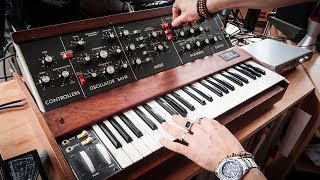
My Incredible 1972 Minimoog In Action

Doctor Mix
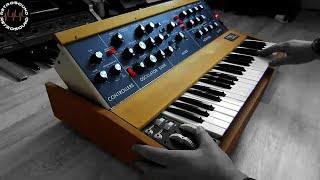
MOOG MINIMOOG Analog Synthesizer (1970) *Number One*

RetroSound
Reviews
PROS
-
Iconic sound with rich, creamy tones and exceptional warmth
-
Unique three-oscillator design allows for complex sound textures
-
Highly responsive interface with a dedicated knob or switch for every control
-
Strong analog character with organic drift for live, evolving sound
-
Powerful filter offering smooth transitions and distinctive resonance
-
Versatile sonic range from bass to lead, strings, and beyond
-
Compatible with MIDI and sequencers like Doepfer Darktime
-
Vintage appeal with a legendary status among synth enthusiasts
CONS
-
Original oscillator boards may lack tuning stability, especially in older models
-
Limited modulation options compared to other vintage Moogs
-
Higher cost often due to brand name rather than features
-
Requires periodic servicing, particularly for keyboard contacts and bushings
-
Loses keytracking of filter when using MIDI
Owner Insights
We analyzed real musician discussions from forums and Reddit to find what players love, question, and tweak about Moog 1970s Minimoog.
Build quality
Comparisons
-
Users note Behringer Poly D and Model D lack the richness and tactile satisfaction of the original Minimoog Model D.
Source -
The reissue is perceived as retaining most of the original Minimoog's components, but new components don't replicate the exact sound of a 40-year-old unit.
Source -
The Grandmother offers PWM and a dedicated LFO that can act as a VCO, providing superior modulation options compared to the Minimoog.
Source
Features and functionality
-
The Model D's large knobs provide smooth resistance, offering a tactile advantage over MIDI controllers with coarser resolutions.
Source -
Modern Minimoogs use similar components to the 1970s versions, but differences in packaging, such as SMD packages, are present.
Source -
The Minimoog's through-hole construction is favored for easier repairs over surface-mount technology used in other synths.
Source -
The Minimoog provides more waveform options and three VCOs with a full waveform complement, enhancing its sound flexibility.
Source -
The Grandmother includes a sequencer and arpeggiator, which are absent on the Minimoog, catering to users who value these features.
Source
Value and pricing
User experience
-
Owners emphasize the unique sound quality of the Minimoog, highlighting its capacity to fill a room with rich, resonant tones unmatched by digital emulations.
Source -
Despite efforts to replicate the 70s sound, some synth enthusiasts feel subtle differences exist between reissues and originals.
Source -
The Grandmother's gain staging offers unique growl and overtones, distinguishing it tonally from other Moog synthesizers like the Matriarch.
Source
Based on 0 Reviews and 0 Ratings
Artist usage
Add artist
Genre Usage
Based on how artists on Equipboard use this gear, it is most commonly found in the following genres.
More Moog Synthesizers

$999.00 - $1,084.00
in Synthesizers Rank


-m.webp?v=1784559463)
$1,100.00
in Synthesizers Rank


$1,487.02 - $1,899.00
in Synthesizers Rank


-m.webp?v=1784612211)
$1,790.00 - $1,899.00
in Synthesizers Rank


$3,999.00 - $4,999.00
in Synthesizers Rank


$350.00
in Synthesizers Rank


$6,600.00 - $10,444.00
in Synthesizers Rank


$52.00 - $781.08
in Synthesizers Rank


-m.webp?v=1784612464)
$348.50 - $399.00
in Synthesizers Rank


$800.00
in Synthesizers Rank


$8,900.00
in Synthesizers Rank


$452.90
in Synthesizers Rank


$555.00 - $656.00
in Synthesizers Rank


-m.webp?v=1784459038)


$9,999.00
-m.webp?v=1784473012)


$12,999.00


-m.webp?v=1784333332)


$964.00


.jpeg?v=1784602819)


$9,999.00


$1,650.00


$1,438.99 - $1,899.00


$3,999.00 - $5,199.00


Accessories & Related Items
-s.webp?v=1784546875)




-s.webp?v=1784556053)


Community setups


Similar


Gear Guides








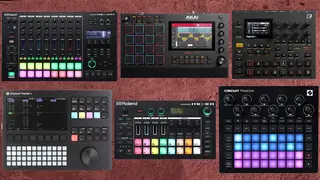

Most Popular Synthesizers
Most Popular Brands
-
Added to Equipboard on by
 etienne_j_stuart
GearIQ 136
-


