

Pricing and availability
We compare 600+ stores and found this item at 9 stores. Prices updated .
Store
Reviews
Price








Average Price: $3,229
High-end/Boutique
$500
$1501+
Price Tier
Budget
Standard
High-end
Price History
Based on price data from 7 merchants for "Moog Muse". Prices shown reflect NEW condition. Tracking began Apr 2, 2026.
* Product prices and availability are updated by Equipboard every 24hrs and are subject to change. Equipboard may receive compensation for purchases made at participating retailers linked on this site. This compensation does not affect what products or prices are displayed, or the order of prices listed. For more information, please refer to our affiliate disclosure.
Description
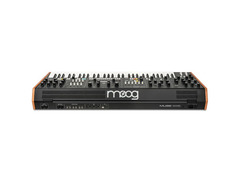
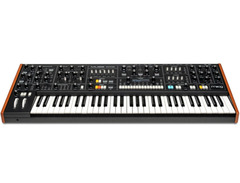
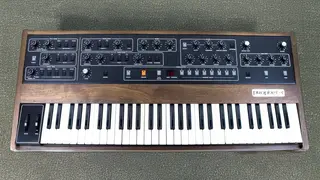
The Moog Muse synthesizer is a harmonious blend of Moog's storied legacy and modern innovation, designed to cater to both the adventurous studio producer and the dynamic stage performer. This eight-voice analog polysynth offers a robust platform for exploring and expressing your musical creativity. With its user-friendly knob-per-function interface, the Muse allows for intuitive sound shaping through its analog oscillators, filters, and amplifiers, complemented by a set of digital effects for added versatility.
At its core, the Muse boasts two voltage-controlled oscillators, each offering selectable waveforms, and a dedicated modulation oscillator to enhance your sound palette. The inclusion of an analog noise generator and a ring modulator further expands your creative possibilities. The Muse's sequencer is a playground for musical arrangement, featuring up to 64 steps with sophisticated editing capabilities.
The Muse's design is not only about sound but also about user experience. Its 61 full-size, semi-weighted keys with velocity and aftertouch make it an expressive tool for both live performances and studio sessions. The innovative Moog Diffusion Delay signal processor provides lush, spatial effects, adding depth to your soundscapes. With connectivity options that include MIDI and CV, the Muse integrates seamlessly into any setup.
Whether you're crafting vintage Moog tones or exploring new sonic territories, the Moog Muse offers a comprehensive and inspiring platform for sound exploration.
Key Features:
- Eight-voice bitimbral analog synthesizer
- 61 full-size semi-weighted keys with velocity and aftertouch
- Knob-per-function interface for intuitive control
- Dual voltage-controlled oscillators with selectable waveforms
- Analog noise generator and ring modulator
- Built-in Moog Diffusion Delay for spatial effects
- Advanced sequencer with 64 steps and parameter recording
- Dual filters with selectable low-pass and high-pass modes
- Rich modulation capabilities with LFOs and modulation oscillator
- Comprehensive connectivity including MIDI and CV input/output
- 256 preset slots with factory patches and user storage options
Owner's manual
Moog Muse User ManualProduct specs
| Type | Bi-timbral Synthesizer |
| Analog/Digital | Analog |
| Number of Keys | 61 |
| Type of Keys | Full-size, Weighted |
| Aftertouch | Yes |
| Velocity Sensitive | Yes |
| Other Controllers | Pitch Wheel, Mod wheel, Macro Knob, Octave Switch, Hold Switch, 44 x Knobs, 16 x Sliders, 129 x Buttons |
| Polyphony | 8-voice |
| Oscillators | 2 x Analog VCO (triangle, sawtooth) |
| Waveforms | Sine, Sawtooth, Reverse Sawtooth, Square, Noise |
| LFO | 2 x LFO, Pitch LFO |
| Filter | 2 x Moog Transistor Ladder Filters |
| Envelope Generator | 2 x ADSR |
| Arpeggiator | Yes, Pre-timbre |
| Sequencer | 64-step, 16 Banks of 16 Sequences |
| Audio Outputs | 2 x 1/4" TRS (left, right) |
| Headphones | 1 x 1/4" TRS |
| USB | 1 x Type B, 1 x Type A |
| MIDI I/O | In/Out/Thru/USB |
| Pedal Inputs | 1 x 1/4" TRS (sustain), 1 x 1/4" TRS (expression) |
| Other I/O | 2 x 1/8" TS (clock in, out), 4 x 1/8" TS CV (in, out) |
| Mod Matrix | 16-slot (per timbre per patch) |
| Features | OLED Display |
| Power Source | Standard IEC AC Input |
FAQs
-
Is the Moog Muse fully analog?
-
Yes, the Moog Muse features a fully analog signal path with analog oscillators, filters, and VCA, while incorporating digital elements like envelopes and LFOs for enhanced functionality.
-
How many voices of polyphony does the Moog Muse support?
-
The Moog Muse supports 8-voice polyphony, allowing you to play complex chords and layered sounds with rich, analog textures.
-
What type of keys does the Moog Muse have?
-
The Moog Muse is equipped with 61 full-size, weighted keys that are both velocity-sensitive and feature aftertouch, providing a dynamic and expressive playing experience.
-
Does the Moog Muse include an arpeggiator and sequencer?
-
Yes, the Moog Muse includes a pre-timbre arpeggiator and a 64-step sequencer with 16 banks of 16 sequences, offering extensive creative possibilities for live performance and studio work.
-
What are the main connectivity options for the Moog Muse?
-
The Moog Muse offers multiple connectivity options, including MIDI In/Out/Thru, USB, audio outputs, and pedal inputs, ensuring seamless integration with other gear and DAWs.
-
What kind of filters does the Moog Muse use?
-
The Moog Muse utilizes two Moog Transistor Ladder Filters, known for their warm and classic analog sound, perfect for crafting rich and dynamic sonic textures.
Videos

Doctor Mix
The Incredible Moog Muse Synthesizer: Unboxing And Jam
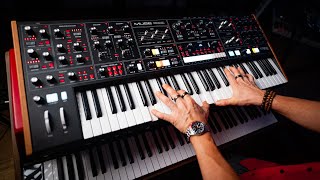
The Incredible Moog Muse Synthesizer: Unboxing And Jam
Doctor Mix
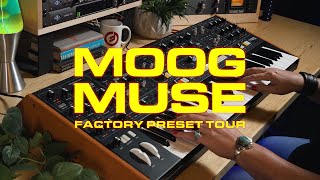
Moog Muse | Factory Preset Tour | All Sounds, No Talking

Moog Music

Moog Muse vs Arturia Polybrute 12 - Which synth WINS?

Sanjay C
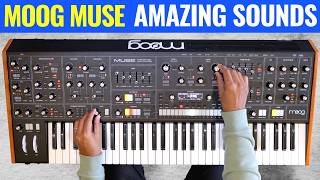
Moog Muse Full Sound Tour 🚀 No Talking!
Sanjay C
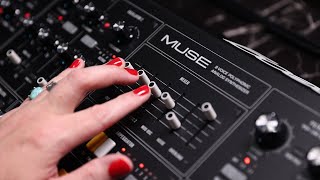
NEW Moog Muse Synthesizer | Demo and Overview with Lisa Bella Donna

Guitar Center
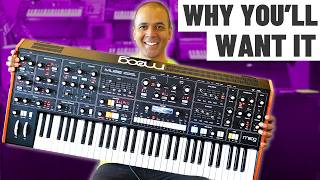
Amazing Moog Muse 😮 Full Review, Features, Sounds
Sanjay C

Moog Muse | Overview & Sound Design | Thomann

Thomann Synthesizers
Reviews
PROS
-
Unique bi-timbral capability for versatile sound design
-
Intuitive controls for seamless creative flow
-
Beautiful classic Moog sound with a modern twist
-
Sequencer and patch storage enhance live performance possibilities
-
Warm, colorful onboard delay and diffusion effects
-
Inspires creativity across multiple electronic music styles
-
Well-constructed with reliable build quality
-
Attractive design and aesthetics
-
Priced competitively for a polyphonic Moog
-
Responsive and dynamic playability
CONS
-
Limited memory with only 256 patch slots
-
Some factory presets lack quality
-
Reports of inconsistent note timing in unison mode
-
Arpeggiator delay affects synchronization with other equipment
-
Firmware requires updates to address tuning and other issues
-
Smaller screen necessitates extensive menu navigation
-
Some users experience artificial sound quality
-
Wobbly knobs and peeling overlay reported by some users
-
Initial batches had quality control issues
Owner Insights
We analyzed real musician discussions from forums and Reddit to find what players love, question, and tweak about Moog Muse.
Features and functionality
-
The Muse's probability and scale-based sequencer functions are highlighted as unique features, not commonly found in other polysynths.
Source -
Users note that the Muse's FM capabilities are limited due to tuning inaccuracies across voices, which affects its usability for precise sound design.
Source -
The Muse includes dual resonant filters with independent controls, a rare feature among analog polysynths.
Source -
The Muse features a unique feedback circuit that loops post-filter sound back into the pre-filter, enhancing harmonic exploration.
Source
Setup and maintenance
-
Owners have reported inconsistent waveform shapes, suggesting underlying design or production issues, with some seeing variations even within low octaves.
Source -
Initial firmware has some bugs, notably with patch effects causing freeze-ups, suggesting potential future updates for improvements.
Source
Comparisons
-
The Muse's raw waveforms differ significantly from the Voyager's, with users noting a thinner, less powerful sound, contrasting with Moog's typical "fat" identity.
Source -
The Novation Summit is often mentioned as a strong alternative due to its rewarding and immediate programming experience, despite not having a sequencer.
Source -
Unlike the Prophet series, the Muse emphasizes hands-on control with nearly a knob-per-function design, minimizing menu diving.
Source
User experience
Software and compatibility
-
The Muse's firmware has unresolved bugs, such as a problematic aftertouch curve, and updates have been slow to address these issues.
Source
Build quality
-
Many owners report that the Muse's tuning is fragile and requires frequent calibration, which can be time-consuming and indicates potential quality control issues.
Source -
Owners have reported the Muse's potentiometers with metal casing provide better dust protection compared to plastic-sealed ones on older Moog models, improving longevity in humid climates.
Source -
Some users have reported issues with panel overlay bubbling, possibly due to heat, though most have not experienced this personally.
Source
Other
-
Some users have noted that Moog's support is commendable, often providing free replacement parts under warranty for issues like faulty potentiometers.
Source
Use cases and applications
Critic Reviews
4.0 out of 5
Based on 0 Reviews and 1 Rating
Artist usage
Add artist

The Real Mike Dean uses the Moog Muse, as evidenced by his Instagram post where he is seen using it while recording the track "Beat It" by Future and Metro Boomin. The post is captioned: "@metroboomin @future that new synth u all been waiting on on its 1st album."

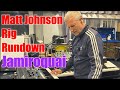
In the video titled "Matt Johnson Jamiroquai Rig Rundown" on the YouTube channel Matt Johnson’s Keyspace, at the timestamp 0:42, Matt Johnson is seen displaying a Moog Muse 8-Voice Polyphonic Analog Synthesizer as part of his studio setup.
It's a big sounding synth. It's great. It's It's a lot of fun.
Genre Usage
Based on how artists on Equipboard use this gear, it is most commonly found in the following genres.
Used With
Based on how musicians on Equipboard use Moog Muse, it is most commonly used with the following gear.




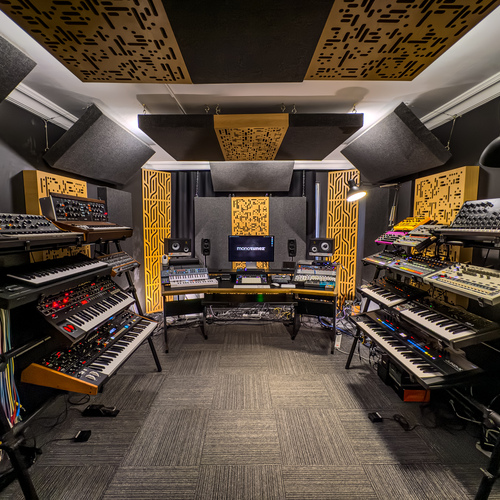
Community setups
Show yours

More Moog Synthesizers

$999.00 - $1,084.00
in Synthesizers Rank


-m.webp?v=1784818786)
$1,100.00
in Synthesizers Rank


$1,479.42 - $1,899.00
in Synthesizers Rank


-m.webp?v=1784871398)
$1,790.00 - $1,899.00
in Synthesizers Rank


$3,999.00 - $4,999.00
in Synthesizers Rank


$350.00
in Synthesizers Rank


$6,600.00 - $10,444.00
in Synthesizers Rank


$52.00 - $750.00
in Synthesizers Rank


-m.webp?v=1784892155)
$348.50 - $399.00
in Synthesizers Rank


$800.00
in Synthesizers Rank


$8,900.00
in Synthesizers Rank


$500.00
in Synthesizers Rank


$555.00 - $656.00
in Synthesizers Rank


-m.webp?v=1784804654)


$9,999.00
-m.webp?v=1784818679)


$12,999.00


-m.webp?v=1784333332)


$965.00


.jpeg?v=1784860561)


$9,999.00


$1,650.00


$1,438.99 - $1,899.00


$3,999.00 - $5,199.00


Accessories & Related Items


-s.webp?v=1784818904)


-s.webp?v=1784871488)

-s.webp?v=1784872221)


Similar


Gear Guides






.webp)

Most Popular Synthesizers
Most Popular Brands
-
Added to Equipboard on by
 pawnuskrels
GearIQ 541
-


