

Pricing and availability
We compare 600+ stores and found this item at 6 stores. Prices updated .
Store
Reviews
Price






Average Price: $745
High-end/Boutique
$150
$501+
Price Tier
Budget
Standard
High-end
Price History
Based on price data from 4 merchants for "RME HDSPe RayDat PCI-Express Sound Card". Prices shown reflect NEW condition. Tracking began Apr 2, 2026.
* Product prices and availability are updated by Equipboard every 24hrs and are subject to change. Equipboard may receive compensation for purchases made at participating retailers linked on this site. This compensation does not affect what products or prices are displayed, or the order of prices listed. For more information, please refer to our affiliate disclosure.
Description
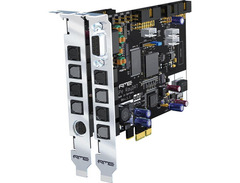
For musicians and audio professionals seeking the pinnacle of performance and flexibility, the RME HDSPe RayDat PCI-Express Sound Card is a game-changer. This multi-channel, multi-format audio interface is crafted to meet the demands of high-end recording, mixing, and mastering. With a robust architecture, it seamlessly integrates RME's SteadyClock technology, ensuring impeccable jitter suppression and precise audio synchronization. Dive into the world of pristine digital audio with its comprehensive connectivity options, including 4 x ADAT optical I/O, SPDIF, and AES/EBU interfaces, allowing for simultaneous use of SPDIF (RCA) and AES/EBU (XLR) channels.
The HDSPe RayDat's TotalMix, a powerful DSP-based real-time mixer, offers unmatched control over your audio environment with hardware-computed level meters and full MIDI remote controllability. Whether you're working in a home studio or a professional setting, this card's Native PCI Express core ensures speedy and reliable data transfer, leveraging the latest in serial bus technology. Plus, with RME's future-proof Secure Flash Option, the RayDat is ready to adapt to future hardware and software updates.
Ideal for both Windows and Mac users, the HDSPe RayDat supports a wide range of drivers, making it versatile and compatible with various setups. Experience ultra-low latency and extreme precision with the ability to operate up to 36 inputs and outputs simultaneously, each channel delivering 24-bit/192 kHz audio quality.
Key Features:
- 36 Inputs / 36 Outputs
- 4 x ADAT I/O, supporting up to 192 kHz via S/MUX4
- 1 x AES/EBU I/O and 1 x SPDIF I/O, both 192 kHz-capable
- 2 x MIDI I/O with high-speed MIDI via breakout cable
- TotalMix DSP-based mixer with 42-bit internal resolution
- SteadyClock technology for jitter suppression
- Secure Flash Option for firmware updates
- Compatible with Windows and Mac systems
Owner's manual
RME HDSPe RayDat PCI-Express Sound Card User ManualProduct specs
| Available since | May 2008 |
| Converter | 24 bit/192 kHz |
| Microphone Inputs | 0 |
| Phantom power | No |
| Number of instrument inputs | 0 |
| Line Inputs | 0 |
| Digital Inputs | ADAT, AES, S/PDIF |
| MIDI interface | Yes |
| SYNC | Yes |
| Analogue Outputs | 0 |
| Digital Outputs | ADAT, AES, S/PDIF |
| Headphone jack | No |
| Zero latency monitoring | Yes |
FAQs
-
What digital input and output options does the RME HDSPe RayDat provide?
-
The RME HDSPe RayDat offers digital inputs and outputs via ADAT, AES, and S/PDIF, making it versatile for various digital audio setups.
-
Does the RME HDSPe RayDat support zero latency monitoring?
-
Yes, the RME HDSPe RayDat supports zero latency monitoring, allowing for real-time audio processing without delay.
-
Can the RME HDSPe RayDat be used with MIDI devices?
-
Yes, the RME HDSPe RayDat includes a MIDI interface, enabling connectivity with MIDI devices for comprehensive studio integration.
-
Is the RME HDSPe RayDat compatible with analog audio inputs or outputs?
-
No, the RME HDSPe RayDat does not support analog audio inputs or outputs; it is designed for digital connectivity only.
-
What is the maximum audio resolution supported by the RME HDSPe RayDat?
-
The RME HDSPe RayDat supports a maximum audio resolution of 24-bit/192 kHz, ensuring high-quality digital audio performance.
Videos

Adam Steel
Upgrading from Firewire audio to the good stuff - PCIe! RME RAYDAT - HOW TO ROCK

Upgrading from Firewire audio to the good stuff - PCIe! RME RAYDAT - HOW TO ROCK
Adam Steel

RME Raydat - update and FAQ
Adam Steel

RME HDSPe RayDAT

DV247 Music Store UK TV
Reviews
PROS
-
Significantly reduces response time, allows lower sample rates
-
Supports high channel counts: 30 input channels, 14 outputs
-
Exceptionally low RT latency achievable (as low as 2.1 ms)
-
Stable drivers, compatible with major DAWs including Cubase
-
High-quality converters provide excellent sound quality
-
Flexible routing options with TotalMix software
-
Solid build quality and reliable performance in live settings
-
Excellent Linux support, stable across different systems
-
Offers flawless RME drivers, minimizing noise compared to USB/Firewire
-
Supports extensive ADAT expansion without dropouts
CONS
-
Can be challenging to clock to internal with some setups
-
Sound may be perceived as altered or "colored" compared to other interfaces
-
Lacks built-in DSP effects like reverb, compression, and EQ
-
Initial setup and monitoring/routing page can be confusing
-
MIDI connector may require additional securing in mobile setups
-
Expensive given its primary function as an ADAT interface
Owner Insights
We analyzed real musician discussions from forums and Reddit to find what players love, question, and tweak about RME HDSPe RayDat PCI-Express Sound Card.
Comparisons
-
The RME HDSPe RayDat offers more digital I/O compared to the Focusrite Clarett, though it lacks analog inputs.
Source -
Users interested in extensive channel access on Linux without proprietary drivers may find the HDSPe RayDat a viable option compared to discontinued models like the Madiface Pro.
Source
Software and compatibility
-
RME's TotalMIX software is highly praised for its stability and ease of use, often considered superior in the market.
Source -
The HDSPe RayDat can run smoothly on Linux using pipewire and JACK without needing additional configuration software, unlike some other RME cards.
Source -
While the HDSPe RayDat lacks built-in DSP effects support on Linux, routing through JACK offers powerful alternatives for digital audio processing.
Source
User experience
Features and functionality
Use cases and applications
-
The RayDat is particularly suited for users needing extensive digital routing without analog input needs, beneficial for pure digital setups.
Source -
The card is ideal for users who prioritize digital routing over built-in DSP effects, especially in environments where Linux is the preferred OS.
Source
Critic Reviews
5.0 out of 5
Based on 2 Reviews and 2 Ratings
.jpg?v=1765829754)
Flawless
I've used USB and Firewire systems before. Once I upgraded to an ADAT optical system, I became aware how much noise the other systems were generating. The RayDat system has proven to be very flexible in terms of routing, has the flawless RME drivers, and has not caused a single issue in 3-4 years of daily use. Highly recommended


768
SUPER CARD SUPER ADAT PORTS
Con esta tarjeta de sonido, se adquieren los beneficios de trabajar con 32 canales de salida y 32 canales de thomann entrada via ADAT, que junto con un convertidor como AURORA LYNX lo vuelven la herramienta perfecta para poder mezclar tu equipo externo.
Artist usage
Add artist

Genre Usage
Based on how artists on Equipboard use this gear, it is most commonly found in the following genres.
Used With
Based on how musicians on Equipboard use RME HDSPe RayDat PCI-Express Sound Card, it is most commonly used with the following gear.


More RME Audio Interfaces

$749.00 - $999.00
in Audio Interfaces Rank

.png?v=1784921366)


$699.00 - $1,899.00
in Audio Interfaces Rank


$350.00
in Audio Interfaces Rank


$899.99
in Audio Interfaces Rank


$237.54
in Audio Interfaces Rank


$550.00 - $929.98
in Audio Interfaces Rank


$698.00 - $999.00
in Audio Interfaces Rank


$138.00 - $179.00
in Audio Interfaces Rank


$1,336.16 - $2,299.00
in Audio Interfaces Rank


$104.00 - $1,999.00


$1,859.00 - $2,799.00


$2,298.00 - $3,199.00


$1,154.00 - $1,699.00


$2,185.00 - $3,199.00


$1,507.00 - $2,299.00


$834.49 - $1,799.00


$1,535.00 - $2,299.00

$3,333.00 - $4,599.00


$1,050.00 - $5,099.00
.png?v=1784755332)


$1,859.00 - $2,999.00

Accessories & Related Items


Community setups


Similar


Gear Guides






.webp)
Most Popular Audio Interfaces
Most Popular Brands
-
Added to Equipboard on by
 cloudcitydisco
GearIQ 99
-


