
Pricing and availability
We compare 600+ stores and found this item at 4 stores. Prices updated .
Store
Reviews
Price




Average Price: $2,599
High-end/Boutique
$150
$501+
Price Tier
Budget
Standard
High-end
* Product prices and availability are updated by Equipboard every 24hrs and are subject to change. Equipboard may receive compensation for purchases made at participating retailers linked on this site. This compensation does not affect what products or prices are displayed, or the order of prices listed. For more information, please refer to our affiliate disclosure.
Description
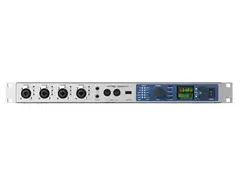
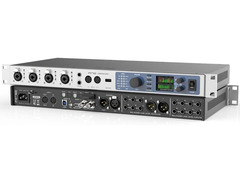
20th Anniversary Flagship Interface The Fireface UFX+ becomes the center of any multitrack studio because it is able to handle up to 94 channels I/O with ease. With unprecedented flexibility, compatibility, the inclusion of DURec (Direct USB Recording) and RME’s famous low latency hardware and driver designs, the Fireface UFX+ raises the bar to new heights.
Packed with features not found on its older sibling, including MADI I/O (188 channels of I/O, 128 channels more than the Fireface UFX), a more powerful DSP, USB 3.0, Thunderbolt™ technology, and a new optional remote control firmly places the RME Fireface UFX+ as the new reference in multitrack recording, mixing and monitoring.
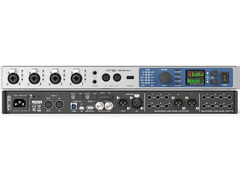
You name it, you connect it Its flexibility in connectivity and expansion is unrivalled – Analog, ADAT, MADI, AES, SPDIF. USB 2, USB 3 and Thunderbolt technology are standard on the Fireface UFX+. The UFX+ has an impressive channel count: 12 analog + 16 ADAT + 2 AES + 64 MADI = 94 channels input plus output = 188 channels in total. Thunderbolt technology gives the Fireface UFX+ real PCI Express audio performance under Mac and Windows, with lowest latency, lowest system overhead and lowest CPU load. The Fireface UFX+ is fully Thunderbolt technology compatible under Windows, including hot-plugging.
All new AD/DA converters, optimized analog I/O circuits, as well as improved SNR and THD values guarantee pristine, crystal clear and transparent audio. A new PAD-free mic circuit design with +18 dBu maximum input level and 75 dB gain range serves even the most critical recording situation and source trouble-free.
New low impedance Hi-Power phones outputs (2 Ohms) with +19 dBu maximum output level provide ample output power as well as volume on any phones, high or low impedance.
ehensive MADI Connectivity The Fireface UFX+ opens the doors to a host of RME and 3rd party digital and analog I/O solutions. Expanding your analog channel count, the ability to route/mix within the digital domain through numerous sources presents many flexible options. Multiple external MADI devices can also be connected in series.
To further enhance MADI flexibility, the Fireface UFX+ boasts some typical RME-style features. For example in USB 2 mode, which is limited to 30 channels I/O (12 analog plus 16 ADAT plus AES), the MADI I/O is still available via RME’s integrated hardware mixer TotalMix FX. Word Clock I/O (BNC) can be switched to MADI I/O (coaxial), and a special split mode even supports the use of both MADI I/Os simultaneously, with 32 channel each on optical and coaxial.
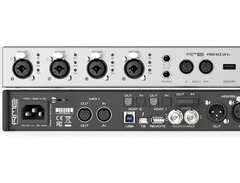
Improved DURec (Direct USB Recording) DURec, which is available on the front of the Fireface UFX+, now offers second generation hardware with improved USB functionality and compatibility, providing greater reliability even with slower or multi-partitioned USB thumb drives.
The maximum number of recordable channels has been raised to 76, meaning all 12 analog inputs plus 64 MADI channels can be recorded simultaneously. An internal Realtime Clock (RTC) delivers time-stamped files, and playback now includes several advanced player functions previously unavailable.
ARC USB Remote Control - Plug’n Play Plus The ARC USB connects to your computer via USB, and talks to TotalMix FX directly. It has 15 freely assignable and illuminated buttons, one encoder wheel, and a TS jack to connect a foot switch.
The ARC USB is a USB 1.1 MIDI remote control for the Fireface UFX+. Thanks to operating as a UAC 1 class device, it is natively compatible to Windows and Mac OS X. As soon as it is present in the operating system, TotaIMix FX will automatically detect the ARC USB, and communicate with it via simple MIDI remote commands to control the UFX+.
TotalMix FX Since 2001, TotalMix has added unlimited routing and mixing to RME audio interfaces. Its unique capability to create as many independent submixes as output channels available, turned it into the most flexible and powerful mixer of its kind.
With supported hardware, TotalMix FX includes a complete effects system, which not only adds flexibility to the recording chain, but also makes latency saddled software solutions obsolete.
TotalMix FX can completely replace an external mixer, enabling the creation of multiple latency-free monitor mixes with EQ, Dynamics, Reverb and Delay for any outputs, incl. main monitors and headphone mixes for musicians.
TotalMix FX for iPad™ App TotalMix FX for iPad™ adds full control over hardware mixer and DSP effects for Fireface UFX+, UFX, UCX, 802, Babyface, Babyface Pro and MADIface Pro when in Class Compliant Mode, and lets you create, store and load complete mixes directly from the iPad™
Technical Specifications Analog
AD, Line In 1-8, rear • Resolution AD: 24 bit • Signal to Noise ratio (SNR): 113 dB RMS unweighted, 116 dBA • Frequency response @ 44.1 kHz, -0.1 dB: 5 Hz – 20.8 kHz • Frequency response @ 96 kHz, -0.5 dB: 3 Hz – 45.8 kHz • Frequency response @ 192 kHz, -1 dB: 2 Hz – 92 kHz • THD: < -110 dB, < 0.00032 % • THD+N: < -104 dB, < 0.00063 % • Channel separation: > 110 dB • Maximum input level: +19 dBu • Input: 6.3 mm TRS jack, electronically balanced • Input impedance: 8 kOhm unbalanced, 12 kOhm balanced • Input sensitivity switchable to Lo Gain, +4 dBu • Input level for 0 dBFS @ Lo Gain: +19 dBu • Input level for 0 dBFS @ +4 dBu: +13 dBu • Variable gain: 0 to +12 dB • Minimum level for 0 dBFS: +1 dBu, -1.2 dBV
Microphone In 9-12, front As AD, but: • Input: XLR, electronically balanced • Input impedance: 3.4 kOhm • Signal to Noise ratio (SNR): 115 dB RMS unweighted, 118 dBA • Gain range: 75 dB • Maximum input level, Gain 0 dB: +18 dBu • Maximum input level, Gain 75 dB: -57 dBu • CLIP LED: 0 dBFS • SIG LED: -60 dBFS
Instrument In 9-12, front As AD, but: • Input: 6.3 mm TS jack, unbalanced • Input impedance: 1 MOhm • Signal to Noise ratio (SNR): 114 dB RMS unweighted, 118 dBA • Gain range: 42 dB • Maximum input level, Gain 8 dB: +21 dBu • Maximum input level, Gain 50 dB: -21 dBu
DA, Line Out 3-8, rear • Resolution: 24 bit • Dynamic range (DR): 115 dB RMS unweighted, 118 dBA • Frequency response @ 44.1 kHz, -0.5 dB: 5 Hz – 20.8 kHz • Frequency response @ 96 kHz, -0.5 dB: 5 Hz – 45 kHz • Frequency response @ 192 kHz, -1 dB: 5 Hz - 89 kHz • THD: < -110 dB, < 0.00032 % • THD+N: < -104 dB, < 0.00063 % • Channel separation: > 110 dB • Maximum output level: +19 dBu • Output: 6.3 mm TRS jack, servo-balanced • Output impedance: 75 Ohm unbalanced, 150 Ohm balanced • Output level switchable Hi Gain, +4 dBu, -10 dBV • Output level at 0 dBFS @ Hi Gain: +19 dBu • Output level at 0 dBFS @ +4 dBu: +13 dBu • Output level at 0 dBFS @ -10 dBV: +2 dBV
DA - Stereo Monitor Output XLR (1-2) As DA, but: • Output: XLR, balanced • Output level switchable 24 dBu, Hi Gain, +4 dBu, -10 dBV • Output level at 0 dBFS @ 24 dBu: +24 dBu • Output level at 0 dBFS @ Hi Gain: +19 dBu • Output level at 0 dBFS @ +4 dBu: +13 dBu • Output level at 0 dBFS @ -10 dBV: +2 dBV
DA - Stereo Monitor Output Phones (9-12) As DA, but: • Output: 2 x 6.3 mm TRS stereo jack, unbalanced • Maximum output level at 0 dBFS, High: +19 dBu • Maximum output level at 0 dBFS, Low: +2 dBV • Output impedance: 2 Ohm • Max power per channel @ 32 Ohm load, 0.1% THD: 210 mW (2.6 Vrms, +10.5 dBu)
MIDI
• 2 x MIDI I/O via 5-pin DIN jacks • Galvanically isolated by optocoupled input • Hi-speed mode: Jitter and response time typically below 1 ms • Separate 128 byte FIFOs for input and output
• 1 x MIDI I/O via MADI • Invisible transmission via User bit of channel 56 (up to 48 kHz) • Invisible transmission via User bit of channel 28 (up to 96 kHz)
Digital
• Clocks: Internal, ADAT, AES, MADI, word clock • Low Jitter Design: < 1 ns in PLL mode, all inputs • Internal clock: 800 ps Jitter, Random Spread Spectrum • Jitter suppression of external clocks: > 30 dB (2.4 kHz) • Effective clock jitter influence on AD and DA conversion: near zero • PLL ensures zero dropout, even at more than 100 ns jitter • Digital Bitclock PLL for trouble-free varispeed ADAT operation • Supported sample rates: 28 kHz up to 200 kHz
Digital Inputs
MADI • Optical via FDDI duplex SC connector • 62.5/125 and 50/125 compatible • Coaxial via BNC (Word Clock input), 75 Ohm • High-sensitivity input stage (< 0.2 Vpp) • Accepts 56 channel and 64 channel mode, plus 96k Frame • Standard: up to 64 channels 24 bit 48 kHz • S/MUX: up to 32 channels 24 bit 96 kHz • S/MUX4: up to 16 channels 24 bit 192 kHz • Lock range: 25 kHz – 54 kHz • Jitter when synced to input signal: < 1 ns
AES/EBU • 1 x XLR, transformer-balanced, galvanically isolated, according to AES3-1992 • High-sensitivity input stage (< 0.3 Vpp) • SPDIF compatible (IEC 60958) • Accepts Consumer and Professional format • Lock range: 27 kHz – 200 kHz • Jitter when synced to input signal: < 1 ns • Jitter suppression: > 30 dB (2.4 kHz)
ADAT Optical • 2 x TOSLINK, format according to Alesis specification • Standard: 2 x 8 channels 24 bit, up to 48 kHz • Double Speed (S/MUX): 2 x 4 channels 24 bit 96 kHz • Quad Speed (S/MUX4): 2 x 2 channels 24 bit 192 kHz • Bitclock PLL ensures perfect synchronisation even in varispeed operation • Lock range: 31.5 kHz – 50 kHz • Jitter when synced to input signal: < 1
SPDIF optical (ADAT2) • 1 x optical, according to IEC 60958 • Accepts Consumer and Professional format • Lock range: 27 kHz – 200 kHz • Jitter when synced to input signal: < 1 ns • Jitter suppression: > 30 dB (2.4 kHz)
Word Clock • BNC • Internal termination 75 Ohm switchable • Automatic Double/Quad Speed detection and internal conversion to Single Speed • SteadyClock guarantees super low jitter synchronization even in varispeed operation • Not affected by DC-offsets within the network • Signal Adaptation Circuit: signal refresh through auto-center and hysteresis • Overvoltage protection • Level range: 1.0 Vpp – 5.6 Vpp • Lock Range: 27 kHz – 200 kHz • Jitter when synced to input signal: < 1 ns • Jitter suppression: > 30 dB (2.4 kHz)
Digital Outputs
MADI • Optical via FDDI duplex SC connector • 62.5/125 and 50/125 compatible • Cable length: up to 2000 m • Coaxial via BNC, 75 Ohm • Output voltage 600 mVpp • Cable length: up to 100 m • Generates 56 channel and 64 channel mode, plus 96k Frame • Standard: up to 64 channels 24 bit 48 kHz • S/MUX / 96k Frame: up to 32 channels 24 bit 96 kHz • S/MUX4: up to 16 channels 24 bit 192 kHz
AES/EBU • XLR, transformer-balanced, galvanically isolated, according to AES3-1992 • Output level Professional 4.5 Vpp, Consumer 2.6 Vpp • Format Professional according to AES3-1992 Amendment 4 • Format Consumer (SPDIF) according to IEC 60958 • Single Wire mode, sample rate 28 kHz up to 200 kHz
ADAT • 2 x TOSLINK • Standard: 2 x 8 channels 24 bit, up to 48 kHz • Double Speed (S/MUX): 2 x 4 channels 24 bit 96 kHz • Quad Speed (S/MUX4): 2 x 2 channels 24 bit 192 kHz
SPDIF optical (ADAT2) • Format Consumer (SPDIF) according to IEC 60958 • Sample rate 28 kHz up to 200 kHz
Word Clock • BNC • Max. output voltage: 5 Vpp • Output voltage @ 75 Ohm termination: 4.0 Vpp • Output impedance: 10 Ohm • Frequency range: 27 kHz – 200 kHz
General
• Power supply: Internal switching PSU, 100 - 240 V AC, 36 Watts • Idle power consumption: 19 Watts • Typical power consumption: 22-25 Watts • Dimensions including rack ears (WxHxD): 483 x 44 x 210 mm (19" x 1.73" x 8.5") • Dimensions without rack ears (WxHxD): 440 x 44 x 210 mm (17.3" x 1.73" x 8.3") • Total depth: 240 mm (9.4”) • Weight: 3 kg ( 6.6 lbs) • Temperature range: +5° up to +50° Celsius (41° F up to 122°F) • Relative humidity: < 75%, non condensing
Product specs
| Brand | RME |
| Model | Fireface UFX+ USB 3.0/Thunderbolt Audio/MIDI Interface |
| Finish | Silver/Blue |
| Year | 2010s |
| Categories | Audio Interfaces |
| Bit Depth | 24-bit |
| Bus-Powered | No |
| Compatibility | Windows, macOS |
| Computer Connectivity | Firewire, Thunderbolt, USB |
| Digital Input Format | ADAT/Optical, AES/EBU, MADI |
| Digital Output Format | ADAT/Optical, AES/EBU, MADI |
| Electronics | Analog, Digital, Solid State |
| Format | 19-inch Rackmount |
| Number of Analog Inputs | 12 |
| Number of Analog Outputs | 8 |
| Number of Channels | 184 |
| Number of Digital Inputs | 82 |
| Number of Digital Outputs | 82 |
| Number of Headphone Outputs | 2 |
| Number of MIDI Inputs | 2 |
| Number of MIDI Outputs | 2 |
| Number of Mic Preamps | 4 |
| Sample Rate | 192 khz |
| Simultaneous I/O | 94 x 94 |
FAQs
-
What connectivity options does the RME Fireface UFX+ offer?
-
The RME Fireface UFX+ provides connectivity via USB 3.0, Thunderbolt, and Firewire, making it versatile for different computer setups. It supports both Windows and macOS systems.
-
How many inputs and outputs does the RME Fireface UFX+ have?
-
The RME Fireface UFX+ features 12 analog inputs, 8 analog outputs, 82 digital inputs, and 82 digital outputs. It also includes 4 mic preamps and 2 headphone outputs.
-
Is the RME Fireface UFX+ suitable for high-resolution audio recording?
-
Yes, the RME Fireface UFX+ supports a sample rate of up to 192 kHz at 24-bit, making it ideal for high-resolution audio recording and playback.
-
Does the RME Fireface UFX+ require an external power source?
-
Yes, the RME Fireface UFX+ is not bus-powered and requires an external power source for operation.
-
Can the RME Fireface UFX+ be used with MIDI devices?
-
Yes, the RME Fireface UFX+ includes 2 MIDI inputs and 2 MIDI outputs, allowing for integration with MIDI devices.
Videos

RME Audio
MADI, Thunderbolt technology and USB 3 Audio Interface - RME Fireface UFX+
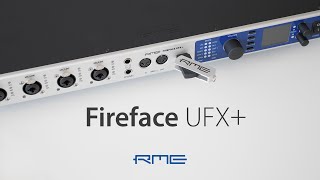
MADI, Thunderbolt technology and USB 3 Audio Interface - RME Fireface UFX+
RME Audio
Reviews
PROS
-
Rock solid drivers ensure stability and reliability
-
Exceptionally low noise levels and high clarity in recordings
-
Direct to USB multitrack recording is indispensable
-
94 channels of I/O offer incredible flexibility
-
Thunderbolt and USB 3.0 connectivity for low latency and broad compatibility
-
Upgraded AD/DA converters for crystal-clear audio
-
Comprehensive MADI connectivity for additional 64 channels
-
4 mic preamps with high input level and gain
-
TotalMix FX mixer for powerful control over audio
-
Long-lived driver support and robust build quality
CONS
-
Limited I/O with Pro Tools to 32 channels, complicating use of MADI
-
Display is small, can be an issue for quick visual checks without software
Owner Insights
We analyzed real musician discussions from forums and Reddit to find what players love, question, and tweak about RME Fireface UFX+.
Software and compatibility
-
RME Fireface UFX+ shows all 96 channels in Wwise's Meter window, making it challenging to monitor active channels due to small visual indicators.
Source -
Changing the Audio setting from "Use Audio Device" to "2.0 Speakers" resolved mono sound routing issues with Wwise.
Source -
Users find TotalMix challenging initially, but it offers a "DAW Mode" for simpler routing directly in DAWs, making it more accessible for some workflows.
Source -
Mutes in TotalMix can unmute channels across all mixes, risking feedback loops; users recommend lowering faders instead of using mutes to avoid this issue.
Source
Features and functionality
-
TotalMix allows channel disabling to clear up the interface, but it's unclear if this affects Wwise.
Source -
The UFX+ includes unique circuitry to prevent "pop" noises when switching on, unlike models like the BabyFace Pro which lack this feature.
Source -
The Arc USB controller enhances TotalMix flexibility, allowing mappable buttons for operations like muting outputs and toggling fader groups.
Source
User experience
-
Owners describe TotalMix's interface as complex and difficult to learn initially, likening it to a "spaceship" due to its intricate design.
Source -
Some owners report the RME Fireface UFX+ as extremely reliable, describing it as the first interface they've used without consistent issues, solidifying their experience with TotalMix.
Source
Build quality
-
The RME Fireface UFX+ has a known power supply issue, with failures reported after approximately 3 years of constant use, costing $300 to fix.
Source
Comparisons
-
Users suggest the UCX II for those needing fewer preamps but similar functionality to the UFX+, noting its improved gain and additional features like USB recording.
Source -
USB 3 on the UFX+ offers more bandwidth but not necessarily lower latency compared to USB 2 on older models like the original UFX.
Source
Use cases and applications
Value and pricing
-
Considering the price difference, the original UFX might be a cost-effective choice despite its age, especially if bought at a good deal.
Source
Critic Reviews
5.0 out of 5
Based on 3 Reviews and 11 Ratings

376
RME Fireface UFX+ USB 3.0/Thunderbolt Audio Interface
RME Fireface UFX+ Audio Interface Features:
94 channels of I/O creates incredible flexibility USB 3.0/Thunderbolt connectivity works with almost any computer Thunderbolt technology delivers ultra-low latency, system overhead, and CPU load Upgraded AD/DA converters and optimized analog I/O yield crystal-clear audio Comprehensive MADI connectivity expands your I/O by 64 channels 4 mic preamps with a +18dBu maximum input level and 75dB of gain for capturing a variety of sources DURec enables direct recording of 76 simultaneous channels to a USB flash drive TotalMix FX mixer gives you powerful control over inputs, outputs, mix levels, and more ARC USB remote (sold separately) provides convenient desktop control

251
"Most reliable audio interface I have ever owned"
"After nightmares with other audio interfaces, who's companies have pretty terrible customer support as well as flaky drivers and bad frimware updates that can create an ongoing battle to get any work done, this company RME out of Germany goes for a no compromises approach to their very industrial designs"

Artist usage
Add artist

Suga (Agust D) received the RME Fireface UFX+ as a birthday gift, as shown in a tweet from BTS's official account featuring his new studio setup.

In this video, Glenn Fricker demos his personal favourite audio interface, the RME Fireface UFX+.


As seen in 7:36 of the video, this is the interface that connects to Martin's computer.


In this photo, you can see Woozi’s RME Fireface UFX+ on the right side of his computer.

.jpg)
This audio interface can be seen in this Instagram picture, uploaded by the artist himself.
Quote:
New toy has just arrived! #rme #rmeaudio #fireface #ufx+ #studiogear #musicstudio

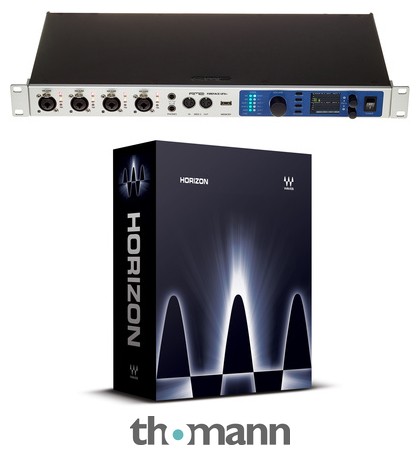
Nicola Lerra utilizes the RME Fireface UFX+ as his primary work platform, as detailed in the RME Fireface UFX+ Horizon Bundle listing on Thomann Italia.


Genre Usage
Based on how artists on Equipboard use this gear, it is most commonly found in the following genres.
Used With
Based on how musicians on Equipboard use RME Fireface UFX+, it is most commonly used with the following gear.
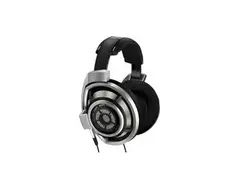


-s.webp?v=1784818777)

Community setups
Show yours
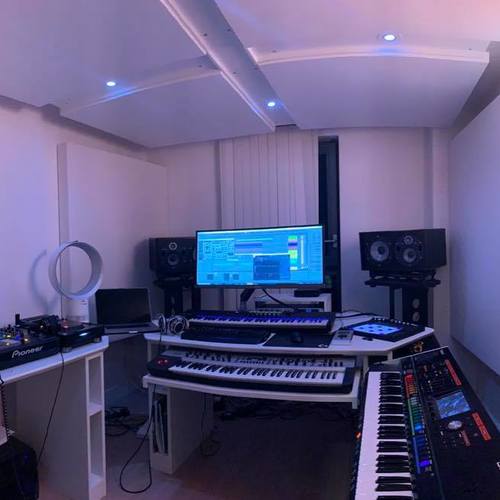
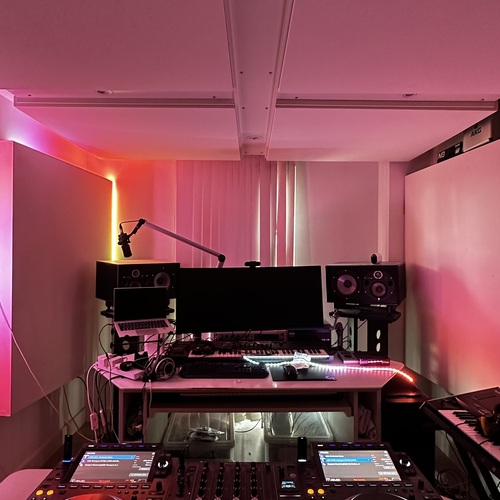


More RME Audio Interfaces

$749.00 - $999.00
in Audio Interfaces Rank

.png?v=1784580320)


$699.00 - $1,899.00
in Audio Interfaces Rank


$350.00
in Audio Interfaces Rank


$899.99
in Audio Interfaces Rank


$237.98
in Audio Interfaces Rank


$571.14 - $929.98
in Audio Interfaces Rank


$698.00 - $999.00
in Audio Interfaces Rank


$138.00 - $179.00
in Audio Interfaces Rank


$1,338.62 - $2,299.00
in Audio Interfaces Rank


$104.00 - $1,999.00


$1,859.00 - $2,799.00


$1,154.00 - $1,699.00


$2,185.00 - $3,199.00


$543.00 - $949.00


$1,507.00 - $2,299.00


$837.36 - $1,799.00


$1,535.00 - $2,299.00

$3,333.00 - $4,599.00


$1,050.00 - $5,099.00
.png?v=1784755332)


$1,879.00 - $2,999.00

Similar


Gear Guides






.webp)
Most Popular Audio Interfaces
Most Popular Brands
-
Added to Equipboard on by
 fleuw
fleuwGearIQ 594
-


