

Pricing and availability
We compare 600+ stores and found this item at 1 store. Prices updated .
Store
Reviews
Price




Average Price: $567
High-end/Boutique
$100
$251+
Price Tier
Budget
Standard
High-end
* Product prices and availability are updated by Equipboard every 24hrs and are subject to change. Equipboard may receive compensation for purchases made at participating retailers linked on this site. This compensation does not affect what products or prices are displayed, or the order of prices listed. For more information, please refer to our affiliate disclosure.
Description
The Sending Firmware version 2 will be available on November 19, 2024!
Sending is an analog delay that melds the archaic voice of bucket brigade devices with a fully modern toolbox of digital control. It embraces the character and idiosyncrasies of the medium while delivering high quality sound and performance-friendly features worthy of the modern musician.
Using two MN3005 BBDs and comprehensive analog processing techniques, Sending can delay a sound up to a full second without clock noise, and it can be pushed to even longer times for compelling sonic degradation. At the input is a discrete preamplifier capable of subtle enhancement or warm saturation that melds perfectly with the delay line. A dual-mode feedback filter shapes the repeats into deep pulses or dub-style bright echoes. Its flexible LFO engine can modulate the delay time to create gentle movement or musical chaos. Conducting this analog ensemble is a 32-bit, 100MHz processor granting deep user control, preset functionality, and MIDI access to every parameter.
Sending is our love letter to the antiquated yet enduring technology of analog delay. As you explore its many shades of interplay between past and future, we hope you find it as immersive as we do.
Controls
Each knob has a primary and secondary function. Access secondary functions by pressing Shift once. Press again to return the panel to normal.
Time: delay time from <5ms to 1 second
Div: tempo divisions
Color: adjusts preamp gain while keeping level consistent
Trim: adjust volume up/down by 6dB
Mix: wet/dry blend
Mix Mode: Sets Mix knob as a crossfader between wet/dry or as a delay level control only
Feedback: sets the number of repeats, from one repeat to self-oscillation
Swell time: adjusts speed of feedback swell when Tap is held
Filter: cut lows or highs in the delay line
Rate: LFO rate
Chaos: LFO randomization
Depth: LFO intensity
Shape: Set LFO waveform
Preset Select Buttons (I, II, III): long press to save a preset, short press to recall
Engage Footswitch: turn effect on/off. Long press to change the bypass mode.
Tap Footswitch: tap four times to set the delay time as a running average. Hold to enter Feedback Swell mode.
• A unique discrete preamplifier for subtle enhancement or full-range saturation that is automatically balanced for optimal output levels at all settings.
• Trails bypass mode that allows the preamp to be used as an always-on drive.
• Dual-mode Filter control that changes the tone of the delay repeats.
• Advanced analog filtering for low noise and high bandwidth on the delay line.
• Comprehensive digital control of every function using a powerful 32-bit processor system that seamlessly integrates with the analog signal path.
• Tap tempo with subdivisions and a hold mode for feedback swells.
• Delay time LFO engine with sine, square, and triangle waves plus a unique Chaos function that modulates the delay time using a truly random Lorenz attractor.
• Insert loop to apply external effects to delay repeats within the feedback path.
• Save and recall up to 32 presets: 3 via the front panel, the rest via MIDI.
• CV/Expression input that can be mapped to one or multiple controls.
• TRS MIDI input for control changes, preset selection, and clocking.
• Web-enabled firmware updates via the MIDI jack.
Specs:
Bypass switching: Electronic bypass with buffered or Trails modes. Trails mode passes signal through the preamplifier.
Input impedance @ 1kHz: 1MΩ
Output impedance @ 1kHz: <1KΩ
Power: 9VDC, 2.1mm center negative barrel. Current draw is 350-380mA depending on the Time setting.
We recommend a regulated, isolated power supply rated for 400 mA minimum. The DC input is protected against reverse polarity and over-voltage up to 24V. Our pedals do not accept batteries.
All Electronic Audio Experiments pedals come with a warranty tied to the original owner.
Version 2 (July 2023)
Complete circuit overhaul. Consider this the new starting point.
Version 1 (Summer 2018)
Original release; only 55 units built.
In many ways, this is a completely different product. For info please visit the legacy product page.
V2 (November 2024) Note: new units are shipped with v2 beginning with Serial Number #508. For a fully detailed changelog, refer to the Technical Manual.
Revamped LFO engine w/ improved tapering, more natural V/Oct pitch movement, continuously variable Shape, clock sync mode, and arpeggio easter egg mode
Modulation Matrix
CV clocking mode
Major updates to Swell mode: adjustable feedback, increased range of swell time, momentary activation in Trails mode, new Hold mode
Improved clock accuracy
Quality of life improvements including reduced LED brightness, parameter resets, and more
Bug fixes:
Reduced feedback in trails mode to eliminate bleed
Fixed PC message behavior for preset loads. Now, sending a message twice reloads the preset instead of exiting to the live panel state.
Fixed a bug that prevents the bypass state from not saving correctly
Fixed a bug that resulted in occasional missed button presses.
V1 (July 2023)
Original release
Product specs
| Brand | Electronic Audio Experiments |
| Model | Sending V2 |
| Finish | Silver |
| Year | 2023 - 2025 |
| Made In | United States |
| Categories | Delay Pedals |
| Pedal Format | Standard |
FAQs
-
What type of power supply does the Electronic Audio Experiments Sending V2 require?
-
The Electronic Audio Experiments Sending V2 requires a standard 9V DC power supply, center-negative. It does not support battery operation.
-
Can the Sending V2 delay pedal be used with a bass guitar?
-
Yes, the Sending V2 is versatile and can be used with both electric and bass guitars, providing rich delay effects suitable for a variety of musical styles.
-
Does the Sending V2 offer tap tempo functionality?
-
The Electronic Audio Experiments Sending V2 does not include tap tempo functionality. It is designed to offer high-quality delay tones with manual control over delay time.
-
What are the main tonal characteristics of the Sending V2 delay pedal?
-
The Sending V2 is known for its warm, analog-inspired delay tones, making it ideal for adding depth and texture to your sound. It excels in creating ambient soundscapes and lush repeats.
Videos

Emily Hopkins
Sending V2 - Electronic Audio Experiments

Sending V2 - Electronic Audio Experiments
Emily Hopkins
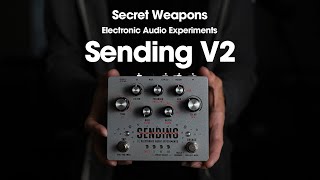
Electronic Audio Experiments Sending V2 | Secret Weapons Demo & Review

Mark Johnston
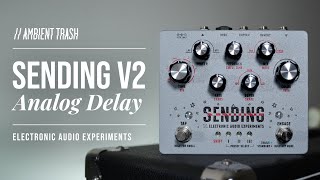
Electronic Audio Experiments - Sending V2 // Full Demo

ambienttrash
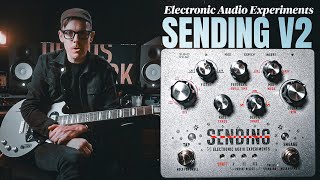
Electronic Audio Experiments Sending V2 | Guitar Pedal Demo

Demos In The Dark
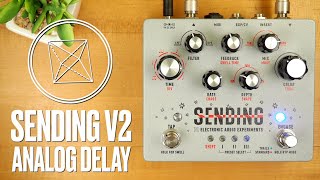
Electronic Audio Experiments Sending V2 Analog Delay

Pedal of the Day

Electronic Audio Experiments: Sending V2 // Analog Delay

MAS Distro
Reviews
Owner Insights
We analyzed real musician discussions from forums and Reddit to find what players love, question, and tweak about Electronic Audio Experiments Sending V2.
Features and functionality
-
The Sending V2 excels in producing LFO modulation and moody, artifacted repeats, closely resembling the MF104, especially with the longest time setting and subdivision used together.
Source -
The Sending V2 includes a preamp that can be used independently of the delay for overdrive and coloration, especially useful in trails mode.
Source
Build quality
-
Some users report issues with the preset buttons being pushed in, affecting usability.
Source
Comparisons
User experience
Use cases and applications
-
The Sending V2 is praised for its ability to create chorus, vibrato, lo-fi sounds, and noise, beyond typical delay effects.
Source
Critic Reviews
Based on 0 Reviews and 0 Ratings
Artist usage
Add artist
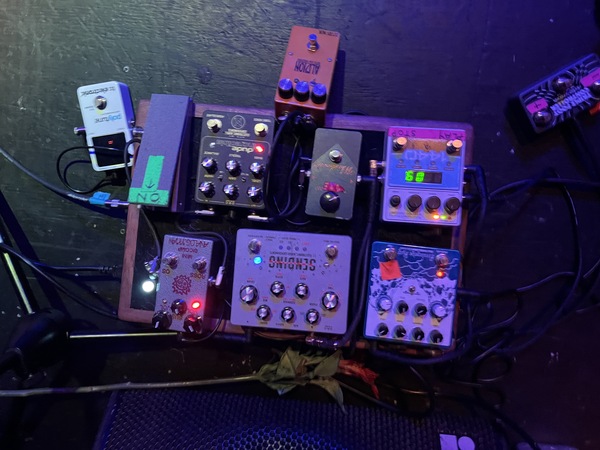
Featured on Justin's pedalboard at the 7/19/24 show at El Club, Detroit.


Genre Usage
Based on how artists on Equipboard use this gear, it is most commonly found in the following genres.
Used With
Based on how musicians on Equipboard use Electronic Audio Experiments Sending V2, it is most commonly used with the following gear.


-s.webp?v=1784905613)


More Delay Effects Pedals
-m.webp?v=1784977261)
$12.95
in Delay Effects Pedals Rank


$249.00 - $379.99
in Delay Effects Pedals Rank


$196.00
in Delay Effects Pedals Rank


$150.00 - $179.00
in Delay Effects Pedals Rank


$399.00 - $449.00
in Delay Effects Pedals Rank

$399.00 - $449.00
in Delay Effects Pedals Rank


$128.00 - $153.99
in Delay Effects Pedals Rank


$90.00
in Delay Effects Pedals Rank


$89.00
in Delay Effects Pedals Rank


$72.00
in Delay Effects Pedals Rank


$154.50 - $197.99
in Delay Effects Pedals Rank


$382.00 - $499.00
in Delay Effects Pedals Rank
.jpeg?v=1784935806)


$357.43 - $389.69
in Delay Effects Pedals Rank


$323.87 - $554.02
in Delay Effects Pedals Rank


$80.00 - $158.00
in Delay Effects Pedals Rank


$125.00 - $176.00
in Delay Effects Pedals Rank


$85.23
in Delay Effects Pedals Rank


$86.82
in Delay Effects Pedals Rank


$123.99 - $170.45
in Delay Effects Pedals Rank


$135.00 - $166.00
in Delay Effects Pedals Rank


$64.00
in Delay Effects Pedals Rank


$164.07
in Delay Effects Pedals Rank


$229.99 - $250.00
in Delay Effects Pedals Rank


$329.99 - $406.99
in Delay Effects Pedals Rank


$207.02 - $235.00
in Delay Effects Pedals Rank

$99.00 - $129.00
in Delay Effects Pedals Rank


-m.webp?v=1784905122)
$119.99
in Delay Effects Pedals Rank


$184.58 - $250.90
in Delay Effects Pedals Rank


$150.00
in Delay Effects Pedals Rank


$389.00 - $429.00
in Delay Effects Pedals Rank

$208.00 - $259.39
in Delay Effects Pedals Rank


$199.00
in Delay Effects Pedals Rank


$155.28 - $194.10
in Delay Effects Pedals Rank


$225.00 - $252.20
in Delay Effects Pedals Rank


$120.00
in Delay Effects Pedals Rank


$199.00 - $228.00
in Delay Effects Pedals Rank


$222.07 - $329.00
in Delay Effects Pedals Rank


$249.00 - $299.00
in Delay Effects Pedals Rank


$87.00 - $107.00
in Delay Effects Pedals Rank


$155.19 - $175.99
in Delay Effects Pedals Rank

Accessories & Related Items


Community setups


Similar


Gear Guides






Most Popular Delay Effects Pedals
Most Popular Brands
-
Added to Equipboard on by
 michael
GearIQ 43708
-


