-s.webp?v=1783436205)

-xl.webp?v=1783436205)
Pricing and availability
We compare 600+ stores and found this item at 1 store. Prices updated .
Store
Reviews
Price




Average Price: $101
Standard/Professional
$100
$276+
Price Tier
Budget
Standard
High-end
* Product prices and availability are updated by Equipboard every 24hrs and are subject to change. Equipboard may receive compensation for purchases made at participating retailers linked on this site. This compensation does not affect what products or prices are displayed, or the order of prices listed. For more information, please refer to our affiliate disclosure.
Description
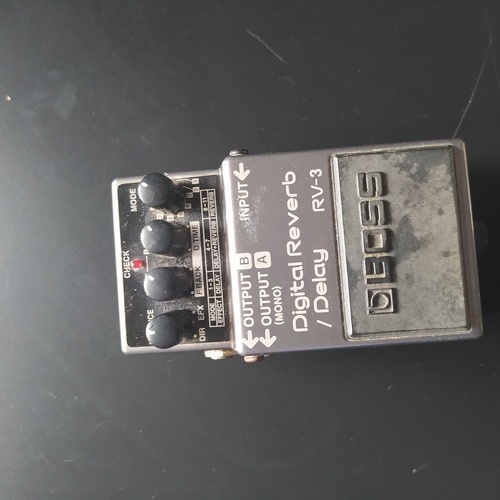
Meet the Boss RV-3 Digital Reverb/Delay, a pioneer among compact digital reverb pedals. Launched in 1994, this gear has stood the test of time and remains a favorite among many musicians. Despite its discontinuation in 2002, the RV-3 continues to be a reliable workhorse, offering more than the traditional spring reverb, with its ability to shape and drag sounds. This pedal is not only a piece of history but a testament to Boss's innovation and commitment to quality sound production.
Key Features:
- Compact digital reverb pedal
- Offers both reverb and delay effects
- Ability to shape and drag sounds
- Launched in 1994 and discontinued in 2002
- Highly reliable and durable
- A favorite among many musicians
- Produced by the renowned Boss brand.
Product specs
| Brand | Boss |
| Model | RV-3 Digital Reverb/Delay (Pink or Dark Gray Label) |
| Finish | Grey |
| Year | 1994 - 2002 |
| Made In | Taiwan |
| Categories | Delay Pedals, Reverb Pedals |
FAQs
-
What are the main features of the Boss RV-3 Digital Reverb/Delay pedal?
-
The Boss RV-3 combines digital reverb and delay effects in one compact pedal, offering options for reverb, delay, or a combination of both. It provides up to 32 seconds of delay time and includes four reverb modes, making it versatile for various musical styles.
-
Can the Boss RV-3 be used for both guitar and bass?
-
Yes, the Boss RV-3 Digital Reverb/Delay is suitable for both guitar and bass, providing rich reverb and delay effects that enhance the sound of both instruments.
-
How does the Boss RV-3 differ from the Boss RV-5?
-
The Boss RV-3 offers both reverb and delay effects in one pedal, while the RV-5 focuses solely on reverb with more modern algorithms and additional modes. The RV-3 is ideal for those needing both effects in a single unit.
-
What power supply does the Boss RV-3 require?
-
The Boss RV-3 requires a 9V DC power supply, which can be provided by a standard Boss PSA adapter or a compatible 9V power source.
-
Is the Boss RV-3 suitable for live performance?
-
Yes, the Boss RV-3 is well-suited for live performance, offering robust build quality and reliable performance with versatile reverb and delay options that can enhance live soundscapes.
Videos

intheblues
BOSS RV-3 Reverb/Delay Pedal
BOSS RV-3 Reverb/Delay Pedal
intheblues
Boss RV-3 Digital Reverb / Delay - Mode 7 is a Place on Earth

Stompbox Breakdown
Boss RV-3 Digital Reverb / Delay

Pedal of the Day
![Video thumbnail for Boss RV-3 Digital Reverb Delay | Demo [NO TALKING] by Dean Wingerter](https://img.youtube.com/vi/LNUXxSZtv3s/mqdefault.jpg)
Boss RV-3 Digital Reverb Delay | Demo [NO TALKING]

Dean Wingerter
BOSS RV-3 Digital Reverb / Delay Pedal SOUND TONE Demo

Fritz's Guitars

Boss RV-3 Digital Reverb / Delay

Pedal Sessions
BOSS RV-3 DIGITAL DELAY & REVERB

The Pedal Picassos
Boss RV-3 Digital Reverb/Delay

Ovation Music and Studios Gallatin
Reviews
PROS
-
Combines reverb and delay effects in one unit
-
Warmer sound compared to newer models like the RV-6
-
Unique reverb-delay settings not found in other RV models
-
Classic pedal with a sound that can emulate bands like Mogwai and Explosions in the Sky
-
Versatile, with settings allowing for a wide variety of mixes
-
Has become a classic, featured on many great albums and pedalboards
-
Compact size saves space on pedalboards
CONS
-
Sound cuts in/out when turning on, considered part of its "character"
-
Has a bass boost when activated that might interfere with desired sound
-
Fixed reverb in combo modes, limiting tail length customization
-
Lacks modern features like attenuated low-pass filter, shimmer blend, LFO, analog warmth
Owner Insights
We analyzed real musician discussions from forums and Reddit to find what players love, question, and tweak about Boss RV-3 Digital Reverb/Delay.
Features and functionality
-
The RV-3 combines reverb and delay, offering a unique ambient quality that is distinct from other Boss models.
Source -
It's noted that the RV-3's reverb has a signature tinny, metallic quality, which can be desirable for specific ambient tones.
Source -
The RV-3 is noted for its unique knob sweep, which some users find particularly inspiring for creative sound shaping.
Source
Use cases and applications
-
Particularly favored for post-rock and indie genres, it creates a "wall of ambience" sound that’s hard to replicate with newer models.
Source -
Explosions in the Sky heavily utilize the RV-3, emphasizing its integral role in crafting their signature sound.
Source -
The RV-3 is considered ideal for creating post-punk sounds akin to The Cure and Joy Division, making it a versatile choice for genre-specific tone crafting.
Source
Comparisons
-
The RV-3 is described as more natural sounding on bass compared to other reverbs, which suits recording applications.
Source -
The delay component of the RV-3 is noted to be brighter than the Boss DD-5, which might appeal to those seeking a more pronounced delay effect.
Source -
The EHX Holy Grail is compared to the RV-3 for its unique, familiar sound that, while not the richest, is loved for its distinct character.
Source -
Users found the Zoom Multistomp CDR70 can match the RV-3's sound while offering more programmability and true bypass options.
Source -
The Noisemaker Nebula is suggested as an alternative to the RV-3, offering combined delay and reverb at a slightly higher price point.
Source -
The RV-3 is favored for its simplicity and nostalgic sound, especially when compared to more feature-rich pedals like the Zoom MS50G/MS70CDR.
Source
User experience
-
Some users report a slight sound cut when activating the pedal, but find it negligible in live settings.
Source -
An owner reported the RV-3 as quiet in operation, with trails that enhance its ambient sound capabilities.
Source -
Some owners find the reverb's "not-quite-right" metallic plate quality unexpectedly inspiring, contributing to creative sound exploration.
Source
Critic Reviews
4.5 out of 5
Based on 4 Reviews and 67 Ratings

194
Not Perfect
Awesome, but has its flaws. When activated, it has a certain bass boost to it that interferes with my standard sound. Can be countered by a well orchestrated equalizer, but I don't like equalizers on my pedboard. Has really great features that allow for a wide variety of Delay/Reverb mixes. I recommend this pedal, because you save a Boss-size space on your board instead of having both Delay and Reverb.

41029
I would guess the bass boost problem would be alleviated by setting the effect 100% wet and putting it in the effects loop if your amp has one... but effects loops are lame so I stay away from reverb....
194
I agree with you, it is just inconvenient.

Artist usage
Add artist

Barry Burns uses the Boss RV-3 Digital Reverb/Delay, as mentioned in the Memoire Online article "Le post-rock et sa sous-estimation au cinéma" by Alexis Tanet.


The translated text of this tweet is as follows: "Today, the BD-2 is a Waza! The [Earthquaker] Arrows and the Centaur are already my go-tos. The [Earthquaker] Plumes is cranked! I'm not good at stepping on switches, so I use Providence loop routing boxes. Since I want to step on the CE-2 and the RE-3 at the same time, I use the loop routing boxes. The RE-6 is for those extra long delays!"
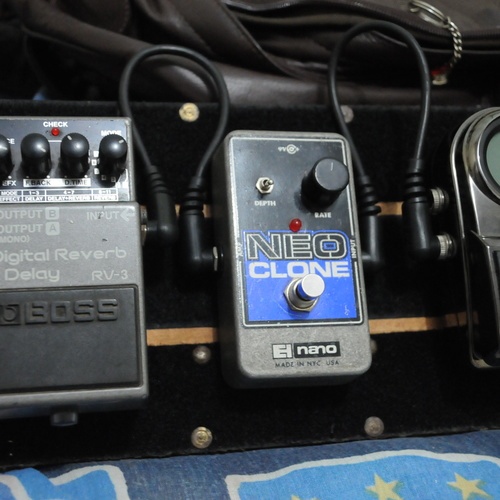
In addition to the two Providence P-4TB routing boxes, this photos shows a BOSS Waza Craft BD-2, BOSS RV-3, RV-6 and CE-2, two Earthquaker pedals (Plumes overdrive, Arrows boost), and a vintage Klon Centaur.

.jpg)
Regarding Marc Byrd's pedalboard, the RV-3 sits at the top center spot.

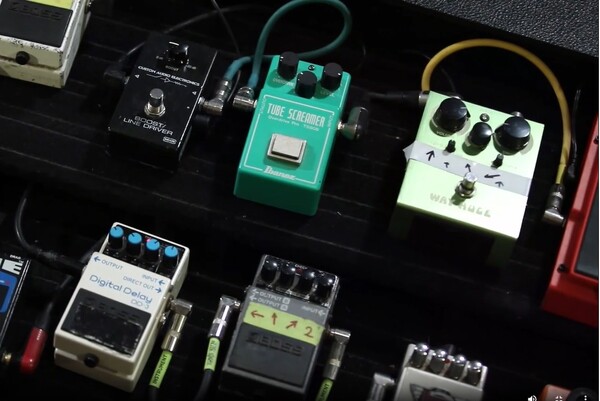
Kerem Özyegen has been using the Boss RV-3 Digital Reverb/Delay pedal as a delay pedal since the early 2000s. This is evidenced by a picture taken from his online guitar course affiliated with Sonsuz Oda, where the pedal is clearly visible in his setup.


On August of 2016, MusicRadar did a Rig Tour with Explosions in the Sky, taking a quick look at their gear. On Mark Smith's board, his signal is first affected by a Boss RV-3.
“It’s been indispensable, and now that I think about it, this exact pedal has lasted me about 15 years without breaking. And we finally bought some backups - so I’m feeling good about that! There are other super nice reverb options these days, but back 15 years ago it seemed far and away the best way to get the most warmth and grandness from the guitar.”

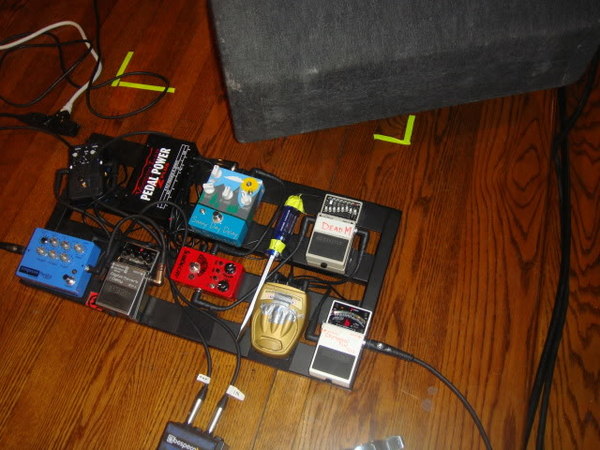

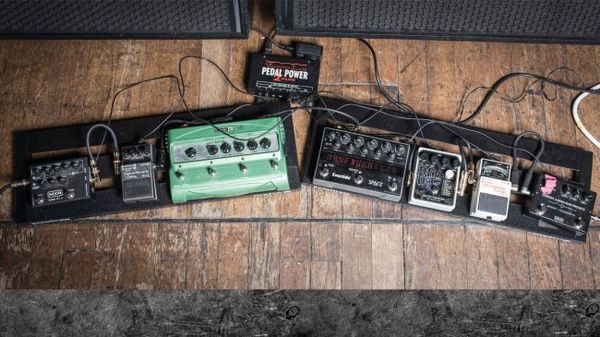
From a Rig Tour by Music Radar with Explosions in the Sky.
“The sound of the RV-3… it’s cloudy enough to mask the digital-ness of it. As the models went along, they just got cleaner and clearer - which is fine if that’s what you’re looking for, but you can also hear the digital sound of that reverb much clearer. Whereas the RV-3 puts this little sheen over everything that makes it sound beautiful and angelic, without sounding really digital.”
.jpg?v=1783299754)
.jpg?v=1783299754)
In a November 2025 article from Future Music, Kjartan Sveinsson is confirmed to use a Boss RV-3 Digital Reverb pedal during the recording of the album "Takk...". Sveinsson states:
The guitars reverberate, evolve and ascend. In terms of effects and recording, what's the secret? Kjartan: Mine is really easy actually. I just use a small Boss pedal, an RV3.


This photo comes from Mono's 2010 Brudenell Social Club performance. One of the pedals that can be seen in Taka's pedalboard is Boss RV-3 digital reverb/delay pedal.

.jpg)

In this video at 46:43, Valerie says: "Yeah, the digital delay reverb pedal was our favorite." and then Roberto agrees.


Album Usage
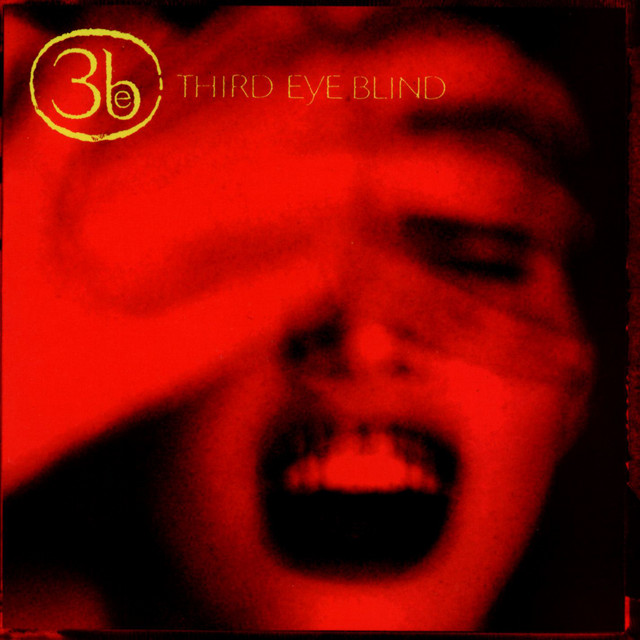
The Boss RV-3 Digital Reverb/Delay has been featured on the following albums:
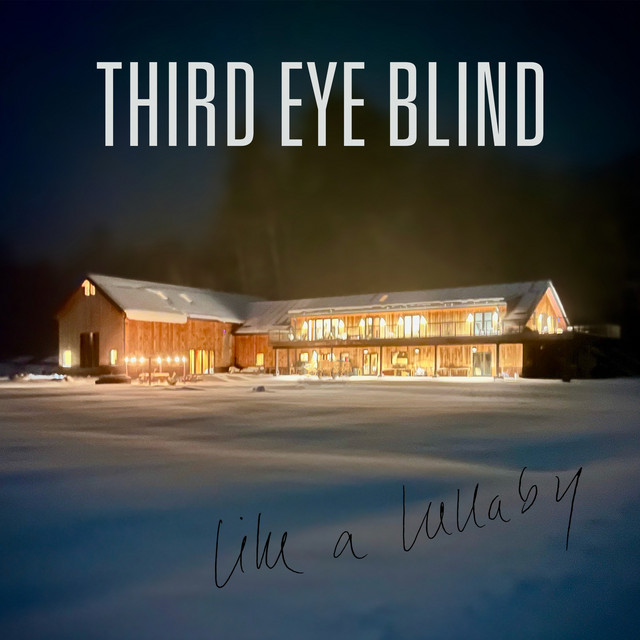
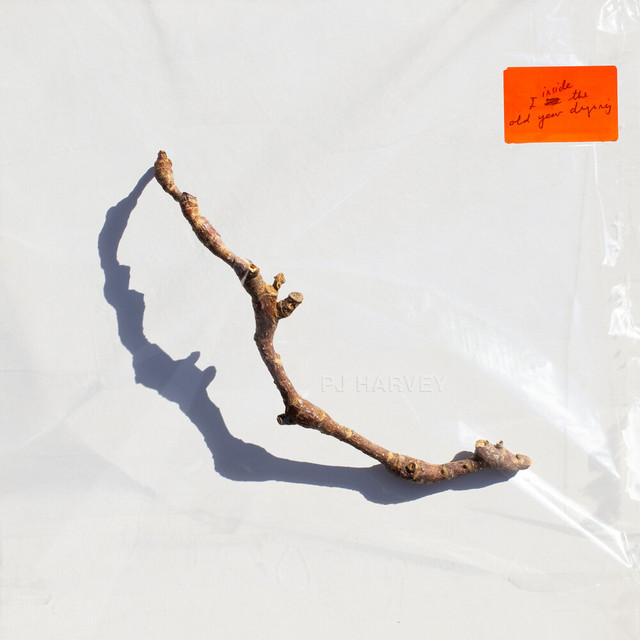
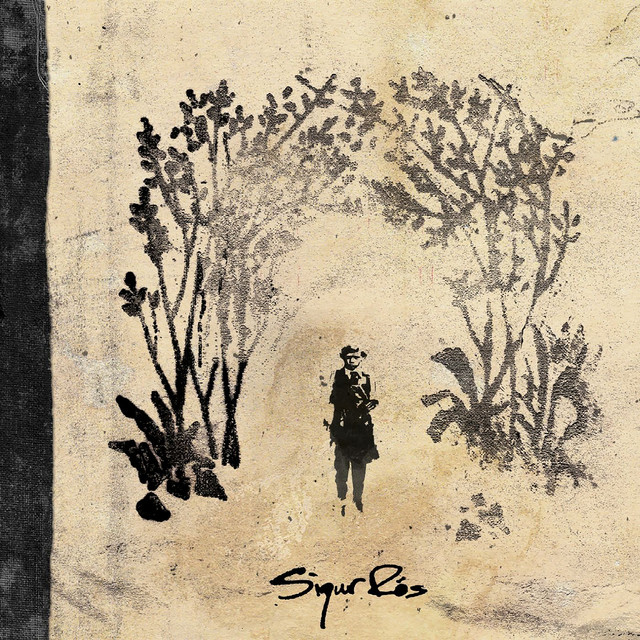
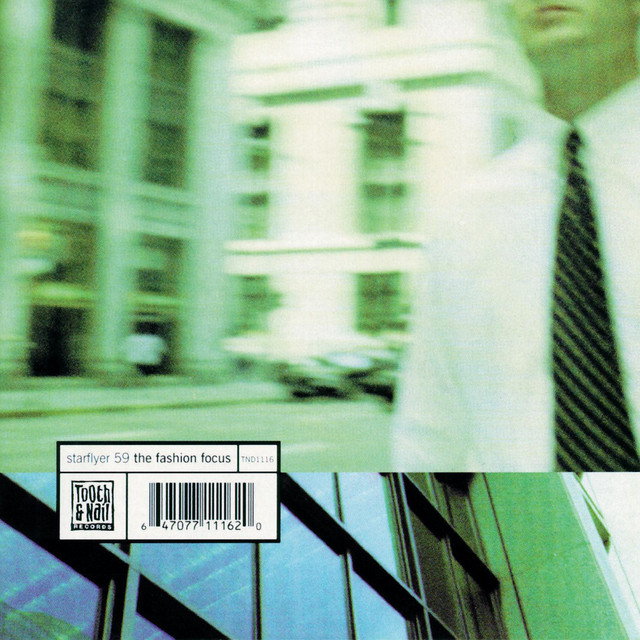
Genre Usage
Based on how artists on Equipboard use this gear, it is most commonly found in the following genres.
Used With
Based on how musicians on Equipboard use Boss RV-3 Digital Reverb/Delay, it is most commonly used with the following gear.

-s.webp?v=1783436200)


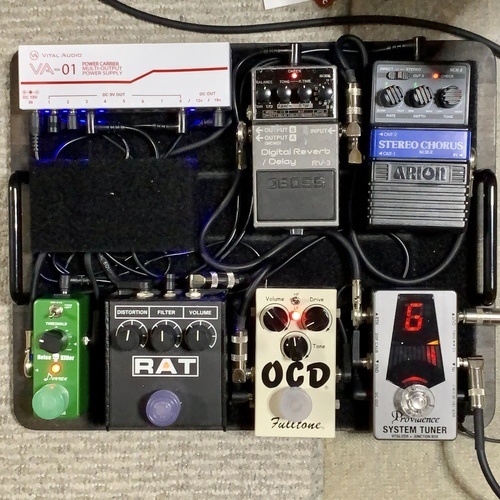
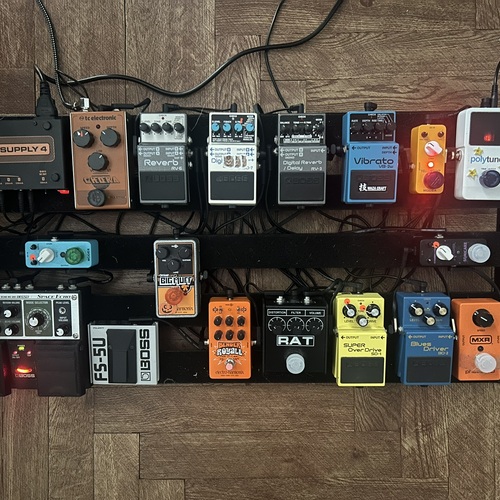
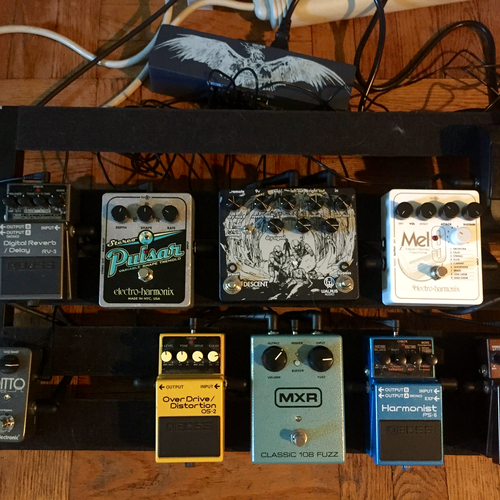
Community setups
Show yours







.jpeg?v=1781936341)

Similar
Add recommendation2 alternative and related items for Boss RV-3 Digital Reverb/Delay, curated by the Equipboard community.

$139.53 - $163.50

$50.00
More Boss Reverb Effects Pedals

$155.29
in Reverb Effects Pedals Rank


$139.53 - $163.50
in Reverb Effects Pedals Rank


$74.31
in Reverb Effects Pedals Rank


$329.99 - $409.00
in Reverb Effects Pedals Rank


-m.webp?v=1783436298)
$137.77
in Reverb Effects Pedals Rank


$182.75 - $296.99


$18.48 - $95.00
in Reverb Effects Pedals Rank


-m.webp?v=1783436244)
$325.00 - $379.00
in Reverb Effects Pedals Rank


$123.00 - $129.99
in Reverb Effects Pedals Rank
-m.webp?v=1783436243)
$439.00 - $479.00
in Reverb Effects Pedals Rank


$209.00 - $235.99
in Reverb Effects Pedals Rank

.jpeg?v=1783323499)


$399.00 - $499.00
in Reverb Effects Pedals Rank


$69.88 - $149.99
in Reverb Effects Pedals Rank


$45.00
in Reverb Effects Pedals Rank


$182.00 - $219.99
in Reverb Effects Pedals Rank


$219.00
in Reverb Effects Pedals Rank


$145.00
in Reverb Effects Pedals Rank


$105.00 - $149.99
in Reverb Effects Pedals Rank


$140.00
in Reverb Effects Pedals Rank


$209.00
in Reverb Effects Pedals Rank


$111.00 - $137.90
in Reverb Effects Pedals Rank


$119.99 - $219.99
in Reverb Effects Pedals Rank


$225.00 - $257.00
in Reverb Effects Pedals Rank

.jpg?v=1783265553)


$219.00 - $234.00
in Reverb Effects Pedals Rank


$145.00
in Reverb Effects Pedals Rank


$145.00 - $185.10
in Reverb Effects Pedals Rank


$179.00 - $209.00
in Reverb Effects Pedals Rank


-m.webp?v=1783436629)
$446.49 - $525.00
in Reverb Effects Pedals Rank


$169.99 - $222.00
in Reverb Effects Pedals Rank


$146.87
in Reverb Effects Pedals Rank


$144.00 - $176.00
in Reverb Effects Pedals Rank


$199.00
in Reverb Effects Pedals Rank


$199.00 - $253.00
in Reverb Effects Pedals Rank


$179.99 - $299.99
in Reverb Effects Pedals Rank


$90.00
in Reverb Effects Pedals Rank


$88.13
in Reverb Effects Pedals Rank


$159.99
in Reverb Effects Pedals Rank


$181.00 - $199.95
in Reverb Effects Pedals Rank


$160.00 - $345.00
in Reverb Effects Pedals Rank
Accessories & Related Items
-s.webp?v=1783436298)


Gear Guides






Most Popular Reverb Effects Pedals
Most Popular Brands
-
Added to Equipboard on by
 equipboard
Gear IQ 4934
-


