-s.webp?v=1783338210)


-xl.webp?v=1783338210)
Pricing and availability
We compare 600+ stores and found this item at 7 stores. Prices updated .
Store
Reviews
Price





Average Price: $98
Standard/Professional
$80
$181+
Price Tier
Budget
Standard
High-end
Price History
Based on price data from 5 merchants for "MXR MX-104 Distortion + (Vintage Model - Block Logo)". Prices shown reflect NEW condition. Tracking began Apr 2, 2026.
* Product prices and availability are updated by Equipboard every 24hrs and are subject to change. Equipboard may receive compensation for purchases made at participating retailers linked on this site. This compensation does not affect what products or prices are displayed, or the order of prices listed. For more information, please refer to our affiliate disclosure.
Description
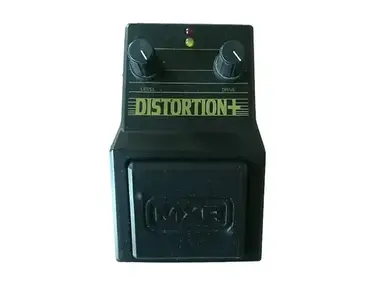
Unleash the vintage fury of the late 1970s with the MXR M-104 Distortion +, a pedal that has etched its place in rock history. Revered by icons like Randy Rhoads and Bob Mould, this classic distortion pedal offers a sonic palette ranging from subtle overdrive to all-out fuzz. Its charm lies in its simplicity, featuring just two knobs: Output and Distortion. Twisting these knobs opens up a world of gritty textures, making it a favorite for those who appreciate tone without the frills.
The MXR M-104 Distortion + is built for musicians who crave pure, analog distortion. The pedal's vintage germanium diodes deliver that signature warmth and character, ensuring your guitar cuts through the mix with authority. Whether you're gently pushing your amp or turning up the heat for a searing solo, this pedal responds with remarkable nuance and sensitivity.
Its compact design makes it a perfect fit for any pedalboard, marrying the convenience of modern gear with the unmistakable sound of yesteryear. Ideal for both studio setups and live performances, the MXR M-104 Distortion + remains a testament to the timeless appeal of analog distortion.
Key Features:
- Classic distortion pedal from the late 1970s
- Simple two-knob operation: Output and Distortion
- Features vintage germanium diodes for authentic tone
- Compact design fits easily on any pedalboard
- Trusted by legendary guitarists like Randy Rhoads and Bob Mould
- Suitable for various music styles, from subtle overdrive to intense fuzz
Owner's manual
MXR MX-104 Distortion + (Vintage Model - Block Logo) User ManualProduct specs
| Brand | MXR |
| Model | MX-104 Block Distortion + |
| Finish | Yellow |
| Year | 1975 - 1984 |
| Made In | United States |
| Categories | Distortion Pedals |
| Pedal Format | Standard |
FAQs
-
What type of distortion does the MXR M-104 Distortion + produce?
-
The MXR M-104 Distortion + is known for its classic, gritty distortion that adds a warm, vintage character to your sound, ideal for rock and blues genres.
-
Is the MXR M-104 Distortion + suitable for use with a bass guitar?
-
While primarily designed for electric guitars, the MXR M-104 Distortion + can be used with a bass guitar, though it may result in some low-end loss due to its mid-focused distortion.
-
Does the MXR M-104 Distortion + require a power supply?
-
The late 1970s model of the MXR M-104 Distortion + operates solely on a 9V battery, as it does not have an AC adapter input.
-
How does the MXR M-104 Distortion + compare to modern distortion pedals?
-
The MXR M-104 Distortion + offers a more vintage, raw distortion sound compared to modern pedals, which often provide more tonal shaping options and higher gain levels.
-
Can the MXR M-104 Distortion + be used for live performances?
-
Yes, the MXR M-104 Distortion + is well-suited for live performances, providing a reliable, classic distortion tone that cuts through the mix effectively.
Videos

Johan Segeborn
MXR Distortion + ORIGINAL vs REISSUE!
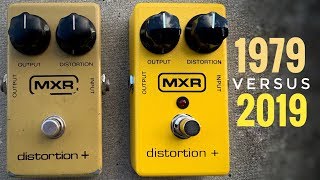
MXR Distortion + ORIGINAL vs REISSUE!
Johan Segeborn
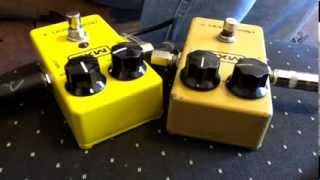
Stomp Box Shootout. MXR Distortion plus new vs vintage

Ron McCann
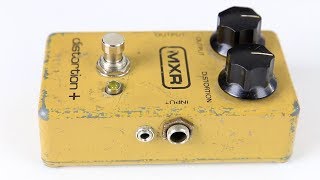
1981 MXR Distortion +

shnobel
demo of MXR distortion + vintage of 1978

Mathieu Millet
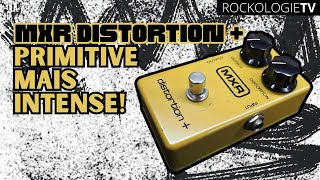
MXR Distortion + : primitive mais intense!

RockologieTV
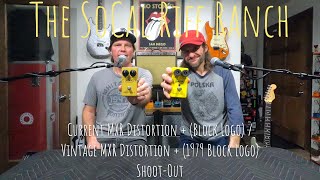
Current MXR Distortion + (Block Logo) / Vintage MXR Distortion + (1979 Block Logo) Shoot-Out!

The SoCal Riff Ranch
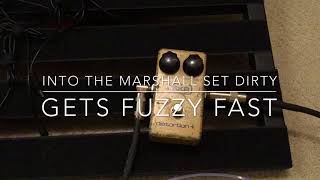
Vintage 1980 MXR Distortion+ block logo demo

DeuceII
Reviews
PROS
-
Offers versatile use as distortion, overdrive, or boost
-
Classic 1970s tone with warmth and brightness
-
Balanced, clear sound even at high settings
-
Unique character with smooth fuzz when used as overdrive
-
Customizable with different diodes for varied tones
-
Notably used by famous artists like Slash
CONS
-
Limited bandwidth and compression with germanium diodes
-
Can sound fizzy at high distortion levels
-
Impractical and inconvenient for modern setups (e.g., no 9v power, no LED)
-
Sound may not have the "muscle" compared to similar pedals
Owner Insights
We analyzed real musician discussions from forums and Reddit to find what players love, question, and tweak about MXR MX-104 Distortion + (Vintage Model - Block Logo).
Mods and upgrades
-
Owners experimenting with pedal building appreciate the simple engineering and modify circuits to adjust diode and capacitor values, influencing the tone.
Source -
Owners recommend pairing the Distortion + with a Tube Screamer to tame high frequencies and boost power chords or solos.
Source -
Owners have drilled holes in the casing for a 9V power jack, although this is controversial among purists who prefer preserving the original state.
Source
Build quality
User experience
-
The pedal's germanium diodes contribute to a fuzz-like sound at maximum distortion, with rich harmonics and clarity in chord notes.
Source -
Pairing the Distortion + with a Micro Amp before it in the chain acts as a gain control without increasing volume, offering a unique tonal option.
Source -
Vintage units are sometimes described as "tone sucky," suggesting the need for use within a loop to maintain sound quality on pedalboards.
Source
Comparisons
-
Ross Distortion, an alternative with similar circuitry, is noted for less fizziness and more crunch compared to the Distortion +.
Source -
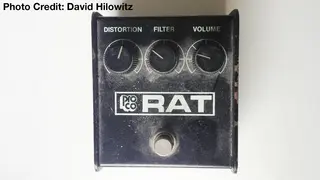
Users often compare the Distortion + to the Pro Co RAT, noting the RAT offers a smoother distortion, which some prefer over the harsher sound of the Distortion +.
Source -
The MXR Distortion + is often compared to the DOD 250, with some owners having experience with both models.
Source
Use cases and applications
Setup and maintenance
-
Foam inside the pedal often disintegrates after years, requiring cleaning and protective measures to prevent accidental grounding.
Source
Value and pricing
-
The Whirlwind Yellow Box is suggested as a cheaper alternative, replicating the original script circuit with added features like an LED and true bypass.
Source
Features and functionality
Critic Reviews
4.0 out of 5
Based on 7 Reviews and 34 Ratings

500
Different kettle of fish...
I've personally never got on with the ubiquitious Boss DS-1, so originally started with the reissue MXR Distortion +. I later moved to the (handmade) Whirlwind Gold Box (modern features; true bypass/LED) before eventually finding a 79/80 model. It's impractical, it's inconvenient (no 9v power, no LED etc.) but it's a different kettle of fish and 'that' 70's tone. It's got the brightness/high mid that I liked about the reissue vs. other Distortion circuits but another level of tone and warmth. This is my holy grail distortion sound.

249
My main distortion.
I'n in love with the sound of this pedal since the first day: it's not only a distortion pedal, you can use it also like an overdrive or a boost with a crunchy tone. But I usually use it with all the settings on the max and the result is a great fuzzy distortion very balanced and clear. On the track "Sipario" I use this last setting and also the "overdrive" setting: https://lepiccolemorti.bandcamp.com/track/sipario

41029
well sure you can use it as an OD, the OD250 is basically the same circuit and they call that an overdrive, at least on the packaging :-) The general wisdom these days is that ODs are soft clip, diodes in feedback lop loop and distortion is hard clip diodes to ground... but 2 of the most heralded ODs break this rule. The Klon is hardclipped diodes to ground but with a unique clean blend and voicing structure... the ever popular fulltone OCD is absed on the old voodoo lab drive which is itself just a distortion plus type circuit with the diodes outputs going to the bias circuit of the op amp rather than static ground whch makes the clipping more dynamic based on what you're giving the amplification part of the circuit but its still just a variable hard clip.... so in pedals overdrive really means nothing. Real overdrive is just DSTORTION produced by using up all the headroom of a power amplifier. Its a fine line between enough gain and too little gain for say a fender bassman to reach its full 45 watts with every type of pickup you throw at it, so the preamp has enough gain to OVERDRIVE the power amp with the average guitar pickup feeding it. Leo kept experimenting, as did dick denny and kenbran and the mighty dave reeves, but by the time circuits were getting really clean guitarists didn't want that anymore (especially not from a tube amp, solid state has come in). The rest is history.
41029
its okay
I don't like this as much as the OD250. If I didn't have both of these already I would build one with a switch to go between silicon and germainium diodes... maybe throw in some LEDs and msofets too.This pedal is more distorted then the DOD, but the germanium diodes are really comrepssed right away and the bandwidth is so limited that whe you put it enct to a 250it doesn't have the muscle. it does sound quite good for 80s elads into a marshall... I'm told its great on a TB303 but have enver tried it. I didn't even know I had one of these until recently. I think I may have inadvertetly stolen this from a rehearsal space 10 years ago. It was there and someone thew it in my bag of tricks thinking it was mine and then I never bothered to give it back. Sorry if I have your distortion+ but you shouldn't leave shit laying around in a public space without your name on the baseplate!

397
Smooth distortion and classic sounds
The MXR Distortion + is basically a DOD250 with different clipping diodes. Mine is a custom built classic 1970s with matched 1N34A diodes. It also has an indicator diode on it (separate power to it when it switches so it is not in the sound circuit). Classic sounds and responds differently than the DOD250. Used buy almost everyone at one point - Slash has used this often thought his career. I used it as an alternative to the harder clipping DOD250. Or even staged with a DOD250.

166
My favorite amp pusher
I have no dislikes other than a little fizzy if you crank the distortion too high. Otherwise it has a more vintage sound.

156
Put me on an island with this beauty
I use it as an overdrive, as it has a really smooth fuzz character to it when backed up. Totally matched my Fender setup. Must add that I put in a new OP amp some day or age ago. Cleaned it up some bit, but nothing major.
Artist usage
Add artist

Michael Weikath, guitarist of Helloween, has confirmed his use of the MXR M-104 Distortion + (Late 1970s Model) pedal. In a statement, Weikath expressed his preference for reliable and vintage gear, stating, "Already in the 70's I used the MXR distortion pedal that I still run and I see no reason to try things I don't need." This information is supported by a source discussing his equipment choices.
.jpg?v=1781439971)
.jpg)
Hank Shermann showcases his late 1970s MXR M-104 Distortion +, featuring a modded LED light, in an Instagram post.


In a Q&A featured on Petefijterrybickers, Terry Bickers discusses using the MXR M-104 Distortion + pedal, specifically a late 1970s model, highlighting its role in shaping his guitar sound.


Spectrasonics Studio List The equipment list for the Spectrasonics studio reads like a gear-head's dream. Favourites amongst Eric's sizeable synthesizer collection include the Access Virus, the Prophet VS, his collection of Waldorf synthesizers, and a 1976 Yamaha CS80. "It's my favourite axe to play, because of the awesome polyphonic aftertouch and that sensuous ribbon," explains Eric.
For effects processing Eric is a fan of the Roland SRV330 reverb, an item that "gets missed by most people, mainly because it doesn't say Lexicon on the front panel." For distortion tricks Eric often uses a rare Boss GL100 guitar preamp: "It's basically the history of Boss pedals in one rack space."
Mixing, until recently, was done on some "very odd, custom-made analogue mixers made by a guy named Mo West," reveals Eric. He recently purchased a Roland VM 7000-series mixer, however, taking him one step closer to an all-digital setup.
SAMPLERS • Roland S760 and S770 • Kurzweill K2000 • Bitheadz Unity DS1 (running on an Apple Macintosh G4)
SYNTHESIZERS/DRUM BOXES • Access Virus • Clavia Nord Lead • Doepfer modular synth • Emu modular synth • Moog Minimoog (modified by Studio Electronics) • Oberheim SEMs • Polyfusion modular synth • Roland JP8000 prototypes & production units • Roland JP8080 • Roland JD800/990 • Roland Jupiter 8 • Roland JV1080 and 2080 • Roland MKS50 Alpha Juno • Roland MKS80 Super Jupiter • Roland System 700 and 100m modular synths • Roland MC303 • Roland MC505 • Roland TB303 • Roland TR808 • Roland TR909 • Korg EX8000 • Korg M1R • Korg Mono/Poly • Sequential Circuits Prophet VS • Waldorf Wave, Microwave, Microwave XT • Yamaha CS80
SOFTWARE • Alchemy • Arboretum HyperEngine • Arboretum Hyperprism plug-in pack • Arboretum Ionizer • Arboretum Raygun noise-reduction plug-in • Antares Infinity • BIAS Peak audio editor • BIAS SFX machine effects • Emagic Logic Audio Platinum • Emagic Sound Diver synth editor/librarian • Fireball • GRM Tools plug-in pack • Metasynth • Opcode Vinyl, Vocode & Filter plug-ins • Propellerheadz Rebirth soft synth • Prosoniq SonicWorx Artist effects • Steinberg Magneto tape-saturation emulator • Steinberg ReCycle sample editor • Thonk soft synth • RAIFF • Region Munger • Transfer Station • Samplifier sample transfer software • Saturator • Sound Morph • Sound Hack audio editor • Unisyn synth editor • Waveboy Voder
SIGNAL PROCESSORS • AMS RMX reverb • API 5502 equaliser • Boss GL100 guitar driver • Boss SE70 multi-effects • Dimension beam controller • Euphonics mixing console • Eventide DSP4000 & H3500 harmonizers • GML stereo parametric EQ • Innovonics compressors • Langevin passive equalisers • Lexicon PCM70/80/480 reverbs • MXR Distortion Plus • Quest custom mixers • Roland Dimension D & C processors • Roland RSP550 multi-effects • Roland RSS10 3-dimensional effects • Roland SDE330 delay • Roland SDX330 chorus • Roland SRV330 reverb • Roland SVC330 vocoder • TC Electronics Fireworx multi-effects • Summit tube mic preamps


In a post on Instagram, Patrick Alavi is pictured using a late 1970s MXR M-104 Distortion + pedal, showcasing its role in his creative process.

At 0:01 you can see the distortion pedal right next to the chromatic tuner


In the YouTube video titled "LOS NATAS - EL NUEVO ORDEN DE LA LIBERTAD [HD]," Sergio Chotsourián uses the MXR M-104 Distortion + pedal, a late 1970s model, to enhance his guitar and bass sound.
.jpg)
Album Usage
The MXR MX-104 Distortion + (Vintage Model - Block Logo) has been featured on the following albums:
Genre Usage
Based on how artists on Equipboard use this gear, it is most commonly found in the following genres.
Used With
Based on how musicians on Equipboard use MXR MX-104 Distortion + (Vintage Model - Block Logo), it is most commonly used with the following gear.


-s.webp?v=1783062192)
Community setups
Show yours

Similar
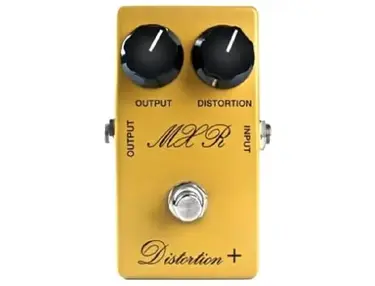
Add recommendation3 alternative and related items for MXR MX-104 Distortion + (Vintage Model - Block Logo), curated by the Equipboard community.
-m.webp?v=1783349870)
$77.97 - $99.99

$310.48

$90.00 - $229.00
More MXR Distortion Effects Pedals
$77.97 - $99.99
in Distortion Effects Pedals Rank


$99.00 - $139.99
in Distortion Effects Pedals Rank


$99.48 - $125.99
in Distortion Effects Pedals Rank


$89.10 - $125.99
in Distortion Effects Pedals Rank


$88.00 - $105.99
in Distortion Effects Pedals Rank


$90.00 - $229.00
in Distortion Effects Pedals Rank


$75.00 - $124.31
in Distortion Effects Pedals Rank


$117.00 - $138.00


-m.webp?v=1783347774)
$164.89 - $246.00


$164.89 - $246.00


-m.webp?v=1783349863)
$79.00 - $89.00
in Distortion Effects Pedals Rank


$77.00 - $109.99
in Distortion Effects Pedals Rank

-m.webp?v=1783349956)
$139.00 - $159.99
in Distortion Effects Pedals Rank


-m.webp?v=1783349880)
$219.00 - $257.00
in Distortion Effects Pedals Rank


-m.webp?v=1783263733)
$109.00
in Distortion Effects Pedals Rank


$129.00 - $152.00
in Distortion Effects Pedals Rank


.jpg?v=1783265553)

$206.39 - $259.00
in Distortion Effects Pedals Rank


$41.00 - $62.90
in Distortion Effects Pedals Rank


$73.58
in Distortion Effects Pedals Rank


$212.64 - $249.00
in Distortion Effects Pedals Rank


$280.00
in Distortion Effects Pedals Rank


$96.91 - $119.00
in Distortion Effects Pedals Rank


$54.99 - $72.00
in Distortion Effects Pedals Rank


$93.60 - $120.99
in Distortion Effects Pedals Rank


$122.00 - $199.99
in Distortion Effects Pedals Rank

$88.00 - $604.00
in Distortion Effects Pedals Rank


$90.00 - $108.90
in Distortion Effects Pedals Rank


$200.00 - $227.00
in Distortion Effects Pedals Rank


$92.82 - $199.99
in Distortion Effects Pedals Rank


$183.20 - $229.00
in Distortion Effects Pedals Rank


Accessories & Related Items

-s.webp?v=1783335766)


-s.webp?v=1783336026)


-s.webp?v=1783335619)


-s.webp?v=1783335686)
Gear Guides
.jpg)





Most Popular Distortion Effects Pedals
Most Popular Brands
-
Added to Equipboard on by
 furus23
Gear IQ 451
-


