


Pricing and availability
We compare 600+ stores and found this item at 1 store. Prices updated .
Store
Reviews
Price




Average Price: $173
Budget/Beginner
$300
$801+
Price Tier
Budget
Standard
High-end
* Product prices and availability are updated by Equipboard every 24hrs and are subject to change. Equipboard may receive compensation for purchases made at participating retailers linked on this site. This compensation does not affect what products or prices are displayed, or the order of prices listed. For more information, please refer to our affiliate disclosure.
Description
Introducing the Yamaha NS10 Studio Monitor, a timeless classic in the world of studio recording. Initially intended for casual home use, this monitor found its true calling in the hands of renowned engineer Bob Clearmountain in the 1980s. Its exceptional performance soon turned it into a staple for major recording studios worldwide. With an unorthodox response curve, the NS10 pushes you to perfect your mix, ensuring it sounds remarkable everywhere. This studio monitor may have its share of critics, but its enduring popularity and acclaim speak volumes about its quality and reliability.
Key Features:
- Originally designed for home use but found its niche in professional recording studios
- Became a global standard after being popularized by Bob Clearmountain
- Encourages the creation of mixes that sound perfect on all types of speakers
- Has a unique response curve that is not flat
- Loved and criticized in equal measure, attesting to its distinctive characteristics
Product specs
| Brand | Yamaha |
| Model | NS-10M (Pair) |
| Finish | Black |
| Year | 1980s |
| Made In | Japan |
| Categories | Studio Monitors |
| Amplification | Passive |
FAQs
-
Are Yamaha NS10 studio monitors active or passive?
-
The Yamaha NS10 studio monitors are passive, meaning they require an external amplifier to power them.
-
What makes the Yamaha NS10 studio monitors unique for mixing?
-
The Yamaha NS10 studio monitors are known for their flat response and ability to reveal flaws in mixes, making them a popular choice for critical listening and mix referencing.
-
Can Yamaha NS10 studio monitors be used for mastering?
-
While Yamaha NS10 monitors are primarily used for mixing due to their revealing nature, they are not typically recommended for mastering, where a more full-range and accurate sound is preferred.
-
Do Yamaha NS10 studio monitors require a specific type of amplifier?
-
Yamaha NS10 studio monitors require a compatible power amplifier that can handle their impedance and power specifications, typically around 8 ohms and 25-100 watts per channel.
-
How should Yamaha NS10 studio monitors be positioned for optimal sound?
-
For optimal sound, Yamaha NS10 studio monitors should be positioned at ear level, forming an equilateral triangle with the listener, and slightly angled towards the mixing position.
Videos

Andy’s Audio Krapp
Yamaha NS-10M Studio Monitor Horizontal Studio Speakers - Are these really "that" good???
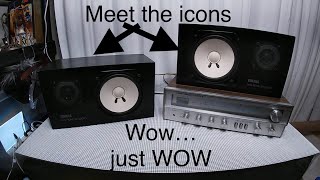
Yamaha NS-10M Studio Monitor Horizontal Studio Speakers - Are these really "that" good???
Andy’s Audio Krapp
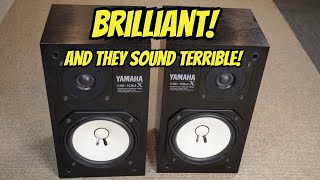
Legendary Yamaha NS-10M Studio Monitor Speakers

Audio Nautica
Reviews
PROS
-
Reveals mixing flaws, making them stick out
-
Mixes that sound good on NS10s translate well everywhere
-
Ideal for balancing mid frequencies in mixes
-
Passive design pairs well with high-powered amps for better sound quality
-
Historical significance in the music industry, used by professionals
-
Provides a consistent playback experience
-
Helps in making quick mixing decisions
-
Various models available catering to different needs
CONS
-
Sound quality described as poor by some users
-
Mid-frequency focus can be taxing on ears over long periods
-
Requires a powerful amplifier to function properly
-
High bass roll-off, limited low-end response
-
Some models are harder to find due to rarity
Owner Insights
We analyzed real musician discussions from forums and Reddit to find what players love, question, and tweak about Yamaha NS10 Studio Monitor.
Use cases and applications
-
NS10s are valued for their ability to expose mix flaws, making them ideal for identifying balance issues and mix clarity.
Source -
NS10s are known for their consistency across different studio environments, making them a reliable reference tool.
Source -
NS10s are primarily used as secondary monitors for mid-range checking, with many professionals using them for mix translation to other systems.
Source
Build quality
-
NS10Ms are praised for low distortion levels, attributed to Yamaha's engineering, which enhances their appeal in blind sound tests.
Source
User experience
-
Despite mixed reputations, some users report satisfaction with NS10Ms powered by a modestly priced Adcom GFA-545, challenging the notion that only high-end amps suffice.
Source -
There's a perception that NS10Ms are widely available in Tokyo, indicating regional differences in accessibility.
Source -
NS10Ms are noted for their accurate time-domain response, with a waterfall plot showing quick stopping of bass and midrange frequencies, aiding in precise mix evaluation.
Source -
Some owners note the need for periodic parts replacement for NS10s, with parts becoming rarer over time, impacting long-term maintenance.
Source
Comparisons
-
Some owners assert NS10Ms are often mistakenly compared to Auratones, but they find NS10Ms offer a more refined sound, not at all like 'grot boxes'.
Source -
Avantone MixCubes are likened to NS10s for their midrange clarity and transient response, but with a focus on single-driver performance.
Source -
The Adam S3A is noted for its midrange clarity, rivaling the NS10s, though it is powered and ported, offering a different listening experience.
Source -
The HEDD Type 20mkii offers a unique feature with ports that can be closed, mimicking the NS10's sealed design but with modern enhancements.
Source
Other
-
The NS10s are highlighted for their time-domain performance, outperforming many competitors in spectral decay, emphasizing their accuracy in critical listening.
Source
Features and functionality
-
NS10s are renowned for their fast transient response due to non-ported cabinets and paper woofers, making them highly revealing of mix details.
Source -
NS10's sealed-box design provides better transient response, crucial for precise monitoring compared to ported alternatives like the Yamaha HS series.
Source
Value and pricing
-
While NS10s are within budget for some, the additional cost of a quality amplifier must be considered, which can significantly affect total investment.
Source
Critic Reviews
4.5 out of 5
Based on 7 Reviews and 36 Ratings

228
The standard for a reason
These sound bad and have a very high bass roll-off. They do their job well though, they translate really well and are pretty consistent as far as playback goes. I find that they are easier to make quick decisions on than other monitors as well (I secretly don't mind their midrange though).


41029
you have to get used to them... in the 90s they were in EVERY studio as the only nearfield option, so if you didn't want ear fatigue from the big wallmounted JBLs or EVs you had to elarn to work on NS10s.... they have fantastic midrange detail though, don't they.... another great option is the unsung NS-A638. They are 3 ways with extended bass response but similar tweeters to the NS-10. I have a pair, great compromise between the NS10 all mids sound and a legit monitor that sounds right.
made history and still useful
made history and still useful, listening pleasure for long mix sessions and a reliable reference
41029
still great at being the NS10 all these years later!

58
Classic and the Best ever
Starting my producing with these monitors and still use in these days. Yamaha Ns-10 is the classic and one of a kind in every space of the music world.


Artist usage
Add artist

In this MusicRadar interview of 2015, Fedde Le Grand explains the monitoring part of his new studio. He mentions using a pair of Yamaha NS10 Studio Monitor in addition to the main set.
"[...] I always like to keep a pair of NS10s, just to help level off the hats, percussion and vocals, plus a set of KRK VXT8s, to cross-reference the sound when I'm working on something that needs to be really EDM… something that I know will work at a festival."

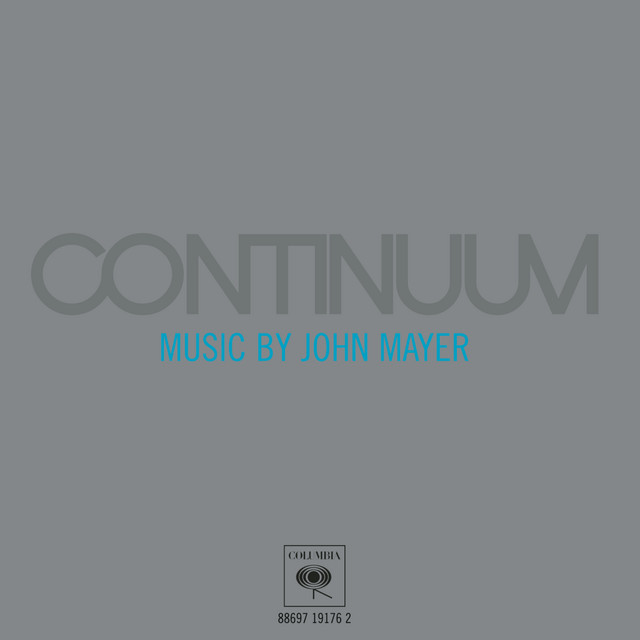
A "reversed" NS10 speaker was used to mike Palladino's bass on John Mayer's Continuum, as stated by recording engineer Chad Franscoviak in this October 1, 2006 Mix Online interview.
“Then, every once in a while, if [John] wanted a beefy sound, I would use a [Yamaha] NS10 speaker that had been reversed,” Franscoviak says. “I would put that right up on the cone of one of his cabinets to get that real low-end thing.”
(...) To capture Palladino's bass, his instrument typically went into either an Ampeg SVT or B-15 into an Avalon U5 mono instrument preamp and DI. “I took the throughput into his amplifier and usually put a FET 47 close up, and on occasion an RE20. Then I almost always put an NS-10 on his bass cabinet to get the ultralow stuff,” Franscoviak explains. “I would compress the DI and the FET 47 lightly, not in any way that would effect the dynamics of his performance, only for tonal reasons. I would never put a compressor on the NS-10.”


at the beginning of this video, posted on instagram, you can see 2 NS10 speakers in front of their studio console


Razer Music lists Metro Boomin as using Yamaha NS-10 studio monitors.


The industry standard reference monitors. Dirty South says "I just got myself a pair of second-hand Yamaha NS10s for that classic "crap" sound reference."


The Chemical Brothers utilize Yamaha NS10 Studio Monitors as part of their pursuit to create a distinctive sound, as discussed in the Kreativsound article "Chemical Brothers – Tom Rowlands – In Studio."


Autechre comments "We replaced our NS10s with these because we thought our music was suffering." this shows that the group did at one point use the NS10s


DVBBS are working in the studio for their new album. In the photo you can see the NS10 monitors in front of Chris
.png?v=1783447610)
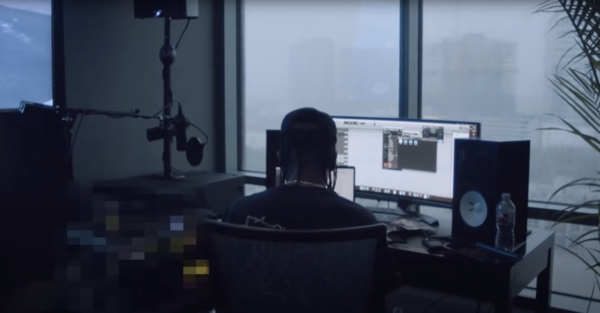
In the FRANCHISE (CACTUS SLATT) behind the scenes video, you can clearly see a pair of Yamaha Hs8 Studio Monitors. These monitors can also be seen in the making of No Bystanders video.


In this 1996 Guitar Player interview, Robin Guthrie says: "I also like to feed back off the Yamaha NS-10 studio monitors as opposed to doing it off the amp."


In the YouTube video titled "Noah '40' Shebib on producing Drake" by Native Instruments, Noah "40" Shebib is shown using the Yamaha NS10 Studio Monitors, highlighting their role in his production setup.

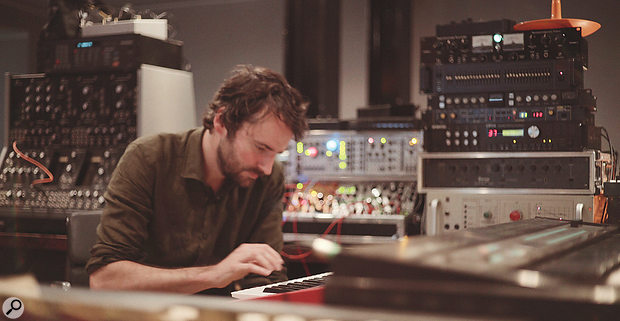
Having no real constraints on their studio time, Brett Shaw and Yannis Philippakis chose to set up a circle of mics in the live room at 123 to try out different vocal sounds. "Yannis sort of insisted on finishing all of the music before we got into the vocals," says Shaw. "I set up usually six microphones in a circle and he could just sort of skip between any of them at any point. You can just record a bit and see what it sounds like."
The circle of microphones generally comprised a Shure SM7, Neumann U67, Flea 47, an Altec 633A 'salt shaker', an AEA R44CX ribbon and a Yamaha NS10 speaker cone used as a mic. "The ribbon AEA again sounded pretty nice on the softer stuff. And then we messed around a lot on the backing vocals singing through the NS10 cone."
Album Usage
The Yamaha NS10 Studio Monitor has been featured on the following albums:




Genre Usage
Based on how artists on Equipboard use this gear, it is most commonly found in the following genres.
Used With
Based on how musicians on Equipboard use Yamaha NS10 Studio Monitor, it is most commonly used with the following gear.
-s.webp?v=1783432848)


-s.webp?v=1783349885)


-s.webp?v=1783349880)
Community setups
Show yours

More Yamaha Active & Passive Monitors
-m.webp?v=1783408993)
$299.99
in Active & Passive Monitors Rank


$243.50 - $398.99
in Active & Passive Monitors Rank


$142.25 - $199.99
in Active & Passive Monitors Rank


-m.webp?v=1783436216)
$203.31 - $594.98
in Active & Passive Monitors Rank
.jpg?v=1783244344)


$277.00 - $398.99
in Active & Passive Monitors Rank


$196.00 - $349.99
in Active & Passive Monitors Rank


$196.00 - $594.98
in Active & Passive Monitors Rank


$274.99 - $487.99
in Active & Passive Monitors Rank


$348.98
in Active & Passive Monitors Rank


$150.00
in Active & Passive Monitors Rank


$149.99 - $169.99
in Active & Passive Monitors Rank


$199.00 - $219.99
in Active & Passive Monitors Rank


$262.49 - $594.98


Accessories & Related Items


Similar


Gear Guides






Most Popular Active & Passive Monitors
Most Popular Brands
-
Added to Equipboard on by
 equipboard
Gear IQ 4934
-


