
Pricing and availability
We compare 600+ stores and found this item at 2 stores. Prices updated .
Store
Reviews
Price




Average Price: $316
High-end/Boutique
$50
$176+
Price Tier
Budget
Standard
High-end
* Product prices and availability are updated by Equipboard every 24hrs and are subject to change. Equipboard may receive compensation for purchases made at participating retailers linked on this site. This compensation does not affect what products or prices are displayed, or the order of prices listed. For more information, please refer to our affiliate disclosure.
Description
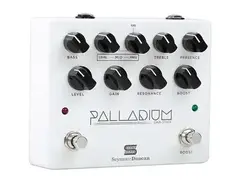
Unleash the full potential of your guitar with the Seymour Duncan Palladium Gain Stage, a formidable overdrive effects pedal designed for musicians who demand versatility and precision. Crafted to enhance both the power and nuance of your sound, the Palladium Gain Stage is your gateway to a world of tonal possibilities. With a clean boost initiating the signal path, this pedal is perfect for both direct power amp setups and those looking to expand the sonic palette of a straightforward clean amp.
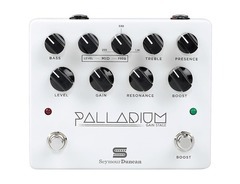
Dial in the perfect level of grit with the intuitive gain knob, while the resonance control allows you to meticulously sculpt the low-end for a beefier presence. The powerful EQ section offers parametric control over the mid-range, letting you tailor your sound to suit any genre or performance setting. Add a touch of attack to your heavily saturated tones with the presence control, ensuring your sound remains crisp and articulate.
Whether you're shredding solos, laying down rhythm, or exploring new sonic landscapes, the Seymour Duncan Palladium Gain Stage empowers you to create a sound that's uniquely yours.
Key Features:
- Clean boost to kickstart the signal path
- Intuitive gain knob for high-gain tones
- Resonance control for low-end sculpting
- Parametric mid-range EQ for precise tone shaping
- Presence control to enhance clarity in saturated sounds
Product specs
| Brand | Seymour Duncan |
| Model | Palladium Gain Stage |
| Finish | Black, White |
| Year | 2010s |
| Made In | United States |
| Categories | Overdrive and Boost Pedals |
FAQs
-
What type of power supply does the Seymour Duncan Palladium Gain Stage require?
-
The Seymour Duncan Palladium Gain Stage requires a standard 9V DC power supply, center-negative, with a minimum of 100mA to operate properly.
-
How does the Palladium Gain Stage differ from other overdrive pedals?
-
The Palladium Gain Stage is designed to emulate the high-gain sound of a tube amplifier, offering extensive EQ controls and a boost function, making it versatile for both rhythm and lead tones.
-
Can the Seymour Duncan Palladium Gain Stage be used with a bass guitar?
-
While primarily designed for electric guitars, the Palladium Gain Stage can be used with bass guitars, though users may need to adjust the EQ settings to suit the lower frequency range.
-
Does the Palladium Gain Stage work well in a pedalboard setup?
-
Yes, the Palladium Gain Stage is designed to integrate seamlessly into a pedalboard, offering true bypass to maintain signal integrity when not in use.
-
What are the main tonal characteristics of the Palladium Gain Stage?
-
The Palladium Gain Stage offers a high-gain, amp-like distortion with a wide range of EQ adjustments, providing a dynamic and responsive tone suitable for various rock and metal genres.
Videos

Keith Merrow
Seymour Duncan Palladium Gain Stage- Metal
Seymour Duncan Palladium Gain Stage- Metal
Keith Merrow
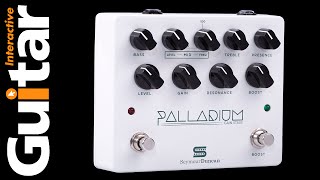
The Best Distortion Pedal? | Seymour Duncan Palladium Gain Stage | Review

Guitar Interactive Magazine
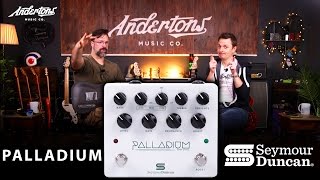
Seymour Duncan Palladium Gain Stage Drive Pedal Demo

Rob Chapman
Seymour Duncan- Palladium Gain Stage Pedal vs. Tube Amp

Seymour Duncan
Seymour Duncan Palladium Gain Stage Pedal

Guitar World
Seymour Duncan: PALLADIUM GAIN STAGE (in Am)

Brett Kingman
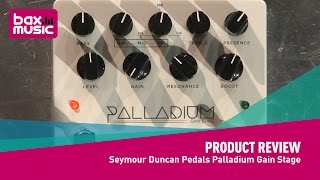
Seymour Duncan Pedals Palladium Gain Stage - Review

Bax Music UK
Reviews
PROS
-
Extremely versatile, from light overdrive to high gain
-
Rich control panel with wide EQ possibilities
-
Boost knob offers the illusion of two pedals in one
-
Responsive pots allow for nuanced sound shaping
-
Capable of producing articulate, amp-like tones
-
Offers a vast range of adjustment without sounding bad
-
Can achieve clean tones at edge of breakup with guitar volume manipulation
-
Presence and resonance knobs ideal for harmonics and finger techniques
-
Does not require a "master level" knob, adding character to the output sound
CONS
-
Lack of a "master level" knob may confuse some users
-
Needs time and experimentation to fully understand and utilize all features
Owner Insights
We analyzed real musician discussions from forums and Reddit to find what players love, question, and tweak about Seymour Duncan Palladium Gain Stage (White).
Features and functionality
-
The mid control has a semi-parametric EQ with a sweep from 254 Hz to 1.1 kHz, allowing users to tailor mids for a pleasant guitar tone.
Source -
The resonance control on the Palladium adds girth and opens up space, particularly enhancing the sound when used with a Strat.
Source -
Unlike the 5150, the Palladium lacks a built-in gate control, which some users wish it included for noise management.
Source -
The Palladium's built-in boost resembles the SD 805 overdrive, providing additional tonal flexibility even if it doesn't fully achieve a standalone bright tone.
Source
Comparisons
-
Some users find the 1.1 kHz midrange more useful than the 2 kHz option on the Empress Heavy for guitar signals.
Source -
The Palladium is described as a gain-stage/pre-amp pedal, offering thicker and more full-bodied tones compared to the fiery overdrive of the EVH 5150.
Source -
The Palladium is seen as more tonally versatile than the 5150, suiting various hard rock/metal styles better, though the 5150 has its own adjustable versatility.
Source -
When combined with a Boss Waza SuperOverdrive, the Palladium achieves a more cutting and bright tone, overcoming its sometimes lacking brightness on its own.
Source
User experience
-
Owners of the white Seymour Duncan Palladium describe it as a "killer pedal," indicating satisfaction with its performance.
Source
Use cases and applications
-
The Palladium pairs effectively with the PowerStage 170 clean Class-D power, providing versatile tonal options for hard rock and metal.
Source -
Palladium performs well with progressive death, doom, and black metal styles, especially when guitars are tuned down to D or drop A#.
Source -
The Palladium, when paired with a PowerStage 200, delivers optimal results due to the ultra-clean sound of the amp, enhancing the pedal's tone.
Source
Critic Reviews
5.0 out of 5
Based on 1 Review and 2 Ratings

89
I guess I don’t need another distortion pedal
I am not a pedal guru, no no. But sometimes I am just in a right place in a right time. That was happening when I bought this one just couse it has the most knobs rather than the other pedals in shop.
It is my experience, I have no other fuzz/distortion gear, I am a bassist after all)) Most often I use that pedal with Gibson sgj 120th anniversary and Grado sp500e headphones. The sound that I have is ... well sometimes it the best, sometime the worst, it depends on the moods after all. I won’t talk about my sound. I want to emphasize that this small pedal along with guitar knobs gives me the variability of possible tones that I couldn’t think of.
First “magic” knob for me was “boost” knob. I really don’t want to use some kind of advertising phrases, but turning that switch on just simply reorganize the effect of all others knobs. It just give you very noticeable illusion of having two pedals in one box. Believe this or not. I believe. Also it is not a binal boost switch, you can rotate this knob and get different outcome result.
Second mind strike for me was the fact that the pedal doesn’t have “master level” knob. The “level” knob is olso change the character of output sound. Maybe it wasn’t clear for me at first and at second but now I use another bypass pedal just to adjust the final signal.
Furthermore I want to add that the pair of two middle frequencies related knobs can do the trick. And it do it for me.
Also if you as me think that high gain hardcore related music is a music of flageolet/harmonics finger-technics you should pay strongest attention to the pair of “presence” and “resonance” knobs.
So it is a great pedal for me, but also a kind of ...well, some personal related stuff, a real challenge in understanding of things, couse after all when I just want to relax I used to play on manufactured suggestion sample settings from included brochure. I still don’t have complet knowingness of what positions I should finally use when I start turning all knobs here and there. But I do know now that when I get a “dumb stupid hum” sound I just maybe need to slightly or radically adjust one of the knobs to get it right and to be rewarded with pretty that sound from that particular hardcore song.
I had that pedal for about 4 years and don’t think of changing it or getting something more. Maybe new guitar or speakers, but this is another story))
Artist usage
Add artist
.jpg)
Visible in this Instagram post by Larson.

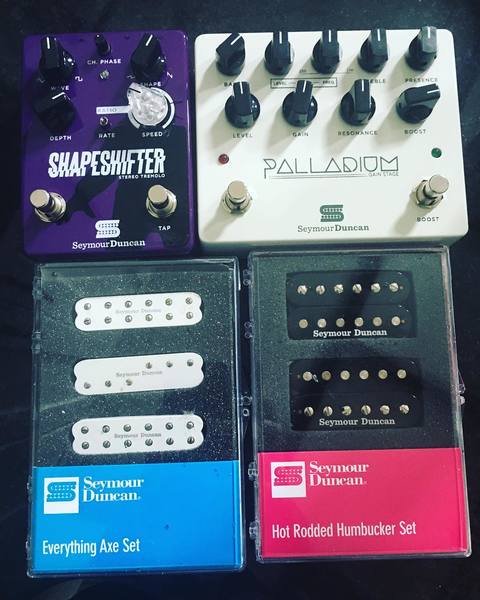
Super stoked to give this Shape Shifter and Palladium Gain a Go all summer long

.jpg)
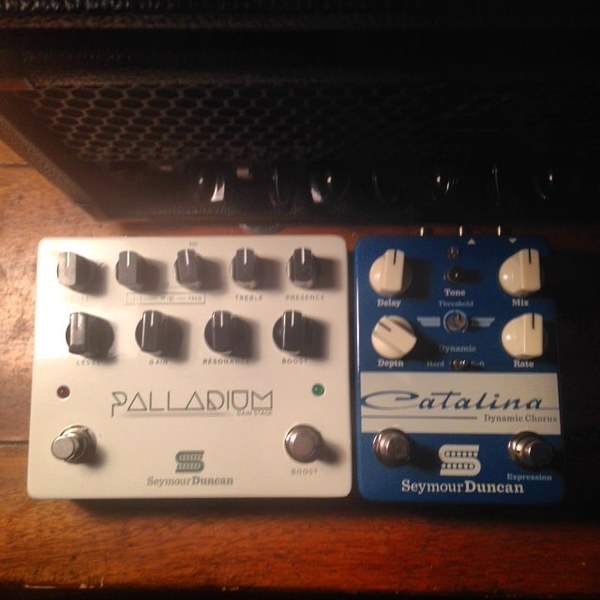
In this post, Tim shows off his duncan palladium pedal he owns

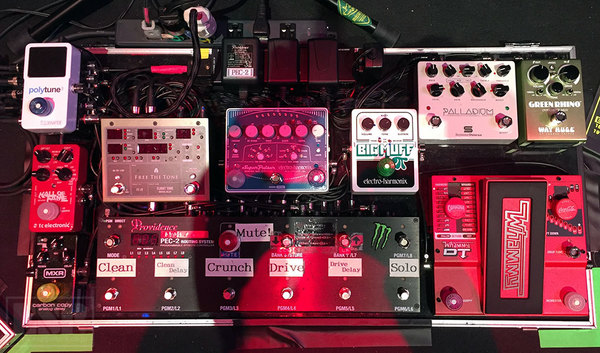
Seen on Jean-Ken Johnny's pedalboard

Genre Usage
Based on how artists on Equipboard use this gear, it is most commonly found in the following genres.
Used With
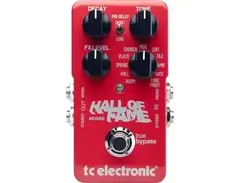
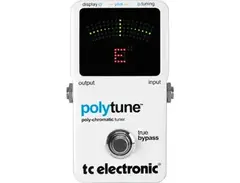
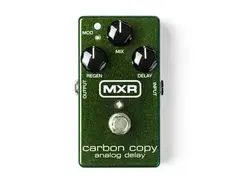
Based on how musicians on Equipboard use Seymour Duncan Palladium Gain Stage (White), it is most commonly used with the following gear.




-s.webp?v=1785077935)
Similar
Add recommendation1 alternative for Seymour Duncan Palladium Gain Stage (White), curated by the Equipboard community.

More Seymour Duncan Overdrive Effects Pedals

$179.00 - $199.00
in Overdrive Effects Pedals Rank


.jpg?v=1784986243)

$198.00 - $338.49


$78.00 - $103.69


$128.00 - $212.00


$299.00 - $338.49

-m.webp?v=1785063627)
$95.00 - $399.52
in Overdrive Effects Pedals Rank


$100.75 - $120.99
in Overdrive Effects Pedals Rank


-m.webp?v=1784905094)
$733.00
in Overdrive Effects Pedals Rank


$180.00 - $216.75
in Overdrive Effects Pedals Rank


$139.00 - $999.99
in Overdrive Effects Pedals Rank


$65.00
in Overdrive Effects Pedals Rank


-m.webp?v=1785065283)
$149.00 - $186.99
in Overdrive Effects Pedals Rank


$179.00 - $229.99
in Overdrive Effects Pedals Rank


.jpg?v=1785033483)

$102.50 - $185.00
in Overdrive Effects Pedals Rank


$99.00 - $143.00
in Overdrive Effects Pedals Rank

$159.99 - $179.00
in Overdrive Effects Pedals Rank


$183.99 - $229.99
in Overdrive Effects Pedals Rank

-m.webp?v=1785063627)
$84.99 - $125.00
in Overdrive Effects Pedals Rank


$266.63
in Overdrive Effects Pedals Rank


$208.62
in Overdrive Effects Pedals Rank


$270.79
in Overdrive Effects Pedals Rank


$190.00 - $229.99
in Overdrive Effects Pedals Rank


$159.00 - $315.00
in Overdrive Effects Pedals Rank


$89.00 - $109.99
in Overdrive Effects Pedals Rank


$122.69 - $181.00
in Overdrive Effects Pedals Rank


$654.63
in Overdrive Effects Pedals Rank


$89.00 - $109.99
in Overdrive Effects Pedals Rank


$199.00 - $287.00
in Overdrive Effects Pedals Rank


$50.60 - $79.99
in Overdrive Effects Pedals Rank


$70.00
in Overdrive Effects Pedals Rank


$59.00 - $69.99
in Overdrive Effects Pedals Rank


-m.webp?v=1785077901)
$129.99 - $166.00
in Overdrive Effects Pedals Rank


$289.00 - $299.00
in Overdrive Effects Pedals Rank


$326.62
in Overdrive Effects Pedals Rank


Accessories & Related Items


Community setups


Gear Guides




.webp)



Most Popular Overdrive Effects Pedals
Most Popular Brands
-
Added to Equipboard on by
 michael
GearIQ 43713
-


