


Pricing and availability
We compare 600+ stores and found this item at 1 store. Prices updated .
Store
Reviews
Price




Average Price: $631
High-end/Boutique
$100
$501+
Price Tier
Budget
Standard
High-end
* Product prices and availability are updated by Equipboard every 24hrs and are subject to change. Equipboard may receive compensation for purchases made at participating retailers linked on this site. This compensation does not affect what products or prices are displayed, or the order of prices listed. For more information, please refer to our affiliate disclosure.
Description
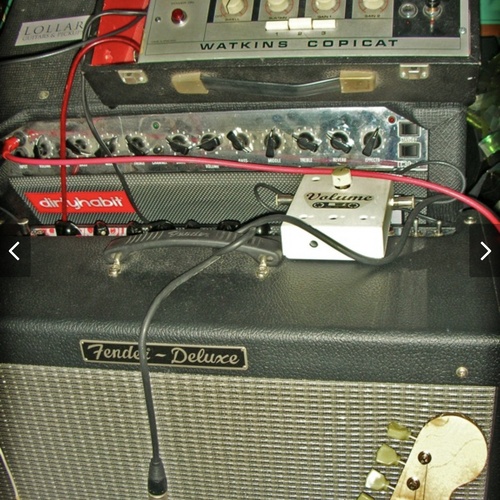
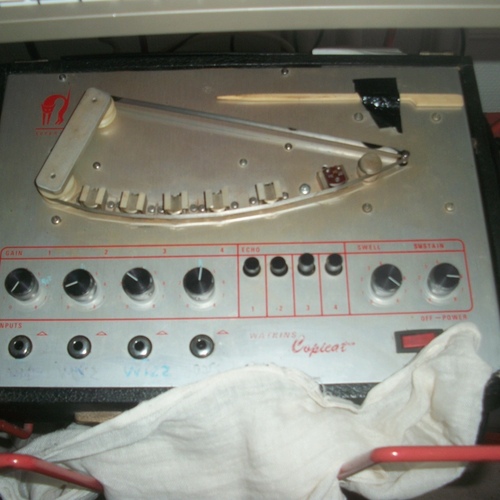
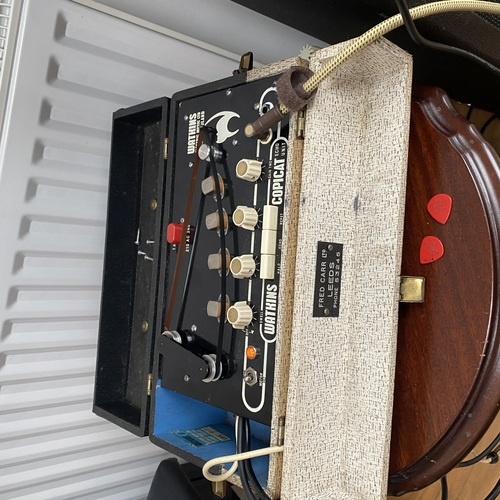
The most famous Tape-Echo Unit in Britain, and possibly in the World, the Copicat also happens to be the first repeat-echo machine manufactured as one compact unit. It was designed by Charlie Watkins in 1958, apparently after he heard a similar sound effect generated by two linked studio quality tape recorders for the Italian singer Marino Marini. Following its introduction, the tape-echo sound revolutionised pop music during the late 1950's and early 1960's, being behind the guitar sound of the top British bands including The Shadows. It also served a secondary purpose after being adopted for providing echo on vocals - the two volume controls acted as a rudimentary microphone mixer. These little machines sold by the thousand!!
Product specs
| Brand | WEM |
| Model | Watkins Copicat IC300 Tape Echo |
| Finish | Metal with Black Case |
| Year | 1970s |
| Made In | United Kingdom |
| Categories | Delay Pedals |
FAQs
-
What type of delay does the WEM Watkins Copicat produce?
-
The WEM Watkins Copicat produces a classic tape delay effect, known for its warm, analog sound and natural echo decay, characteristic of vintage tape echo units.
-
Is the WEM Watkins Copicat suitable for live performances?
-
Yes, the WEM Watkins Copicat is suitable for live performances, offering reliable tape echo effects that add depth and character to guitar and vocal performances on stage.
-
How does the WEM Watkins Copicat differ from digital delay pedals?
-
Unlike digital delay pedals, the WEM Watkins Copicat uses an analog tape mechanism, providing a warmer, more organic sound with natural modulation and subtle imperfections typical of vintage tape echoes.
-
Can the WEM Watkins Copicat be used with instruments other than guitar?
-
Yes, the WEM Watkins Copicat can be used with a variety of instruments, including vocals and keyboards, to add rich, analog delay effects to any audio signal.
-
What maintenance does the WEM Watkins Copicat require?
-
The WEM Watkins Copicat requires regular maintenance, such as cleaning the tape heads and replacing the tape loop, to ensure optimal performance and longevity of the tape delay effect.
Videos

Nick Adams
Watkins Copicat Mk3 Valve Echo Demonstration.
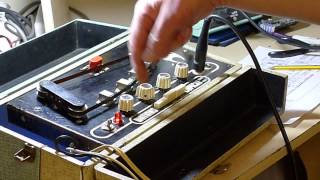
Watkins Copicat Mk3 Valve Echo Demonstration.
Nick Adams
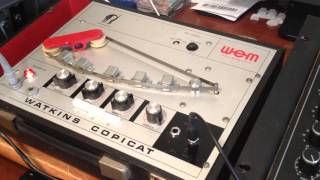
WEM Watkins Copicat Analog Tape Delay SS with Wet / Dry Mod

marcusdolby1
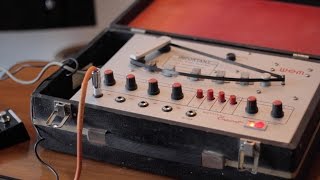
Watkins WEM Copicat 60 Second Demo IC-300

jrsrareguitars
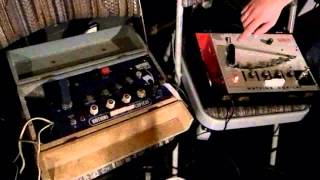
Sabella Studios: Watkins Copicat Mk II & Mk IV comparison (solid state & valve) also MXR Carbon Copy

Sabella Studios
Reviews
PROS
-
Exceptional analog delay tones, crisp and genuine
-
Offers a variety of sounds: rockabilly, cavernous tones, haunting pads
-
Simple transport design, no need for expensive tape cartridges
-
Can be used with a compressor for expanded soundscapes
-
Synchronous AC motors minimize mechanical noise
-
Footswitch adds practicality for live performance
-
Works well for both recording and live gigs
-
Unique color and dynamic response not found in digital delays
CONS
-
Requires proper earthing to avoid potential electrical hazards
-
Finding the "sweet spots" can be time-consuming
-
Basic and noisy, inherent to its vintage design
-
Lacks varispeed, limiting some sound manipulation options
Owner Insights
We analyzed real musician discussions from forums and Reddit to find what players love, question, and tweak about WEM Watkins Copicat.
Use cases and applications
-
Owners love using the Copicat for slapback effects on vocals and drums, adding a unique lofi and dreamy quality to recordings.
Source
Setup and maintenance
-
Regular maintenance such as re-oiling the motor and cleaning tape heads is crucial for optimal performance. A new UK plug might be necessary for older units.
Source -
One user successfully restored a non-working IC400 by resoldering two internal connections, showcasing the potential for DIY repairs.
Source
Mods and upgrades
-
A wet-out output mod enhances its use as an outboard effects unit, offering more creative possibilities.
Source
User experience
-
Some owners prefer the slight high-end signal loss from worn tape loops, appreciating the added character and uniqueness.
Source -
Owners highlight the short lifespan of the tape loops as a minor inconvenience, requiring frequent replacements for optimal performance.
Source -
Owners report that the IC400 is more durable and reliable for gigging compared to tube models, which are more prone to feedback and less suitable for live use.
Source
Comparisons
-
Users note that digital emulations like the GSi VariSpeed plugin can achieve about 95% of the original Copicat sound, but the analog unpredictability remains unmatched.
Source -
Solid state Copicats are noted to compete well against the Roland RE-201 Space Echo, offering similar quality with less maintenance at a lower cost.
Source -
The IC400 is described as having a lofi, crunchy character in its repeats, contrasting with the RE-201's warm and lush sound, leading some to desire both for their unique qualities.
Source
Value and pricing
-
Fully serviced units are available around £175, though some users prefer spending £250 to £350 for models with varispeed control, like the IC400.
Source
Features and functionality
-
The IC400 model is favored for its varispeed control, enhancing the delay's versatility and user control.
Source -
The IC400 model is praised for its sophisticated MICR font and IC components, offering a more refined sound compared to earlier models.
Source -
The echo tone control on the IC400 may not offer drastic changes, with some owners recommending keeping it on a darker setting for subtle tonal shifts.
Source
Critic Reviews
4.0 out of 5
Based on 3 Reviews and 7 Ratings

1172
My main Echo
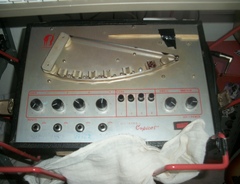
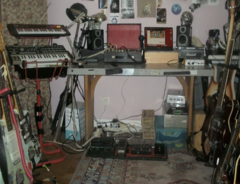
I use it on all my recording and live gigs... I plug everything in and go to my loopers... and then my amps cool stuff for a one man band gig...

1172
One of the things i'll never sell...

3378
Amazing tone, but with obvious age related flaws
This box has genuinely one of the most crisp, and genuine analog delay tones I've ever heard. It may be basic, and noisy, but those are all part of the fact that it was made fifty years ago. The footswitch also adds a practical element.
3378
Solid state Jim, unfortunately, still good though

Character
A Super Noisy Machine that I fall in love every time I switch it on, even if a vintage tape it brings that kind of color that was just missing before.
Artist usage
Add artist

Jamie Cook uses a Watkins Electric Music Copicat Echo Unit during the recording of “Suck It and See” noted in an interview with James Ford.
In an interview with James Ford about the recording of “Suck It and See,” Ford gives insight on why and how Jamie’s set up incorporates the Copicat. “Cook's guitar setup revolves around a '60s Simms Watts rig and custom‑built Rosewell Bluesman, though for the Sound City sessions, he also borrowed engineer James Brown's Audio Kitchen Big Chopper amp. For more ambient sounds, he'd plug into various toys, including a WEM Copicat or Roland Space Echo, Electro‑Harmonix Holiest Grail reverb pedal and Fulltone Deja Vibe stereo phase/chorus.” These extras expanded Cook’s sound in such as giving his tone a more ambient sound which is different in ways that had not been seen on Arctic Monkey’s previous efforts.
Ford continues, "Cookie does either the spacey, watery, roomy sounds,” says Ford, "which were vibrato and reverb and a bit of echo. Or he does the kind of heavy, single‑note type of stuff. We used the Audio Kitchen for his heavier stuff — it had a Vox AC30 sort of vibe, but with a bit more presence and clarity. His live take would be close‑miked, and then we'd bring the amp into the room and maybe double it with a distant mic, Jimi Hendrix‑style, from the other side of the room.”
In the interview shows a picture of Jamie’s set up of the WEM Copicat along with a Rolland Space Echo. Jamie used these two plug ins into his various amps used during the recording of their album at Sound City Studios in Van Nuys in the San Fernando Valley, Los Angeles.
(Sound on Sound, James Ford: Producing Arctic Monkeys) https://www.soundonsound.com/people/james-ford-producing-arctic-monkeys


Mentioned by mixing engineer Michael Brauer as being used on "Violet Hill" in this Sound on Sound interview about the production of Viva la Vida & Death and All of His Friends.
Guitars: EMI Chandler TG1, Lexicon PCM42, API 525, API 5502, Roland Dimension D SDD320, Watkins Copicat
"Normally I send each side of a stereo guitar to my EMI Chandler TG1 panned left and right and coming back on the console, but I didn't in this case, so I must have felt that it sounded bad. It might have taken away from the tightness of the guitars. They had already recorded it very tightly. So instead I didn't add anything to their stereo chorus verse guitar. I also had a mono verse guitar, which I sent to a PCM42 delay set at 224ms and panned to the opposite side, and every time the guitar strums it goes over to the right. On the acoustic guitar I did what I normally do, which is to send it through my acoustic patch, an API 525 going into an API 5502. That's a great combo and I have been using that for years. It makes the acoustic guitar very natural and full and gives it great presence without it sounding processed. In this song it's not very evident, because the acoustic guitar isn't very important, but, for example, on Parachutes the acoustic is very important, and I used the patch back then. There was no insert on the solo guitar. I did have a Dimension D SDD320 chorus on it, which spreads the sound naturally, and which went to a Watkins Copicat Echo unit with a fairly short delay. Otherwise it's totally dry, no reverb, hardly any EQ. Again, it was so well recorded that it didn't need a lot of work."

Mentioned by mixing engineer Michael Brauer as being used on "Violet Hill" in this Sound on Sound interview about the production of Viva la Vida & Death and All of His Friends.
Vocals: Waves Renaissance & Digidesign de–essers, AMS reverb, Zoom 1202, Lexicon PCM81, Watkins Copicat, Empirical Labs Distressor, Federal, Gates, Fairchild 666, EAR 660, Neve 1176 & Awa G7201 compressors
"I used two Renaissance de–essers on Chris's voice that were doing different things, and then a stock Digidesign de-esser. That was it for the plug–ins I added on this session. The Sonnox Oxford and the Eoisis were not out yet at the time.
"The analogue things I did on the lead vocal are really interesting. As I said, I initially mixed the songs on my own, because the band was in England re–recording some songs, so I knew I might have to recall each song. But on this song I pretty much nailed it, apart from that Chris wanted the vocals to be more exciting and different. In the end the vocal had some AMS non–linear reverb on it, while the main sound came from an old Zoom 1202 reverb and a Watkins Copicat delay, plus a special patch that I created in the PCM81, which is a much bigger reverb. So it's a combination of things, but you don't really notice them, all you notice is that Chris is in a very present, big room. When I had found that combination 'Violet Hill' really became a song, it really came alive, because his voice was able to fight through all the stuff that was going on and make it personable. There's no reverb on the rest of the track, which is another reason why the lead vocal sounds so huge: it's not fighting another bunch of reverbs. If you send everything to reverb, you don't hear it, but if you send only one thing to reverb, it'll be huge.
"For the main part of the song I had a Distressor on the insert of the lead vocal, and I sent this to another five compressors: the Federal, the Gates, the Fairchild 666, the Neve 1176 and another Distressor in Nuke mode. They're all coming back individually on the board, and it was a matter of blending those compressors. As usual in my way of working, the compressors are there to give attitude and tone, and don't necessarily compress. For the end bit of the song, where it's just Chris and the piano, I used the Awa G7201 limiter/compressor. It's an Australian compressor and it has an incredible air and presence. It's a unique sound that you can clearly hear at the end, as it's the only effect on the vocal on that point. Finally, the church group background vocals are sent to the same combination of reverbs as the main vocals. No other effects, no EQ. It means that all the vocals in the main section blend together."


According to an article on Guitar Lobby titled "Ritchie Blackmore Guitars & Gear (2022 Update)," Ritchie Blackmore used a WEM Watkins Copicat tape echo in the early 1970s.


Mentioned in this May 1974 Guitar Player interview, transcribed to the Elephant Talk wiki on November 11, 1997.
What type of volume pedal is it?
It's the cheapest one I found, and the only one I could afford at the time that seemed any good. I think it's a Farfisa [by C.M.I.] pedal. It's still the finest volume pedal I've found anywhere. It's the only one that goes off and still has a wide movement. It's quite incredible. On stage I use three pedals on a pedal board: A volume pedal, fuzz-tone, and wah-wah. The fuzz-tone and wah-wah are pretty rubbishy. I'm not sure what type of wah-wah it is. The best fuzz-box to use is a Burn's Buzz-around which they discontinued making in England about six years ago. I have two of them, but they're not at the moment attached to my pedal board. The more pedals you go through, the longer leads you need, and in turn the less volume you get. You lose gain along the way. To lessen that, the wah-wah and the fuzz are on the knock-off circuit. In other words, when I'm playing, all the time I'm going through the volume, but when I'm using either fuzz or wah-wah, I knock a different pedal which brings in a different circuit for the fuzz and the wah-wah. When I'm not using them I press a button and knock them out of the circuit so that the circuit shortens, and I keep up my gain. I also use a Watkins Kopy Kat echo unit. It's all right, but it's not particularly good. It suffices for what I want, which is not really a lot of echo effects but just a slight edge, because the sound on stage is very dead in a lot of halls I play in. It really doesn't matter what kind of fuzz box you use. It has more to do with the state of mind.
But if somebody wanted to obtain the same sound you got, wouldn't it be important to know what type of fuzz you were using?
No. I can get that same sound with every kind of fuzz box I've ever used. It's not a question of equipment.


Seen here on Adult Swim's Fish Center Live is JPD hookin' it up with the classic Krautrock tape echo,the watkins copicat,just to the left of his amp head where his keyboards used to be
I'm guessing it's being used for guitar here because there's an orange cable going from the output of the tape echo to the input of the amp and Dwyer runs his keys through the PA,not his amp.
Plus,dig those runaway tape tones when he mutes a hard strum,real cool.


Pictured on Gallagher's official website's "Effects / Pedals" page and mentioned in an interview in Kerrang No. 15, May 6-19 1982.
"Echo units are indispensable, however. I always have a small delay on one of my amps, like a Memory Man or a DOD, but if you want anything like that authentic Rock 'n' Roll sound, then you have to have tape echo. The Copicat is great for that, but you can also set it with a very shallow delay and it can compensate for dead halls.


In the Equipment Notes on his official website, Robin Guthrie mentions using the WEM Watkins Copicat in the 10th paragraph, 10th line.
.jpg?v=1784660163)

Jeff Tweedy owns a 60s tube WEM Watkins Copicat tape echo, as listed on Reverb's Wilco Loft Shop. This vintage effects processor, known for its unique sound, features modifications like a 3-prong grounded AC plug and a Switchcraft output jack. Despite its quirks, including occasional ground noise and a broken tape loop, it remains a cherished piece of studio gear.




A MK2 unit was listed for sale on Reverb.com on July 21, 2021.
This Watkins Copy Cat Tape is owned by Mike Campbell
Cosmetically the unit is in pretty good shape other than a few small scuffs and rips here and there. The inside tolex is also coming apart. This unit is currently non functioning and will need to be repaired. There is a piece of tape with it that is currently held together with blue tape but it will likely need a new tape entirely.
The unit passes signal and the "gain" functions but the echo does not work. Again this unit will need some repairs to get it to full functionality but with the right expertise it could be pretty close!
Serial: All items in The Official Mike Campbell Reverb Shop ship fully insured with delivery confirmation and a signed and embossed Certificate Of Authenticity from Mike.


Album Usage
The WEM Watkins Copicat has been featured on the following albums:

Disposable
The Deviants (2020)

Suck It and See
Arctic Monkeys (2011)

Viva La Vida or Death and All His Friends
Coldplay (2008)

Violet Hill
Coldplay (2008)
Bring It Back
McAlmont & Butler (2002)

Parachutes
Coldplay (2000)

The Sound Of McAlmont And Butler
McAlmont & Butler (1995)

Ptooff!
The Deviants (1968)
Genre Usage
Based on how artists on Equipboard use this gear, it is most commonly found in the following genres.
Used With
Based on how musicians on Equipboard use WEM Watkins Copicat, it is most commonly used with the following gear.



-s.webp?v=1784559385)


Community setups
Show yours

Similar
Add recommendation2 alternative and related items for WEM Watkins Copicat, curated by the Equipboard community.

$79.99
A faithful replica of the Copicat preamp. Capable of pushing an amp into overdrive.

A rare digital version of the Copicat, very little is known about. Part of the WEM/Watkins Soundbuilder series.
More Watkins Effects Processors


$1,500.00
in Effects Processors Rank


-m.webp?v=1784559394)
$640.00
in Effects Processors Rank


$203.84
in Effects Processors Rank


$1,799.00
in Effects Processors Rank


$1,549.00
in Effects Processors Rank


$1,999.00
in Effects Processors Rank


$749.99 - $833.00
in Effects Processors Rank


$137.00
in Effects Processors Rank


$1,450.00
in Effects Processors Rank


$3,799.00 - $4,985.00
in Effects Processors Rank


-m.webp?v=1784732292)
$40.00 - $2,999.00
in Effects Processors Rank

$5,777.00 - $6,999.00
in Effects Processors Rank
.jpg?v=1784591665)


$1,153.00 - $2,635.00
in Effects Processors Rank


.jpg?v=1784637724)

$892.96 - $1,799.95
in Effects Processors Rank


$3,570.64 - $4,750.00
in Effects Processors Rank


$220.00
in Effects Processors Rank


$624.99
in Effects Processors Rank


$69.95
in Effects Processors Rank


$199.99 - $299.00
in Effects Processors Rank


-m.webp?v=1784559423)
$320.00
in Effects Processors Rank


$419.99 - $1,179.99
in Effects Processors Rank


$749.99 - $4,999.00
in Effects Processors Rank


$1,710.00
in Effects Processors Rank


$2,999.00 - $3,250.00
in Effects Processors Rank


$629.99 - $849.00
in Effects Processors Rank


$35.72 - $199.00
in Effects Processors Rank


-m.webp?v=1784732439)
$309.56 - $936.00
in Effects Processors Rank

$2,555.00 - $3,225.00
in Effects Processors Rank


-m.webp?v=1784732389)
$450.00 - $699.00
in Effects Processors Rank


$4,999.00 - $8,054.01
in Effects Processors Rank

$999.00
in Effects Processors Rank

.jpg?v=1784681042)


$138.00
in Effects Processors Rank


$1,339.44
in Effects Processors Rank


$202.50 - $599.99
in Effects Processors Rank


$363.11
in Effects Processors Rank


$66.00
in Effects Processors Rank


$175.00
in Effects Processors Rank

$475.00
in Effects Processors Rank


$1,135.25 - $1,199.00
in Effects Processors Rank
Accessories & Related Items





Gear Guides








Most Popular Effects Processors
Most Popular Brands
-
Added to Equipboard on by
 jessico
GearIQ 5925
-


