



Pricing and availability
We compare 600+ stores and found this item at 5 stores. Prices updated .
Store
Reviews
Price


Price History
Based on price data from 4 merchants for "Waves Renaissance Compressor Plugin". Prices shown reflect NEW condition. Tracking began Apr 2, 2026.
* Product prices and availability are updated by Equipboard every 24hrs and are subject to change. Equipboard may receive compensation for purchases made at participating retailers linked on this site. This compensation does not affect what products or prices are displayed, or the order of prices listed. For more information, please refer to our affiliate disclosure.
Description
Step into the world of dynamic sound shaping with the Waves Renaissance Compressor Plugin—a perfect blend of analog warmth and digital precision. This compressor is a favorite among musicians and sound engineers who crave the nostalgic punch of vintage gear combined with the versatility of modern technology. Whether you're looking to emulate the smooth behavior of an opto-compressor or the crisp control of a solid-state device, this plugin has you covered with its dual compression modes: Vintage Opto and Modern Electro.
Designed to enhance your audio projects, the Renaissance Compressor features an internal brickwall limiter that ensures your output remains distortion-free even when you push it to the limits. Its Auto Release Control (ARC) system is engineered for seamless gain reduction, allowing you to achieve increased RMS levels effortlessly. With support for up to 24-bit/192kHz resolution, your sound retains its pristine quality, whether you're working in mono or stereo.
This plugin doesn't just stop at providing exceptional audio quality; its user-friendly interface means you can dive straight into your creative process without getting bogged down by complicated settings. Ideal for both seasoned professionals and aspiring producers, the Waves Renaissance Compressor is your go-to tool for achieving that classic warm compression with modern flexibility.
Key Features:
- Vintage Opto and Modern Electro compression modes
- Internal brickwall limiting for clip-free output
- Auto Release Control (ARC) for increased RMS levels
- Double precision bit resolution processing
- Up to 24-bit/192kHz resolution
- Mono and Stereo components
Product specs
| Software Type | Compressor |
| Platform | Mac, PC |
| Upgrade/Full | Full |
| Download/Boxed | Download |
| Bit Depth | 64-bit |
| Format | AAX Native, AudioSuite, VST, AU, SoundGrid |
| Hardware Requirements - Mac | Intel Core i7 or higher (M1 support), 8GB RAM minimum |
| Hardware Requirements - PC | Intel Core i5 / AMD Quad-core or higher (AVX required), 8GB RAM minimum |
| OS Requirements - Mac | macOS 10.15.7 or later |
| OS Requirements - PC | Windows 10 or later (21H2), 64-bit |
FAQs
-
What are the key features of the Waves Renaissance Compressor Plugin?
-
The Waves Renaissance Compressor Plugin features classic warm compression and expansion with an optimized interface, integrating technologies from the C1-Compressor/Gate and L1 Ultramaximizer. It also includes Waves' ARC (Auto Release Control) technology for effective dynamic control.
-
Is the Waves Renaissance Compressor Plugin compatible with my DAW?
-
The Waves Renaissance Compressor supports AAX Native, AudioSuite, VST, AU, and SoundGrid formats, making it compatible with most popular DAWs on both Mac and PC platforms.
-
Can the Waves Renaissance Compressor Plugin be used on both Mac and PC?
-
Yes, the Waves Renaissance Compressor Plugin is compatible with both Mac (macOS 10.15.7 or later) and PC (Windows 10 or later, 64-bit) systems, meeting specific hardware and software requirements.
-
What are the system requirements for running the Waves Renaissance Compressor Plugin on a Mac?
-
For Mac, the Waves Renaissance Compressor requires macOS 10.15.7 or later, an Intel Core i7 or higher (M1 support), and at least 8GB of RAM.
-
Does the Waves Renaissance Compressor Plugin offer any unique sound characteristics?
-
While it's not primarily a character compressor, the Waves Renaissance Compressor can add warmth and flavor to your audio, especially when the "warm" parameter is engaged, making it versatile for various tonal applications.
Videos

Mixing With Mike
Mixing With Mike Plugin of the Week: Waves Renaissance Compressor
Mixing With Mike Plugin of the Week: Waves Renaissance Compressor
Mixing With Mike
Waves Renaissance Compressor: Why Is It So Popular??🧐

Dxt3r
Waves Mix Bus Compression - Episode #1 Renaissance Compressor

Production Expert
Renaissance Compressor from Waves || Tuesday Review Day

Topmop Productions
Reviews
PROS
-
Intuitive and user-friendly interface
-
Delivers phenomenal transparency for clean audio processing
-
Features a "warm" parameter for added audio flavor
-
Suitable for both small and large audio productions
-
Highly recommended addition for any audio project collection
CONS
Owner Insights
We analyzed real musician discussions from forums and Reddit to find what players love, question, and tweak about Waves Renaissance Compressor Plugin.
Features and functionality
-
The Renaissance Compressor is noted for its transparency and ease of use, with auto-release and a built-in limiter on the output providing a foolproof experience.
Source -
Users appreciate the musical algorithms and unique features like the arc, opto, and warm settings, which enhance its utility beyond basic compression tasks.
Source -
The absence of a knee control in RComp is noted, but it remains a favorite for well-recorded material.
Source
Comparisons
-
While some newer engineers favor the versatile Fabfilter C2, the Renaissance Compressor is appreciated for its classic hardware-inspired curves and tone, making it familiar to seasoned professionals.
Source -
RComp's simplicity with its original GUI is favored over Logic's visually appealing but complex interface that can disrupt workflow.
Source -
Users note that while Waves plugins are generally high-quality, alternatives like Plugin Alliance and Universal Audio are often preferred for specific emulations, such as the 1176 compressor.
Source
Use cases and applications
-
The compressor excels on vocals and snare, often used for initial compression before layering with other compressors like the CLA 76 for a natural sound.
Source -
RComp is likened to an LA-2A in opto mode and 1176 in electro mode, providing specific tonal characteristics reminiscent of these classic compressors.
Source -
Renaissance Compressor is highlighted as a staple in vocal chains, commonly used alongside other plugins like the CLA 76 for enhanced vocal treatment.
Source
User experience
-
The plugin's longstanding presence and streamlined workflow appeal to professionals who prioritize efficiency and familiarity in their mixing processes.
Source -
Some users miss the original RComp GUI, but appreciate the ability to revert back from the newer version.
Source -
Owners report that the Renaissance Compressor is reliable and straightforward, often described as a "just works" tool, appreciated for its simplicity in complex mixes.
Source
Software and compatibility
-
Users often face compatibility issues due to frequent software updates, requiring paid upgrades to maintain functionality across different operating systems.
Source
5.0 out of 5
Based on 0 Reviews and 15 Ratings
Artist usage
Add artist

"Imogen's workhorse plug-ins at the mixing stage were the Focusrite D2 EQ and D3 compressor, along with the Waves Renaissance Compressor." (From Imogen Heap's interview with Sound On Sound.)


At 9:22 in this video, Sean can be seen opening the Renaissance Compressor.


"...but the vocal itself, I use, um, here I used a Waves Renaissance Compressor, just to tame them a little bit." (12:11)


Used on Rihanna's lead vocals for "SOS", as stated by mix engineer Phil Tan in this February 2007 Sound on Sound interview. An image of the settings can be found here.
Lead vocal: Waves Renaissance Compressor
"'SOS' is a pounding type of song, and the lyrics are a cry for help, so the vocals need to be 'in your face', almost aggressive. I therefore wanted to make sure that the vocal is fairly constant. There's plenty of level automation with the vocals going on, riding the faders with the mouse — this song was done in-the-box at Silent Sound Studios, also in Atlanta. Ideally it would be nice if you didn't hear compression, but in some cases you do want to hear it. The compression ratio isn't that much, and I pressed the Opto button, which emulates the feel of older analogue compressors."

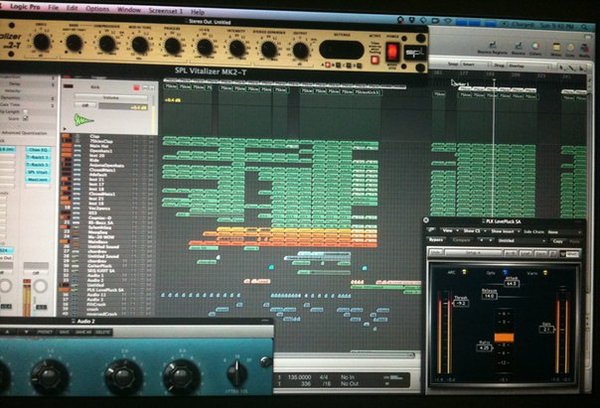
bottom right corner of the screen you can see the Waves Renaissance Compressor


Used for "How to Talk", as stated by mix engineer Kesha Lee in this December 2017 Sound on Sound article.
“The intro track was a voice note Uzi had recorded on his phone, and he played it in the booth on his phone, and we recorded it through the mic like that. It sounded really telephone-y, which we wanted, but I tried to take out some of the highs with the Waves OneKnob. All audio vocal tracks apart from the intro have Antares Auto-Tune as the first plug-in. Uzi hears his Auto-Tuned vocals in his headphones while singing. We used to just have it on default, with a Retune speed of 20, but lately he has been like: ‘Give me more Auto-Tune!’ so now we have the Retune Speed set to anywhere from 12 to 5. The ‘D’ after Auto-Tune is the Waves De-Esser, the ‘Q’ the Avid EQ3 seven-band, and the ‘1’ is the Waves C1 gate. All vocal audio tracks also have sends to the delay and the reverb aux tracks. The delay aux track has the Avid Mod Delay II set to half notes, with feedback at 43 percent, the Waves Renaissance Reverberator, set to ‘Hall 1’ reverb, with the highs cut on the reverb EQ, and the Waves S1 stereo imager. The reverb aux has the Renaissance Reverberator.
“All audio vocal tracks go to the vocal aux track. I had two vocal aux tracks in this session, because I wanted to try something different, using plug-ins I don’t normally use. That’s why one of the aux tracks is muted. The vocal aux track that I did use has the Waves De-Esser acting around 4230Hz, then the EQ3 seven-band which has a high-pass at 96.4Hz, and I’m dipping out muddiness at 200 and 500 Hz. I’m also adding some high end at 6.52kHz. I don’t normally add EQ with the seven-band, but Seth would add some high end on Future’s voice and that worked well, so I tried it here. Next is the Waves Renaissance Compressor, to keep the dynamics in check, and then the Waves SSL E-channel, on which I am again dipping out various frequencies. The latter plug-in is more for colour and character. The Waves CLA-3A is more for the sound, and the RN Digital Detailer made Uzi’s vocals sound fuller and wider.
"The final plug-in in the chain is the Nomad Factory MCL-2269 limiter and compressor, again for the sound and for more volume. We always go for a warm, full, loud, in-your-face vocal sound, also because we like the vocals to be louder than the beat. I always turn the beat down 1-2 dB. There are no plug-ins on the master track, because I used to work for a producer who didn’t want that, as the mix would go to the mastering engineer. So I’m still used to doing it like that. I turn the master volume down anywhere between -7 to -9 dB before it goes to mastering, so they have room to work with.”


Mentioned by sound engineer Trevor Muzzy in this Sound on Sound interview about the production of "Starships".
"You can see that the pre-chorus and chorus vocals have a lot of timing and comp edits. They were imported directly from the session I cut the vocals in. I did not merge or consolidate them, they just are the way they are. There's quite a lot going on with the vocals. I tried to create a nice basic vocal sound using the inserts, and once they sat well in the track, most of the sonic variations between the sections came from the sends. There was no tuning on the rapping, but the sung vocals in this track had a fair amount of tuning with the Logic Pitch Corrector plug-in on the inserts. The tuning is part of the sound of the record, with vocals needing to be very, very precise. In some cases, we pitched them up or down for vocal effects. Logic Pitch Corrector is a little harder-sounding than Auto-Tune, but it has its own distinct sound that we liked for the vocals in this track. It really fits the song.
"The other inserts on most of the vocals were all Waves: the C1 compressor, SSL Channel, Renaissance Channel, De-Esser, Renaissance Compressor, API 2500, and the Logic Channel EQ. The C1 compressor is the first in line on several lead vocals, and it does the same Pensado trick I used on the guitars, which is to compress a specific band — in the case of the verse lead vocal, around 2849Hz — focusing on notes that sounded a little harsh. It smooths this problem out more elegantly than using an EQ. Then the signal goes through the R Channel with some basic EQ, cutting significantly at 281Hz. Again, it was a matter of removing some less pleasant things to let the nice aspects shine. I bypassed the compressor in the R Channel. I needed a bit of de-essing, and the Waves De-Esser is a great all-purpose de-esser, in this case working at 5634Hz with the side-chain set to high-pass.
"There were two more compressors on her vocal. There was no science behind this, it was just a matter of experimenting to find a unique sound. The first is the Renaissance Compressor, which I love and which is set to a fast attack time and takes off about 6dB, so quite subtle, not too intense. The API 2500 is set pretty aggressively and you can hear it pumping a little bit on the vocal. It was already in the session — it had been used on the demo vocal. I pulled it over to Nicki's channel and liked what it was doing, so I adjusted it to fit her vocal. Finally, the Channel EQ notches quite a lot around 600Hz and a little bit more around 235Hz, just carving out some low-mids to make the vocal sit better in the track.
"Regarding the sends, there are some really distinct things happening here. The main lead vocal was similar throughout the song, but I tweaked it as it went along. The pre-chorus and chorus vocals all have Bus 1, which went to the same Altiverb effect that I had on the drums, to add some ambience to the vocal. The rap verses are much drier. Bus 35 is the Waves Doubler, which gives a bit of spread to the lead vocal — I used this on the rap as well as on the sung vocals. Bus 4 is the Waves CLA with a drastic telephone effect. That was another effect that was there from the demo version and added a cool quality. Bus 50 is the [Sound Toys] Echo Boy, which is the main plug-in I use for delay throws, whenever I want to repeat a word. In this case it's on a quarter-note Echoplex setting. It's a single, mono echo that I panned a little bit to the side. Bus 7 has the Waves VX1 Maserati Vocal Enhancer, and that was, again, a plug-in I inherited. It is set to a very compressed, bright vocal sound that I brought in and out to add some sparkle to the sound when necessary.
"Bus 6 has the main reverb in the track, which you are hearing in the pre-chorus and chorus, and which is a Lexicon Plate plug-in on the 'VocalPlate2' preset. It's a really bright, over-the-top plate sound that is not trying to blend in but that's actually brightening the vocal up a lot. It's loud and wet. Busses 16 and 29 are different stereo delays: the Waves SuperTap was already in the session and I kept it, and the other is a standard Logic stereo delay that I use all the time on vocals. Bus 3 is the Logic Bitcrusher, which gives the vocals a grainy sound. The vocals already had an aggressive sonic quality to them because of the 251-TG2-1176 chain, and the Bitcrusher enhanced that. It's nasty, there's nothing nice about a bit-crusher, and it adds a bit of attitude. I used it on some of the background vocals as well, like in the second verse, where you have the pitch effects. You can hear it in the very processed harmony vocals that come in. That was something we added when we were doing the final vocal comp and arrangement. It gave that second verse some more life and helped the track build. The background vocals are a very big part of the hook vocal sound as well, and, for example, track 140 has many effects on it. That actually contains the vocals of the demo singers. Nicki's lead and background vocals are dominant, but in the chorus the background vocals from Mohombi and Wayne Hector added to the crowd feeling. The chorus vocals are really big in this track, and they were part of that.”


Selena Gomez's engineer stated, "Many of the vocal tracks have the same chain on the inserts: Waves Q10 EQ, Waves Renaissance Compressor, Waves REQ6, FabFilter Pro‑DS, Waves CLA‑2A and the Pro‑Q2," as reported by Sound On Sound in their article "Inside Track: Selena Gomez 'Rare'."

At 2:17 of Neek's video, we can see the use of the Waves Renaissance Compressor Plugin on the vocal track, followed later in the chain by a RDeEsser.


Used on SZA's vocals for "All the Stars", as stated by producer Matt Schaeffer in this May 2018 Sound on Sound interview. An image of the settings can be found here.
There are 12 SZA vocal audio tracks in total: two for the main hook, one second verse lead track, and nine verse backing tracks, which in fact provide emphasis and overdubs of single words. All SZA audio tracks have the Antares Auto?Tune 8.1 plug-in, the two hook tracks each also have the FabFilter Pro?Q2 equaliser, and the main SZA verse track also has a de-esser, while the backing vocals have two instances of the Waves RVerb and one of the same company’s H-Delay. Apart from Auto?Tune, most of the processing is done on the ‘SZA ?’ aux, to which all SZA audio tracks are sent.
Schaeffer: “The inserts of the sum track for SZA’s vocals consist of the EQ3 seven-band, Waves RComp, UAD Pultec EQP1A, UAD 1176E, Waves De-Esser, UAD LA2A, another Waves De-Esser, the Pro?Q2, yet another Waves De-Esser and the SoundToys MicroShift. The De-Essers affect 11400Hz, 15032Hz and 2000Hz respectively. I like stacking de-essers set to different frequencies. It works like narrow multiband compression. Sometimes I will in fact use a multiband compressor, like the Waves C4, but if the vocals have very specific harsh frequencies, I prefer to use several de-essers. They also are helpful as I like boosting high frequencies in vocals; here, the EQP1A boosts 16kHz. The EQ3 has a high-pass at 216Hz and cuts at 695Hz, and the Q2 lowers the high end to some degree. When a frequency bothers me, I usually sweep through [with a band set temporarily to boost] to find the frequency and then I cut. The MicroShift provides a little extra width and a slight ambience with the delay parameter, without actually making the vocal sound too stereo.
“The sends go to auxes called ‘SZA Verb’ and ‘DVerb’, both of which have the DVerb and EQ3 seven-band, two ‘SZA Delays’ with the Waves H-Delay, and the ‘SZA Chamber’, which has the Waves RVerb and again the EQ3 seven-band. I put an EQ after the reverb, because I don’t like too much low end in reverb. You get a cleaner sound by taking it out, and you make space for actual instruments to take up that spectrum. The delays are both set to eighth note, and one of them is set to ping-pong delay and also is automated to only come in on certain places.”

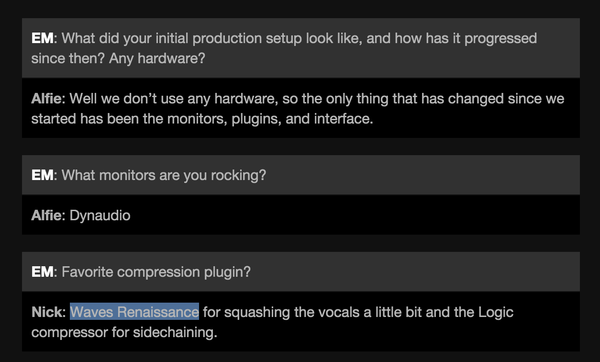
When asked about a favorite compression plugin, Nick Harriman of Dusky answers:
"Waves Renaissance for squashing the vocals a little bit and the Logic compressor for sidechaining."
Originally sourced from this Sept 2013 article.


Album Usage
The Waves Renaissance Compressor Plugin has been featured on the following albums:

american dream (nightcore version)
21 Savage (2024)
Low
Flo Rida (2022)

4NEM
Chief Keef (2021)

Rare
Selena Gomez (2020)

Sum 2 Prove
Lil Baby (2020)
Esskeetit
Lil Pump (2018)

Eloah
Sun Diego (2018)
All The Stars (with SZA)
Kendrick Lamar & SZA (2018)

Bodak Yellow (feat. Kodak Black)
Cardi B & Kodak Black (2017)
![Waves Renaissance Compressor Plugin as heard on Bodak Yellow (feat. Messiah) [Latin Trap Remix] by Cardi B (2017)](https://images.equipboard.com/uploads/album/image/658146/bodak-yellow-feat-messiah-latin-trap-remix.jpg)
Bodak Yellow (feat. Messiah) [Latin Trap Remix]
Cardi B (2017)

Alone
Alan Walker (2016)
To Pimp A Butterfly
Kendrick Lamar (2015)
Dancing In My Head
Avicii & Eric Turner (2012)

Pink Friday ... Roman Reloaded
Nicki Minaj (2011)

Headlines
Drake (2011)
Ellipse (Deluxe Version)
Imogen Heap (2009)

Low (feat. T-Pain)
Flo Rida (2008)

Hips Don't Lie - Bamboo (feat. Wyclef Jean)
Shakira (2006)
Genre Usage
Based on how artists on Equipboard use this gear, it is most commonly found in the following genres.
Used With
Based on how musicians on Equipboard use Waves Renaissance Compressor Plugin, it is most commonly used with the following gear.


-s.webp?v=1783173681)


-s.webp?v=1783173639)
Community setups
Show yours
More Waves Compressor Plugins
-m.webp?v=1783173639)
$33.00 - $39.99
in Compressor Plugins Rank


-m.webp?v=1783173726)
$33.00 - $39.99
in Compressor Plugins Rank


$33.00 - $39.99
in Compressor Plugins Rank


$38.00 - $39.99
in Compressor Plugins Rank


$33.00 - $39.99
in Compressor Plugins Rank


$33.00 - $99.00
in Compressor Plugins Rank


$33.00 - $34.99
in Compressor Plugins Rank

.jpg?v=1783082401)


$33.00 - $39.99
in Compressor Plugins Rank


$33.00 - $34.99
in Compressor Plugins Rank


$33.00 - $39.99
in Compressor Plugins Rank

-m.webp?v=1783173687)
$33.00 - $39.99
in Compressor Plugins Rank


-m.webp?v=1783173736)
$34.99 - $39.99
in Compressor Plugins Rank


$33.00 - $34.99
in Compressor Plugins Rank


$33.00 - $34.99
in Compressor Plugins Rank


$33.00 - $34.99
in Compressor Plugins Rank


$29.99
in Compressor Plugins Rank

$33.00 - $39.99
in Compressor Plugins Rank


$33.00 - $82.50
in Compressor Plugins Rank


$33.00 - $34.99
in Compressor Plugins Rank


$39.99 - $149.00
in Compressor Plugins Rank


$29.00 - $29.99
in Compressor Plugins Rank


$29.99 - $34.99
in Compressor Plugins Rank


$33.00 - $35.99


$39.99 - $199.00


$144.00 - $199.00
in Compressor Plugins Rank


$134.00 - $149.00
in Compressor Plugins Rank


$144.00 - $199.00
in Compressor Plugins Rank

-m.webp?v=1783173632)
$141.00 - $149.00
in Compressor Plugins Rank


$45.00 - $49.00
in Compressor Plugins Rank
.jpeg?v=1783200117)


$39.00 - $1,549.00
in Compressor Plugins Rank


$49.00 - $149.00
in Compressor Plugins Rank


$26.00 - $49.00
in Compressor Plugins Rank


Accessories & Related Items


-s.webp?v=1783173726)


-s.webp?v=1783173736)
-s.webp?v=1783173699)
-s.webp?v=1783173737)


-s.webp?v=1783144077)


Similar


Gear Guides






Most Popular Compressor Plugins
Most Popular Brands
-
Added to Equipboard on by
 odysseyeurobeat
Gear IQ 1709
-