
Pricing and availability
We compare 600+ stores and found this item at 1 store. Prices updated .
Store
Reviews
Price




Average Price: $195
High-end/Boutique
$50
$176+
Price Tier
Budget
Standard
High-end
* Product prices and availability are updated by Equipboard every 24hrs and are subject to change. Equipboard may receive compensation for purchases made at participating retailers linked on this site. This compensation does not affect what products or prices are displayed, or the order of prices listed. For more information, please refer to our affiliate disclosure.
Description
A lot has changed since Jon Blackstone first offered his “Mosfet Overdrive” circuit as a pedal in 1998. Yet here in 2025, with all the boutique amps, emulators and pedals available, many guitarists continue to rely on it as their go-to dirt box.
People that bond with the Blackstone Mosfet Overdrive are probably looking for the same thing Jon was during the decades he was modding tube amps – harmonics that seem integral to the tone, not a fizz that sits on top of it.
The pedals Jon is currently building are the same ones he's been making for 20 years or so. Two “channels” (footswitchable presets), in an MXR-sized pedal with unique recessed controls. They're sold here on this website, not on Reverb or Amazon.
While most overdrive pedals create distortion with a pair of head-to-toe diodes, the Blackstone instead employs four gain stages, each contributing a small amount of soft clipping. That avoids intermodulation and the creation of fizzy high-order harmonics, just as in the best vintage amps. Those amps sound good in large part because the distortion does not occur at just one point.
The circuit is also unusual in that it interacts with the inductance of your guitar's pickups to get its unique dynamic response. Because the guitar's pickups and controls are actually part of the input stage, you can go from a juicy lead sound to a barely-breaking twang with just the guitar's volume control.
The Mosfet Overdrive gets its distortion entirely on its own – it is not a "boost" pedal meant to cause distortion in your amp. It does its thing into pretty much any amp, at any volume.
3 WAYS IN WHICH THE BLACKSTONE IS DIFFERENT: The character changes as the gain increases. It's glassy at low settings, becoming fat and midrangey when cranked. This is the opposite behavior of most pedals, which get thinner and fizzier at high settings. And this makes it versatile, ranging smoothly from very subtle to pretty heavy.
Control it from your guitar. Another area where the Blackstone stands out is in how you can control it with the volume control on your guitar. If you listen to the third clip on the sound clips page, you'll hear how most pedals just get a little brighter when the guitar volume is increased from 6 to 10, while the Blackstone runs the gamut from almost clean to a fully saturated sound. The Blackstone must be the first effect after the guitar to acheive this.*
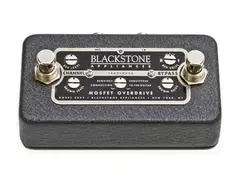
OK, the controls are weird. It has slotted-shaft pots that are flush with the etched steel nameplate on the top of the pedal. They can be turned easily enough with your thumbnail, but they hold their settings when the pedal is stuffed into a gig bag. The EQ control is not a high cut, it's a post-distortion mid cut.
At higher drive settings, the Mosfet Overdrive is very sensitive to the differences between pickups. That's why the drive control for the "red" channel is divided into two ranges - one which causes single-coil pickups to sound fatter as maximum drive is approached, and one which tightens the bass when humbuckers or P-90s are used. In its standard mode, the circuit interacts with the guitar's pickups, and needs to be the first effect after the guitar. But there is now an internal switch that puts the pedal into "buffered" mode, permitting use after other effects, wireless systems and active pickups.
It's important to remember that recommendations you hear on overdrive pedals often stem from somebody getting a good sound out of a combination of a certain pedal with a certain amp, when a lot of the distortion was actually occurring in the amp. Again, the Blackstone is intended to get the distortion on its own, into whatever amp is suitable (or available!) for the gig you're playing.
Distorting the electric guitar is a very subjective thing. But if you're looking for a tone that's more juicy than fizzy – something that inspires expressive playing – you may want to check out the Blackstone.
Product specs
| Brand | Blackstone Appliances |
| Model | Mosfet Overdrive |
| Finish | Black |
| Year | 2010 |
| Made In | United States |
| Categories | Overdrive and Boost Pedals |
FAQs
-
What type of overdrive sound can I expect from the Blackstone Appliances Mosfet Overdrive?
-
The Blackstone Appliances Mosfet Overdrive provides a rich, dynamic overdrive with a focus on clarity and note articulation. It offers a natural-sounding distortion that is responsive to playing dynamics, making it suitable for a variety of genres.
-
Does the Blackstone Appliances Mosfet Overdrive work well with both single-coil and humbucker pickups?
-
Yes, the Blackstone Appliances Mosfet Overdrive is designed to complement both single-coil and humbucker pickups, providing a versatile overdrive tone that enhances the character of your guitar's sound.
-
What power supply does the Blackstone Appliances Mosfet Overdrive require?
-
The Blackstone Appliances Mosfet Overdrive can be powered by a standard 9V DC power supply, commonly used for guitar pedals, or a 9V battery, offering flexibility for different pedalboard setups.
-
Is the Blackstone Appliances Mosfet Overdrive suitable for live performances?
-
Yes, the Blackstone Appliances Mosfet Overdrive is well-suited for live performances due to its robust build and ability to maintain clarity and definition at higher volumes, making it a reliable choice for gigging musicians.
-
How does the Blackstone Appliances Mosfet Overdrive differ from traditional diode-based overdrive pedals?
-
Unlike traditional diode-based overdrive pedals, the Blackstone Appliances Mosfet Overdrive uses MOSFETs for distortion, resulting in a more precise and controlled overdrive with greater headroom and dynamic response.
Videos

gearmanndude
Blackstone Appliances MOSFET OVEDRIVE guitar effects pedal demo w Strat & Dr Z amp
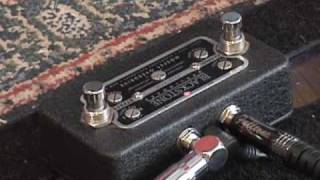
Blackstone Appliances MOSFET OVEDRIVE guitar effects pedal demo w Strat & Dr Z amp
gearmanndude
Reviews
PROS
-
Exceptional natural overdrive mimics cranked tube amp sound
-
Highly responsive to playing dynamics and guitar pickup type
-
Versatile tone shaping with humbucker/single coil mode and midrange control
-
Offers a wide range of tonal options in a compact design
-
Two distinct channels (brown and red) provide varied distortion sounds
-
Maintains clarity and warmth, avoiding harshness at bedroom volumes
-
Superior build quality and unique aesthetic
-
Screw adjustments preferred for stability during use
-
Works excellently with a variety of guitars and amps
-
Celebrated by professionals for its unique tone and quality
CONS
-
May not serve well as an overdrive boost for already loud tube amps
Owner Insights
We analyzed real musician discussions from forums and Reddit to find what players love, question, and tweak about Blackstone Appliances Mosfet Overdrive.
Features and functionality
-
The Blackstone's high gain red channel retains chord definition and offers significant harmonic richness despite being highly compressed, enhancing sustain.
Source -
The pedal features two channels: Brown for cleaner tones and Red for higher gain, with a unique gain knob that increases in both directions from noon.
Source -
The pedal's EQ knob allows for a range from scooped modern tones to flat vintage tones, providing versatile sound shaping options.
Source
User experience
Comparisons
-
The Blackstone is often compared with the OCD pedal. Users report complementary EQ curves, with Blackstone having more mids and OCD being flat or slightly scooped.
Source -
The Blackstone Mosfet reportedly offers more midrange presence than the DOD Looking Glass, appealing to those seeking a unique flavor within transparent overdrive tones.
Source -
When used with a dirty amp channel, it is preferred over a Tubescreamer or clean boost for its ability to push the front end with substantial volume.
Source
Use cases and applications
-
The Storm v1 is favored for its ability to act as a compressed boost with a slight mid-push, ideal for lead tones when stacked with other pedals.
Source -
For genres like Dream Pop and Shoegaze, the Blackstone's versatile EQ can accommodate various single coil Fender guitars and a Gibson 335 style Eastman T486.
Source -
Performs well with various amps, including Fender Bassman and Mesa F-50, when placed first in the signal chain, especially favoring clean amp settings.
Source
Build quality
-
Knobs are recessed to prevent accidental adjustments, and they can be easily changed using a guitar pick, showcasing thoughtful design.
Source
5.0 out of 5
Based on 1 Review and 4 Ratings
57
Always on, defines my tone
As I said in the title, this pedal has been always on for my tone in my pedalboard, I use the lighter gain orange channel all the time, and have the red channel gained up a bit for heavier parts. I found out about this pedal from a friend, I'm honestly surprised it's not more widely used. This pedal allows me to get the sound I want from my Vox AC15. If it ever stops working, I would buy another in a heartbeat.
Artist usage
Add artist

"Billy says the Blackstone is all over the new ZZ Top album!" was posted from the Blackstone Mosfet Overdrive facebook page.


As can be seen in the touring rig of 2009 source, Gustavo Cerati used the Blackstone Overdrive.


In a Rig Rundown video by Premier Guitar, Adam Granduciel of The War On Drugs discusses using the Blackstone Mosfet Overdrive 2SV3. He appreciates its clarity, noting, "This is great for distortion. If you play a chord, you can hear every string." While some describe it as a "Plexi in a box," the manufacturer clarifies that this is a misconception, instead likening its tone to a Dumble Overdrive Special.
.png?v=1784519118)
.png?v=1784519118)
What amps and pedals do you currently use? "Traynor, Bogner and Koch amps. Blackstone Appliances Mosfet Overdrive…"

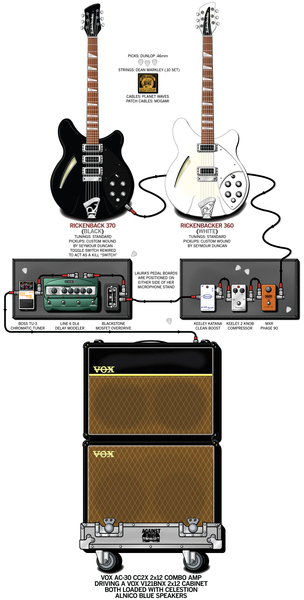
As shown on this Guitar Geek rig diagram, Laura uses a Blackstone Mosfet Overdrive.

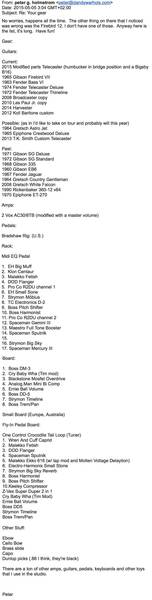
In my interview with Peter Holmström, he mentioned using the Blackstone Mosfet Overdrive 2SV3 pedal.



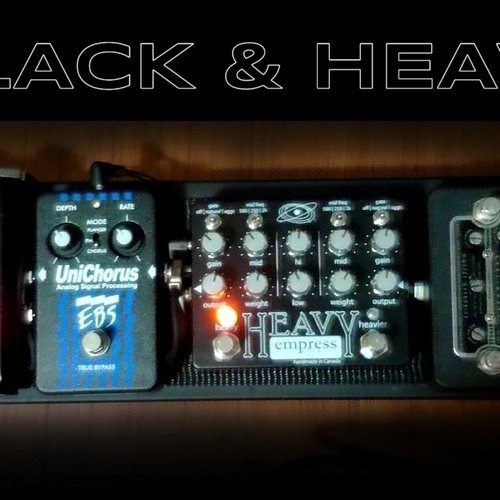
On the accompanying photo of Dave Stewart's pedalboard the Blackstone Mosfet Overdrive can be seen.


On the accompanying photo of Dave Stewart's pedalboard the Blackstone Mosfet Overdrive can be seen.


Geoff Farina's pedalboard in later years features the Blackstone Mosfet Overdrive 2SV3, as shown in a user-uploaded photo on TinyPic. It remains unclear if this pedal was used during his time with Karate.

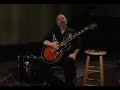
Glenn Kaiser has confirmed that he uses the Blackstone Appliances Mosfet Overdrive in both live and studio recordings, specifically with the Rez/Resurrection Band and for his blues performances, as mentioned in a Grrr Records YouTube video titled "Glenn Kaiser - School of Blues Vol. 2 - Electric Blues Part 1."

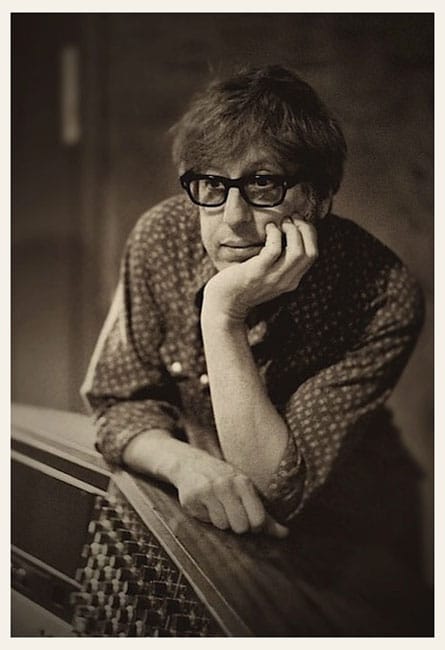
Genre Usage
Based on how artists on Equipboard use this gear, it is most commonly found in the following genres.
Used With
Based on how musicians on Equipboard use Blackstone Appliances Mosfet Overdrive, it is most commonly used with the following gear.

-s.webp?v=1784804443)





Community setups
Show yours
Similar
Add recommendation1 alternative for Blackstone Appliances Mosfet Overdrive, curated by the Equipboard community.

$119.99
More Overdrive Effects Pedals
-m.webp?v=1784818682)
$105.00 - $399.52
in Overdrive Effects Pedals Rank


$100.75 - $120.99
in Overdrive Effects Pedals Rank


-m.webp?v=1784818688)
$733.00
in Overdrive Effects Pedals Rank


$180.00 - $217.15
in Overdrive Effects Pedals Rank


$139.00 - $999.99
in Overdrive Effects Pedals Rank


$65.00
in Overdrive Effects Pedals Rank


-m.webp?v=1784818902)
$149.00 - $169.99
in Overdrive Effects Pedals Rank


$179.00 - $229.99
in Overdrive Effects Pedals Rank


.jpg?v=1784782132)

$102.50 - $185.00
in Overdrive Effects Pedals Rank


$99.00 - $143.00
in Overdrive Effects Pedals Rank


$159.99 - $179.00
in Overdrive Effects Pedals Rank


$183.99 - $229.99
in Overdrive Effects Pedals Rank

-m.webp?v=1784804416)
$84.99 - $125.00
in Overdrive Effects Pedals Rank


$266.42
in Overdrive Effects Pedals Rank


$185.00
in Overdrive Effects Pedals Rank


$271.29
in Overdrive Effects Pedals Rank


$189.00 - $229.99
in Overdrive Effects Pedals Rank


$88.81 - $315.00
in Overdrive Effects Pedals Rank


$89.00 - $109.99
in Overdrive Effects Pedals Rank


$122.91 - $181.00
in Overdrive Effects Pedals Rank


$655.84
in Overdrive Effects Pedals Rank


$89.00 - $109.99
in Overdrive Effects Pedals Rank


$199.00 - $286.00
in Overdrive Effects Pedals Rank


$50.60 - $79.99
in Overdrive Effects Pedals Rank


$70.00
in Overdrive Effects Pedals Rank


$59.00 - $69.99
in Overdrive Effects Pedals Rank


-m.webp?v=1784818732)
$129.99 - $166.00
in Overdrive Effects Pedals Rank


$289.00 - $299.00
in Overdrive Effects Pedals Rank


$380.76
in Overdrive Effects Pedals Rank


$75.00 - $89.00
in Overdrive Effects Pedals Rank


$40.00 - $62.90
in Overdrive Effects Pedals Rank


$139.99
in Overdrive Effects Pedals Rank


$385.00 - $389.15
in Overdrive Effects Pedals Rank


$142.58 - $149.38
in Overdrive Effects Pedals Rank


$169.99 - $199.99
in Overdrive Effects Pedals Rank


$80.00 - $199.00
in Overdrive Effects Pedals Rank


$229.00 - $266.00
in Overdrive Effects Pedals Rank


$179.00 - $300.85
in Overdrive Effects Pedals Rank


$89.99 - $125.99
in Overdrive Effects Pedals Rank


$126.04 - $169.00
in Overdrive Effects Pedals Rank


Accessories & Related Items




Gear Guides




.webp)



Most Popular Brands
-
Added to Equipboard on by
 austinmw
GearIQ 5227
-


